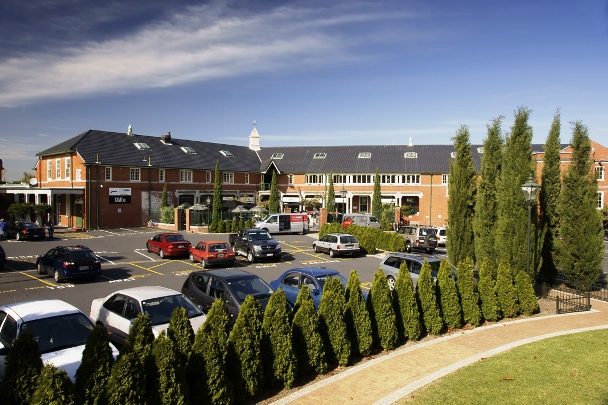
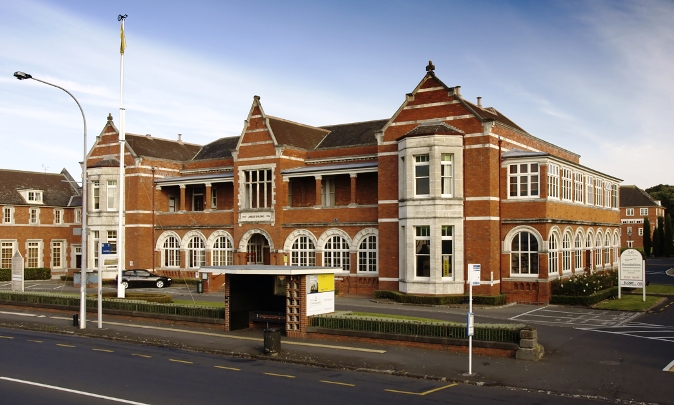
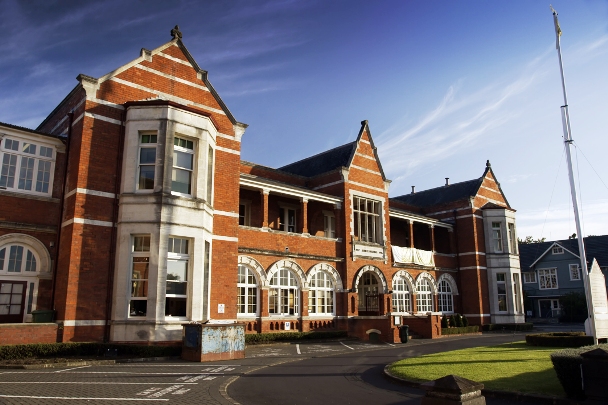
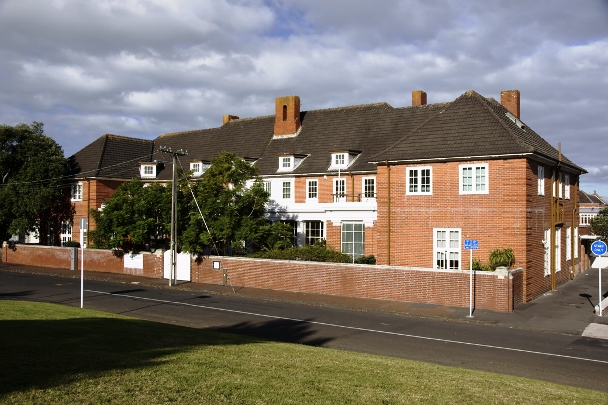
The first school for blind children and adults anywhere in New Zealand was established on the Parnell site in 1892. A major fundraising drive throughout the country enabled the erection of the building in 1907-8, opened the following year by the Governor-General, Sir William Lee (Lord) Plunket. The building of impressive design is architecturally significant as an important example of the red brick Gothic Revival style of architecture associated with educational buildings at that time. The main form of the building with Oamaru stone dressed arches, window surrounds and banded gables, has largely been retained, although the double height verandah, wrapped around all sides, has since been mostly enclosed. This building contained classrooms downstairs and dormitory bedrooms upstairs. At the rear was a dining hall wing and toilet block. The dining hall was later extended to house an organ.
In 1926, the prominent architectural partnership of Gummer and Ford designed a one-storey brick shop to sell products through an outlet attached to the southwest side of the building a facility which became a well-known feature of the Institute. A year later a new storey was added to this addition, to provide a women’s dormitory. This work occurred during a period when other major buildings in the associated complex were erected, including workshops (1926; List No. 4579) and men’s accommodation (also 1926; List No. 4580).
In 1964, when children were no longer educated in the building following changes in attitudes towards the schooling of children with disabilities, major changes were carried out on the ground floor to convert it into offices for the Foundation. Further internal changes were made in the 1980s and 1990s, and the toilet block was demolished in 1990. The building currently (2015) houses the Parnell library and community facilities.
List Entry Information
Status
Listed
List Entry Status
Historic Place Category 1
Access
Private/No Public Access
List Number
4579
Date Entered
24th November 1988
Date of Effect
24th November 1988
City/District Council
Auckland Council
Region
Auckland Council
Extent of List Entry
Extent includes the land described as Lot 3 DP 362696 (RT 255816) and part of the land described as Lot 2 DP 362696 (RT 255815), North Auckland Land District, and the building known as Royal New Zealand Foundation of the Blind Main Building thereon. Refer to the extent map tabled at the Heritage New Zealand Board meeting on 25 June 2015.
Legal description
Lot 2 DP 362696 (RT 255815), Lot 3 DP 362696 (RT 255816), North Auckland Land District
Status
Listed
List Entry Status
Historic Place Category 1
Access
Private/No Public Access
List Number
4579
Date Entered
24th November 1988
Date of Effect
24th November 1988
City/District Council
Auckland Council
Region
Auckland Council
Extent of List Entry
Extent includes the land described as Lot 3 DP 362696 (RT 255816) and part of the land described as Lot 2 DP 362696 (RT 255815), North Auckland Land District, and the building known as Royal New Zealand Foundation of the Blind Main Building thereon. Refer to the extent map tabled at the Heritage New Zealand Board meeting on 25 June 2015.
Legal description
Lot 2 DP 362696 (RT 255815), Lot 3 DP 362696 (RT 255816), North Auckland Land District
Why is this place significant?
Historic Significance
Historical Significance or Value The Jubilee Institute for the Blind has been associated with this site for nearly 100 years and in 1896 a fund was begun to enable a larger more permanent brick residential school to be constructed. The Institute was founded in 1890 and by 1892 had acquired a two storey wooden house in Parnell. This became the first school for the care, education and training of blind children and adults. The plans for the new building were drawn up in 1904 after the Institute had received a munificent gift from the estate of William Mason. This money which was received in several large sums, amounted to £14,650 by 1911. The whole of this sum was devoted to the building fund, making erection a reality far sooner than mould have been possible by ordinary fundraising. The government added £2500 subsidy and the design was subject to the approval of the education board. Prominent citizens associated with the Blind Institute included John Logan Campbell who was one of the original trustees and Alfred Nathan who was the chairman. Lord Plunkett the Governor and President of the Institute opened the new building in May 1909 while the main building was under construction. The pupils were taught Braille, Shorthand and typing as well as several handcrafts, music, gymnastics and drill. Some students went on to attain university degrees. As well as the residential school there were workshops where technical and trades training was available. The Institute gradually acquired the remainder of the Parnell block. Additional buildings constructed include Pearson House designed by Gummer and Ford to house those blinded during World War I. In 1965 a college was completed at Manurewa and the main block was converted to offices. The institute became the New Zealand Institute for the Blind in 1926 in recognition of its assumed nationwide responsibility. The title was amended in 1955 to the New Zealand Foundation for the Blind under the Act of Parliament. The Foundation is now under Royal Patronage. In the 1970s a change in the philosophy of the foundation meant that the blind were to remain in the community rather than be cared for in an institutional setting. The foundation has, for nearly one hundred years, provided excellent care for the blind in New Zealand.
Physical Significance
Architectural Significance: This is an important example of the red brick Gothic Revival style of architecture which has become associated with educational buildings. The design of the Blind Institute was influenced by those of the English schools of the 1890s, some of which were published in the Builder. In contrast with the 'Collegiate' Gothic Revival Style the school buildings were designed without decorative crockets, finials or the lancet windows commonly associated with the style. These decorative elements carried ecclesiastical connotations and the school boards were determined to express the secular nature of education. Hygiene was an important design consideration and much of the Gothic detailing commonly used in designing schools was omitted from modern schools designs because medieval interiors were considered dark, poorly lit and consequently unsuitable for studying. This was the first permanent building constructed for the Blind and the Institute hoped the design would reflect the high standard of care and education of the blind in New Zealand. The age was one in which numerous institutional buildings were constructed and they stand as a reminder of the Edwardian concern with education. School buildings stood in prominent locations and the school environment was to set an important example to pupils. The Blind Institute is not planned according to British examples which include a school hall around which the classrooms were grouped. This plan would have been inappropriate for blind students and the Institute has a central corridor which enables pupils to navigate themselves around the building. Edward Bartley was a truly Victorian architect who would design in whichever style was appropriate for the building type. His Auckland Savings Bank building is Italianate, a suitable style for commercial buildings, his Synagogue has Eastern decoration evoking associations with Judaism and the Gothic revival style of the Blind Institute was considered to be appropriate for education. The façade detail with the banded gables bear similarity to English schools in particular Roedean in Brighton. It also shows some influence of Pugin and Pugin's design for the Gothic Revival Bishops Palace in Ponsonby. Townscape/Landmark Significance: The administration building for the Royal New Zealand Foundation for the Blind is situated on the rise at the top of Parnell Road and is an important landmark in this part of Auckland. It is in the centre of an historically important area, with the Domain and Auckland Museum on one side and St Mary's cathedral, Selwyn Court, Kinder House and Ewelme Cottage on the other. It is one of a number of buildings owned by the Royal New Zealand Foundation for the Blind on the block bounded by Parnell Road, George Street, Titoki Street and Maunsell Road which form a unique city block enclosing an open space.
Why is this place significant?
Historic Significance
Historical Significance or Value The Jubilee Institute for the Blind has been associated with this site for nearly 100 years and in 1896 a fund was begun to enable a larger more permanent brick residential school to be constructed. The Institute was founded in 1890 and by 1892 had acquired a two storey wooden house in Parnell. This became the first school for the care, education and training of blind children and adults. The plans for the new building were drawn up in 1904 after the Institute had received a munificent gift from the estate of William Mason. This money which was received in several large sums, amounted to £14,650 by 1911. The whole of this sum was devoted to the building fund, making erection a reality far sooner than mould have been possible by ordinary fundraising. The government added £2500 subsidy and the design was subject to the approval of the education board. Prominent citizens associated with the Blind Institute included John Logan Campbell who was one of the original trustees and Alfred Nathan who was the chairman. Lord Plunkett the Governor and President of the Institute opened the new building in May 1909 while the main building was under construction. The pupils were taught Braille, Shorthand and typing as well as several handcrafts, music, gymnastics and drill. Some students went on to attain university degrees. As well as the residential school there were workshops where technical and trades training was available. The Institute gradually acquired the remainder of the Parnell block. Additional buildings constructed include Pearson House designed by Gummer and Ford to house those blinded during World War I. In 1965 a college was completed at Manurewa and the main block was converted to offices. The institute became the New Zealand Institute for the Blind in 1926 in recognition of its assumed nationwide responsibility. The title was amended in 1955 to the New Zealand Foundation for the Blind under the Act of Parliament. The Foundation is now under Royal Patronage. In the 1970s a change in the philosophy of the foundation meant that the blind were to remain in the community rather than be cared for in an institutional setting. The foundation has, for nearly one hundred years, provided excellent care for the blind in New Zealand.
Physical Significance
Architectural Significance: This is an important example of the red brick Gothic Revival style of architecture which has become associated with educational buildings. The design of the Blind Institute was influenced by those of the English schools of the 1890s, some of which were published in the Builder. In contrast with the 'Collegiate' Gothic Revival Style the school buildings were designed without decorative crockets, finials or the lancet windows commonly associated with the style. These decorative elements carried ecclesiastical connotations and the school boards were determined to express the secular nature of education. Hygiene was an important design consideration and much of the Gothic detailing commonly used in designing schools was omitted from modern schools designs because medieval interiors were considered dark, poorly lit and consequently unsuitable for studying. This was the first permanent building constructed for the Blind and the Institute hoped the design would reflect the high standard of care and education of the blind in New Zealand. The age was one in which numerous institutional buildings were constructed and they stand as a reminder of the Edwardian concern with education. School buildings stood in prominent locations and the school environment was to set an important example to pupils. The Blind Institute is not planned according to British examples which include a school hall around which the classrooms were grouped. This plan would have been inappropriate for blind students and the Institute has a central corridor which enables pupils to navigate themselves around the building. Edward Bartley was a truly Victorian architect who would design in whichever style was appropriate for the building type. His Auckland Savings Bank building is Italianate, a suitable style for commercial buildings, his Synagogue has Eastern decoration evoking associations with Judaism and the Gothic revival style of the Blind Institute was considered to be appropriate for education. The façade detail with the banded gables bear similarity to English schools in particular Roedean in Brighton. It also shows some influence of Pugin and Pugin's design for the Gothic Revival Bishops Palace in Ponsonby. Townscape/Landmark Significance: The administration building for the Royal New Zealand Foundation for the Blind is situated on the rise at the top of Parnell Road and is an important landmark in this part of Auckland. It is in the centre of an historically important area, with the Domain and Auckland Museum on one side and St Mary's cathedral, Selwyn Court, Kinder House and Ewelme Cottage on the other. It is one of a number of buildings owned by the Royal New Zealand Foundation for the Blind on the block bounded by Parnell Road, George Street, Titoki Street and Maunsell Road which form a unique city block enclosing an open space.
Construction Professional
Name
Bartley, Edward
Type
Architect
Biography
Edward Bartley was born in Jersey in 1839, and educated in the Channel Islands where he learned techniques of the building trade from his father, an architect and builder. Bartley immigrated to New Zealand with his elder brother Robert, also an architect, while still in his teens. They eventually settled in Devonport, Auckland. Initially Edward was in the building trade but later he practised solely as an architect. He was at one time vice-president of the Auckland Institute of Architects and was also Diocesan Architect for the Church of England. Amongst Bartley's most notable works were his ecclesiastical buildings including St John's Church, Ponsonby (1881), St David's Church, Symonds Street (1880), Holy Trinity Church, Devonport, and the Synagogue (1884). He was also responsible for the Opera House (1884) and Auckland Savings Bank, Queen Street (1884).
Name
Philcox & Sons
Type
Builder
Biography
No biography is currently available for this construction professional
Construction Details
Start Year
1907
Finish Year
1908
Type
Original Construction
Start Year
1990
Type
Partial Demolition
Description
Toilet block demolished
Type
Refurbishment/renovation
Description
Renovations and strengthening
Period
1990s
Type
Modification
Description
Dining hall expanded to house an organ
Start Year
1926
Type
Additional building added to site
Description
Single-storey shop
Start Year
1929
Type
Addition
Description
Second storey for women’s dormitory added above the shop
Type
Modification
Description
Verandahs progressively enclosed
Period
1930s
Start Year
1964
Type
Modification
Description
Alterations to ground floor to house offices
Type
Modification
Description
Internal alterations
Period
1980s
Construction Materials
The Royal New Zealand Foundation for the Blind, Main Building, is constructed of red brick with Oamaru stone dressed arches, window surrounds and banding on the gables. The brickworks had difficulty in supplying bricks resulting in delays in construction. In the end bricks had to be imported from Sydney to complete the job.
Notable Features
The steep gable ends, arcaded verandah treatment and Oamaru stone detailing are special features of this design.
Construction Professional
Name
Bartley, Edward
Type
Architect
Biography
Edward Bartley was born in Jersey in 1839, and educated in the Channel Islands where he learned techniques of the building trade from his father, an architect and builder. Bartley immigrated to New Zealand with his elder brother Robert, also an architect, while still in his teens. They eventually settled in Devonport, Auckland. Initially Edward was in the building trade but later he practised solely as an architect. He was at one time vice-president of the Auckland Institute of Architects and was also Diocesan Architect for the Church of England. Amongst Bartley's most notable works were his ecclesiastical buildings including St John's Church, Ponsonby (1881), St David's Church, Symonds Street (1880), Holy Trinity Church, Devonport, and the Synagogue (1884). He was also responsible for the Opera House (1884) and Auckland Savings Bank, Queen Street (1884).
Name
Philcox & Sons
Type
Builder
Biography
No biography is currently available for this construction professional
Construction Details
Start Year
1907
Finish Year
1908
Type
Original Construction
Start Year
1990
Type
Partial Demolition
Description
Toilet block demolished
Type
Refurbishment/renovation
Description
Renovations and strengthening
Period
1990s
Type
Modification
Description
Dining hall expanded to house an organ
Start Year
1926
Type
Additional building added to site
Description
Single-storey shop
Start Year
1929
Type
Addition
Description
Second storey for women’s dormitory added above the shop
Type
Modification
Description
Verandahs progressively enclosed
Period
1930s
Start Year
1964
Type
Modification
Description
Alterations to ground floor to house offices
Type
Modification
Description
Internal alterations
Period
1980s
Construction Materials
The Royal New Zealand Foundation for the Blind, Main Building, is constructed of red brick with Oamaru stone dressed arches, window surrounds and banding on the gables. The brickworks had difficulty in supplying bricks resulting in delays in construction. In the end bricks had to be imported from Sydney to complete the job.
Notable Features
The steep gable ends, arcaded verandah treatment and Oamaru stone detailing are special features of this design.
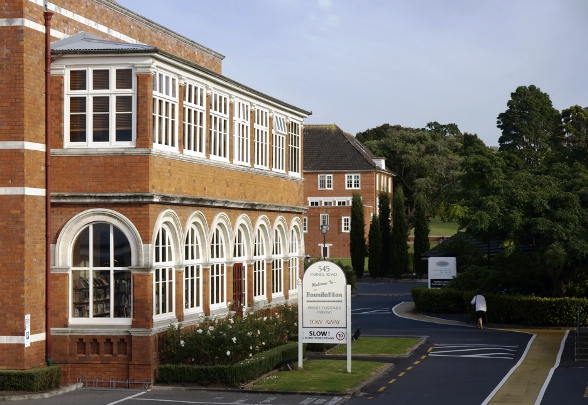
Architectural Description (Style): The school is in the Gothic Revival style favoured for education buildings. The main façade is symmetrical with three gabled pavilions which are linked by a double height verandah. At ground level these are arched but at first floor level square columns form the arcade. The central gable features horizontal bands of Oamaru stone and a rectangular window with stone mullions and dressings which originally contained stained glass. The end pavilions have a double height bay window and similar stone banding of the brickwork and gable. The plan is simple and consists of one main corridor per floor and a centrally located staircase. At the rear of the building is the dining hall which has a steeply pitched roof. Modifications: In 1917 the dining hall was extended to include a pipe organ donated by Sir Henry Brett. In 1927 a new wing was added by architects Gummer and Ford in a similar style which had a shop on Parnell Road and dormitories above. The building was modified to be used as the administrative headquarters for the Royal Foundation for the Blind in the late 1960s. The stained glass windows have been removed and portions of the arcade glazed.
Historical and Associated Iwi / Hapū / Whānau
Completion Date
8th June 2015
Report Written By
Elizabeth Cox
Information Sources
Auckland Institute & Museum
Auckland Star
Auckland Star
Cyclopedia of New Zealand, 1902
Cyclopedia Company, Industrial, descriptive, historical, biographical facts, figures, illustrations, Wellington, N.Z, 1897-1908, Vol.2, Christchurch, 1902
New Zealand Herald
New Zealand Herald, 12 July 1932, p. 6; 28 September 1933, p. 6.
Seaborne, 1971
Malcolm Seaborne, The English School: Its Architecture and Organization 1370-1870, London, 1971
Stacpoole, 1972
John Stacpoole and Peter Beaven, 'Architecture 1820-1970', Wellington, 1972
Bartley, 2006
M W Bartley, Colonial Architect, The Career of Edward Bartley 1839-1919, Wellington, 2006
Bartley, n. d.
Bartley, Edward, ‘Early Reminiscences of Auckland’, MS 1369, Auckland War Memorial Museum, transcribed at http://localhistorybartley.blogspot.co.nz/p/early-reminiscences-of-auckland-bartley.html
Catran & Hansen, 1992
Catran, Ken and Penny Hansen, Pioneering a Vision: A History of the Royal New Zealand Foundation for the Blind 1890-1990, Auckland, 1992.
Hansen, 2013
Hansen, Penelope, 'Mackenzie, Clutha Nantes', from the Dictionary of New Zealand Biography. Te Ara - the Encyclopedia of New Zealand, updated 12-Nov-2013 URL: http://www.TeAra.govt.nz/en/biographies/4m17/mackenzie-clutha-nantes
Newbold, 2008
Newbold, Greg, Quest For Equity, A History of Blindness Advocacy in New Zealand, Palmerton North, 2008
Oldham, 1995
Oldham, Denys, The Jubilee Building, 545 Parnell Road, Auckland: Conservation Report, Kingston Morrison (architects), 1995 (revised version).
Other Information
Please note that entry on the New Zealand Heritage List/Rarangi Korero identifies only the heritage values of the property concerned, and should not be construed as advice on the state of the property, or as a comment of its soundness or safety, including in regard to earthquake risk, safety in the event of fire, or insanitary conditions. A fully referenced upgrade report is available on request from the Northern Region Office of Heritage New Zealand
Historical and Associated Iwi / Hapū / Whānau
Completion Date
8th June 2015
Report Written By
Elizabeth Cox
Information Sources
Auckland Institute & Museum
Auckland Star
Auckland Star
Cyclopedia of New Zealand, 1902
Cyclopedia Company, Industrial, descriptive, historical, biographical facts, figures, illustrations, Wellington, N.Z, 1897-1908, Vol.2, Christchurch, 1902
New Zealand Herald
New Zealand Herald, 12 July 1932, p. 6; 28 September 1933, p. 6.
Seaborne, 1971
Malcolm Seaborne, The English School: Its Architecture and Organization 1370-1870, London, 1971
Stacpoole, 1972
John Stacpoole and Peter Beaven, 'Architecture 1820-1970', Wellington, 1972
Bartley, 2006
M W Bartley, Colonial Architect, The Career of Edward Bartley 1839-1919, Wellington, 2006
Bartley, n. d.
Bartley, Edward, ‘Early Reminiscences of Auckland’, MS 1369, Auckland War Memorial Museum, transcribed at http://localhistorybartley.blogspot.co.nz/p/early-reminiscences-of-auckland-bartley.html
Catran & Hansen, 1992
Catran, Ken and Penny Hansen, Pioneering a Vision: A History of the Royal New Zealand Foundation for the Blind 1890-1990, Auckland, 1992.
Hansen, 2013
Hansen, Penelope, 'Mackenzie, Clutha Nantes', from the Dictionary of New Zealand Biography. Te Ara - the Encyclopedia of New Zealand, updated 12-Nov-2013 URL: http://www.TeAra.govt.nz/en/biographies/4m17/mackenzie-clutha-nantes
Newbold, 2008
Newbold, Greg, Quest For Equity, A History of Blindness Advocacy in New Zealand, Palmerton North, 2008
Oldham, 1995
Oldham, Denys, The Jubilee Building, 545 Parnell Road, Auckland: Conservation Report, Kingston Morrison (architects), 1995 (revised version).
Other Information
Please note that entry on the New Zealand Heritage List/Rarangi Korero identifies only the heritage values of the property concerned, and should not be construed as advice on the state of the property, or as a comment of its soundness or safety, including in regard to earthquake risk, safety in the event of fire, or insanitary conditions. A fully referenced upgrade report is available on request from the Northern Region Office of Heritage New Zealand
Current Usages
Uses: Civic Facilities
Specific Usage: Community centre
Uses: Civic Facilities
Specific Usage: Library
Former Usages
General Usage: Health
Specific Usage: Non-government health organisation building
Current Usages
Uses: Civic Facilities
Specific Usage: Community centre
Uses: Civic Facilities
Specific Usage: Library
Former Usages
General Usage: Health
Specific Usage: Non-government health organisation building
Location
Related listings
Stay up to date with Heritage this month