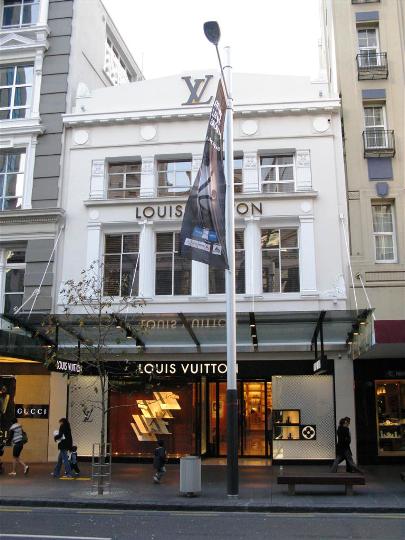
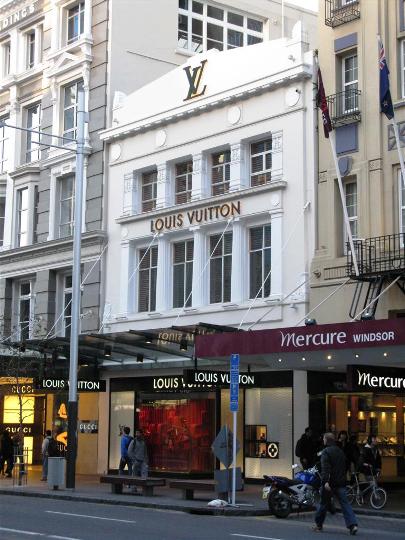
Incorporating a three-storey brick building fronting Queen Street and a rear warehouse to Fort Lane, this property reflects the scale of much construction in the commercial heart of nineteenth-century Auckland as well as significant changes in business activity and recreation in the twentieth century. Probably retaining parts of an original mid 1860s-1880s structure behind a classical Grecian façade to Queen Street, the building was converted to an elegant picture theatre in 1915 and again in 1935, to take advantage of the increase in popularity of cinema. Later, the building played an important role in the development of open aisle retailing as the second Woolworths (NZ) Ltd. store in the country.
Before Auckland was created as colonial capital, the site formed part of the foreshore at the bottom of the Waihorotiu valley, fronting the Waitemata Harbour. The bay that it adjoined contained a pipi bank known as Te Roukai. Called Commercial Bay by early colonial settlers, the area became Auckland’s main trading port and contained a wharf erected in 1852 in the vicinity of lower Queen Street, beside the Everybody’s Building site. After a large area to the east of the wharf was reclaimed from 1859 onwards, the site incorporated two separate brick buildings, respectively fronting Queen Street and Fort Lane. In early 1867, the Queen Street building was two storeys high with a slate roof.
In 1881, ownership was transferred from the early landholder, Alexander Wright, to Christopher Greenway. In early 1886, Greenway evidently remodelled the premises and possibly joined the two buildings on the site. Two immediately subsequent sources show a three-storey brick building fronting Queen Street. The buildings were let to auctioneer Gabriel Lewis, who advertised his remodelled premises in February 1886 as ‘the Arcade Auction Rooms, the largest in the colony, being 200 feet through from street to street’. Sales in the same month included ironmongery claimed as ‘the finest goods ever imported, being all new designs’ and a series of dining, kitchen and other tables imported from New York. A fire in March 1887 damaged and possibly destroyed the rear part of Lewis’ premises.
After restoration, the property was described as a substantial building with the rear part being occupied by a spacious lofty showroom, the front as shops with offices above.
In 1915 Gaiety Theatre Ltd. issued a prospectus outlining plans for converting the building to a theatre. Plans by architects Grierson and Aimer included the ‘reconstruction’ of the Queen Street façade in a classical Grecian design, the fitting of two shop fronts, a luxurious and spacious public lounge and offices, and a theatre for 700-800 people. Hugh Grierson, in his partnership with Kenneth Aimer and later Malcolm Draffin, was responsible for the design of many theatres. The firm is best known for creating the Auckland War Memorial Museum, for which it received a New Zealand Institute of Architects Gold Medal (1929). Everybody’s Theatre was opened in September 1915.
Conversion to a theatre occurred at a time when moving pictures were becoming an extremely popular form of recreation. Novel seating at Everybody’s Theatre allowed two people to sit together without an armrest separating them. The prospectus also boasted that a sliding roof would be inserted to allow open air viewing on warm summer nights. As a response to conflict in Europe during the First World War (1914-18), a two-month lease was granted to the Civic League for tearooms known as the ANZAC, to raise money for families of soldiers who were serving overseas. During the 1920s, the theatre was owned by entrepreneur Thomas O’Brien (1888-1948), who subsequently erected the nearby Civic. Everybody’s Theatre closed in 1928, reflecting a shift to larger cinemas with the introduction of ‘talkies’.
In the following year, the large space was remodelled to accommodate Woolworths’ Department store. This new concept in retail opened in its Queen Street shop in November 1929, just a month after the first New Zealand store in Wellington. A fire in 1934 was the impetus for Woolworths to move to the Imperial Buildings next door, which it owned. Amalgamated Theatres took over Everybody’s Building and re-created a picture theatre called the Roxy in the space, designed by architect George Tole. Attention was paid to the latest trends in acoustics, and the décor reflected the Art Deco style popular at the time. The existing façade was retained with two shops at street level. Founded by notable Auckland businessmen, J.P. and M.J. Moodabe, Amalgamated Theatres also established its head office in the building.
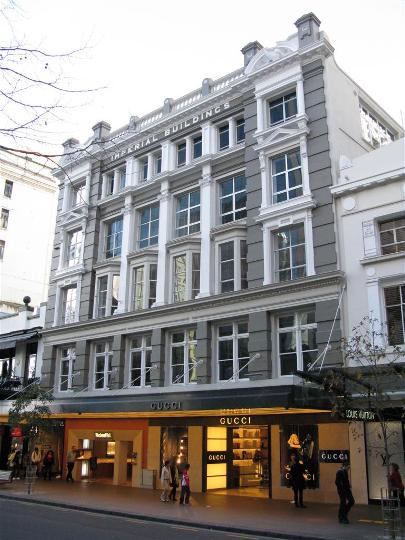
Woolworths bought the building in 1955 and, as they already owned Imperial Buildings, planned to use the ground floor space of both buildings by removing a party wall between the two structures. Foundations were driven 30 feet into the old harbour bed. The conversion took a year to complete and the store opened just in time for Christmas 1960. The retail space had more than doubled and innovations included a coffee lounge and chicken rotisserie, air conditioning said to have been the first for a retail store in Auckland, and a conveyor system to storage rooms at the rear that was considered to be among the first of its type in New Zealand. The buildings were sold to AMP in 1960, although Woolworths (NZ) Ltd retained a 40-year lease and undertook extensive renovations in 1983.
Upmarket retailers such as Gucci and Louis Vuitton have since occupied the main frontage, reflecting Queen Street’s late twentieth-century resurgence as the CBD’s main shopping area. In 2009, the rear section of the building was converted to a bar accessed from Fort Lane. Vestigial internal elements reflecting the classical style of the 1915 exterior remain, including simple scotia mouldings to the ceiling and beam junctions, both at first floor level.
Everybody’s Building has architectural value for reflecting the scale of much nineteenth-century commercial construction in central Auckland, and for retaining parts of a 1915 design by the notable architectural firm of Grierson and Aimer. It is important for potentially incorporating one of the oldest remaining buildings in Queen Street, and for visibly reflecting the moderate size of purpose-built picture theatres prior to the introduction of ‘talkies’. It is historically significant for its long association with Auckland’s commercial development, including as auction rooms claimed to have been the largest in the colony; the development of picture theatres and cinema; and the introduction of open aisle retailing. Everybody’s Building is also historically notable for its associations with charitable activities in the First World War, and for its close connections with significant firms such as Woolworths, Thomas O’Brien’s cinema chain, and Amalgamated Theatres Ltd.
Before Auckland was created as colonial capital, the site formed part of the foreshore at the bottom of the Waihorotiu valley, fronting the Waitemata Harbour. The bay that it adjoined contained a pipi bank known as Te Roukai. Called Commercial Bay by early colonial settlers, the area became Auckland’s main trading port and contained a wharf erected in 1852 in the vicinity of lower Queen Street, beside the Everybody’s Building site. After a large area to the east of the wharf was reclaimed from 1859 onwards, the site incorporated two separate brick buildings, respectively fronting Queen Street and Fort Lane. In early 1867, the Queen Street building was two storeys high with a slate roof.
In 1881, ownership was transferred from the early landholder, Alexander Wright, to Christopher Greenway. In early 1886, Greenway evidently remodelled the premises and possibly joined the two buildings on the site. Two immediately subsequent sources show a three-storey brick building fronting Queen Street. The buildings were let to auctioneer Gabriel Lewis, who advertised his remodelled premises in February 1886 as ‘the Arcade Auction Rooms, the largest in the colony, being 200 feet through from street to street’. Sales in the same month included ironmongery claimed as ‘the finest goods ever imported, being all new designs’ and a series of dining, kitchen and other tables imported from New York. A fire in March 1887 damaged and possibly destroyed the rear part of Lewis’ premises.
After restoration, the property was described as a substantial building with the rear part being occupied by a spacious lofty showroom, the front as shops with offices above.
In 1915 Gaiety Theatre Ltd. issued a prospectus outlining plans for converting the building to a theatre. Plans by architects Grierson and Aimer included the ‘reconstruction’ of the Queen Street façade in a classical Grecian design, the fitting of two shop fronts, a luxurious and spacious public lounge and offices, and a theatre for 700-800 people. Hugh Grierson, in his partnership with Kenneth Aimer and later Malcolm Draffin, was responsible for the design of many theatres. The firm is best known for creating the Auckland War Memorial Museum, for which it received a New Zealand Institute of Architects Gold Medal (1929). Everybody’s Theatre was opened in September 1915.
Conversion to a theatre occurred at a time when moving pictures were becoming an extremely popular form of recreation. Novel seating at Everybody’s Theatre allowed two people to sit together without an armrest separating them. The prospectus also boasted that a sliding roof would be inserted to allow open air viewing on warm summer nights. As a response to conflict in Europe during the First World War (1914-18), a two-month lease was granted to the Civic League for tearooms known as the ANZAC, to raise money for families of soldiers who were serving overseas. During the 1920s, the theatre was owned by entrepreneur Thomas O’Brien (1888-1948), who subsequently erected the nearby Civic. Everybody’s Theatre closed in 1928, reflecting a shift to larger cinemas with the introduction of ‘talkies’.
In the following year, the large space was remodelled to accommodate Woolworths’ Department store. This new concept in retail opened in its Queen Street shop in November 1929, just a month after the first New Zealand store in Wellington. A fire in 1934 was the impetus for Woolworths to move to the Imperial Buildings next door, which it owned. Amalgamated Theatres took over Everybody’s Building and re-created a picture theatre called the Roxy in the space, designed by architect George Tole. Attention was paid to the latest trends in acoustics, and the décor reflected the Art Deco style popular at the time. The existing façade was retained with two shops at street level. Founded by notable Auckland businessmen, J.P. and M.J. Moodabe, Amalgamated Theatres also established its head office in the building.
Woolworths bought the building in 1955 and, as they already owned Imperial Buildings, planned to use the ground floor space of both buildings by removing a party wall between the two structures. Foundations were driven 30 feet into the old harbour bed. The conversion took a year to complete and the store opened just in time for Christmas 1960. The retail space had more than doubled and innovations included a coffee lounge and chicken rotisserie, air conditioning said to have been the first for a retail store in Auckland, and a conveyor system to storage rooms at the rear that was considered to be among the first of its type in New Zealand. The buildings were sold to AMP in 1960, although Woolworths (NZ) Ltd retained a 40-year lease and undertook extensive renovations in 1983.
Upmarket retailers such as Gucci and Louis Vuitton have since occupied the main frontage, reflecting Queen Street’s late twentieth-century resurgence as the CBD’s main shopping area. In 2009, the rear section of the building was converted to a bar accessed from Fort Lane. Vestigial internal elements reflecting the classical style of the 1915 exterior remain, including simple scotia mouldings to the ceiling and beam junctions, both at first floor level.
Everybody’s Building has architectural value for reflecting the scale of much nineteenth-century commercial construction in central Auckland, and for retaining parts of a 1915 design by the notable architectural firm of Grierson and Aimer. It is important for potentially incorporating one of the oldest remaining buildings in Queen Street, and for visibly reflecting the moderate size of purpose-built picture theatres prior to the introduction of ‘talkies’. It is historically significant for its long association with Auckland’s commercial development, including as auction rooms claimed to have been the largest in the colony; the development of picture theatres and cinema; and the introduction of open aisle retailing. Everybody’s Building is also historically notable for its associations with charitable activities in the First World War, and for its close connections with significant firms such as Woolworths, Thomas O’Brien’s cinema chain, and Amalgamated Theatres Ltd.