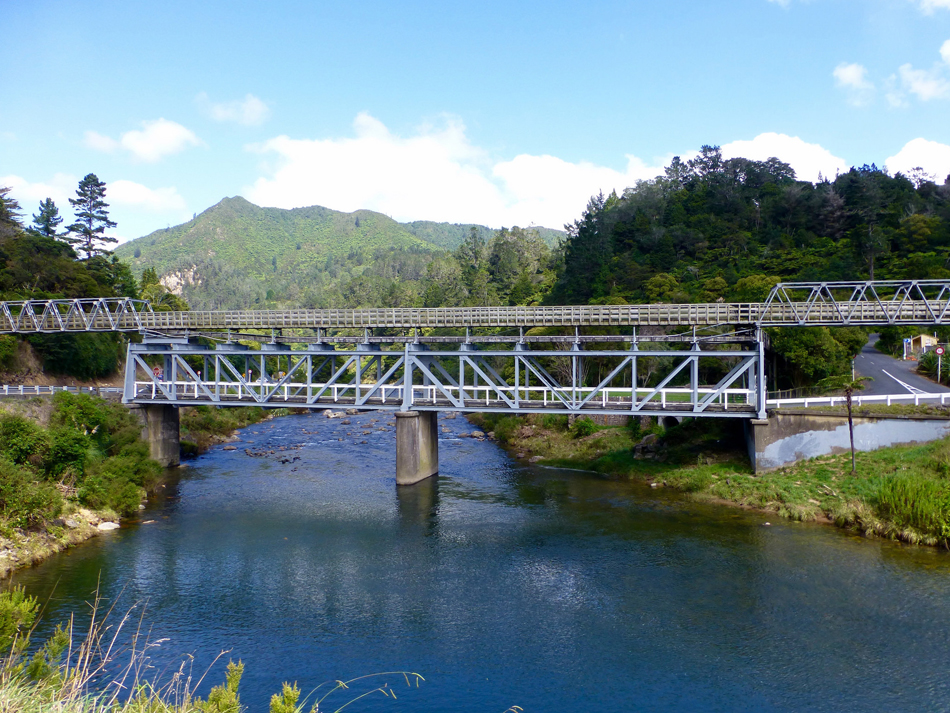
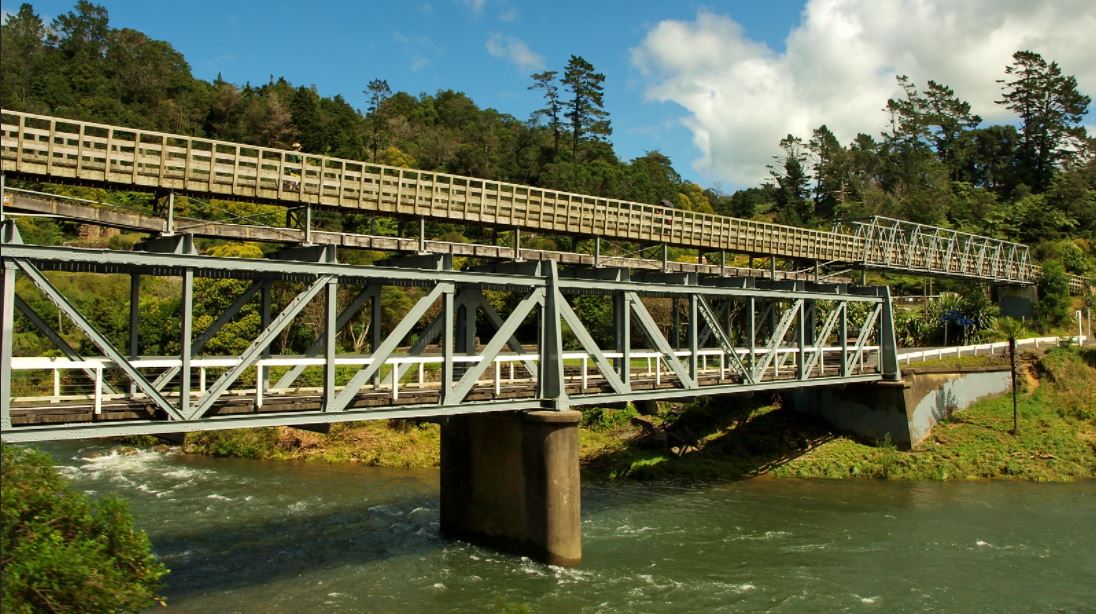
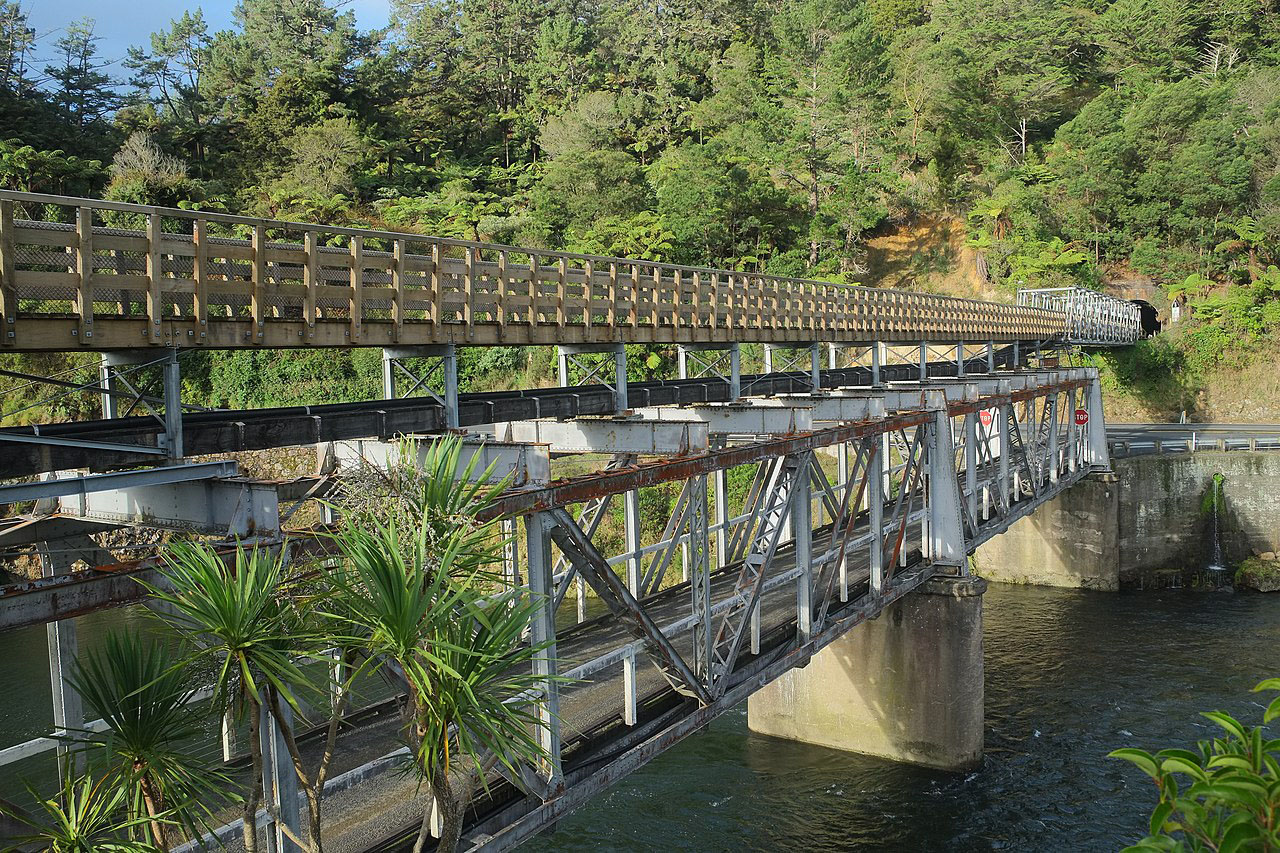
Ohinemuri Bridge, constructed between 1902-4 in the Karangahake Gorge, is technologically significant as one of only three existing double-decker road and railway bridges in New Zealand. Created by the Public Works Department to connect the important mining operations at Crown Hill Battery with the nearby East Coast Main Trunk Railway (ECMT), the bridge is also historically notable for its close links with the expansion of the gold industry in Hauraki at the turn of the century and accompanying government investment in public infrastructure. Its rare design especially reflects efforts to provide safe transport routes in difficult terrain. The structure’s more recent repurposing for a historic walking trail and cycle route demonstrates public interest in industrial and engineering heritage and the latter’s value as a focus for recreational infrastructure into the twenty-first century.
The Karangahake Gorge and Ohinemuri River have extensive connections with the history of regional communication routes. Linking the Bay of Plenty coast and Hauraki Plains, they collectively formed one of four traditional ara or pathways used by the iwi of Hauraki, and are associated with many groups. Containing numerous wāhi tapu, including pā and ancient urupā, the gorge has acoustic properties utilised by Hauraki iwi to amplify warning signals from sentries. Although goldmining began in surrounding districts from 1853, Ohinemuri iwi resisted its expansion under the leadership of Te Hira Te Tuiri of Ngāti Tamaterā. During the 1870s, however, the Crown increased pressure through monopoly purchasing powers and raihana (loans advanced against land as collateral), forcing the district to open for mining from 1875 and later pursuing acquisition of freehold title over the strong objections of rangatira and iwi. In 1880 and 1882, the Native Land Court divided land in the region between Māori and the Crown, and the Ohinemuri 9 and 14 blocks, encompassing both sides of the gorge, were determined to be Crown owned.
Goldmining was not economically sustainable in the gorge until introduction of the cyanide process, which was first field tested at Crown Hill Battery on Karangahake maunga in 1889 and enabled gold to be extracted more efficiently. Largely funded by overseas capital, the Karangahake goldmines were considered world leaders in this process’s use, with peak production and profitability in the early twentieth century. The earliest formal road through the gorge was opened in 1891 and construction of bridges over the Ohinemuri River, including a railway bridge as part of the proposed ECMT between Paeroa and Tauranga, underway before the end of the decade. Evidently aiming to assist transportation of materials and personnel to and from the extensive Crown Hill Battery complex, the Public Works Department (PWD) began construction of a double decker bridge across the gorge and river in 1902, incorporating ‘two six meter timber spans, two 18.2 meter curved steel plate girders and two main spans of 27.4 meter steel Pratt through trusses’. The truss style, patented by Americans Thomas and Caleb Pratt in 1844, was popular for its strength and relative simplicity. Completed in time for the peak year of production at Crown Hill in 1904, the upper chord contained a railway track while the lower chord supported a road. The style of two level bridge had been pioneered in England and was selectively utilised by the PWD for challenging terrain in varying parts of the country. The Ohinemuri Bridge steelwork was prepared by Christchurch contractors J. and A. Anderson, employed for many railway projects around the country. Local workers constructed the concrete foundations to which the trusses were attached.
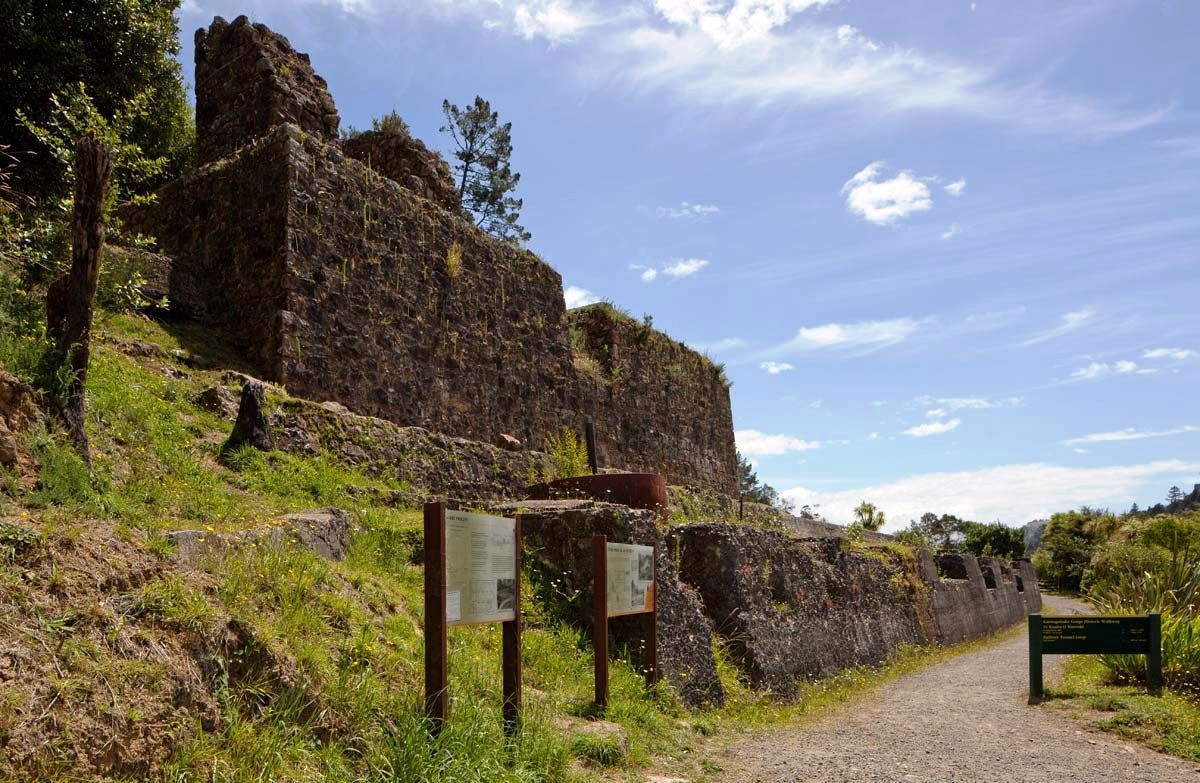
Although goldmining at Crown Hill Battery ended in the 1920s, the bridge continued to form an important vehicle crossing point in the gorge maintaining connections between communities in and around the gorge. The upper railway track was maintained until 1981, although following modifications to the ECMT in 1978 the gorge line was no longer required. As the area developed a greater economic focus on tourism at a time of rising interest in industrial heritage, the bridge was repurposed for use as part of the Karangahake Gorge Historic Walkway, a loop track that facilitated exploration of remnants associated with the former railway and gold mines. Rail track and decking on the bridge’s upper chord was replaced by a superimposed timber footbridge after 1981 and the walkway officially opened in early 1985. In 2013, parts of a twentieth-century Callender Hamilton steel truss bridge were attached to the west side of Ohinemuri Bridge to expand the footbridge element for the newly-created Hauraki cycle trail - the general concept of which had been promoted by National party leader John Key. Still accommodating a public road at its lower level and immediately adjoining the Crown Hill Battery ruins (List No.4603), the bridge forms a visually prominent part of an important historical and cultural landscape associated with both goldmining and earlier settlement in the Karangahake Gorge.
The Karangahake Gorge and Ohinemuri River have extensive connections with the history of regional communication routes. Linking the Bay of Plenty coast and Hauraki Plains, they collectively formed one of four traditional ara or pathways used by the iwi of Hauraki, and are associated with many groups. Containing numerous wāhi tapu, including pā and ancient urupā, the gorge has acoustic properties utilised by Hauraki iwi to amplify warning signals from sentries. Although goldmining began in surrounding districts from 1853, Ohinemuri iwi resisted its expansion under the leadership of Te Hira Te Tuiri of Ngāti Tamaterā. During the 1870s, however, the Crown increased pressure through monopoly purchasing powers and raihana (loans advanced against land as collateral), forcing the district to open for mining from 1875 and later pursuing acquisition of freehold title over the strong objections of rangatira and iwi. In 1880 and 1882, the Native Land Court divided land in the region between Māori and the Crown, and the Ohinemuri 9 and 14 blocks, encompassing both sides of the gorge, were determined to be Crown owned.
Goldmining was not economically sustainable in the gorge until introduction of the cyanide process, which was first field tested at Crown Hill Battery on Karangahake maunga in 1889 and enabled gold to be extracted more efficiently. Largely funded by overseas capital, the Karangahake goldmines were considered world leaders in this process’s use, with peak production and profitability in the early twentieth century. The earliest formal road through the gorge was opened in 1891 and construction of bridges over the Ohinemuri River, including a railway bridge as part of the proposed ECMT between Paeroa and Tauranga, underway before the end of the decade. Evidently aiming to assist transportation of materials and personnel to and from the extensive Crown Hill Battery complex, the Public Works Department (PWD) began construction of a double decker bridge across the gorge and river in 1902, incorporating ‘two six meter timber spans, two 18.2 meter curved steel plate girders and two main spans of 27.4 meter steel Pratt through trusses’. The truss style, patented by Americans Thomas and Caleb Pratt in 1844, was popular for its strength and relative simplicity. Completed in time for the peak year of production at Crown Hill in 1904, the upper chord contained a railway track while the lower chord supported a road. The style of two level bridge had been pioneered in England and was selectively utilised by the PWD for challenging terrain in varying parts of the country. The Ohinemuri Bridge steelwork was prepared by Christchurch contractors J. and A. Anderson, employed for many railway projects around the country. Local workers constructed the concrete foundations to which the trusses were attached.
Although goldmining at Crown Hill Battery ended in the 1920s, the bridge continued to form an important vehicle crossing point in the gorge maintaining connections between communities in and around the gorge. The upper railway track was maintained until 1981, although following modifications to the ECMT in 1978 the gorge line was no longer required. As the area developed a greater economic focus on tourism at a time of rising interest in industrial heritage, the bridge was repurposed for use as part of the Karangahake Gorge Historic Walkway, a loop track that facilitated exploration of remnants associated with the former railway and gold mines. Rail track and decking on the bridge’s upper chord was replaced by a superimposed timber footbridge after 1981 and the walkway officially opened in early 1985. In 2013, parts of a twentieth-century Callender Hamilton steel truss bridge were attached to the west side of Ohinemuri Bridge to expand the footbridge element for the newly-created Hauraki cycle trail - the general concept of which had been promoted by National party leader John Key. Still accommodating a public road at its lower level and immediately adjoining the Crown Hill Battery ruins (List No.4603), the bridge forms a visually prominent part of an important historical and cultural landscape associated with both goldmining and earlier settlement in the Karangahake Gorge.