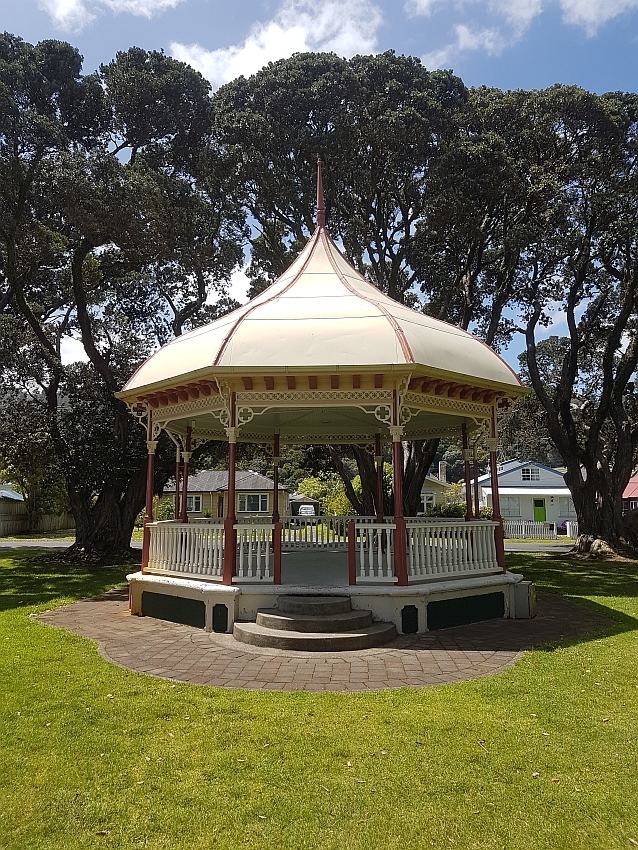
Erected in Victoria Park on the Thames foreshore in 1902, this exotic-looking Band Rotunda was created to commemorate the coronation of British monarch King Edward VII. It also reflects investment in civic facilities in the prominent goldmining settlement at the turn of the century. Initially linked with popular brass band entertainment, the octagonal timber structure has been used for musical performances and related events for over a century including during coronation celebrations for King George VI in 1937. Visually appealing in both its setting and design, it forms a relatively early surviving structure of its type in northern New Zealand. Its restoration in 2002 reflects the ongoing importance of the place to the community into the twenty-first century.
Te Kauaeranga was initially settled by Ngāti Huarere prior to conquest by Marutūahu iwi during the sixteenth century. Flat plains by the shoreline were generally cultivated and protected by defensive pā. Prior to European arrival, the Thames foreshore - later largely infilled for Victoria Park and other purposes - was divided into numerous customary interests enabling hapū from throughout Hauraki to access pātiki (flatfish) in associated fishing grounds. After the discovery of gold in 1867, a mining settlement at Thames rapidly developed. Grahamstown Railway station was built by the Thames foreshore in 1898. Reclamation for a recreational reserve beside the station entrance was underway when long-serving British sovereign Queen Victoria died in 1901, after which the intended facility became commemoratively known as Victoria Park. When the New Zealand government offered subsidies for civic projects to celebrate the coronation of Victoria’s successor Edward VII in 1902, Thames Borough Council drew on both these funds and its own finances for an additional commemorative feature as a centrepiece to the reserve: a band rotunda. This was promoted for its capacity to popularise the new park as well as reinforce Thames’ stature as a major settlement. During the late nineteenth and early twentieth centuries, the main popular music in outdoor locations was that created by military, community or work-based brass bands.
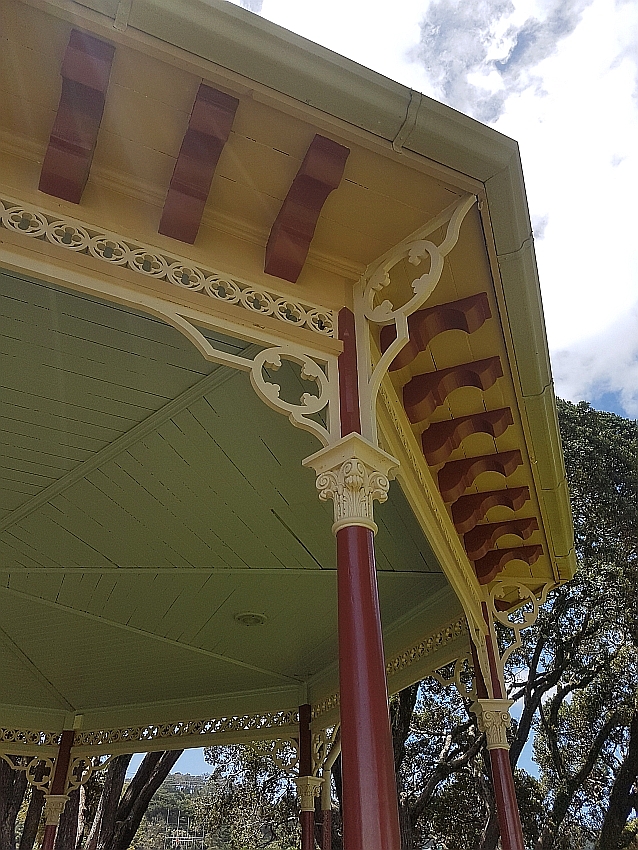
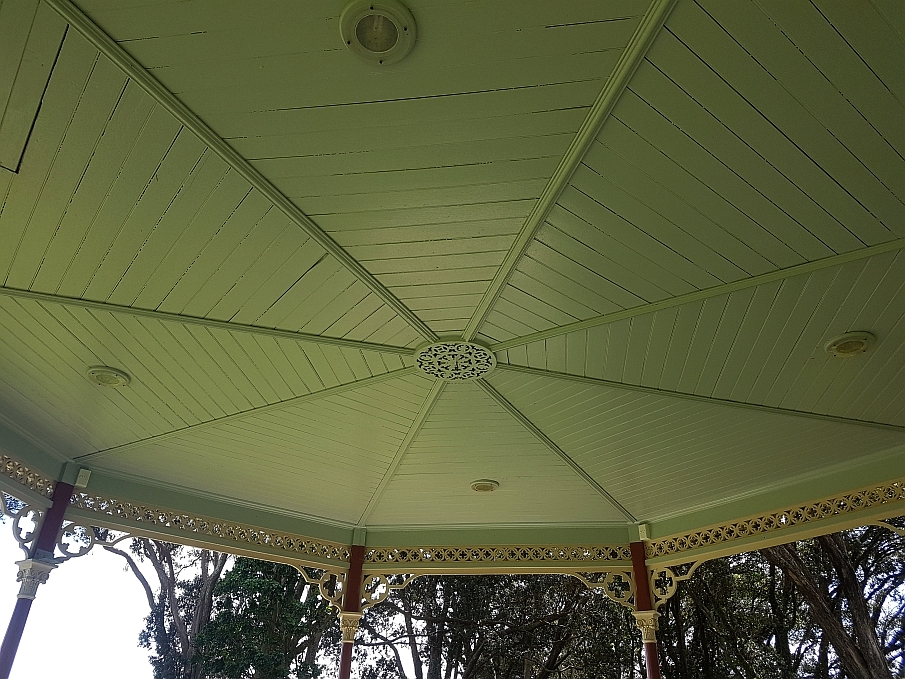
The octagonal rotunda was designed by the Council’s foreman of works Henry Simmonds, who also supervised its construction by local contractor C. W. Adams. Simmonds had previously visited Te Aroha and Rotorua to inspect recently-erected examples there. Simmonds’ ornate design incorporated an oriental-style ogee roof, evidently inspired by that at Rotorua and referencing wider British imperial networks. It also encompassed decoratively finished features such as elaborately corbelled eaves, timber columns with carved capitals, and balustraded railings. The open superstructure was mounted on a raised concrete platform, enabling better sight and sound projection for performing bands. Both the rotunda and Victoria Park were simultaneously opened in November 1902 as part of official celebrations for Edward VII’s birthday. Following opening speeches, a concert was played by the No. 2 Hauraki Battalion Band from the rotunda platform for the assembled crowd.
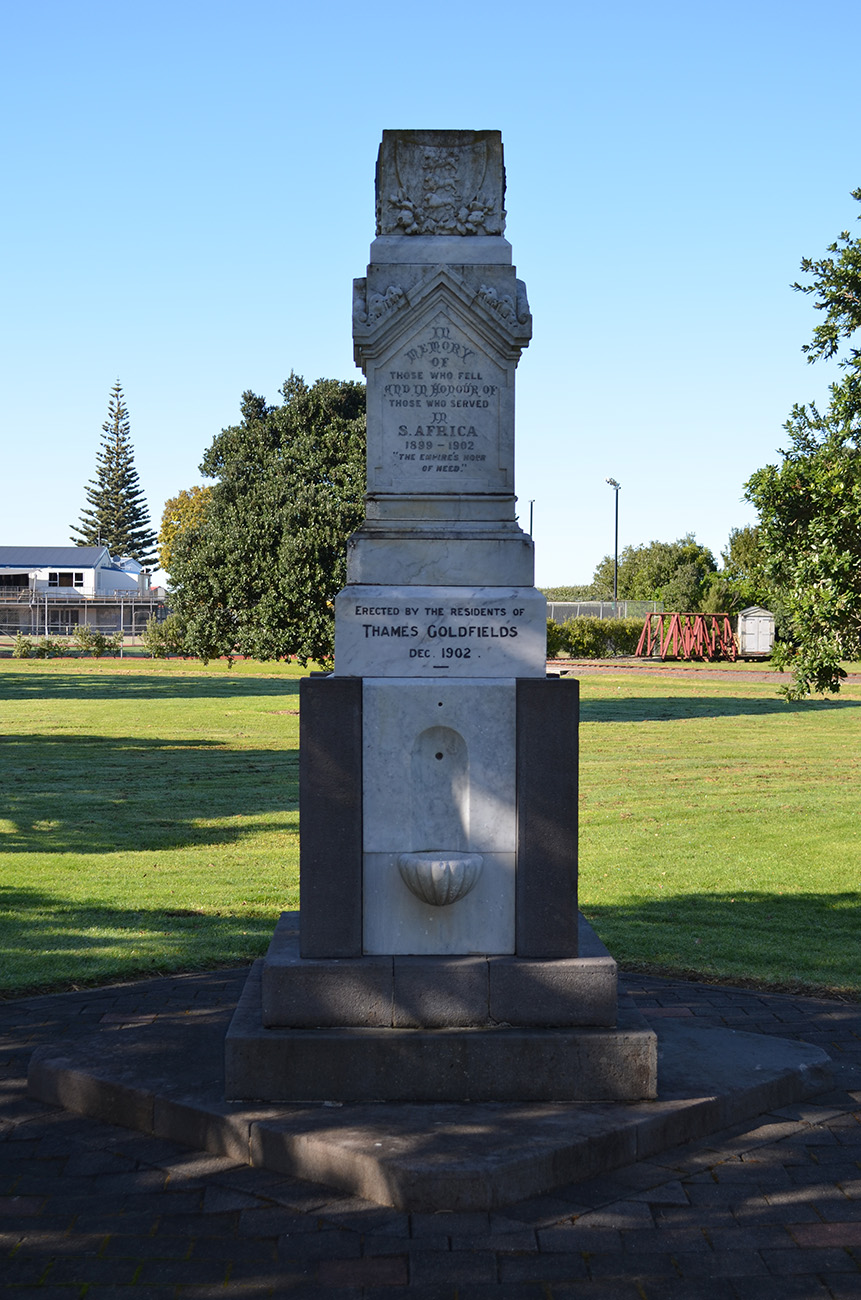
The contemporary park layout included a number of recently-planted trees, paths and a picket fence around its perimeter, creating a ‘lung of the town’ for popular use in an otherwise industrial and commercial landscape. The rotunda continued to be used for public performances over the following decades by the Battalion Band, later known as the Thames Citizen Band, which had been established in 1869. In 1937, official celebrations of the coronation of King George VI included speeches from the rotunda, reinforcing the place’s already strong commemorative role linked with British royalty and empire. The structure was repaired in 1983, after which the Thames Band resumed performing at the site. By 1986, balustraded railings and some fretwork had been removed. As part of centennial preparations in 2001-2, Thames-Coromandel District Council undertook large-scale restoration of the rotunda which included renewal of its iron roof cladding. Reopened in early 2002 at a well-attended ceremony, it remains an important part of a significant recreational and commemorative landscape in Thames that also includes pōhutukawa trees from the original 1901-2 Victoria Park design and the nearby South African War Memorial - whose foundation stone was laid the same day that the rotunda was opened in 1902, and which was rededicated at the same ceremony as the rotunda 100 years later.