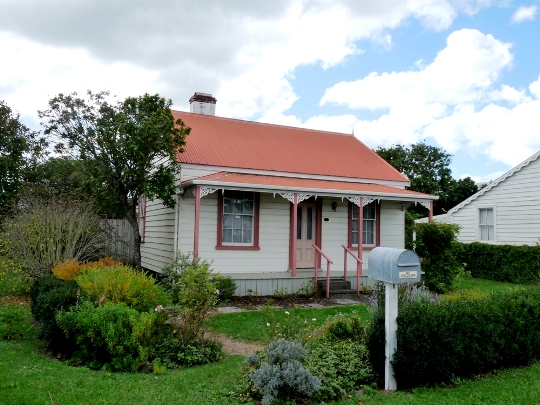
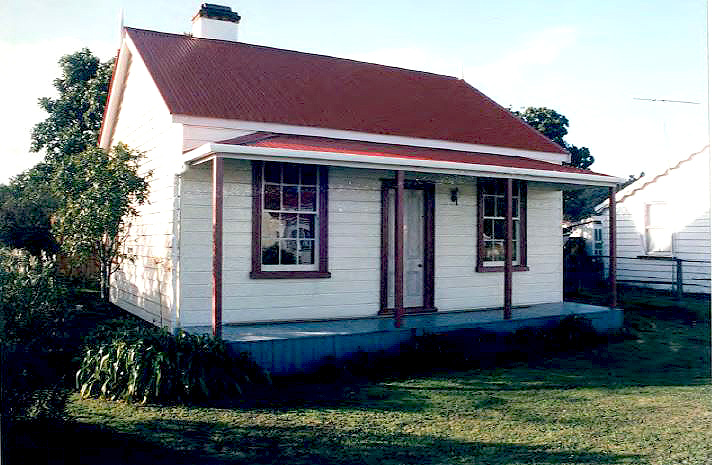
The former McTavish House is one of a group of surviving residences in central Whitianga linked with the expansion of nineteenth-century European settlement on the west side of the Whitianga Harbour. Of wide-gabled, double-box design, the single-storey timber dwelling was probably initially erected in the mid-1880s, while the property was held by Catherine McTavish and her husband Thomas. Thomas McTavish was employed in the local sawmilling industry, which fuelled Whitianga’s growth at this time. Subsequent property holders included a notable local merchant and public official, Dugald Bryce. In conjunction with the adjacent Postmaster’s House, the dwelling reflects the nature of accommodation owned by skilled workers and middle class citizens in an expanding nineteenth- and early twentieth-century timber town.
Te Whitianga o Kupe (Whitianga) has a long history extending back to the navigator Kupe and ancestral migrations from Hawaiki. The area forms a stronghold of Ngāti Hei, descended from the eponymous Hei who arrived on the Arawa waka. Although heavily impacted by early nineteenth-century conflicts including the tāua or so-called Musket Wars of the 1820s and 1830s, Ngāti Hei retained a distinct presence. Local Māori communities engaged significantly with early European entrepreneurs and settlers involved in the timber industry and other activity at Whitianga from the 1830s.
In 1866, the Karamuramu Block beside the Whitianga Harbour was held by Peneamene Tanui, of Te Rapupo hapū. By early 1880 the land had been acquired by Thomas Peacock, a prominent Auckland businessman and politician who helped found the emerging township’s Mercury Bay Timber Company. In 1883, this enterprise relocated Whitianga’s sawmill from an earlier site on the east side of the harbour to a modern, 24-hour facility near the Karamuramu Block. While the latter was being built, Peacock laid out private sections a short distance to the south, attracting both residential and commercial purchasers. In 1884, Lots 65 and 68 - extending between Owen Street and Campbell Street - were obtained by Catherine McTavish, wife of Thomas McTavish, a cook. The couple had been married two years previously and had a young family. Thomas McTavish (c.1834-1911) was a Scottish-born baker and confectioner, who had worked for the Cunard line before arriving in New Zealand. Subsequently joining the Waikato militia, he was present at the battle of Ōrākau in the 1860s and later awarded the New Zealand War Medal.
The current timber cottage was likely erected in the mid-1880s, perhaps initially on the Campbell Street frontage. Its relatively early date is indicated by features that include twelve-pane windows of double-hung sash type. Incorporating a wide-gabled main structure of double-box type and a rear lean-to, the dwelling is broadly comparable in dimensions and overall appearance to the neighbouring Postmaster’s House (List No. 4619), erected at a similar period. Like the latter, it contains a verandah and rusticated weatherboards on its front elevation, and plain weatherboarded walls elsewhere. The length of time or extent to which the McTavish family may have occupied the residence is currently unclear. In the late 1880s, Thomas McTavish was in charge of the sawmill kitchen at nearby Upper Mill, Whitianga. By the 1890s, both he and Catherine were residing at Kūaotunu where they ran a boarding house.
In 1898, both lots were transferred to Jane Bryce, wife of Dugald Bryce, a storekeeper and businessman. As well as maintaining general stores and bakeries at both Kūaotunu and Whitianga, Dugald Bryce was a director or shareholder of several gold-prospecting companies and a trustee of the recently-built, nearby un-denominational church (List No. 4655). Whilst holding the Owen Street site, he additionally became a Justice of the Peace and long-term member of Coromandel County Council. After retiring in 1921, Dugald and Jane Bryce moved to Auckland but retained possession of the property. Oral traditions have suggested that at about this time the building was relocated from a previous situation fronting Campbell Street to its current position. The main sawmill in Whitianga closed in 1922.
From 1931, the property was held by three of Dugald and Jane Bryce’s sons who sold the rear section (Lot 68) in 1946, after the Second World War (1939-45). The front section (Lot 65), including the house, remained in their possession, being subsequently transferred to an expanded family group in 1951 and eventually sold in 1972. During this period, Whitianga gained an increasing reputation as a holiday destination and resort. The residence subsequently passed through several owners including architect Terence Olsen and his wife Ngaire Edith Olsen, and then Norwegian-American master builder Hans Forlie and his wife Suzy (née Henry), the latter a founding member of the Chester Historic Preservation Committee in Vermont, USA. Renovations by the latter in the 1990s included adding verandah fretwork when the property was employed as a gift shop and florist. The house and its associated site have since been reconverted to private residential use.