DonateMembershipVisit Heritage
  • Tūrangawaewae
    Places
  • Tira Māori
    Māori Heritage
  • Poutairangahia
    Archaeology
  • Rauemi
    Resources
  • Mō Tātou
    About Us
  • New Zealand Heritage List
  • Nominate and submit
  • Explore the List
  • National Historic Landmarks
  • Plaques
  • Rainbow List Project
  • Lost heritage
  • Visit Heritage
  • Our properties
  • Turnbull House Project
  • Collections
  • Shop
  • Tohu Whenua
  • Tira Māori
  • Conserving Māori heritage
  • Marae built heritage
  • Māori heritage on the List
  • Hinemihi—Te Hokinga Mai
  • What is archaeology?
  • Is there a site on my property?
  • What are my legal requirements?
  • Affecting an archaeological site
  • Declaring an archaeological site
  • Archaeology FAQs
  • Archaeology Digital Library
  • Archaeology guidelines and templates
  • Resources
  • Funding
  • Publications
  • Sustainable management guides
  • Disaster recovery
  • Podcasts & digital resources
  • Education Hub
  • Conservation plans
  • About
  • Board
  • Māori Heritage Council
  • Senior Staff
  • Offices
  • Contact us
  • Careers
  • Covenants
  • Fast-track
  • Corporate documents
  • Currently consulting on
  • Our submissions
  • News
  • Covid-19 response
Quick links
Rārangi Kōrero | The List
Explore the List
National Historic Landmarks
Ngā Manawhenua o Aotearoa me ōna Kōrero Tūturu
Quick links
Tapuwae
A Vision for Places of Māori Heritage
Funding for Māori Heritage
Resources
Quick links
Archaeological Authority Portal
Applying for an archaeological authority
Archaeology FAQs
Browse the most frequently asked questions about archaeological authorities and the archaeological process.
Quick links
Quick links
News
News Keep up to date with Heritage New Zealand Pouhere Taonga
Membership
Membership Find out more and sign up today
DonateMembershipVisit Heritage
  • Tūrangawaewae
    Places
  • Tira Māori
    Māori Heritage
  • Poutairangahia
    Archaeology
  • Rauemi
    Resources
  • Mō Tātou
    About Us
  • New Zealand Heritage List
  • Nominate and submit
  • Explore the List
  • National Historic Landmarks
  • Plaques
  • Rainbow List Project
  • Lost heritage
  • Visit Heritage
  • Our properties
  • Turnbull House Project
  • Collections
  • Shop
  • Tohu Whenua
  • Tira Māori
  • Conserving Māori heritage
  • Marae built heritage
  • Māori heritage on the List
  • Hinemihi—Te Hokinga Mai
  • What is archaeology?
  • Is there a site on my property?
  • What are my legal requirements?
  • Affecting an archaeological site
  • Declaring an archaeological site
  • Archaeology FAQs
  • Archaeology Digital Library
  • Archaeology guidelines and templates
  • Resources
  • Funding
  • Publications
  • Sustainable management guides
  • Disaster recovery
  • Podcasts & digital resources
  • Education Hub
  • Conservation plans
  • About
  • Board
  • Māori Heritage Council
  • Senior Staff
  • Offices
  • Contact us
  • Careers
  • Covenants
  • Fast-track
  • Corporate documents
  • Currently consulting on
  • Our submissions
  • News
  • Covid-19 response
Quick links
Rārangi Kōrero | The List
Explore the List
National Historic Landmarks
Ngā Manawhenua o Aotearoa me ōna Kōrero Tūturu
Quick links
Tapuwae
A Vision for Places of Māori Heritage
Funding for Māori Heritage
Resources
Quick links
Archaeological Authority Portal
Applying for an archaeological authority
Archaeology FAQs
Browse the most frequently asked questions about archaeological authorities and the archaeological process.
Quick links
Quick links
News
News Keep up to date with Heritage New Zealand Pouhere Taonga
Membership
Membership Find out more and sign up today
  • Places
  • Nominate and submit
  • National Historic Landmarks
  • Places
  • Nominate and submit
  • National Historic Landmarks
  • Tira Māori
  • Conserving Māori heritage
  • Marae built heritage
  • Tira Māori
  • Conserving Māori heritage
  • Marae built heritage
  • Archaeological authorities
  • Archaeology Digital Library
  • Archaeological authorities
  • Archaeology Digital Library
  • All resources
  • Publications
  • Funding
  • All resources
  • Publications
  • Funding
  • FAQs
  • FAQs
Follow us on:
Places
  • Places
  • Nominate and submit
  • National Historic Landmarks
Tira Māori
  • Tira Māori
  • Conserving Māori heritage
  • Marae built heritage
Archaeology
  • Archaeological authorities
  • Archaeology Digital Library
Resources
  • All resources
  • Publications
  • Funding
FAQs
  • FAQs
Follow us on
HomePrivacyTerms and conditionsAbout this site
© Heritage New Zealand Pouhere Taonga 2026.
 
Morris’ Buildings (Former)

13 Wansbeck Street, OAMARU

Private

Historic Place Category 2

List No. 4688

Quick links:
List GalleryLocationDetails
Built in 1879, Morris’ Buildings (Former) are a terrace of shops on Wansbeck Street, at the edge of the harbour business district in Oamaru; they have historical and architectural significance as they were designed by the distinguished Oamaru architectural partnership Forrester and Lemon for Oamaru saddler Thomas Morris.

In the 1870s, the area around Wansbeck Street was close to the business hub of Oamaru – near to the warehousing area, the harbour and the railway station. Edward Milton Weedon owned a large block of land. Weedon advertised the land and ‘the very Extensive Buildings and Improvements thereon’ for sale in April 1878. The buildings were timber, and housed small businesses.

Saddler Thomas Morris bought the property. Morris had set up business in Oamaru in 1865, having previously worked for Reany Brothers in Dunedin. His first premises were opposite the ‘Times’ building on Wansbeck Street – perhaps in Weedon’s buildings. Morris purchased the land and buildings for £3,000 in May 1878, taking a mortgage out in August 1879. In June 1879, Morris’ premises were badly damaged by fire. The Star reported that the fire led to the ‘total destruction of five shops, the property of Mr T. Morris.’ The shops had been occupied by boot manufacturers Mair and Son, cabinet makers Tudhope and Hendry, and painter Mr Larkin. The stables owned by a Mr Nihill were undamaged.

By the middle of July, Morris had plans to rebuild the premises, with the council approving plans for the ‘new shops’. On 2 July, John Lemon advertised for tenders for the ‘Erection of SIX SHOPS’ to be built of stone in Wansbeck Street. Local historian WHS Roberts records that Morris’ shops had offices and dwelling-rooms on the second floor. Once the shops were complete, they were again occupied by small businesses.

The terrace is made up of three blocks – each with two shop fronts, with residential or office accommodation above. The buildings are plainly detailed, with the balustrades on the parapet being the only ornate detail. The balustrading was removed (or closed in), sometime after the 1930s. The shop fronts had large plate glass fronts with entrance doors to one side. Upstairs are double hung sash windows – a smaller pair in the centre, with wider windows on the outside. There is keystone detailing over the windows. Decoration was formed by a string course above which was the parapet and balustrading. The rear of the building is utilitarian. In recent years, some of the shop fronts have been filled in or reconfigured.

Thomas Henry Townsend bought the property in 1882, and owned them until his death around 1901. His estate seems to have owned the property until 1923 when it was sold to company manager John Amies. Amies owned the property as tenant in common with land agent Edgar Fox, and Wellington solicitor Frederick Ongley. The property was subdivided in 1955. Oamaru market gardener Ah Lee bought the property in 1967. In 1976, the buildings were sold to Firth Industries (later renamed Fletcher Concrete and Infrastructure Limited) and they still own the buildings in 2015.

In 2015, the buildings are used for storage or are largely vacant.
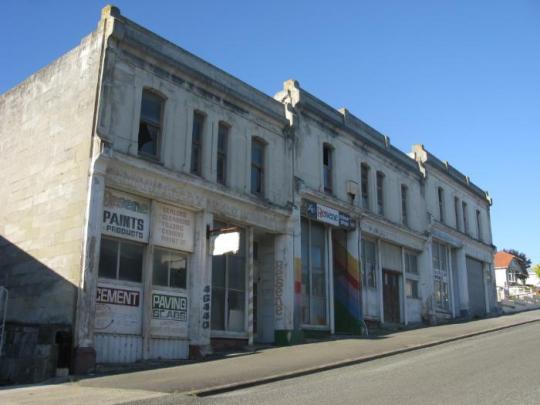
Morris’ Buildings (Former), Oamaru | Maree Cadogan | 01/11/2024 | Maree Cadogan

List Entry Information

Overview

Status
Listed

List Entry Status
Historic Place Category 2

Access
Private/No Public Access

List Number
4688

Date Entered
25th September 1986

Date of Effect
25th September 1986

City/District Council
Waitaki District

Region
Otago Region

Extent of List Entry

Extent includes the land described as Lot 3 DP 8249 (RT OT383/249), Otago Land District, and the buildings known as Morris’ Buildings (Former) thereon

Legal description

Lot 3 DP 8249 (RT OT383/249), Otago Land District

Detailed List Entry

Construction Professional

Name

Forrester & Lemon

Type

Architectural Partnership

Biography

The architectural partnership of Forrester and Lemon was established in Oamaru in 1872. Thomas Forrester (1838-1907) was born in Glasgow and educated at the Glasgow School of Art. Emigrating to New Zealand in 1861 he settled in Dunedin and worked under William Mason (1810-97) and William Henry Clayton (1823-77) and later Robert Arthur Lawson (1833-1902). In 1865 he superintended the Dunedin Exhibition and from 1870 he became involved with the supervision of harbour works. Some time after 1885 he became Engineer to the Oamaru Harbour Board and in this capacity designed the repairs to the breakwater following storm damage in 1886 and later the Holmes Wharf. On his death in 1907 he was still in the employ of the Harbour Board. John Lemon (1828-1890) was born in Jamaica and travelled to England before emigrating to New Zealand in 1849. He settled in Oamaru in 1860 and with his brother Charles established a timber merchant's business. By 1869 he was in partnership with his father-in-law, George Sumpter calling themselves "Timber and General Merchants, Land and Commission Agents". This partnership was dissolved in 1872 and Lemon entered into partnership with Forrester. Lemon had no architectural experience at all, but had a wide circle of business contacts and was an efficient administrator. Buildings designed by the partnership of Forrester and Lemon include St Paul's Church (1875-76), the Harbour Board Offices (1876), Queen's (later Brydone) Hotel (1881), Waitaki Boys' High School (1883), The Courthouse (1883) and the Post Office (1883-84), all in Oamaru. Forrester and Lemon contributed greatly to Oamaru's nineteenth century character. On Lemon's death in 1890 the practice was taken over by Forrester's son, John Megget Forrester (1865-1965).

Construction Details

Start Year

1879

Type

Original Construction

Description

Original construction in June

Start Year

1879

Type

Additional building added to site

Description

New shops erected, August

Reference

Completion Date

12th August 2015

Report Written By

Heather Bauchop

Information Sources

McCarthy, 2002

Conal McCarthy, Forrester and Lemon of Oamaru, architects, Oamaru, 2002

Report Written By

This place was identified as significant under previous legislation with different information requirements. It remains significant under the current legislation. There is opportunity under our legislation and policies to add to this information. Further information about this place may be available from the Otago/Southland Office of Heritage New Zealand Pouhere Taonga. This registration is also included in the Harbour/Tyne Street Historic Area (Record no. 7064). Please note that entry on the New Zealand Heritage List/Rarangi Korero identifies only the heritage values of the property concerned, and should not be construed as advice on the state of the property, or as a comment of its soundness or safety, including in regard to earthquake risk, safety in the event of fire, or insanitary conditions. A fully referenced upgrade report is available on request from the Otago/Southland Office of Heritage New Zealand

Further Information

Current Usages

Uses: Trade

Specific Usage: Warehouse/storage area

Uses: Vacant

Specific Usage: Vacant

Former Usages

General Usage:: Trade

Specific Usage: Office building/Offices

General Usage:: Trade

Specific Usage: Shop

Themes

Web Links

Overview

Status

Listed

List Entry Status

Historic Place Category 2

Access

Private/No Public Access

List Number

4688

Date Entered

25th September 1986

Date of Effect

25th September 1986

City/District Council

Waitaki District

Region

Otago Region

Extent of List Entry

Extent includes the land described as Lot 3 DP 8249 (RT OT383/249), Otago Land District, and the buildings known as Morris’ Buildings (Former) thereon

Legal description

Lot 3 DP 8249 (RT OT383/249), Otago Land District

Status

Listed

List Entry Status

Historic Place Category 2

Access

Private/No Public Access

List Number

4688

Date Entered

25th September 1986

Date of Effect

25th September 1986

City/District Council

Waitaki District

Region

Otago Region

Extent of List Entry

Extent includes the land described as Lot 3 DP 8249 (RT OT383/249), Otago Land District, and the buildings known as Morris’ Buildings (Former) thereon

Legal description

Lot 3 DP 8249 (RT OT383/249), Otago Land District

Construction Information

Construction Professional

Name

Forrester & Lemon

Type

Architectural Partnership

Biography

The architectural partnership of Forrester and Lemon was established in Oamaru in 1872. Thomas Forrester (1838-1907) was born in Glasgow and educated at the Glasgow School of Art. Emigrating to New Zealand in 1861 he settled in Dunedin and worked under William Mason (1810-97) and William Henry Clayton (1823-77) and later Robert Arthur Lawson (1833-1902). In 1865 he superintended the Dunedin Exhibition and from 1870 he became involved with the supervision of harbour works. Some time after 1885 he became Engineer to the Oamaru Harbour Board and in this capacity designed the repairs to the breakwater following storm damage in 1886 and later the Holmes Wharf. On his death in 1907 he was still in the employ of the Harbour Board. John Lemon (1828-1890) was born in Jamaica and travelled to England before emigrating to New Zealand in 1849. He settled in Oamaru in 1860 and with his brother Charles established a timber merchant's business. By 1869 he was in partnership with his father-in-law, George Sumpter calling themselves "Timber and General Merchants, Land and Commission Agents". This partnership was dissolved in 1872 and Lemon entered into partnership with Forrester. Lemon had no architectural experience at all, but had a wide circle of business contacts and was an efficient administrator. Buildings designed by the partnership of Forrester and Lemon include St Paul's Church (1875-76), the Harbour Board Offices (1876), Queen's (later Brydone) Hotel (1881), Waitaki Boys' High School (1883), The Courthouse (1883) and the Post Office (1883-84), all in Oamaru. Forrester and Lemon contributed greatly to Oamaru's nineteenth century character. On Lemon's death in 1890 the practice was taken over by Forrester's son, John Megget Forrester (1865-1965).

Construction Details

Start Year

1879

Type

Original Construction

Description

Original construction in June

Start Year

1879

Type

Additional building added to site

Description

New shops erected, August

Construction Professional

Name

Forrester & Lemon

Type

Architectural Partnership

Biography

The architectural partnership of Forrester and Lemon was established in Oamaru in 1872. Thomas Forrester (1838-1907) was born in Glasgow and educated at the Glasgow School of Art. Emigrating to New Zealand in 1861 he settled in Dunedin and worked under William Mason (1810-97) and William Henry Clayton (1823-77) and later Robert Arthur Lawson (1833-1902). In 1865 he superintended the Dunedin Exhibition and from 1870 he became involved with the supervision of harbour works. Some time after 1885 he became Engineer to the Oamaru Harbour Board and in this capacity designed the repairs to the breakwater following storm damage in 1886 and later the Holmes Wharf. On his death in 1907 he was still in the employ of the Harbour Board. John Lemon (1828-1890) was born in Jamaica and travelled to England before emigrating to New Zealand in 1849. He settled in Oamaru in 1860 and with his brother Charles established a timber merchant's business. By 1869 he was in partnership with his father-in-law, George Sumpter calling themselves "Timber and General Merchants, Land and Commission Agents". This partnership was dissolved in 1872 and Lemon entered into partnership with Forrester. Lemon had no architectural experience at all, but had a wide circle of business contacts and was an efficient administrator. Buildings designed by the partnership of Forrester and Lemon include St Paul's Church (1875-76), the Harbour Board Offices (1876), Queen's (later Brydone) Hotel (1881), Waitaki Boys' High School (1883), The Courthouse (1883) and the Post Office (1883-84), all in Oamaru. Forrester and Lemon contributed greatly to Oamaru's nineteenth century character. On Lemon's death in 1890 the practice was taken over by Forrester's son, John Megget Forrester (1865-1965).

Construction Details

Start Year

1879

Type

Original Construction

Description

Original construction in June

Start Year

1879

Type

Additional building added to site

Description

New shops erected, August

Reference

Historical and Associated Iwi / Hapū / Whānau

Completion Date

12th August 2015

Report Written By

Heather Bauchop

Information Sources

McCarthy, 2002

Conal McCarthy, Forrester and Lemon of Oamaru, architects, Oamaru, 2002

Other Information

This place was identified as significant under previous legislation with different information requirements. It remains significant under the current legislation. There is opportunity under our legislation and policies to add to this information. Further information about this place may be available from the Otago/Southland Office of Heritage New Zealand Pouhere Taonga. This registration is also included in the Harbour/Tyne Street Historic Area (Record no. 7064). Please note that entry on the New Zealand Heritage List/Rarangi Korero identifies only the heritage values of the property concerned, and should not be construed as advice on the state of the property, or as a comment of its soundness or safety, including in regard to earthquake risk, safety in the event of fire, or insanitary conditions. A fully referenced upgrade report is available on request from the Otago/Southland Office of Heritage New Zealand

Historical and Associated Iwi / Hapū / Whānau

Completion Date

12th August 2015

Report Written By

Heather Bauchop

Information Sources

McCarthy, 2002

Conal McCarthy, Forrester and Lemon of Oamaru, architects, Oamaru, 2002

Other Information

This place was identified as significant under previous legislation with different information requirements. It remains significant under the current legislation. There is opportunity under our legislation and policies to add to this information. Further information about this place may be available from the Otago/Southland Office of Heritage New Zealand Pouhere Taonga. This registration is also included in the Harbour/Tyne Street Historic Area (Record no. 7064). Please note that entry on the New Zealand Heritage List/Rarangi Korero identifies only the heritage values of the property concerned, and should not be construed as advice on the state of the property, or as a comment of its soundness or safety, including in regard to earthquake risk, safety in the event of fire, or insanitary conditions. A fully referenced upgrade report is available on request from the Otago/Southland Office of Heritage New Zealand

Further Information

Current Usages

Uses: Trade

Specific Usage: Warehouse/storage area

Uses: Vacant

Specific Usage: Vacant

Former Usages

General Usage: Trade

Specific Usage: Office building/Offices

General Usage: Trade

Specific Usage: Shop

Current Usages

Uses: Trade

Specific Usage: Warehouse/storage area

Uses: Vacant

Specific Usage: Vacant

Former Usages

General Usage: Trade

Specific Usage: Office building/Offices

General Usage: Trade

Specific Usage: Shop

Location

Loading
Related listings
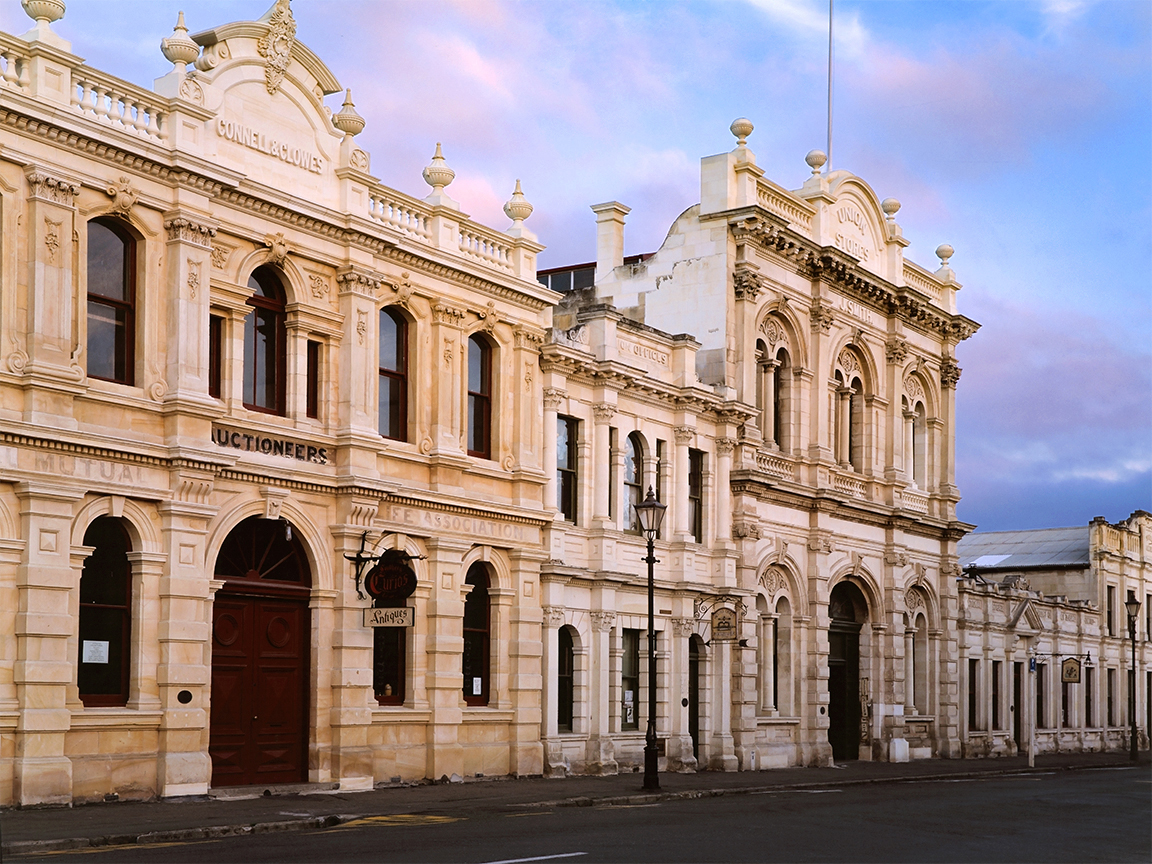
Oamaru Historic Area. Image courtesy of www.jimwitkowski.com
Oamaru Historic Area
Oamaru Historic Area. Image courtesy of www.jimwitkowski.com
Oamaru Historic Area
Stay up to date with Heritage this month