

During the 1870s there was a growing interest in opening up the land between Wellington and Foxton for settlement. The government began preliminary work on a west coast route out of Wellington in 1879, part of what would ultimately become a line between Wellington and Auckland. When a change of government brought a halt to funding in 1880, a group of mainly Wellington businessmen joined together and successfully lobbied the government to allow for a private company to complete the line. In August 1881 the Wellington and Manawatu Railway Company Limited was incorporated, and in March 1882 the company signed a contract with the government to construct a railway between Wellington and Longburn. The contract stipulated the standard of construction, charges, and that the railway would be open on 25 September 1887.
The first contract was let in September 1882, and construction was begun on several sections of the line rather than from each end. Progress was slow, hampered by swamps and there were difficulties with the construction of the tunnels along the Kapiti coast. On 21 September 1885 the first 25 km section between Wellington and Paremata was opened. A little over a year later the entire line was completed, and the Governor General, Sir William Jervois (1821-1897), drove in the last spike at Otaihanga on 3 November 1886, ten months ahead of the government deadline. Along the new line the company had selected sites for settlement, including that of Shannon, named after George Vance Shannon (1842-1920), a director of the company. Shannon, and fellow directors, John Plimmer (1812-1905) and William Hort Levin (1845-1893), had each taken 2,000 shares (equal to £30,000) out of the initial capital required of £50,000. Like Shannon, Plimmer and Levin contributions were acknowledged in the names of stations along the railway line.
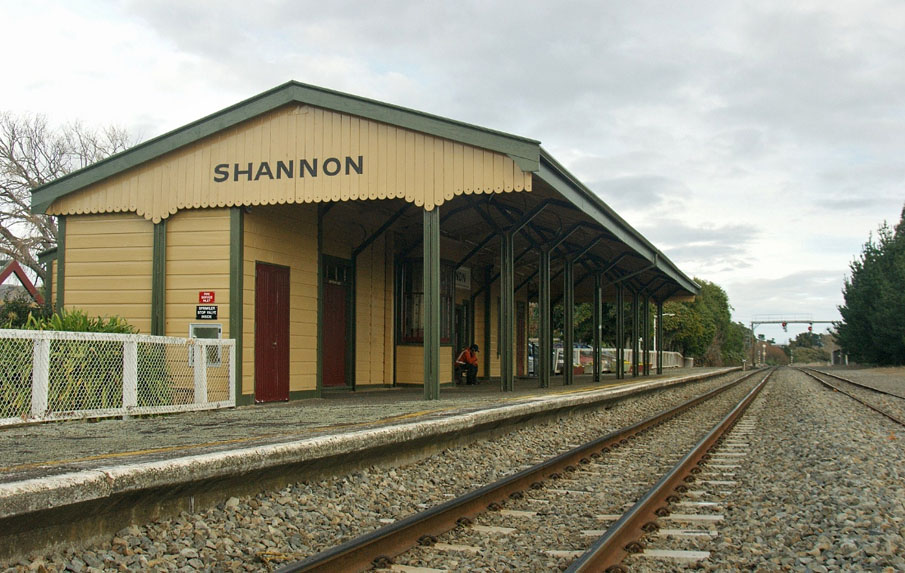
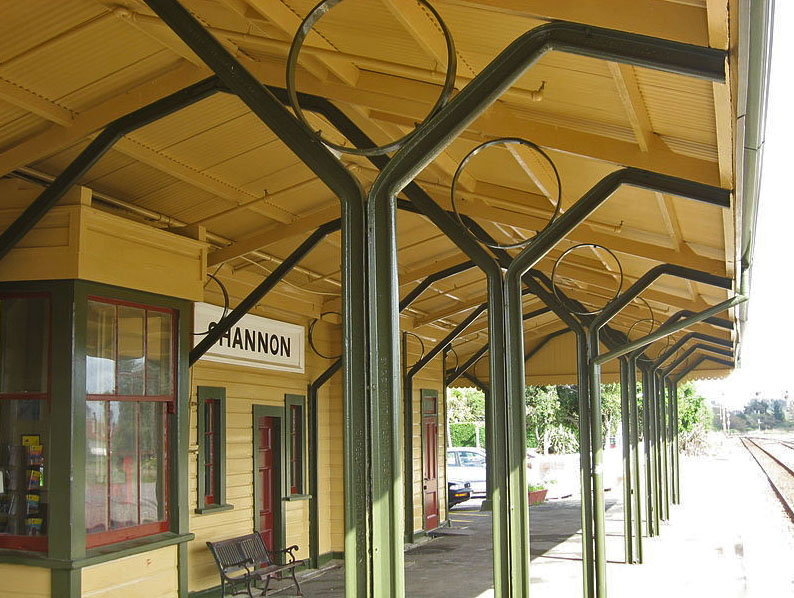
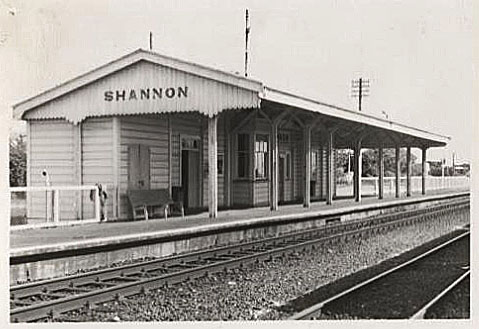
The first railway station at Shannon was built in 1886 and was essentially a flag station/shelter shed. In 1893 this station was removed to Paraparaumu and replaced with the current station. When built this second station was based on a standard Public Works Department plan, and known as a 'Vogel class 4'. It was essentially a wooden three-roomed lean-to structure consisting of a stationmaster's office, ladies' waiting room, and ticket lobby. The platform consisted of concrete and gravel. In 1902 a luggage/parcels room was added. In 1908, with the North Island Main Trunk Line almost completed, the government acquired the Wellington and Manawatu Railway Company. In 1910 a verandah was added to the station. Before the First World War additional stock sidings were added to the station yard to cope with the increased amount of livestock being carried by the railway. Between 1921 and 1924 the hydro-electric scheme at Mangahao further increased the demands placed on the railway and station, and again the sidings accommodation was increased. Passenger travel also continued to increase and in 1936 a new parcels/luggage room was constructed.
By the latter half of the twentieth century competition from road transport led to the decline in railway traffic and in 1980 the station was closed. In 1985 the Shannon Railway Station Trust was formed to save the building. In 1992 the Horowhenua District Council acquired the station from the New Zealand Railways. Between 1993 and 1998 the trust, in association with the district council, Shannon Tourism Development Taskforce Inc. and the New Zealand Historic Places Trust/Pouhere Taonga, restored the building with the help of a grant from the Lotteries Grants Board. The station was 're-opened' for community use in March 1998 and the following year the Rail Heritage Trust acknowledged the restoration work with an award. Today the station building contains an information centre, with displays on the history of the station and the Shannon district. Commuter trains travelling between Wellington and Palmerston North still stop at Shannon.
The Shannon Railway Station has great historical significance as the only remaining station building built by the Wellington and Manawatu Railway Company. Locally it is a tangible reminder of the role of the Wellington and Manawatu Railway Company in the founding of Shannon. Although modified, the building is architecturally interesting, as very few 'Vogel class 4' buildings remain. It engenders local pride as shown by the community's efforts to restore the station.
List Entry Information
Status
Listed
List Entry Status
Historic Place Category 1
Access
Private/No Public Access
List Number
4703
Date Entered
25th September 1986
Date of Effect
25th September 1986
City/District Council
Horowhenua District
Region
Horizons (Manawatū-Whanganui) Region
Extent of List Entry
Extent is part of the land described as Lot 1 DP 71514 (RT WN 39D/463, NZ Gazette 1999 p. 849), Wellington Land District, part of the land described as Railway Land, Wellington Land District, as shown on SO 13409, and the building known as Shannon Railway Station thereon and its platform.
Legal description
Lot 1 DP 71514 (RT WN39D/463, NZ Gazette 1999 p. 849); Railway Land, Wellington Land District
Status
Listed
List Entry Status
Historic Place Category 1
Access
Private/No Public Access
List Number
4703
Date Entered
25th September 1986
Date of Effect
25th September 1986
City/District Council
Horowhenua District
Region
Horizons (Manawatū-Whanganui) Region
Extent of List Entry
Extent is part of the land described as Lot 1 DP 71514 (RT WN 39D/463, NZ Gazette 1999 p. 849), Wellington Land District, part of the land described as Railway Land, Wellington Land District, as shown on SO 13409, and the building known as Shannon Railway Station thereon and its platform.
Legal description
Lot 1 DP 71514 (RT WN39D/463, NZ Gazette 1999 p. 849); Railway Land, Wellington Land District
Why is this place significant?
Historic Significance
Historical Significance or Value This is the only surviving station building built by the Wellington and Manawatu Company, a private company which operated between Wellington and Longburn, from 1885 until taken over by the NZ railways in 1908. It is named after C.V. Shannon, a Director of the Wellington and Manawatu Railway Company.
Physical Significance
A utilitarian wooden station building typical of the period. Wooden stations of this age are quite rare
Why is this place significant?
Historic Significance
Historical Significance or Value This is the only surviving station building built by the Wellington and Manawatu Company, a private company which operated between Wellington and Longburn, from 1885 until taken over by the NZ railways in 1908. It is named after C.V. Shannon, a Director of the Wellington and Manawatu Railway Company.
Physical Significance
A utilitarian wooden station building typical of the period. Wooden stations of this age are quite rare
Construction Details
Start Year
1893
Type
Original Construction
Start Year
1902
Type
Addition
Description
Addition of a parcel and luggage room
Start Year
1910
Type
Addition
Description
Addition of verandah
Start Year
1936
Type
Addition
Description
Addition of a new parcels/luggage room
Start Year
1993
Finish Year
1996
Type
Other
Description
Restoration of station
Construction Materials
Weatherboard, with corrugated iron roof
Construction Details
Start Year
1893
Type
Original Construction
Start Year
1902
Type
Addition
Description
Addition of a parcel and luggage room
Start Year
1910
Type
Addition
Description
Addition of verandah
Start Year
1936
Type
Addition
Description
Addition of a new parcels/luggage room
Start Year
1993
Finish Year
1996
Type
Other
Description
Restoration of station
Construction Materials
Weatherboard, with corrugated iron roof
Historical and Associated Iwi / Hapū / Whānau
Information Sources
Churchman, 1990
Geoffrey B. Churchman and Tony Hurst, 'The Railways of New Zealand, a journey through history', Auckland, 1990
Law, 1987
Marjorie D. Law, From bush & swamp: the centenary of Shannon, 1887-1897, Palmerston North, 1987
Mahoney, 1987
J. D. Mahoney, Down at the Station: A Study of the New Zealand Railway Station, Palmerston North, 1987
New Zealand Historic Places
New Zealand Historic Places
Conservation Plan
Conservation Plan
Other Information
This place was identified as significant under previous legislation with different information requirements. It remains significant under the current legislation. There is opportunity under our legislation and policies to add to this information. Further information about this place may be available from the Central Regional Office of Heritage New Zealand Pouhere Taonga. Please note that entry on the New Zealand Heritage List/Rarangi Korero identifies only the heritage values of the property concerned, and should not be construed as advice on the state of the property, or as a comment of its soundness or safety, including in regard to earthquake risk, safety in the event of fire, or insanitary conditions.
Historical and Associated Iwi / Hapū / Whānau
Information Sources
Churchman, 1990
Geoffrey B. Churchman and Tony Hurst, 'The Railways of New Zealand, a journey through history', Auckland, 1990
Law, 1987
Marjorie D. Law, From bush & swamp: the centenary of Shannon, 1887-1897, Palmerston North, 1987
Mahoney, 1987
J. D. Mahoney, Down at the Station: A Study of the New Zealand Railway Station, Palmerston North, 1987
New Zealand Historic Places
New Zealand Historic Places
Conservation Plan
Conservation Plan
Other Information
This place was identified as significant under previous legislation with different information requirements. It remains significant under the current legislation. There is opportunity under our legislation and policies to add to this information. Further information about this place may be available from the Central Regional Office of Heritage New Zealand Pouhere Taonga. Please note that entry on the New Zealand Heritage List/Rarangi Korero identifies only the heritage values of the property concerned, and should not be construed as advice on the state of the property, or as a comment of its soundness or safety, including in regard to earthquake risk, safety in the event of fire, or insanitary conditions.
Current Usages
Uses: Civic Facilities
Specific Usage: Information/Visitors Centre
Uses: Transport
Specific Usage: Railway station/ platform/ refreshment room
Current Usages
Uses: Civic Facilities
Specific Usage: Information/Visitors Centre
Uses: Transport
Specific Usage: Railway station/ platform/ refreshment room
Location
Sign up to hear more
Get the latest heritage news, features and events delivered
straight to your inbox.
