

The introduction of electricity to Hawke’s Bay created widespread debate. Lighting was first raised at a Hastings Borough Council meeting in 1889, and twenty years later, in 1909 it was agreed the Hastings Borough Council would take a poll on raising 12,000 pounds to install Electric Light and Power to the Borough.
Havelock North, part of the Borough, anticipated receiving electricity although there was community unrest about the supply of three essential services: electricity, water and sewerage. Ratepayers’ dissatisfaction with Hastings Borough Council’s poor performance - they believed their requests were ignored in favour of Hastings residents - led to a move for their own governance authority that would correct the injustices. So the Havelock North Town Board was established in August 1912.
Thomas Mason Chambers, the main instigator of the reform, was elected Chairman. His attempt to supply electricity to his district was thwarted by lack of availability from Hastings Borough Council who were equally frustrated that their procurement was unreliable. When Government rejected their request for part-funding to develop an electrical-hydro scheme, Council established their own diesel oil generating plant in Hastings; a license was granted in 1910.
At the Town Board’s December 1912 meeting, an offer from Hastings Borough Council was read to supply Havelock North with ‘Electric current’; it was accepted for a term of seven years. However it proved unsatisfactory, as Hastings could not guarantee regular supply.
Six months later the Havelock North Town Board were discussing ways of providing electricity for themselves. Chambers’ brother, John, had already built his own power station for his residential and farm requirements, at Mokopeka, in the Maraetotara Valley, from 1892. There was potential for excess electricity from Mokopeka, from a second power plant to be built further downstream, in the near future, that could supply the district. This became Board business early in 1913 and in anticipation they approved raising a loan.
The purchase of land, and plans for the Transformer House followed. It was necessary for power distribution but would also provide a public ‘Rest House’, and serve as a tribute to Thomas Mason Chambers for his contributions to the community. Given these considerations, high quality design and construction was essential. There was a call for an independent appraisal of designs, subject to adjudication by an architect outside the district. Architect, James Walter Chapman-Taylor was announced the winner of the design competition.
Already an acknowledged architect of merit the Chapman-Taylor commission was public recognition of his work, and was accepted at a time when he was designing and building homes for Hawke’s Bay residents. Construction was completed by mid-July 1915.
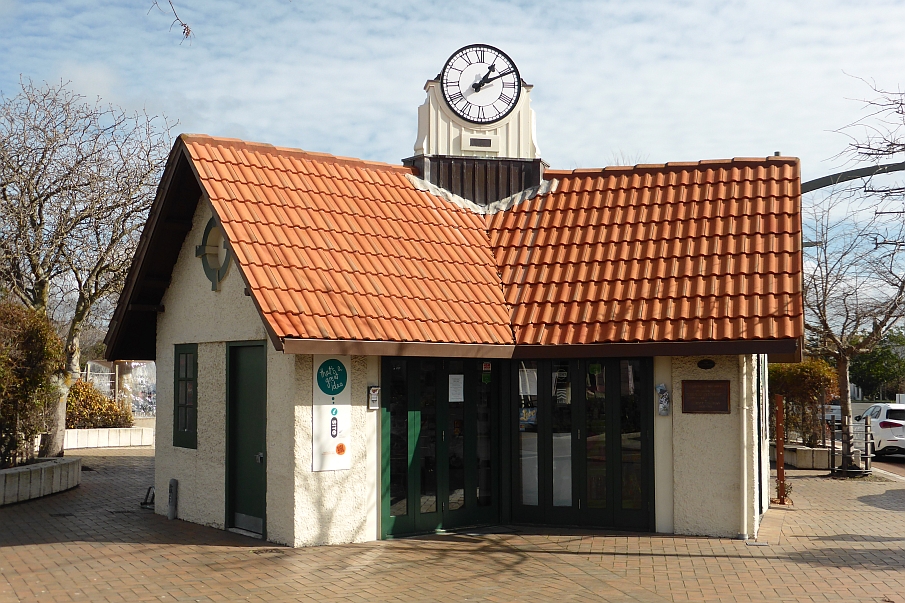
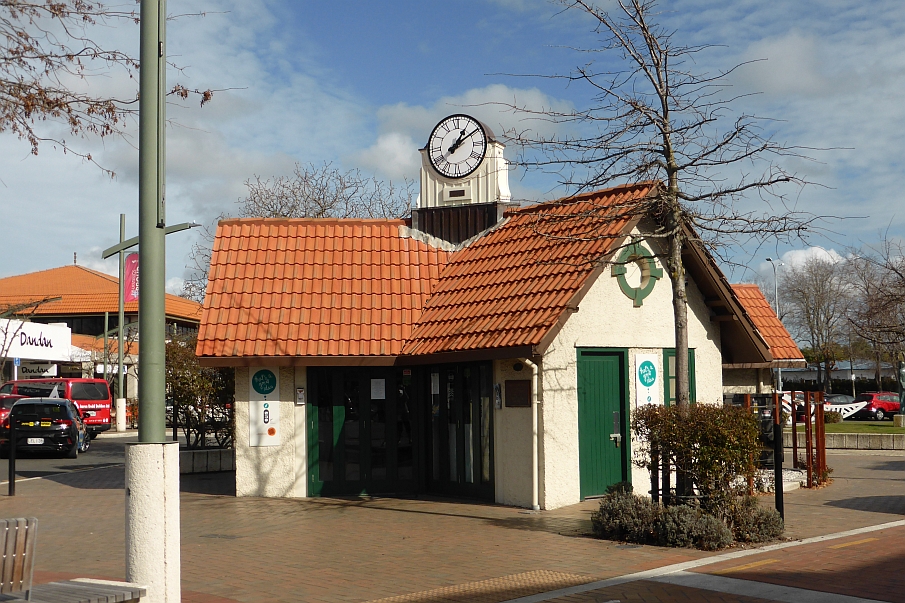
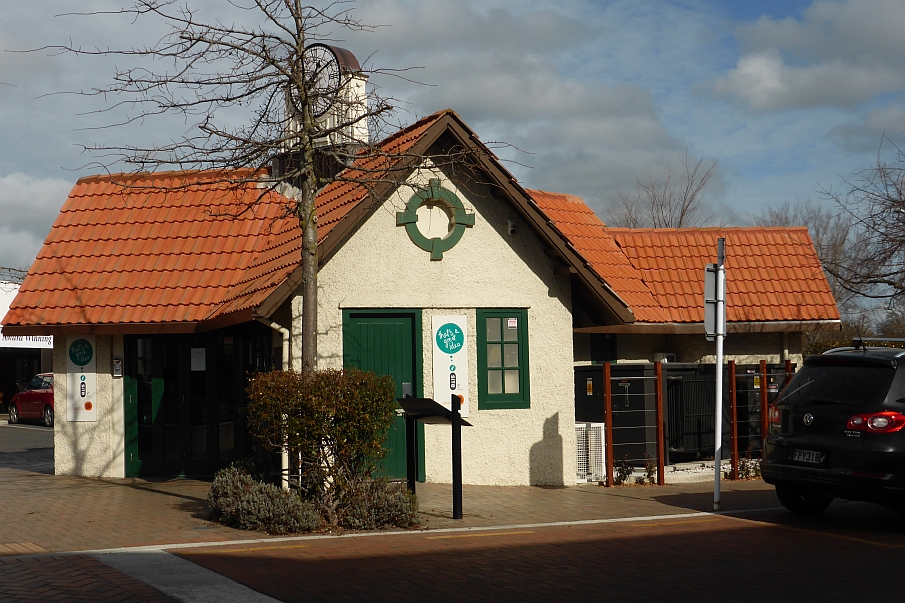
The Transformer House was designed to point in three directions, acknowledging the circular junction of the five roads and, suited to its site. A single storeyed building constructed in brick and concrete and styled in the popular English Arts and Crafts style, it featured a high pitched roof of three gables, rough cast plaster finish and a Marseilles tiled roof. It was painted in a light colour, possibly a white-wash, with dark-coloured paint trim around the window panes, frames and doors. Photographs taken during the Peace Day celebrations, 19 July 1919, were the first images that show the completed Transformer House, shelter, and bell tower in position.
A symbol of Chapman-Taylor’s design in brick buildings was incorporated as the circular ventilators under each gable, derived from the ‘oculus’ form. Circular windows were included in his first brick house, for Harry Tombs in Wellington, and were repeated throughout his career. The Transformer House designs are similar to those in ‘Inverness’, Dannevirke, a house he designed and built in 1914.
Electricity distributed throughout Havelock North until the early 1920s came from Hastings, and there is no evidence that the Transformer House was used until the expansion of the power supply from Mokopeka, on the completion of the second Maraetotara River power station, was received in 1923. At last Havelock North had its own power for heating, lighting and cooking and this remained in place until 1937 when the town joined Hastings and was supplied from the national grid. At this time the bell tower of Chapman-Taylor’s original design was replaced with a clock.
There have been many alterations and additions to the Transformer House over the years, with a demand for increased public seating, and toilet facilities that are regularly upgraded. This continues today but in addition an information centre has been established on the north-east side. The transformer, and the accompanying electrical equipment, remains housed in the centre of the building, and it continues to supply the needs of the Village’s central business area.
The Transformer House remains a significant architectural feature of the Village, an historical point of identity reflecting Village pride.
List Entry Information
Status
Listed
List Entry Status
Historic Place Category 2
Access
Private/No Public Access
List Number
4797
Date Entered
27th November 1986
Date of Effect
27th November 1986
City/District Council
Hastings District
Region
Hawke's Bay Region
Extent of List Entry
Extent includes part of the land described as Road Reserve, Hawkes Bay Land District and the building known as Transformer House and Shelter thereon, and its fittings and fixtures.
Legal description
Road Reserve, Hawkes Bay Land District
Location Description
The Transformer House sits at the centre junction of Te Aute, Havelock, Joll, Te Mata and Middle Roads, on Road Reserve.
Status
Listed
List Entry Status
Historic Place Category 2
Access
Private/No Public Access
List Number
4797
Date Entered
27th November 1986
Date of Effect
27th November 1986
City/District Council
Hastings District
Region
Hawke's Bay Region
Extent of List Entry
Extent includes part of the land described as Road Reserve, Hawkes Bay Land District and the building known as Transformer House and Shelter thereon, and its fittings and fixtures.
Legal description
Road Reserve, Hawkes Bay Land District
Location Description
The Transformer House sits at the centre junction of Te Aute, Havelock, Joll, Te Mata and Middle Roads, on Road Reserve.
Construction Professional
Name
Chapman-Taylor, James Walter
Type
Architect
Biography
Chapman-Taylor (1878-1958) was born in London and his family came to New Zealand in 1880. He was apprenticed to a builder in Stratford, and there he studied architecture by correspondence. In 1909 Chapman-Taylor went on a voyage to England where he acquainted himself with the English vernacular and the Arts and Crafts movement. This trip had a profound effect on Chapman-Taylor's future work as he followed the principles of the Arts and Crafts movement, a movement with origins in the English Gothic Revival. Chapman-Taylor adhered to the Arts and Crafts principles of permanence, honesty, simplicity and beauty as espoused by architects C.F.A. Voysey (1857-1941), Baillie Scott, Parker and Unwin whom he met on this trip to England. He adapted the English movement to local conditions. His is an honest architecture which remained popular despite changing fashions. Chapman-Taylor adhered to Arts and Crafts principles over the 50 years of his career and showed a keen awareness of local forms and materials. He designed the furniture and fittings for many of his houses, including details such as wrought iron door and window fittings. As an architect and a craftsman, Chapman-Taylor designed and then built his houses himself - approximately 80 of them dated between 1904 and 1953. While most of these houses are situated in Wellington and Heretaunga, there are others throughout the North Island and one in the South Island.
Construction Details
Start Year
1915
startYearCirca
Finish Year
1923
finishYearCirca
Type
Other
Description
Electrical power was supplied to, and connected with the transformer for distribution.
Type
Modification
Description
Alterations to serve as a bus shelter and rest area as well as a substation
Start Year
1937
Type
Modification
Description
11 June: A clock, donated by Mr and Mrs H.W.C Baird was installed replacing the original bell tower
Type
Addition
Description
External bus shelter added to the building
Period
1970s
Start Year
1993
startYearCirca
Type
Modification
Description
Clock replaced
Start Year
2002
Type
Modification
Description
Bus Shelter addition removed; automated public toilets installed
Start Year
2004
Finish Year
2005
Type
Modification
Description
Alterations to establish the building as an Information Centre; existing transformer equipment remains in place with new security glass for the windows. Original Marseille tiles on the roof replaced with modern clay tiles.
Construction Professional
Name
Chapman-Taylor, James Walter
Type
Architect
Biography
Chapman-Taylor (1878-1958) was born in London and his family came to New Zealand in 1880. He was apprenticed to a builder in Stratford, and there he studied architecture by correspondence. In 1909 Chapman-Taylor went on a voyage to England where he acquainted himself with the English vernacular and the Arts and Crafts movement. This trip had a profound effect on Chapman-Taylor's future work as he followed the principles of the Arts and Crafts movement, a movement with origins in the English Gothic Revival. Chapman-Taylor adhered to the Arts and Crafts principles of permanence, honesty, simplicity and beauty as espoused by architects C.F.A. Voysey (1857-1941), Baillie Scott, Parker and Unwin whom he met on this trip to England. He adapted the English movement to local conditions. His is an honest architecture which remained popular despite changing fashions. Chapman-Taylor adhered to Arts and Crafts principles over the 50 years of his career and showed a keen awareness of local forms and materials. He designed the furniture and fittings for many of his houses, including details such as wrought iron door and window fittings. As an architect and a craftsman, Chapman-Taylor designed and then built his houses himself - approximately 80 of them dated between 1904 and 1953. While most of these houses are situated in Wellington and Heretaunga, there are others throughout the North Island and one in the South Island.
Construction Details
Start Year
1915
startYearCirca
Finish Year
1923
finishYearCirca
Type
Other
Description
Electrical power was supplied to, and connected with the transformer for distribution.
Type
Modification
Description
Alterations to serve as a bus shelter and rest area as well as a substation
Start Year
1937
Type
Modification
Description
11 June: A clock, donated by Mr and Mrs H.W.C Baird was installed replacing the original bell tower
Type
Addition
Description
External bus shelter added to the building
Period
1970s
Start Year
1993
startYearCirca
Type
Modification
Description
Clock replaced
Start Year
2002
Type
Modification
Description
Bus Shelter addition removed; automated public toilets installed
Start Year
2004
Finish Year
2005
Type
Modification
Description
Alterations to establish the building as an Information Centre; existing transformer equipment remains in place with new security glass for the windows. Original Marseille tiles on the roof replaced with modern clay tiles.
Historical and Associated Iwi / Hapū / Whānau
Completion Date
18th August 2011
Report Written By
Judy Siers & Blyss Wagstaff
Information Sources
Boyd, 1984
Mary Boyd, City of the Plains, A History of Hastings, Wellington, 1984
Orr, 1974
Russell Orr, Fifty Years on - A history of the Hawke's Bay Electric Power Board, Hawke's Bay, 1974
Wright, 2001 (3)
Matthew Wright, Town and Country: The History of Hastings and District, Hastings, 2001.
Grant, 1978
SW Grant, Havelock North: From Village to Borough 1860-1952, Central Hawkes Bay Printers/Publishers 1978
Siers, 2007
Judy Siers, The life and time of James Walter Chapman-Taylor. Napier, New Zealand: Millwod Heritage Productions, 2007
Other Information
This place was identified as significant under previous legislation with different information requirements. It remains significant under the current legislation. There is opportunity under our legislation and policies to add to this information. Further information about this place may be available from the Central Regional Office of Heritage New Zealand Pouhere Taonga. A fully referenced report is available from the NZHPT Central Regional office Please note that entry on the New Zealand Heritage List/Rarangi Korero identifies only the heritage values of the property concerned, and should not be construed as advice on the state of the property, or as a comment of its soundness or safety, including in regard to earthquake risk, safety in the event of fire, or insanitary conditions.
Historical and Associated Iwi / Hapū / Whānau
Completion Date
18th August 2011
Report Written By
Judy Siers & Blyss Wagstaff
Information Sources
Boyd, 1984
Mary Boyd, City of the Plains, A History of Hastings, Wellington, 1984
Orr, 1974
Russell Orr, Fifty Years on - A history of the Hawke's Bay Electric Power Board, Hawke's Bay, 1974
Wright, 2001 (3)
Matthew Wright, Town and Country: The History of Hastings and District, Hastings, 2001.
Grant, 1978
SW Grant, Havelock North: From Village to Borough 1860-1952, Central Hawkes Bay Printers/Publishers 1978
Siers, 2007
Judy Siers, The life and time of James Walter Chapman-Taylor. Napier, New Zealand: Millwod Heritage Productions, 2007
Other Information
This place was identified as significant under previous legislation with different information requirements. It remains significant under the current legislation. There is opportunity under our legislation and policies to add to this information. Further information about this place may be available from the Central Regional Office of Heritage New Zealand Pouhere Taonga. A fully referenced report is available from the NZHPT Central Regional office Please note that entry on the New Zealand Heritage List/Rarangi Korero identifies only the heritage values of the property concerned, and should not be construed as advice on the state of the property, or as a comment of its soundness or safety, including in regard to earthquake risk, safety in the event of fire, or insanitary conditions.
Current Usages
Uses: Civic Facilities
Specific Usage: Clocktower/ clock
Uses: Civic Facilities
Specific Usage: Information/Visitors Centre
Uses: Civic Facilities
Specific Usage: Public Lavatory
Uses: Civic Facilities
Specific Usage: Square - public
Uses: Government
Specific Usage: Council/local government building
Uses: Utilities
Specific Usage: Electricity Transformer/Substation
Former Usages
General Usage: Civic Facilities
Specific Usage: Clocktower/ clock
General Usage: Civic Facilities
Specific Usage: Square - public
General Usage: Transport
Specific Usage: Bus Station/Depot/station/shelter
General Usage: Utilities
Specific Usage: Electricity Transformer/Substation
Current Usages
Uses: Civic Facilities
Specific Usage: Clocktower/ clock
Uses: Civic Facilities
Specific Usage: Information/Visitors Centre
Uses: Civic Facilities
Specific Usage: Public Lavatory
Uses: Civic Facilities
Specific Usage: Square - public
Uses: Government
Specific Usage: Council/local government building
Uses: Utilities
Specific Usage: Electricity Transformer/Substation
Former Usages
General Usage: Civic Facilities
Specific Usage: Clocktower/ clock
General Usage: Civic Facilities
Specific Usage: Square - public
General Usage: Transport
Specific Usage: Bus Station/Depot/station/shelter
General Usage: Utilities
Specific Usage: Electricity Transformer/Substation
Sign up to hear more
Get the latest heritage news, features and events delivered
straight to your inbox.
