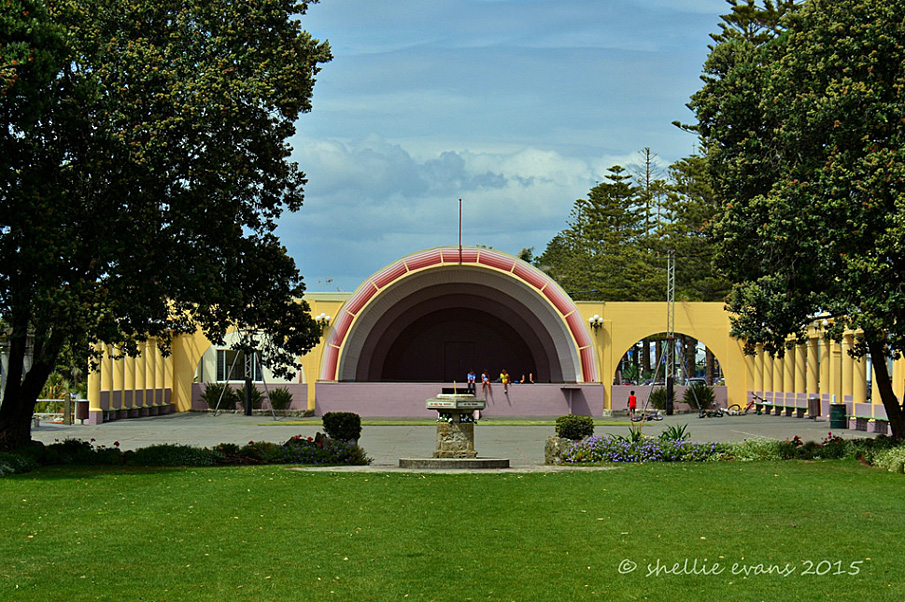
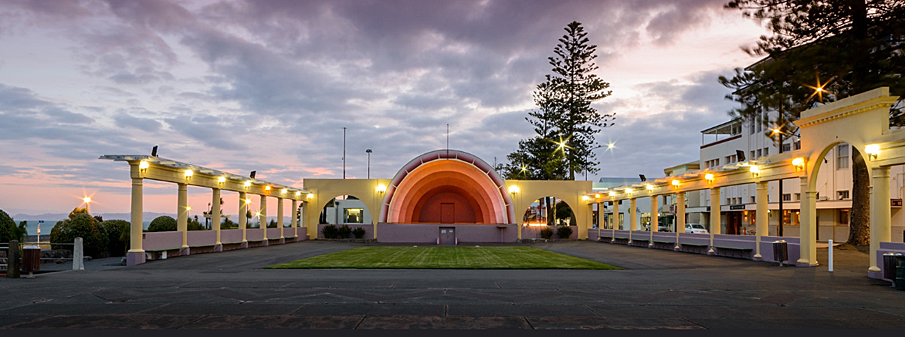
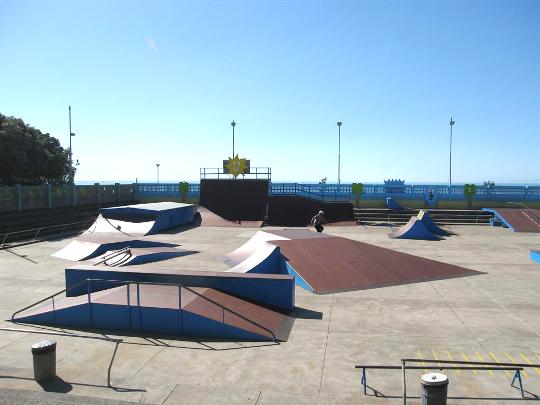
In 1932 the construction of a skating rink, from patterned concrete, began on Napier’s Marine Parade within sight and sound of both the Central Business District and the Pacific Ocean. Original documentation describes it as an ‘outdoor auditorium’. Its construction was followed by that of the concrete Sound Shell immediately to its south, which was completed in 1934. The integrated design of the two elements has aesthetic significance, successfully creating a place of social value where the community could meet to dance, skate or attend civic events. The Sound Shell has architectural significance as an example of notable local architect John Thomas Watson’s work.
After the destructive 1931 Hawke’s Bay Earthquake rubble was cleared from central Napier and dumped along the newly uplifted foreshore. It was levelled for new development, which was ongoing through the 1930s. This included not just the skating rink and Sound Shell, but also in the immediate proximity the arches, colonnades, Veronica Sunbay and Kirk Sundial, each memorialising the Hawke’s Bay Earthquake and Napier’s subsequent rebirth.
The construction of the skating rink was funded by Government Relief and council funds, with contributions by the public. The cement, ordered from England, arrived in 1933 and was poured to create a colourful Art Deco pattern in the centre and around the borders of the surface. A public fundraising campaign for the rink’s construction, involving paying for individual paving slabs, was well supported. It was originally designed as a space for outdoor dancing but it soon became a town square-like space popular for the new craze of recreational skating.
In 1934, the Sound Shell was constructed immediately south of the skating rink. The Sound Shell stage is set within a north-facing semi-circular dome. It was designed by Napier architect John Thomas Watson to promote the space’s use for outdoor concerts, assorted entertainment and civic events. The Thirty Thousand Club funded the project, and opened it with ceremony in December 1934 with speeches, fireworks and a band rendition of ‘The New Napier March’. It was described in the press at the time as ‘the first music shell erected on the foreshore in any part of the world’.
Originally a temporary structure, Napier’s citizens - initially dubious of the Sound Shell’s aesthetic contribution to the landscape - were eventually convinced to retain it permanently. It quickly became an icon of Napier, appearing on promotional material produced by both the Napier Borough Council and the Thirty Thousand Club. By the 1950s the concrete surface of the skating rink had deteriorated and it was no longer possible to skate on it. In 2017 it was described as ‘a health and safety hazard area’ with ‘multiple cracks’ and a dangerously uneven concrete surface. Although it is no longer used for skating, the rink and the Sound Shell are still a venue for public occasions, such as Annual New Year’s Eve celebrations and Art Deco Weekend events.