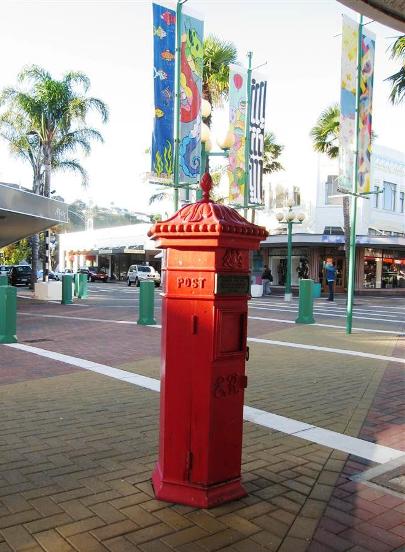
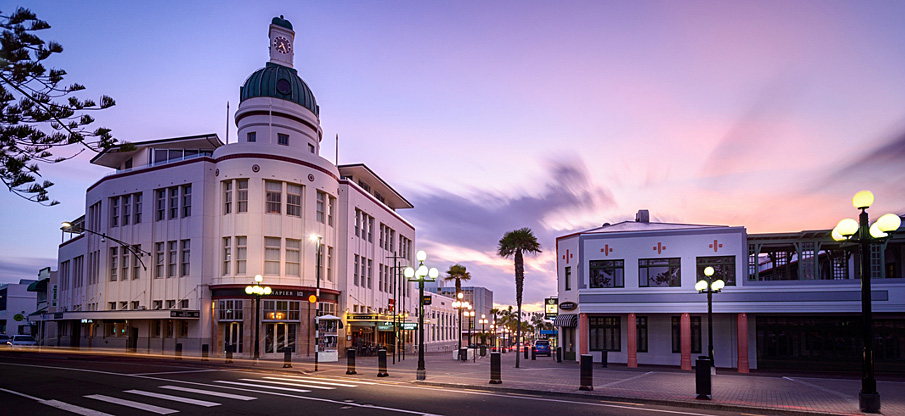
Installed in central Napier in 1905, Post Box (Former) is a rare remaining example of a New Zealand-manufactured cast iron pillar box using the popular design of leading British architect and surveyor, John Wornham Penfold (1828-1909).
Until the mid twentieth century, Victorian and Edwardian pillar boxes or ‘letter receivers’ were common along the streets of New Zealand urban centres. Remaining examples, such as Post Box (Former), have historic and social significance because they were an important facility in an age when post was the quintessential means of distance communication.
The first Hawke’s Bay post office was established in Ahuriri/Napier in the 1850s. Stamps became compulsory for national post in 1862, and prior to this New Zealanders had to go to a post office for their items to be marked with the correct postage cost. Stamps quickly became popular and correspondingly the Post Office Department increasingly installed post boxes as an ‘obvious complement to their usefulness.’ They meant people did not need to travel to a post office to mail letters and could do so at any time.
Letter receivers were predominantly installed to meet the demands of large towns and cities. Napier had post boxes from the 1880s onwards. In the early twentieth century the number of post boxes consistently increased by one or two per year, following the 1 January 1901 introduction of universal penny post in New Zealand. This significantly cut the cost of posting letters nationally and internationally. Penny postage had an ‘electrifying effect. Almost everyone seemed to take to letter writing.’ Post Box (Former), originally installed outside of the Napier Working Men’s Club, catered to this demand.
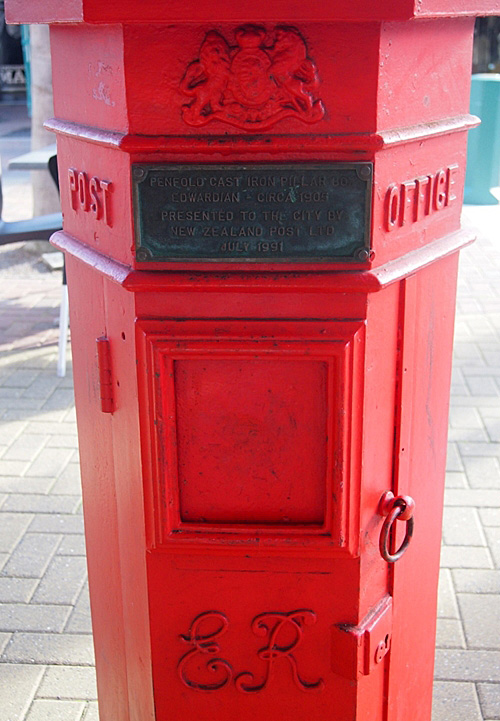
The design used was that of the British receivers designed by Penfold, and named after him. In 1865 Penfold was invited to design a new standard pillar box, and there were subsequently several variations. The style of Post Box (Former) shows it to be one of the last implemented in Britain, dating from around 1872. The British Postal Museum and Archive states that this type of Penfold pillar box is ‘very rare.’ Unlike Britain, in New Zealand Penfold boxes continued to be manufactured into the Edwardian period, and, like Post Box (Former), have an ER insignia.
By the mid twentieth century the New Zealand Post Office Association began replacing the cast iron pillar boxes. Considered unsanitary, leaky, and difficult to clear, most boxes were sold to museums and private collectors or scrapped. However Post Box (Former) was one of the pillar boxes retained ‘in those districts where they were of historical interest.’
The current position of Post Box (Former) is approximately 50 metres east along lower Emerson Street from its original location. The letter aperture has been covered with a bronze plaque commemorating the donation of the box to Napier City in 1991.
Until the mid twentieth century, Victorian and Edwardian pillar boxes or ‘letter receivers’ were common along the streets of New Zealand urban centres. Remaining examples, such as Post Box (Former), have historic and social significance because they were an important facility in an age when post was the quintessential means of distance communication.
The first Hawke’s Bay post office was established in Ahuriri/Napier in the 1850s. Stamps became compulsory for national post in 1862, and prior to this New Zealanders had to go to a post office for their items to be marked with the correct postage cost. Stamps quickly became popular and correspondingly the Post Office Department increasingly installed post boxes as an ‘obvious complement to their usefulness.’ They meant people did not need to travel to a post office to mail letters and could do so at any time.
Letter receivers were predominantly installed to meet the demands of large towns and cities. Napier had post boxes from the 1880s onwards. In the early twentieth century the number of post boxes consistently increased by one or two per year, following the 1 January 1901 introduction of universal penny post in New Zealand. This significantly cut the cost of posting letters nationally and internationally. Penny postage had an ‘electrifying effect. Almost everyone seemed to take to letter writing.’ Post Box (Former), originally installed outside of the Napier Working Men’s Club, catered to this demand.
The design used was that of the British receivers designed by Penfold, and named after him. In 1865 Penfold was invited to design a new standard pillar box, and there were subsequently several variations. The style of Post Box (Former) shows it to be one of the last implemented in Britain, dating from around 1872. The British Postal Museum and Archive states that this type of Penfold pillar box is ‘very rare.’ Unlike Britain, in New Zealand Penfold boxes continued to be manufactured into the Edwardian period, and, like Post Box (Former), have an ER insignia.
By the mid twentieth century the New Zealand Post Office Association began replacing the cast iron pillar boxes. Considered unsanitary, leaky, and difficult to clear, most boxes were sold to museums and private collectors or scrapped. However Post Box (Former) was one of the pillar boxes retained ‘in those districts where they were of historical interest.’
The current position of Post Box (Former) is approximately 50 metres east along lower Emerson Street from its original location. The letter aperture has been covered with a bronze plaque commemorating the donation of the box to Napier City in 1991.