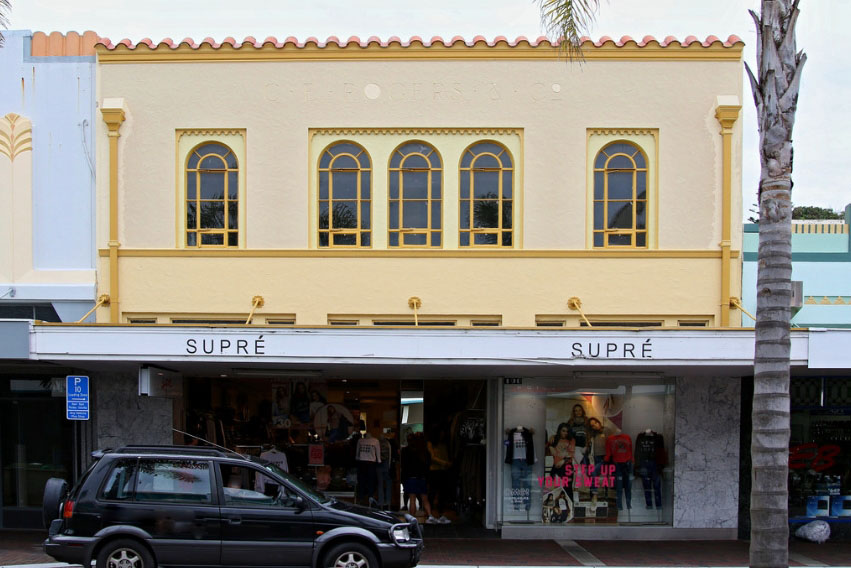
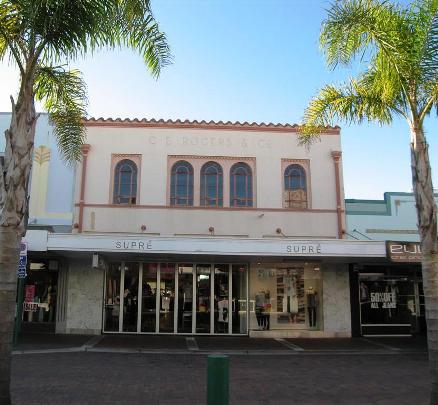
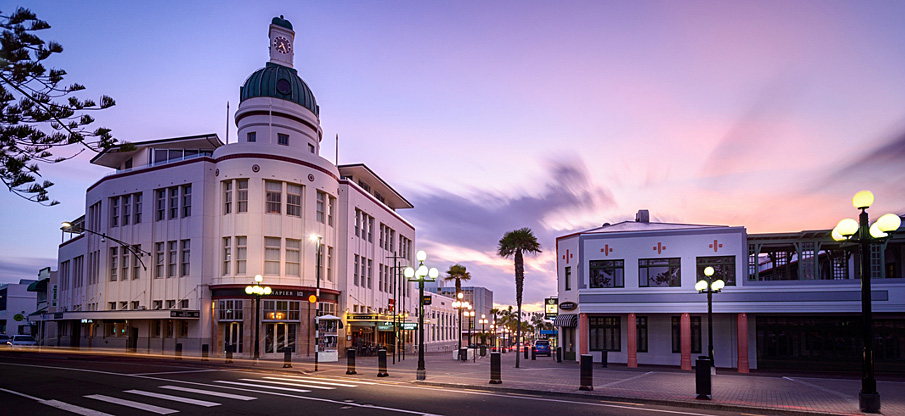
The former C.E. Rogers & Co Building (constructed 1932-1940) occupies a prominent location within Napier’s central business district, and is notable for its dual frontages to Emerson and Tennyson Streets. The building has historical significance through its association with long-standing Napier furniture manufacturing business C.E. Rogers and Co. and with the devastating 1931 Napier earthquake. It is a key contributor to the Art Deco streetscape of central Napier, and is architecturally significant for showcasing both Spanish Mission and Neo-Norman architecture within the one united building.
Tribal traditions, whakapapa and archaeological evidence indicate many centuries of Māori occupation in Ahuriri (Napier). Early Māori tribes in Te Matau-a-Māui (Hawke’s Bay) descended from Māui and down through Toi-kai-rākau, and included Ngāti Hotu, Ngāti Mahu and Whatumamoa. Ngāti Kahungunu arrived in the sixteenth century and became the dominant tribal group in the region through both warfare and strategic marriage. Large-scale Pākehā settlement commenced from the mid-1850s following the government’s 1851 Ahuriri Block purchase. By the 20th century Napier was a flourishing township and in early 1924 local furniture manufacturers C.E. Rogers & Co sold their Hastings Street property, relocating to a site on Emerson Street which ran through to Tennyson Street. Their original Emerson Street premises were destroyed by the devastating Napier earthquake on 3 February 1931 and the ensuing fires, but the company quickly announced their intention to rebuild. A new factory building was soon erected, fronting on to Tennyson Street. The timely re-establishment of their factory enabled C.E. Rogers and Co. to construct office furniture and shop fittings as part of the post-earthquake rebuild. In 1932 a new two-storey commercial building was constructed for C.E. Rogers & Co at the Emerson Street end of the property, designed by architects Finch and Westerholm.
The façade of the two-storey commercial building was designed in the Spanish Mission style with Cordova roof tiles, arched windows, smooth plaster finish and mock-Roman pillar ornamentation. A plan of the building’s interior reveals shops and an office on the ground floor with a small internal courtyard on its eastern elevation. There was an expansive showroom on the first floor and an additional floor used as a workroom at the rear. C.E. Rogers & Co subsequently expanded into the undertaking business and in April 1940 a large fire broke out in their ‘furniture factory and mortuary chapel’. The Finch and Westerholm-designed commercial building fronting Emerson Street escaped from damage. The fire-damaged factory and mortuary chapel were replaced by a new building reportedly housing factory workshops and show rooms. Constructed by builder W. Atherfold, it was designed in a Neo-Norman style with a castle-like appearance due to the solid walls topped by low-rise faux battlements. The front entrance had garage access to the east of the main doors and there was a small internal courtyard on the eastern elevation. The roof space had a mezzanine floor.
C.E. Rogers and Co occupied the entire property through until the early 1960s. In 1965 C.B. Soft Furnishings Ltd received approval to use the building for soft furnishings manufacture and from 1976 to 2006 the building was home to textile retailers Dressways Limited. Fashion retailer Supré then occupied the building and undertook alterations as part of a shop refit, including modifications to the Emerson Street shop frontage. Otherwise, the building retains a high level of original fabric, particularly on the upper floors. This includes staircases with native timber balustrades; timber floors, wall linings and trussed ceilings; steel casement windows; and Bakelite light fittings and switches. Supré closed circa. 2018 and in 2021 the C.E. Rogers & Co Building (Former) remains vacant.
Tribal traditions, whakapapa and archaeological evidence indicate many centuries of Māori occupation in Ahuriri (Napier). Early Māori tribes in Te Matau-a-Māui (Hawke’s Bay) descended from Māui and down through Toi-kai-rākau, and included Ngāti Hotu, Ngāti Mahu and Whatumamoa. Ngāti Kahungunu arrived in the sixteenth century and became the dominant tribal group in the region through both warfare and strategic marriage. Large-scale Pākehā settlement commenced from the mid-1850s following the government’s 1851 Ahuriri Block purchase. By the 20th century Napier was a flourishing township and in early 1924 local furniture manufacturers C.E. Rogers & Co sold their Hastings Street property, relocating to a site on Emerson Street which ran through to Tennyson Street. Their original Emerson Street premises were destroyed by the devastating Napier earthquake on 3 February 1931 and the ensuing fires, but the company quickly announced their intention to rebuild. A new factory building was soon erected, fronting on to Tennyson Street. The timely re-establishment of their factory enabled C.E. Rogers and Co. to construct office furniture and shop fittings as part of the post-earthquake rebuild. In 1932 a new two-storey commercial building was constructed for C.E. Rogers & Co at the Emerson Street end of the property, designed by architects Finch and Westerholm.
The façade of the two-storey commercial building was designed in the Spanish Mission style with Cordova roof tiles, arched windows, smooth plaster finish and mock-Roman pillar ornamentation. A plan of the building’s interior reveals shops and an office on the ground floor with a small internal courtyard on its eastern elevation. There was an expansive showroom on the first floor and an additional floor used as a workroom at the rear. C.E. Rogers & Co subsequently expanded into the undertaking business and in April 1940 a large fire broke out in their ‘furniture factory and mortuary chapel’. The Finch and Westerholm-designed commercial building fronting Emerson Street escaped from damage. The fire-damaged factory and mortuary chapel were replaced by a new building reportedly housing factory workshops and show rooms. Constructed by builder W. Atherfold, it was designed in a Neo-Norman style with a castle-like appearance due to the solid walls topped by low-rise faux battlements. The front entrance had garage access to the east of the main doors and there was a small internal courtyard on the eastern elevation. The roof space had a mezzanine floor.
C.E. Rogers and Co occupied the entire property through until the early 1960s. In 1965 C.B. Soft Furnishings Ltd received approval to use the building for soft furnishings manufacture and from 1976 to 2006 the building was home to textile retailers Dressways Limited. Fashion retailer Supré then occupied the building and undertook alterations as part of a shop refit, including modifications to the Emerson Street shop frontage. Otherwise, the building retains a high level of original fabric, particularly on the upper floors. This includes staircases with native timber balustrades; timber floors, wall linings and trussed ceilings; steel casement windows; and Bakelite light fittings and switches. Supré closed circa. 2018 and in 2021 the C.E. Rogers & Co Building (Former) remains vacant.