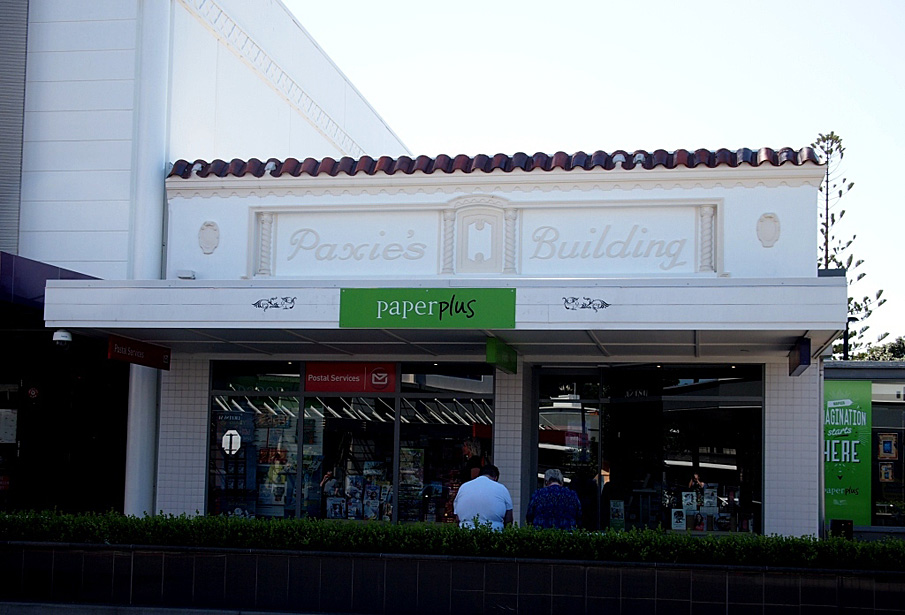
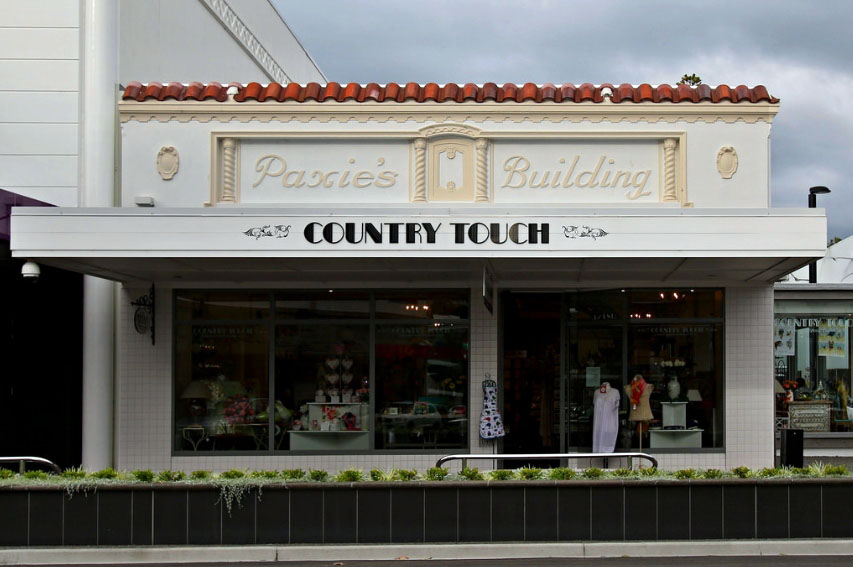
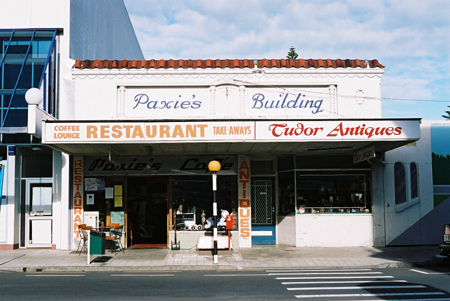
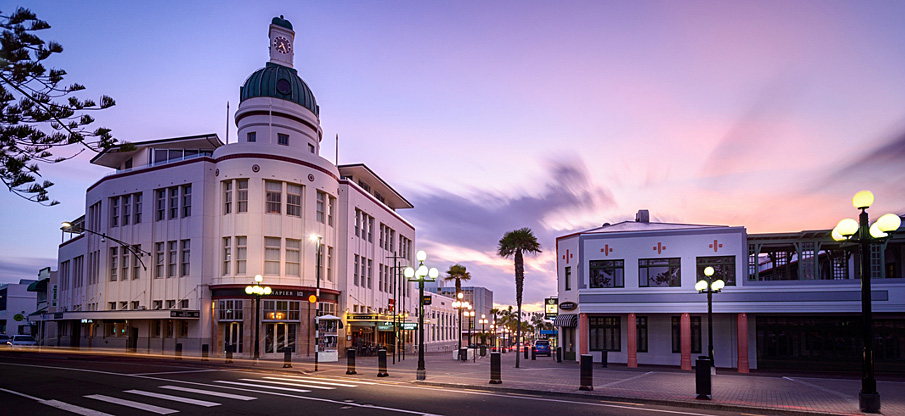
Paxie’s Building (1932), Hastings Street, forms part of the Napier City Centre Historic Area. The building is valued for its Spanish Mission style façade, which is adorned with the building’s name, motifs including barley twist columns, and a parapet capped with a horizontal band of Cordova Mission barrel tiles. It has historical significance for its association with the family of Andrew Paxie, a Greek immigrant who established the long-running business Paxie’s Cafe. Although extensively altered in the 2010s, the building still contributes to the streetscape through its scale and façade.
Napier is within the rohe of Ngāti Kahungunu, whose ancestors arrived in what is now known as Hawke’s Bay during the sixteenth century, and it is also within the area of interest of Ahuriri Hapū. Pākehā whalers, traders, and missionaries had arrived in the region by the 1830s, but it was the purchase of land by the government from 1851 and the founding of principal towns that spurred European settlement and the growth of the region’s economy. Napier was established by the government in 1855 and it remained Hawke’s Bay’s leading town until the early twentieth century. On 3 February 1931, a magnitude 7.8 earthquake and resulting fires led to the devastation of Napier and Hastings, and a death toll of 256. The city centre was rebuilt with improvements such as wider streets and underground power and telephone lines, and architects opted for art deco and Spanish Mission styles, the latter of which was characterised by smooth cream walls, tiled parapets, balconies, inlaid tiles, wrought iron, and baroque decoration.
The Spanish Mission style originated in the southwestern states of the USA and was introduced to New Zealand in the 1910s, with the earliest examples in Hawke’s Bay, perhaps due to the region’s warm and sunny climate. Promoted by cement manufacturers as suiting earthquake-proof reinforced concrete construction, the architectural partnership Finch and Westerholm was the style’s major exponent in Napier from 1931. In 1932 the firm designed a building for a Hastings Street section that had been purchased by Andrew Paxie in 1928. Around 1910, Paxie, originally known as Andreas Paxinou, migrated from Ithaca, Greece, following his brother, Arthur. He returned briefly to Ithaca in 1929 and married Polexeny (Pauline), then the family established a number of restaurants in Napier. The Suburban Land Co. Ltd constructed the building in 1932. The single storey building of reinforced concrete featured an asymmetrical shopfront and living quarters at the rear. Wunderlich patent steel panels lined the ceilings and verandah soffit, and the interior included concrete columns and beams, the latter with angled haunches.
Until 2006, the northern part of the building was occupied by Paxie’s Café, which was regarded as a ‘Napier institution’ and, in its early decades, ‘the leading restaurant in Napier’. The Paxie’s eight children worked alongside their parents, serving customers that ranged from governors general and prime ministers to artists and performers. The second part of the building was occupied by consecutive businesses, including a butcher shop. The building remained in the family’s possession until 2011, with Andrew and Pauline’s children operating Paxie’s Café (run by Nick Paxie from 1972-2006) and Tudor Antiques (run by Arthur Paxie from 1979-2010). The shopfront was altered in 1959 and repairs were undertaken in 1971 due to fire damage in the restaurant but, by the early 2000s, the building had deteriorated.
Following its sale, Paxie’s Building and its site underwent significant changes. In early 2012 the interior was gutted, a lean-to at the eastern end was demolished, and the remainder of the site was cleared. Development in 2013 included the construction of new shops adjoining Paxie’s Building and facing a pedestrian walkway linking Hastings Street and Marine Parade. It has since had various retail tenants and is currently (2024) occupied by BNZ. The walkway, built on a neighbouring site that was vacant since 1931, was named Paxie’s Lane in honour of the family.
Napier is within the rohe of Ngāti Kahungunu, whose ancestors arrived in what is now known as Hawke’s Bay during the sixteenth century, and it is also within the area of interest of Ahuriri Hapū. Pākehā whalers, traders, and missionaries had arrived in the region by the 1830s, but it was the purchase of land by the government from 1851 and the founding of principal towns that spurred European settlement and the growth of the region’s economy. Napier was established by the government in 1855 and it remained Hawke’s Bay’s leading town until the early twentieth century. On 3 February 1931, a magnitude 7.8 earthquake and resulting fires led to the devastation of Napier and Hastings, and a death toll of 256. The city centre was rebuilt with improvements such as wider streets and underground power and telephone lines, and architects opted for art deco and Spanish Mission styles, the latter of which was characterised by smooth cream walls, tiled parapets, balconies, inlaid tiles, wrought iron, and baroque decoration.
The Spanish Mission style originated in the southwestern states of the USA and was introduced to New Zealand in the 1910s, with the earliest examples in Hawke’s Bay, perhaps due to the region’s warm and sunny climate. Promoted by cement manufacturers as suiting earthquake-proof reinforced concrete construction, the architectural partnership Finch and Westerholm was the style’s major exponent in Napier from 1931. In 1932 the firm designed a building for a Hastings Street section that had been purchased by Andrew Paxie in 1928. Around 1910, Paxie, originally known as Andreas Paxinou, migrated from Ithaca, Greece, following his brother, Arthur. He returned briefly to Ithaca in 1929 and married Polexeny (Pauline), then the family established a number of restaurants in Napier. The Suburban Land Co. Ltd constructed the building in 1932. The single storey building of reinforced concrete featured an asymmetrical shopfront and living quarters at the rear. Wunderlich patent steel panels lined the ceilings and verandah soffit, and the interior included concrete columns and beams, the latter with angled haunches.
Until 2006, the northern part of the building was occupied by Paxie’s Café, which was regarded as a ‘Napier institution’ and, in its early decades, ‘the leading restaurant in Napier’. The Paxie’s eight children worked alongside their parents, serving customers that ranged from governors general and prime ministers to artists and performers. The second part of the building was occupied by consecutive businesses, including a butcher shop. The building remained in the family’s possession until 2011, with Andrew and Pauline’s children operating Paxie’s Café (run by Nick Paxie from 1972-2006) and Tudor Antiques (run by Arthur Paxie from 1979-2010). The shopfront was altered in 1959 and repairs were undertaken in 1971 due to fire damage in the restaurant but, by the early 2000s, the building had deteriorated.
Following its sale, Paxie’s Building and its site underwent significant changes. In early 2012 the interior was gutted, a lean-to at the eastern end was demolished, and the remainder of the site was cleared. Development in 2013 included the construction of new shops adjoining Paxie’s Building and facing a pedestrian walkway linking Hastings Street and Marine Parade. It has since had various retail tenants and is currently (2024) occupied by BNZ. The walkway, built on a neighbouring site that was vacant since 1931, was named Paxie’s Lane in honour of the family.