

Settlements were established by Māori in Hawke’s Bay between 1250 and 1300 AD, along the coast between Māhia to the north and Pōrangahau to the south, and along the inland rivers. Rangitāne ancestors arrived around the same time, settling in the Heretaunga area. With the migration into the region of Ngāti Kahungunu in the sixteenth century Rangitāne moved south to Tāmaki-nui-a-Rua (Dannevirke area) and Ngāti Kahungunu became the dominant tribal group in Hawke’s Bay . In the Central Hawke’s Bay area, Whātuma (now known as Lake Hātuma) was an important food-gathering area. The lake was renowned for eeling, and the stands of timber surrounding the lake provided an abundance of Kereru (wood pigeon). From the 1820s, Ngāti Kahungunu were attacked by tribes from the north and the west, who had traded with European settlers and acquired muskets. Ngāti Kahungunu moved to Māhia to escape the raids, only returning in the late 1830s just as European settlers started to arrive, attracted by the opportunities for farming in the area. The first flock of sheep arrived in Hawke’s Bay in 1849, and negotiations took place directly with Māori to lease land for agriculture. Large-scale sheep stations soon dominated the Central Hawke’s Bay landscape.
Settled by runholder Frederick Abbott in 1860, Waipawa was originally named Abbottsford after its founder; so called because Abbott founded the town next to a ford over the Tukituki River. Early settlers however preferred the Māori name, Waipawa, and the fledgling town, surrounded by rich pasture lands, became an important rural service centre throughout the late nineteenth century. By 1861 it already boasted a church, courthouse, survey office, and blacksmith, alongside four hotels, two stores, two butcher shops and a milkman. Ten years later there was a daily coach service between Napier, Waipawa and Waipukurau. Waipawa was ideally suited as a stopping place being situated at the junction of Middle Road and Te Aute Road.
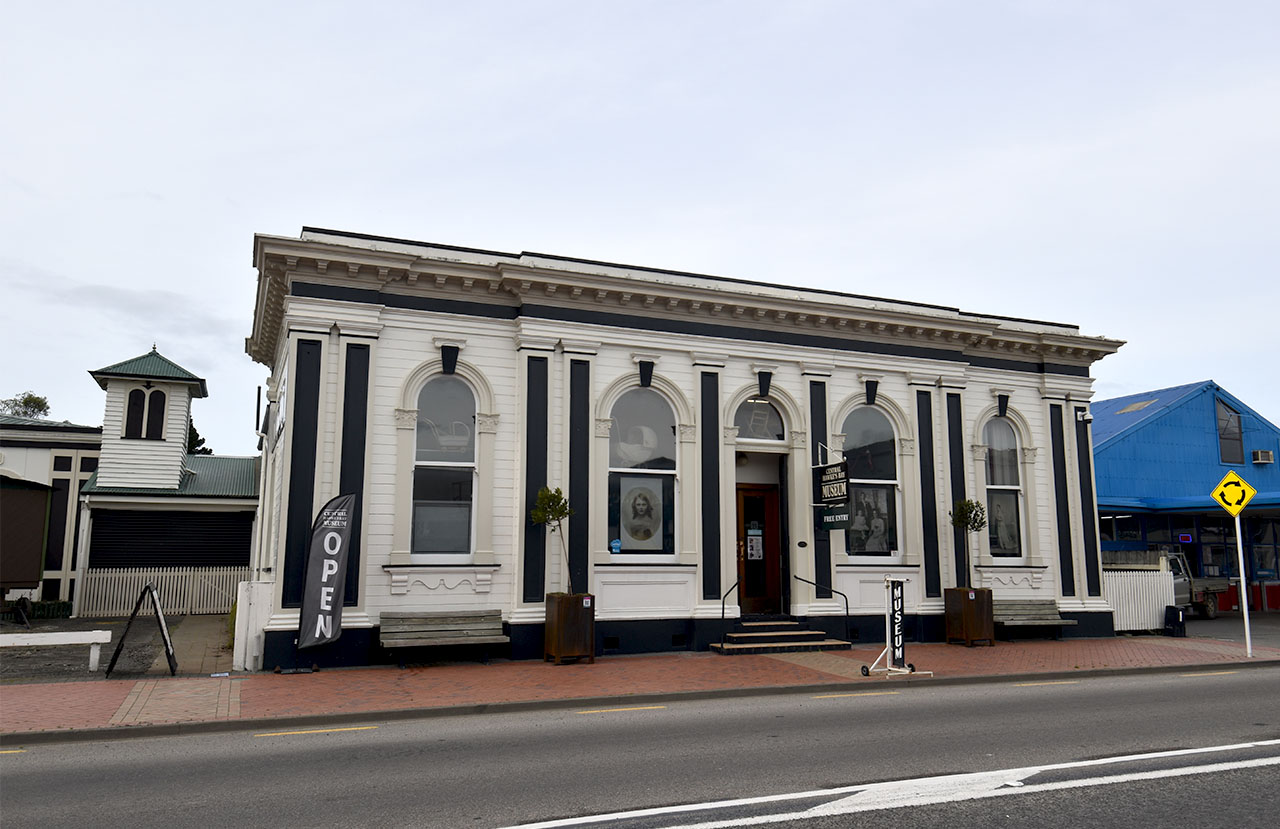
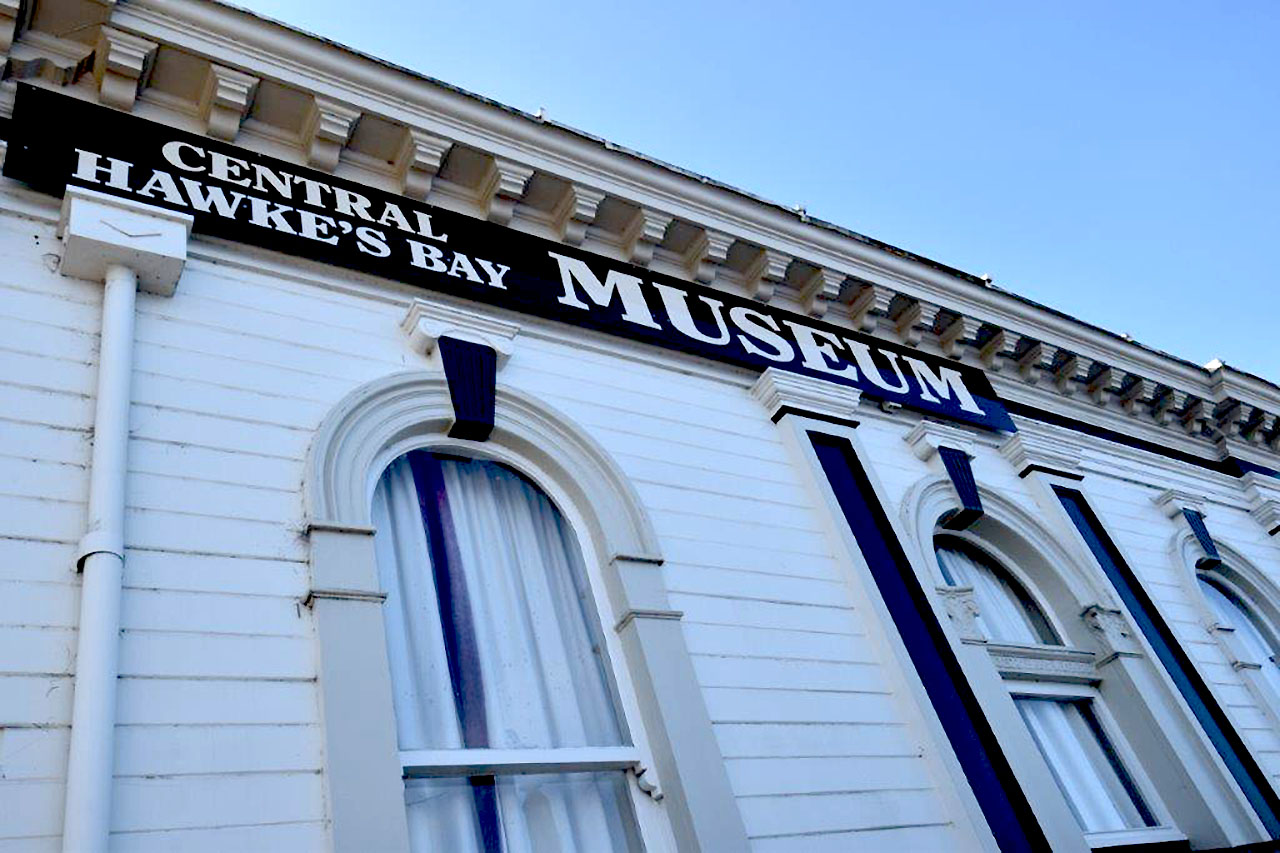
The Bank of New Zealand first opened a branch in Waipawa in June 1874, operating firstly from the bar of Cowper’s hotel, and then at Mr Rathbone’s store from 1 July 1874. In January 1886 a fire destroyed the bank building that had been constructed in 1882, and a replacement building was constructed in 1886, opening in January of 1887. This building, although somewhat altered internally since its construction, housed the bank until 1985. The design is typical of bank buildings of the time, featuring a symmetrical façade with a central entrance and arched windows framed by pilasters topped with Corinthian capitals. On its completion the building provided banking services at the front of the building, and accommodation for the bank manager at the rear.
The bank closed in 1985, and the building was sold to Waipawa District Council who gifted it to the people of Waipawa in 1986 to house a museum dedicated to the history of Central Hawke’s Bay.

List Entry Information
Status
Listed
List Entry Status
Historic Place Category 2
Access
Able to Visit
List Number
4843
Date Entered
27th November 1986
Date of Effect
27th November 1986
City/District Council
Central Hawke's Bay District
Region
Hawke's Bay Region
Extent of List Entry
Extent includes part of the land described as Pt Blk 46 Patangata CGD (RTs HB131/289, HBL3/547), Hawkes Bay Land District, and the building known as Museum (Former Bank of New Zealand) thereon. The extent does not include the outbuildings. Refer to the extent map tabled at the Rārangi Kōrero Committee meeting on 21 November 2024.
Legal description
Pt Blk 46 Patangata CGD (RTs HB131/289, HBL3/547), Hawkes Bay Land District
Status
Listed
List Entry Status
Historic Place Category 2
Access
Able to Visit
List Number
4843
Date Entered
27th November 1986
Date of Effect
27th November 1986
City/District Council
Central Hawke's Bay District
Region
Hawke's Bay Region
Extent of List Entry
Extent includes part of the land described as Pt Blk 46 Patangata CGD (RTs HB131/289, HBL3/547), Hawkes Bay Land District, and the building known as Museum (Former Bank of New Zealand) thereon. The extent does not include the outbuildings. Refer to the extent map tabled at the Rārangi Kōrero Committee meeting on 21 November 2024.
Legal description
Pt Blk 46 Patangata CGD (RTs HB131/289, HBL3/547), Hawkes Bay Land District
Construction Professional
Name
McConochie
Type
Builder
Biography
Construction Details
Start Year
1886
Finish Year
1887
Type
Original Construction
Start Year
1930
Type
Additional building added to site
Description
Outbuilding in brick consisting of washhouse, Garage, W.C., woodshed and book store room
Start Year
1931
Finish Year
1932
Type
Maintenance/repairs
Description
Earthquake damage – reinstatement of premises, verandah and sleeping porch; electric light; central heating; papering and repairs
Start Year
1948
Type
Maintenance/repairs
Description
Interior remodelling
Start Year
1966
Finish Year
1967
Type
Refurbishment/renovation
Description
Interior remodelling
Construction Professional
Name
McConochie
Type
Builder
Biography
Construction Details
Start Year
1886
Finish Year
1887
Type
Original Construction
Start Year
1930
Type
Additional building added to site
Description
Outbuilding in brick consisting of washhouse, Garage, W.C., woodshed and book store room
Start Year
1931
Finish Year
1932
Type
Maintenance/repairs
Description
Earthquake damage – reinstatement of premises, verandah and sleeping porch; electric light; central heating; papering and repairs
Start Year
1948
Type
Maintenance/repairs
Description
Interior remodelling
Start Year
1966
Finish Year
1967
Type
Refurbishment/renovation
Description
Interior remodelling
Historical and Associated Iwi / Hapū / Whānau
Completion Date
20th November 2024
Report Written By
Anna Renton-Green
Information Sources
Lowrie, 1974
Meryl Lowrie, ‘Waipawa and the Bank of New Zealand’, BNZ Archives, 1974 (held at BNZ Archives https://www.bnz.co.nz/about-us/heritage )
Other Information
A fully referenced copy of the summary upgrade report is available upon request from the Central Regional Office of Heritage New Zealand Pouhere Taonga. This place was identified as significant under previous legislation with different information requirements. It remains significant under the current legislation. There is opportunity under our legislation and policies to add to this information. Further information about this place may be available from the Central Regional Office of Heritage New Zealand Pouhere Taonga. Please note that entry on the New Zealand Heritage List/Rārangi Kōrero identifies only the heritage values of the property concerned and should not be construed as advice on the state of the property, or as a comment of its soundness or safety, including in regard to earthquake risk, safety in the event of fire, or insanitary conditions.
Historical and Associated Iwi / Hapū / Whānau
Completion Date
20th November 2024
Report Written By
Anna Renton-Green
Information Sources
Lowrie, 1974
Meryl Lowrie, ‘Waipawa and the Bank of New Zealand’, BNZ Archives, 1974 (held at BNZ Archives https://www.bnz.co.nz/about-us/heritage )
Other Information
A fully referenced copy of the summary upgrade report is available upon request from the Central Regional Office of Heritage New Zealand Pouhere Taonga. This place was identified as significant under previous legislation with different information requirements. It remains significant under the current legislation. There is opportunity under our legislation and policies to add to this information. Further information about this place may be available from the Central Regional Office of Heritage New Zealand Pouhere Taonga. Please note that entry on the New Zealand Heritage List/Rārangi Kōrero identifies only the heritage values of the property concerned and should not be construed as advice on the state of the property, or as a comment of its soundness or safety, including in regard to earthquake risk, safety in the event of fire, or insanitary conditions.
Current Usages
Uses: Civic Facilities
Specific Usage: Museum
Former Usages
General Usage: Finance
Specific Usage: Bank
Current Usages
Uses: Civic Facilities
Specific Usage: Museum
Former Usages
General Usage: Finance
Specific Usage: Bank
Location
Sign up to hear more
Get the latest heritage news, features and events delivered
straight to your inbox.
