List Entry Information
Status
Listed
List Entry Status
Historic Place Category 1
Access
Private/No Public Access
List Number
4980
Date Entered
21st September 1989
Date of Effect
21st September 1989
City/District Council
Napier City
Region
Hawke's Bay Region
Legal description
Lots 1 & 2 DP 6051 TS 117-120
Status
Listed
List Entry Status
Historic Place Category 1
Access
Private/No Public Access
List Number
4980
Date Entered
21st September 1989
Date of Effect
21st September 1989
City/District Council
Napier City
Region
Hawke's Bay Region
Legal description
Lots 1 & 2 DP 6051 TS 117-120
Why is this place significant?
Historic Significance
Historical Significance or Value This historic place was registered under the Historic Places Act 1980. This report includes the text from the original Building Classification Committee report considered by the NZHPT Board at the time of registration. The present Municipal Theatre replaced the original theatre of 1912 which was destroyed in the 1931 earthquake. Money and effort in the period immediately after the earthquake was devoted to restoring essential services and rebuilding commercial properties. Entertainment had a low priority. However, in September 1935 J.A. Louis Hay put forward an amended design for a new theatre. At the height of the Depression the Council estimated that only £15,000 could be spent on such a project, and they rejected Hay's design in favour of J.T. Watson's more practical and less ornate concept. The foundation stone was laid on 24 November 1937, by which time building costs had increased. In June 1938, the theatre was completed at a cost of £8000 above the 1935 estimate.
Physical Significance
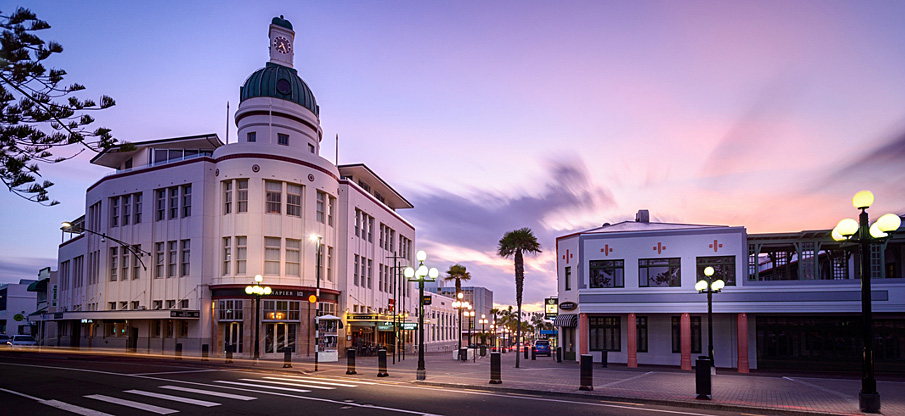
This historic place was registered under the Historic Places Act 1980. This report includes the text from the original Building Classification Committee report considered by the NZHPT Board at the time of registration. ARCHITECTURAL SIGNIFICANCE: The Municipal Theatre is a characteristic example of an archetypal Art Deco building - the theatre. Designs for amusement and entertainment houses in Europe and America allowed architects to indulge theatrical fantasies which created prototypes for more mundane building during the heyday of Art Deco. Interior design in these theatre buildings was as important as architectural structure. Radio City Music Hall (1932) in New York, for example, incorporated elements which celebrated modern materials and new technology; electric lights were shaped as torches, the handles of the main doors formed a chevron motif. These same features are repeated on the Municipal Theatre, Napier, and there is evidence of a concern to create a "streamlined" effect. Streamlining was the greatest stylistic innovation of the Depression era, and it is a strong feature of the interior of the Municipal Theatre. There are dynamic curving lines, and leaping naked female forms surrounded by swirls of drapery done in plaster, and the foyer has coloured neon lights which are indebted for their form to the aesthetics of the automobile. This theme is continued in the curved walnut-veneer ticket box (like a dashboard in a vehicle) and the lavish use of chromium-plated steel which extends in lines from wall lights in the auditorium and also features around the circle in the auditorium. Typical of the Art Deco celebration of new technology are the lighting fixtures which are an integral part of the decorative scheme. The auditorium is flood-lit by coloured lights from a central dome, and from this, stretched to the four points of a compass, project the raised linear panels with geometrically-shaped light fittings. Watson has used sandblasted glass for layered light fittings; the type of glass popularised by A.B. Young in the Troughton and Young building (1930-32) London, and featured extensively in British Vogue magazine during the period 1930-1939. In his combination of modern external architectural features with an integrated internal decoration scheme, Watson has created an exemplary Art Deco theatre building closely linked to European and American theatre designs of the time which sought to integrate the fine and decorative arts. TOWNSCAPE/LANDMARK SIGNIFICANCE: The monumental scale and impressive façade of the Municipal Theatre create an impressive streetscape on one of the principal routes to the Marine Parade. Its three massive arched windows on the upper storey relate well to the three arched openings at the nearby Desco building (old Napier Fire Station (1921) remodelled by J.A. Louis Hay in 1931.
Why is this place significant?
Historic Significance
Historical Significance or Value This historic place was registered under the Historic Places Act 1980. This report includes the text from the original Building Classification Committee report considered by the NZHPT Board at the time of registration. The present Municipal Theatre replaced the original theatre of 1912 which was destroyed in the 1931 earthquake. Money and effort in the period immediately after the earthquake was devoted to restoring essential services and rebuilding commercial properties. Entertainment had a low priority. However, in September 1935 J.A. Louis Hay put forward an amended design for a new theatre. At the height of the Depression the Council estimated that only £15,000 could be spent on such a project, and they rejected Hay's design in favour of J.T. Watson's more practical and less ornate concept. The foundation stone was laid on 24 November 1937, by which time building costs had increased. In June 1938, the theatre was completed at a cost of £8000 above the 1935 estimate.
Physical Significance
This historic place was registered under the Historic Places Act 1980. This report includes the text from the original Building Classification Committee report considered by the NZHPT Board at the time of registration. ARCHITECTURAL SIGNIFICANCE: The Municipal Theatre is a characteristic example of an archetypal Art Deco building - the theatre. Designs for amusement and entertainment houses in Europe and America allowed architects to indulge theatrical fantasies which created prototypes for more mundane building during the heyday of Art Deco. Interior design in these theatre buildings was as important as architectural structure. Radio City Music Hall (1932) in New York, for example, incorporated elements which celebrated modern materials and new technology; electric lights were shaped as torches, the handles of the main doors formed a chevron motif. These same features are repeated on the Municipal Theatre, Napier, and there is evidence of a concern to create a "streamlined" effect. Streamlining was the greatest stylistic innovation of the Depression era, and it is a strong feature of the interior of the Municipal Theatre. There are dynamic curving lines, and leaping naked female forms surrounded by swirls of drapery done in plaster, and the foyer has coloured neon lights which are indebted for their form to the aesthetics of the automobile. This theme is continued in the curved walnut-veneer ticket box (like a dashboard in a vehicle) and the lavish use of chromium-plated steel which extends in lines from wall lights in the auditorium and also features around the circle in the auditorium. Typical of the Art Deco celebration of new technology are the lighting fixtures which are an integral part of the decorative scheme. The auditorium is flood-lit by coloured lights from a central dome, and from this, stretched to the four points of a compass, project the raised linear panels with geometrically-shaped light fittings. Watson has used sandblasted glass for layered light fittings; the type of glass popularised by A.B. Young in the Troughton and Young building (1930-32) London, and featured extensively in British Vogue magazine during the period 1930-1939. In his combination of modern external architectural features with an integrated internal decoration scheme, Watson has created an exemplary Art Deco theatre building closely linked to European and American theatre designs of the time which sought to integrate the fine and decorative arts. TOWNSCAPE/LANDMARK SIGNIFICANCE: The monumental scale and impressive façade of the Municipal Theatre create an impressive streetscape on one of the principal routes to the Marine Parade. Its three massive arched windows on the upper storey relate well to the three arched openings at the nearby Desco building (old Napier Fire Station (1921) remodelled by J.A. Louis Hay in 1931.
Construction Professional
Name
Watson, John Thomas
Type
Architect
Biography
Watson was born in Hull, England, and worked on the construction of the Rand goldmines in South Africa before coming to New Zealand in 1905. He practised architecture in Greymouth, Masterton and Wellington before moving to Napier in 1932. In Masterton he was responsible for the design of the Soldiers' Wing at Masterton Hospital (1918) and in Wellington for the Wellington Show Association Buildings (1927) while working as an architect for the Edwards Construction Company. Initially he practised privately in Napier, but in 1935 he was pointed Borough Architect and designed the Memorial Colonnade (1937), New Napier Arch (1937), the Sound Shell and the Municipal Theatre (1937). In 1955 Watson retired to resume private practice. He then designed the Power Board building, Marewa (1956), the Napier Boys' High School Memorial Gateway (1960) and also had a role in the design of extensions to Napier Girls' High School and the construction of the Napier Airport Terminal Building.
Construction Details
Start Year
1937
Finish Year
1938
Type
Original Construction
Description
Art Deco; Foundation stone laid 24 November 1937; Building opened June 1938
Start Year
1965
Type
Modification
Description
Orchestra well enlarged
Start Year
1965
Type
Modification
Description
Emergency lighting installed
Start Year
1967
Type
Modification
Description
Alterations to sweet shop entrance
Start Year
1979
Type
Modification
Description
Alterations to sweet shop, including widening of entry doors
Start Year
1981
Type
Modification
Description
Upgrading of stage extension
Construction Materials
Concrete columns and beams with infill panels partly concrete and partly brick.
Notable Features
Exterior - "Torch" light fixtures Interior - Female forms in plasterwork Sand-blasted glass light fittings Ticket-box in foyer
Construction Professional
Name
Watson, John Thomas
Type
Architect
Biography
Watson was born in Hull, England, and worked on the construction of the Rand goldmines in South Africa before coming to New Zealand in 1905. He practised architecture in Greymouth, Masterton and Wellington before moving to Napier in 1932. In Masterton he was responsible for the design of the Soldiers' Wing at Masterton Hospital (1918) and in Wellington for the Wellington Show Association Buildings (1927) while working as an architect for the Edwards Construction Company. Initially he practised privately in Napier, but in 1935 he was pointed Borough Architect and designed the Memorial Colonnade (1937), New Napier Arch (1937), the Sound Shell and the Municipal Theatre (1937). In 1955 Watson retired to resume private practice. He then designed the Power Board building, Marewa (1956), the Napier Boys' High School Memorial Gateway (1960) and also had a role in the design of extensions to Napier Girls' High School and the construction of the Napier Airport Terminal Building.
Construction Details
Start Year
1937
Finish Year
1938
Type
Original Construction
Description
Art Deco; Foundation stone laid 24 November 1937; Building opened June 1938
Start Year
1965
Type
Modification
Description
Orchestra well enlarged
Start Year
1965
Type
Modification
Description
Emergency lighting installed
Start Year
1967
Type
Modification
Description
Alterations to sweet shop entrance
Start Year
1979
Type
Modification
Description
Alterations to sweet shop, including widening of entry doors
Start Year
1981
Type
Modification
Description
Upgrading of stage extension
Construction Materials
Concrete columns and beams with infill panels partly concrete and partly brick.
Notable Features
Exterior - "Torch" light fixtures Interior - Female forms in plasterwork Sand-blasted glass light fittings Ticket-box in foyer
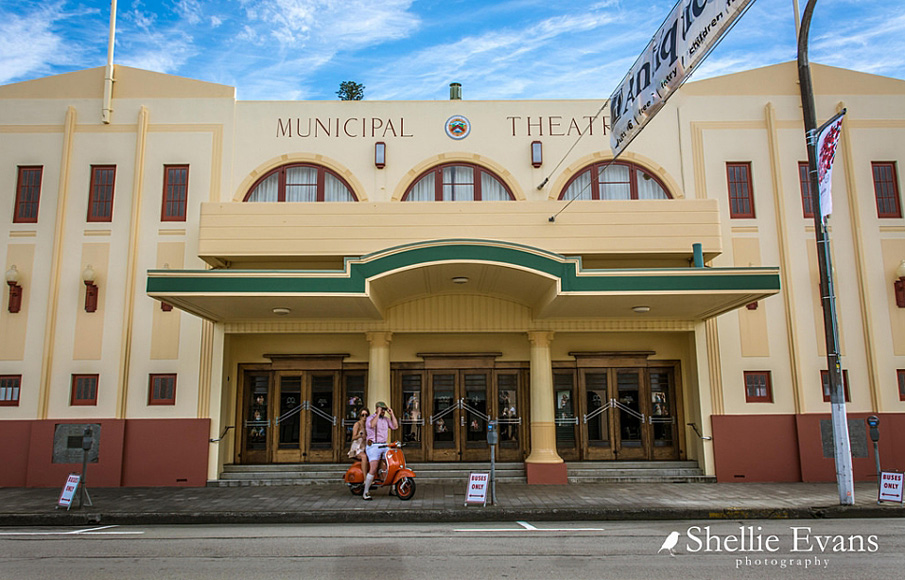
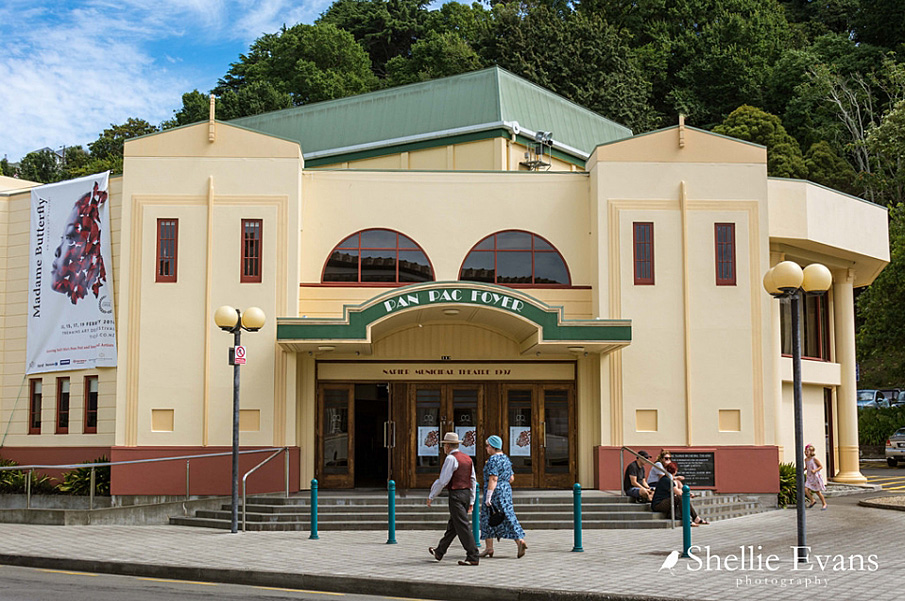
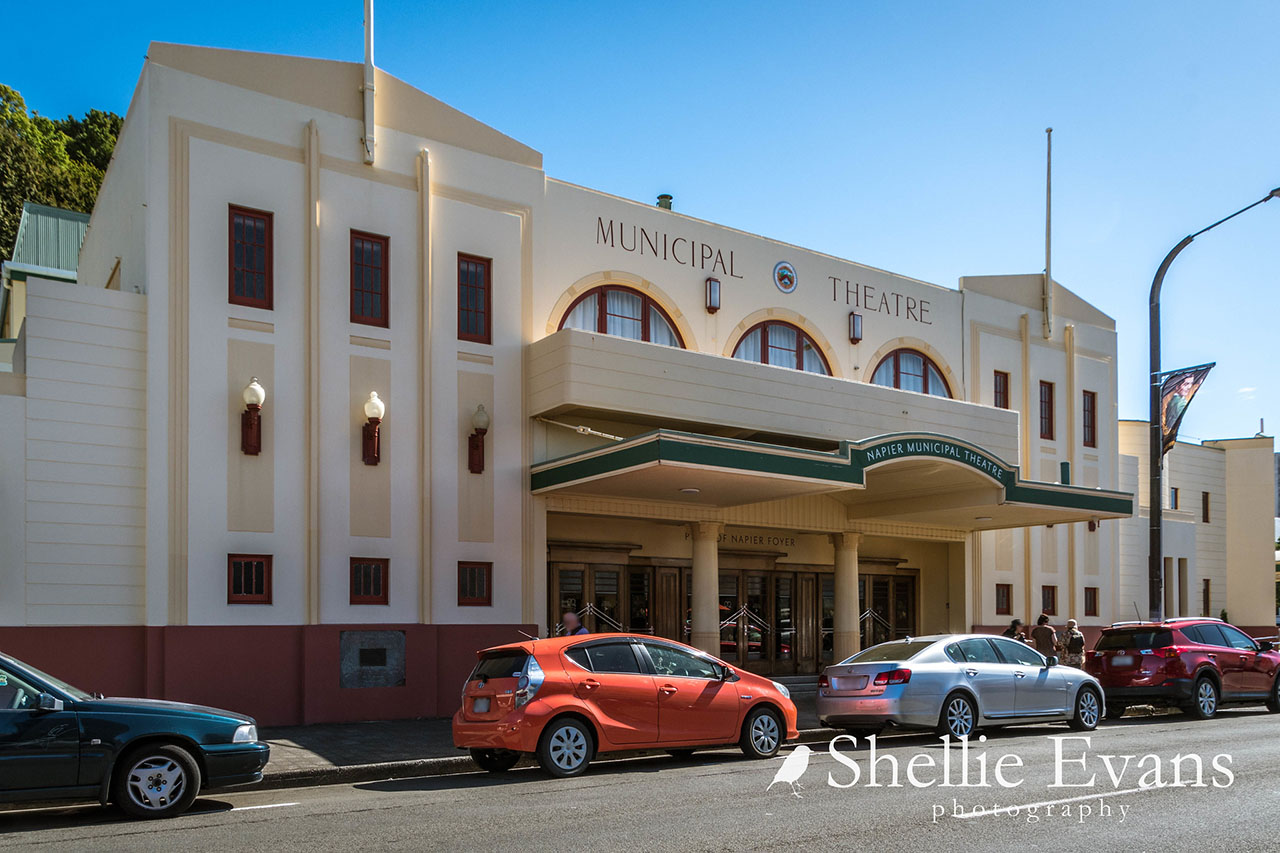
This historic place was registered under the Historic Places Act 1980. This report includes the text from the original Building Classification Committee report considered by the NZHPT Board at the time of registration. ARCHITECTURAL DESCRIPTION (STYLE): Typical Art Deco theatre design with an emphatic entrance marked by massive columns and extended awnings. Arcuated window openings feature on the upper level and the central bay is flanked by two wings which have pedimented gables with flagpoles at the centre breaking above the horizontal roofline.
This historic place was registered under the Historic Places Act 1980. This report includes the text from the original Building Classification Committee report considered by the NZHPT Board at the time of registration. ARCHITECTURAL DESCRIPTION (STYLE): Typical Art Deco theatre design with an emphatic entrance marked by massive columns and extended awnings. Arcuated window openings feature on the upper level and the central bay is flanked by two wings which have pedimented gables with flagpoles at the centre breaking above the horizontal roofline.
Historical and Associated Iwi / Hapū / Whānau
Completion Date
18th April 1989
Information Sources
Alexander Turnbull Library
Alexander Turnbull Library, Wellington
Campbell, 1975
M. D. N. Campbell, Story of Napier, 1874-1974; Footprints Along the Shore
Daily Telegraph
Daily Telegraph
Ives, 1982
Heather Ives, The Art Deco Architecture of Napier, Napier, 1982
Shaw, 1987
Shaw, Peter and Peter Hallett. Art Deco Napier: Styles of the Thirties, Reed Methuen, Auckland, 1987.
Other Information
A copy of this report is available from the NZHPT Central region office Please note that entry on the New Zealand Heritage List/Rarangi Korero identifies only the heritage values of the property concerned, and should not be construed as advice on the state of the property, or as a comment of its soundness or safety, including in regard to earthquake risk, safety in the event of fire, or insanitary conditions.
Historical and Associated Iwi / Hapū / Whānau
Completion Date
18th April 1989
Information Sources
Alexander Turnbull Library
Alexander Turnbull Library, Wellington
Campbell, 1975
M. D. N. Campbell, Story of Napier, 1874-1974; Footprints Along the Shore
Daily Telegraph
Daily Telegraph
Ives, 1982
Heather Ives, The Art Deco Architecture of Napier, Napier, 1982
Shaw, 1987
Shaw, Peter and Peter Hallett. Art Deco Napier: Styles of the Thirties, Reed Methuen, Auckland, 1987.
Other Information
A copy of this report is available from the NZHPT Central region office Please note that entry on the New Zealand Heritage List/Rarangi Korero identifies only the heritage values of the property concerned, and should not be construed as advice on the state of the property, or as a comment of its soundness or safety, including in regard to earthquake risk, safety in the event of fire, or insanitary conditions.
Current Usages
Uses: Civic Facilities
Specific Usage: Opera House
Uses: Civic Facilities
Specific Usage: Theatre
Web Links
description:
Current Usages
Uses: Civic Facilities
Specific Usage: Opera House
Uses: Civic Facilities
Specific Usage: Theatre
Web Links
description: