DonateSupporterVisit Heritage
  • Tūrangawaewae
    Places
  • Tira Māori
    Māori Heritage
  • Poutairangahia
    Archaeology
  • Rauemi
    Resources
  • Mō Tātou
    About Us
  • New Zealand Heritage List
  • Nominate and submit
  • Explore the List
  • National Historic Landmarks
  • Plaques
  • Rainbow List Project
  • Lost heritage
  • Visit Heritage
  • Our properties
  • Turnbull House Project
  • Collections
  • Shop
  • Tohu Whenua
  • Tira Māori
  • Conserving Māori heritage
  • Marae built heritage
  • Māori heritage on the List
  • Hinemihi—Te Hokinga Mai
  • What is archaeology?
  • Is there a site on my property?
  • What are my legal requirements?
  • Affecting an archaeological site
  • Declaring an archaeological site
  • Archaeology FAQs
  • Archaeology Digital Library
  • Archaeology guidelines and templates
  • Resources
  • Funding
  • Publications
  • Sustainable management guides
  • Disaster recovery
  • Podcasts & digital resources
  • Education Hub
  • Conservation plans
  • About
  • Board
  • Māori Heritage Council
  • Senior Staff
  • Offices
  • Contact us
  • Careers
  • Covenants
  • Fast-track
  • Corporate documents
  • Currently consulting on
  • Our submissions
  • News
Quick links
Rārangi Kōrero | The List
Explore the List
National Historic Landmarks
Ngā Manawhenua o Aotearoa me ōna Kōrero Tūturu
Quick links
Tapuwae
A Vision for Places of Māori Heritage
Funding for Māori Heritage
Resources
Quick links
Archaeological Authority Portal
Applying for an archaeological authority
Archaeology FAQs
Browse the most frequently asked questions about archaeological authorities and the archaeological process.
Quick links
Quick links
Contact us
Offices
DonateSupporterVisit Heritage
  • Tūrangawaewae
    Places
  • Tira Māori
    Māori Heritage
  • Poutairangahia
    Archaeology
  • Rauemi
    Resources
  • Mō Tātou
    About Us
  • New Zealand Heritage List
  • Nominate and submit
  • Explore the List
  • National Historic Landmarks
  • Plaques
  • Rainbow List Project
  • Lost heritage
  • Visit Heritage
  • Our properties
  • Turnbull House Project
  • Collections
  • Shop
  • Tohu Whenua
  • Tira Māori
  • Conserving Māori heritage
  • Marae built heritage
  • Māori heritage on the List
  • Hinemihi—Te Hokinga Mai
  • What is archaeology?
  • Is there a site on my property?
  • What are my legal requirements?
  • Affecting an archaeological site
  • Declaring an archaeological site
  • Archaeology FAQs
  • Archaeology Digital Library
  • Archaeology guidelines and templates
  • Resources
  • Funding
  • Publications
  • Sustainable management guides
  • Disaster recovery
  • Podcasts & digital resources
  • Education Hub
  • Conservation plans
  • About
  • Board
  • Māori Heritage Council
  • Senior Staff
  • Offices
  • Contact us
  • Careers
  • Covenants
  • Fast-track
  • Corporate documents
  • Currently consulting on
  • Our submissions
  • News
Quick links
Rārangi Kōrero | The List
Explore the List
National Historic Landmarks
Ngā Manawhenua o Aotearoa me ōna Kōrero Tūturu
Quick links
Tapuwae
A Vision for Places of Māori Heritage
Funding for Māori Heritage
Resources
Quick links
Archaeological Authority Portal
Applying for an archaeological authority
Archaeology FAQs
Browse the most frequently asked questions about archaeological authorities and the archaeological process.
Quick links
Quick links
Contact us
Offices
  • Places
  • Nominate and submit
  • National Historic Landmarks
  • Places
  • Nominate and submit
  • National Historic Landmarks
  • Tira Māori
  • Conserving Māori heritage
  • Marae built heritage
  • Tira Māori
  • Conserving Māori heritage
  • Marae built heritage
  • Archaeological authorities
  • Archaeology Digital Library
  • Archaeological authorities
  • Archaeology Digital Library
  • All resources
  • Publications
  • Funding
  • All resources
  • Publications
  • Funding
  • FAQs
  • FAQs
Follow us on:
Places
  • Places
  • Nominate and submit
  • National Historic Landmarks
Tira Māori
  • Tira Māori
  • Conserving Māori heritage
  • Marae built heritage
Archaeology
  • Archaeological authorities
  • Archaeology Digital Library
Resources
  • All resources
  • Publications
  • Funding
FAQs
  • FAQs
Follow us on
HomePrivacyTerms and conditionsAbout this site
© Heritage New Zealand Pouhere Taonga 2026.
 
Blackball Coal Mine Chimneys

Roa Road, BLACKBALL

Public

Historic Place Category 1

List No. 5005

Quick links:
List GalleryLocationDetails
The Blackball Coal Mine Chimneys, built between the 1890s and the first decade of the twentieth century, are a tangible reminder of the major coal mine which supported the settlement of Blackball and of the importance of coal mining to the West Coast as a whole. There were [four] chimneys, two which served the boilers, and [two] mine ventilation chimneys. The smaller of the two boiler chimneys collapsed in 2014 but its footprint remains included in the extent of the List entry.

Early History in Te Tai o Poutini
Te Tai o Poutini features prominently in the early Māori history of occupation in Aotearoa/New Zealand and is named after Poutini, the taniwha who accompanied Ngahue on his voyage from Hawaiiki. Poutini is also rendered as the taniwha who abducted Tamaahua's wife Waitaiki and turned her to pounamu, and who swims along the coastline protecting people and pounamu. The regions rich geological resources were investigated and utilised for centuries prior to the arrival of Pākehā. During these centuries, travel pathways were created by successive generations, relying on cumulative mātauranga (knowledge) to successfully navigate the landscape. Geographic features such as mountains, rivers and ranges were given names attributed to memorialise people, events, resources or physical characteristics. Nohoanga, mahinga kai and mahinga toi were dotted along rivers and plains along with inland kainga at Ohinetaketake near Ahaura, Takataka and Te Kainga at Kotukuwhakaoko (Lake Brunner), although the majority of kainga were located on the coastline and mostly within a day's walking distance of each other. When Pākehā began arriving in the area in the mid-19th century, Ngāti Waewae played a key role in assisting the visitors and newcomers with surveying and exploration.

Gold had been found in Blackball Creek as early as 1865, but it was not until November 1890 that coal was discovered by the Blackball Coal Company which had been established to supply an English shipping line with fuel for its ships. Quartz mining began in the area at about the same time, but it was the mining of coal that fostered the growth of Blackball township. The mine was nationalised in 1940 but on 24 September 1964 it closed.

There were two different types of chimneys at the mine – two boiler house chimneys located on a sharp steep ridge just to the east of the Return Air Vent and Fan Chamber (List No. 5006) and, much further to the north, now surrounded by forest in steep country and difficult to get to, were [two] ventilation chimneys. [The] ventilation chimneys are recorded archaeological sites (K31/93 square chimney and K31/94 round chimney).

Boiler house Chimneys:
There are two boiler house chimneys. It would appear that the smaller structure had been built first and was left standing after it had been supplanted by the taller chimney first decade of the twentieth century. The shorter chimney was rectangular with an arched base and corbelled lip. It stood in front of a tapered circular chimney with a corbelled lip and is approximately four times higher than its rectangular counterpart. These two chimneys were formerly linked by a brick flue to the boiler house which was located at the base of the ridge on which the chimneys stand. By this means the effective height of the chimneys was significantly increased without unduly increasing the height of the freestanding chimney structure. Of the two boiler house chimneys, the shorter and older of the pair collapsed in 2014. However, the tall round boiler house chimney remains and was strengthened and repaired in 2020 and 2021.

Mine Ventilation Chimneys:
A Geological Map of Mawheranui & Brunner Survey Districts, 1911 shows [two] ‘vent chimneys’ located at the north of the mine site, towards Blackball Creek. The chimneys stand approximately one hundred metres apart and they worked by drawing foul air out of the mine drives after fires had been lit beneath them. One ventilation chimney (1897-9) is circular in shape and is made up of an estimated fifty thousand wedge-shaped bricks. This chimney could displace thirteen thousand cubic feet of air per minute and stands approximately fourteen metres above ground, extending a further eleven metres below ground. The chimney has an opening in one side of it at ground level and, like the other chimneys, has a corbelled lip.

[The other] ventilation chimney (1895-6) stands downstream of the first and is about twenty metres high, with a further six metres below ground. Designed to displace thirty thousand cubic feet of air per minute, this chimney has an arched firebox, carved from sandstone and lined with bricks, which extends for approximately five metres from the base of the chimney to the mine drive beyond. A narrow passage running adjacent to the firebox provides access to it via a low doorway beside the chimney.

Details of the third ventilation chimney are not clear.
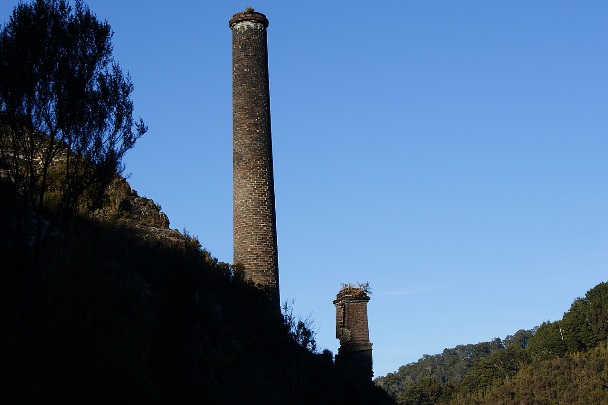
Blackball Coal Mine Chimneys, Blackball. Image courtesy of www.flickr.com | Hugh McCall – Braxholm | Hugh McCall

List Entry Information

Overview

Status
Listed

List Entry Status
Historic Place Category 1

Access
Able to Visit

List Number
5005

Date Entered
28th June 1990

Date of Effect
28th June 1990

City/District Council
Grey District

Region
West Coast Region

Extent of List Entry

Extent includes part of the land described as Pt RS 4979 (NZ Gazette 2008, p.2527) and RS 5111 (SO 5974), Westland Land District structures known as Blackball Coal Mine Chimneys thereon. Refer to extent map tabled at the RKC meeting 29 July 2021.

Legal description

Pt RS 4979 (NZ Gazette 2008, p.2527) and RS 5111 (SO 5974), Westland Land District

Detailed List Entry
Significance

Historic Significance

Historical Significance or Value The Blackball Mine chimneys are a visible reminder of the major coal mine which supported the settlement of Blackball and of the importance of coal mining to the West Coast as a whole.

Physical Significance

ARCHITECTURAL QUALITY: Constructed of bricks manufactured at the Brunner Industrial site, the Blackball mine chimneys are virtually all that visibly remains of a mine which flourished for over seventy years. In both design and function they were probably modelled on similar structures built on the British coalfields from whence many of the Blackball coal miners had come. These are large industrial chimneys and are impressive examples of construction in brick. TOWNSCAPE/LANDMARK VALUE: The boiler house chimneys are prominent landscape features above the site of the former Blackball mine. The ventilation chimneys are now largely concealed by secondary growth beech forest.

Construction Professional

Name

Moore, Martin

Type

Architect

Biography

Martin Moore (b.1858) was born in Australia and came to New Zealand with his parents at the age of ten. After being educated at Brunnerton, Moore worked at the Dispatch Foundry in Greymouth and then at the quartz mines in Reefton. In the early 1880s he worked at a number of Grey County coal mines before joining the Blackball Coal Company as mine engineer when it commenced operations in 1890.

Construction Details

Start Year

2014

Finish Year

2014

Type

Damaged

Description

small square Boiler House chimney collapsed

Start Year

1902

Type

Original Construction

Description

small square Boiler House Chimney

Start Year

1907

Finish Year

1908

Type

Original Construction

Description

Tall round Boiler House Chimney

Start Year

2020

Finish Year

2021

Type

Maintenance/repairs

Description

strengthening and repair of surviving Boiler House chimney

Start Year

1896

Type

Modification

Description

Square chimney heightened

Start Year

1899

Type

Modification

Description

Section of round chimney above ground, originally built of wood, rebuilt in brick.

Start Year

1984

Type

Modification

Description

Flue structure to boilerhouse removed

Start Year

1895

Finish Year

1899

Type

Original Construction

Description

Mine ventilation Chimneys

Construction Materials

Brunner bricks.

Physical Description

This historic place was registered under the Historic Places Act 1980. The following text is the original citation considered by the NZHPT Board at the time of registration. Information in square brackets indicate modifications made after the paper was considered by the Board. ARCHITECTURAL DESCRIPTION: There are four chimneys on the site of the former Blackball Coal Mine. Two stand on the hillside above the mine entrance where they served the boiler house which generated steam for the winches and winding gear used in the mine. The two other chimneys stand on the opposite side of the hill from the mine entrance, overlooking Blackball Creek, where they were part of the mine ventilation system. [One of the chimneys collapsed in 2014]. Boiler house Chimneys: The smaller of these is rectangular with an arched base and corbelled lip. It stands in front of a tapered circular chimney which also has a corbelled lip and is approximately four times higher than its rectangular counterpart. It would appear that the smaller structure was built first and was left standing after it had been supplanted by the taller chimney (c.1903). These two chimneys were formerly linked by a brick flue to the boiler house which was located at the base of the ridge on which the chimneys stand. By this means the effective height of the chimneys was significantly increased without unduly increasing the height of the freestanding chimney structure. Mine Ventilation Chimneys: The chimneys stand approximately one hundred metres apart and they worked by drawing foul air out of the mine drives after fires had been lit beneath them. The smaller of the two (1897-9) is circular in shape and is made up of an estimated fifty thousand wedge-shaped bricks. This chimney could displace thirteen thousand cubic feet of air per minute and stands approximately fourteen metres above ground, extending a further eleven metres below ground. The chimney has an opening in one side of it at ground level and, like the other chimneys, has a corbelled lip. The second ventilation chimney (1895-6) stands downstream of the first and is about twenty metres high, with a further six metres below ground. Designed to displace thirty thousand cubic feet of air per minute, this chimney has an arched firebox, carved from sandstone and lined with bricks, which extends for approximately five metres from the base of the chimney to the mine drive beyond. A narrow passage running adjacent to the firebox provides access to it via a low doorway beside the chimney. MODIFICATIONS: c.1984 - Flue structure to boiler house removed. 1896 - Square chimney heightened. 1899 - Section of round chimney above ground, originally built of wood, rebuilt in brick.

Reference

Completion Date

24th June 2021

Report Written By

Robyn Burgess

Information Sources

Appendices to the Journals of the House of Representatives (AJHR)

Appendices to the Journals of the House of Representatives

Cyclopedia of New Zealand, 1906

Cyclopedia Company, Industrial, descriptive, historical, biographical facts, figures, illustrations, Wellington, N.Z, 1897-1908, Vol. 5, Nelson, Marlborough, Westland, 1906

Eastwood, 1982

D. Eastwood, A Brief History of Gold Mining in Moonlight & Blackball Creeks, Westland, NZ Forest Service, Hokitika, 1982

Bowkett, 1966

Official Souvenir Booklet of Blackball Centennial, 1866-1966, comp. A. Bowkett, Blackball, 1966

Wilson, 1987

J. Wilson (ed.), The Past Today - Historic Places in New Zealand, Pacific Publishers, Auckland, 1987

Howitt, 1966

G. Howitt (ed.), 'Centennial of Blackball, 1866-1966', Looking at the West Coast, Greymouth, February 1966

New Zealand Coal

New Zealand Coal

Greymouth Public Library

Greymouth Public Library

Report Written By

A fully referenced upgrade report is available on request from the Canterbury/West Coast Office of Heritage New Zealand Pouhere Taonga This historic place was registered under the Historic Places Act 1980. This report includes the text from the original Building Classification Committee report considered by the NZHPT Board at the time of registration. Please note that entry on the New Zealand Heritage List/Rarangi Korero identifies only the heritage values of the property concerned, and should not be construed as advice on the state of the property, or as a comment of its soundness or safety, including in regard to earthquake risk, safety in the event of fire, or insanitary conditions.

Further Information

Current Usages

Former Usages

Themes

Web Links

Overview

Status

Listed

List Entry Status

Historic Place Category 1

Access

Able to Visit

List Number

5005

Date Entered

28th June 1990

Date of Effect

28th June 1990

City/District Council

Grey District

Region

West Coast Region

Extent of List Entry

Extent includes part of the land described as Pt RS 4979 (NZ Gazette 2008, p.2527) and RS 5111 (SO 5974), Westland Land District structures known as Blackball Coal Mine Chimneys thereon. Refer to extent map tabled at the RKC meeting 29 July 2021.

Legal description

Pt RS 4979 (NZ Gazette 2008, p.2527) and RS 5111 (SO 5974), Westland Land District

Status

Listed

List Entry Status

Historic Place Category 1

Access

Able to Visit

List Number

5005

Date Entered

28th June 1990

Date of Effect

28th June 1990

City/District Council

Grey District

Region

West Coast Region

Extent of List Entry

Extent includes part of the land described as Pt RS 4979 (NZ Gazette 2008, p.2527) and RS 5111 (SO 5974), Westland Land District structures known as Blackball Coal Mine Chimneys thereon. Refer to extent map tabled at the RKC meeting 29 July 2021.

Legal description

Pt RS 4979 (NZ Gazette 2008, p.2527) and RS 5111 (SO 5974), Westland Land District

Significance

Why is this place significant?

Historic Significance

Historical Significance or Value The Blackball Mine chimneys are a visible reminder of the major coal mine which supported the settlement of Blackball and of the importance of coal mining to the West Coast as a whole.

Physical Significance

ARCHITECTURAL QUALITY: Constructed of bricks manufactured at the Brunner Industrial site, the Blackball mine chimneys are virtually all that visibly remains of a mine which flourished for over seventy years. In both design and function they were probably modelled on similar structures built on the British coalfields from whence many of the Blackball coal miners had come. These are large industrial chimneys and are impressive examples of construction in brick. TOWNSCAPE/LANDMARK VALUE: The boiler house chimneys are prominent landscape features above the site of the former Blackball mine. The ventilation chimneys are now largely concealed by secondary growth beech forest.

Why is this place significant?

Historic Significance

Historical Significance or Value The Blackball Mine chimneys are a visible reminder of the major coal mine which supported the settlement of Blackball and of the importance of coal mining to the West Coast as a whole.

Physical Significance

ARCHITECTURAL QUALITY: Constructed of bricks manufactured at the Brunner Industrial site, the Blackball mine chimneys are virtually all that visibly remains of a mine which flourished for over seventy years. In both design and function they were probably modelled on similar structures built on the British coalfields from whence many of the Blackball coal miners had come. These are large industrial chimneys and are impressive examples of construction in brick. TOWNSCAPE/LANDMARK VALUE: The boiler house chimneys are prominent landscape features above the site of the former Blackball mine. The ventilation chimneys are now largely concealed by secondary growth beech forest.

Construction Information

Construction Professional

Name

Moore, Martin

Type

Architect

Biography

Martin Moore (b.1858) was born in Australia and came to New Zealand with his parents at the age of ten. After being educated at Brunnerton, Moore worked at the Dispatch Foundry in Greymouth and then at the quartz mines in Reefton. In the early 1880s he worked at a number of Grey County coal mines before joining the Blackball Coal Company as mine engineer when it commenced operations in 1890.

Construction Details

Start Year

2014

Finish Year

2014

Type

Damaged

Description

small square Boiler House chimney collapsed

Start Year

1902

startYearCirca

Type

Original Construction

Description

small square Boiler House Chimney

Start Year

1907

startYearCirca

Finish Year

1908

Type

Original Construction

Description

Tall round Boiler House Chimney

Start Year

2020

Finish Year

2021

Type

Maintenance/repairs

Description

strengthening and repair of surviving Boiler House chimney

Start Year

1896

Type

Modification

Description

Square chimney heightened

Start Year

1899

Type

Modification

Description

Section of round chimney above ground, originally built of wood, rebuilt in brick.

Start Year

1984

startYearCirca

Type

Modification

Description

Flue structure to boilerhouse removed

Start Year

1895

Finish Year

1899

Type

Original Construction

Description

Mine ventilation Chimneys

Construction Materials

Brunner bricks.

Construction Professional

Name

Moore, Martin

Type

Architect

Biography

Martin Moore (b.1858) was born in Australia and came to New Zealand with his parents at the age of ten. After being educated at Brunnerton, Moore worked at the Dispatch Foundry in Greymouth and then at the quartz mines in Reefton. In the early 1880s he worked at a number of Grey County coal mines before joining the Blackball Coal Company as mine engineer when it commenced operations in 1890.

Construction Details

Start Year

2014

Finish Year

2014

Type

Damaged

Description

small square Boiler House chimney collapsed

Start Year

1902

startYearCirca

Type

Original Construction

Description

small square Boiler House Chimney

Start Year

1907

startYearCirca

Finish Year

1908

Type

Original Construction

Description

Tall round Boiler House Chimney

Start Year

2020

Finish Year

2021

Type

Maintenance/repairs

Description

strengthening and repair of surviving Boiler House chimney

Start Year

1896

Type

Modification

Description

Square chimney heightened

Start Year

1899

Type

Modification

Description

Section of round chimney above ground, originally built of wood, rebuilt in brick.

Start Year

1984

startYearCirca

Type

Modification

Description

Flue structure to boilerhouse removed

Start Year

1895

Finish Year

1899

Type

Original Construction

Description

Mine ventilation Chimneys

Construction Materials

Brunner bricks.

Physical Description

This historic place was registered under the Historic Places Act 1980. The following text is the original citation considered by the NZHPT Board at the time of registration. Information in square brackets indicate modifications made after the paper was considered by the Board. ARCHITECTURAL DESCRIPTION: There are four chimneys on the site of the former Blackball Coal Mine. Two stand on the hillside above the mine entrance where they served the boiler house which generated steam for the winches and winding gear used in the mine. The two other chimneys stand on the opposite side of the hill from the mine entrance, overlooking Blackball Creek, where they were part of the mine ventilation system. [One of the chimneys collapsed in 2014]. Boiler house Chimneys: The smaller of these is rectangular with an arched base and corbelled lip. It stands in front of a tapered circular chimney which also has a corbelled lip and is approximately four times higher than its rectangular counterpart. It would appear that the smaller structure was built first and was left standing after it had been supplanted by the taller chimney (c.1903). These two chimneys were formerly linked by a brick flue to the boiler house which was located at the base of the ridge on which the chimneys stand. By this means the effective height of the chimneys was significantly increased without unduly increasing the height of the freestanding chimney structure. Mine Ventilation Chimneys: The chimneys stand approximately one hundred metres apart and they worked by drawing foul air out of the mine drives after fires had been lit beneath them. The smaller of the two (1897-9) is circular in shape and is made up of an estimated fifty thousand wedge-shaped bricks. This chimney could displace thirteen thousand cubic feet of air per minute and stands approximately fourteen metres above ground, extending a further eleven metres below ground. The chimney has an opening in one side of it at ground level and, like the other chimneys, has a corbelled lip. The second ventilation chimney (1895-6) stands downstream of the first and is about twenty metres high, with a further six metres below ground. Designed to displace thirty thousand cubic feet of air per minute, this chimney has an arched firebox, carved from sandstone and lined with bricks, which extends for approximately five metres from the base of the chimney to the mine drive beyond. A narrow passage running adjacent to the firebox provides access to it via a low doorway beside the chimney. MODIFICATIONS: c.1984 - Flue structure to boiler house removed. 1896 - Square chimney heightened. 1899 - Section of round chimney above ground, originally built of wood, rebuilt in brick.

This historic place was registered under the Historic Places Act 1980. The following text is the original citation considered by the NZHPT Board at the time of registration. Information in square brackets indicate modifications made after the paper was considered by the Board. ARCHITECTURAL DESCRIPTION: There are four chimneys on the site of the former Blackball Coal Mine. Two stand on the hillside above the mine entrance where they served the boiler house which generated steam for the winches and winding gear used in the mine. The two other chimneys stand on the opposite side of the hill from the mine entrance, overlooking Blackball Creek, where they were part of the mine ventilation system. [One of the chimneys collapsed in 2014]. Boiler house Chimneys: The smaller of these is rectangular with an arched base and corbelled lip. It stands in front of a tapered circular chimney which also has a corbelled lip and is approximately four times higher than its rectangular counterpart. It would appear that the smaller structure was built first and was left standing after it had been supplanted by the taller chimney (c.1903). These two chimneys were formerly linked by a brick flue to the boiler house which was located at the base of the ridge on which the chimneys stand. By this means the effective height of the chimneys was significantly increased without unduly increasing the height of the freestanding chimney structure. Mine Ventilation Chimneys: The chimneys stand approximately one hundred metres apart and they worked by drawing foul air out of the mine drives after fires had been lit beneath them. The smaller of the two (1897-9) is circular in shape and is made up of an estimated fifty thousand wedge-shaped bricks. This chimney could displace thirteen thousand cubic feet of air per minute and stands approximately fourteen metres above ground, extending a further eleven metres below ground. The chimney has an opening in one side of it at ground level and, like the other chimneys, has a corbelled lip. The second ventilation chimney (1895-6) stands downstream of the first and is about twenty metres high, with a further six metres below ground. Designed to displace thirty thousand cubic feet of air per minute, this chimney has an arched firebox, carved from sandstone and lined with bricks, which extends for approximately five metres from the base of the chimney to the mine drive beyond. A narrow passage running adjacent to the firebox provides access to it via a low doorway beside the chimney. MODIFICATIONS: c.1984 - Flue structure to boiler house removed. 1896 - Square chimney heightened. 1899 - Section of round chimney above ground, originally built of wood, rebuilt in brick.

Reference

Historical and Associated Iwi / Hapū / Whānau

Completion Date

24th June 2021

Report Written By

Robyn Burgess

Information Sources

Appendices to the Journals of the House of Representatives (AJHR)

Appendices to the Journals of the House of Representatives

Cyclopedia of New Zealand, 1906

Cyclopedia Company, Industrial, descriptive, historical, biographical facts, figures, illustrations, Wellington, N.Z, 1897-1908, Vol. 5, Nelson, Marlborough, Westland, 1906

Eastwood, 1982

D. Eastwood, A Brief History of Gold Mining in Moonlight & Blackball Creeks, Westland, NZ Forest Service, Hokitika, 1982

Bowkett, 1966

Official Souvenir Booklet of Blackball Centennial, 1866-1966, comp. A. Bowkett, Blackball, 1966

Wilson, 1987

J. Wilson (ed.), The Past Today - Historic Places in New Zealand, Pacific Publishers, Auckland, 1987

Howitt, 1966

G. Howitt (ed.), 'Centennial of Blackball, 1866-1966', Looking at the West Coast, Greymouth, February 1966

New Zealand Coal

New Zealand Coal

Greymouth Public Library

Greymouth Public Library

Other Information

A fully referenced upgrade report is available on request from the Canterbury/West Coast Office of Heritage New Zealand Pouhere Taonga This historic place was registered under the Historic Places Act 1980. This report includes the text from the original Building Classification Committee report considered by the NZHPT Board at the time of registration. Please note that entry on the New Zealand Heritage List/Rarangi Korero identifies only the heritage values of the property concerned, and should not be construed as advice on the state of the property, or as a comment of its soundness or safety, including in regard to earthquake risk, safety in the event of fire, or insanitary conditions.

Historical and Associated Iwi / Hapū / Whānau

Completion Date

24th June 2021

Report Written By

Robyn Burgess

Information Sources

Appendices to the Journals of the House of Representatives (AJHR)

Appendices to the Journals of the House of Representatives

Cyclopedia of New Zealand, 1906

Cyclopedia Company, Industrial, descriptive, historical, biographical facts, figures, illustrations, Wellington, N.Z, 1897-1908, Vol. 5, Nelson, Marlborough, Westland, 1906

Eastwood, 1982

D. Eastwood, A Brief History of Gold Mining in Moonlight & Blackball Creeks, Westland, NZ Forest Service, Hokitika, 1982

Bowkett, 1966

Official Souvenir Booklet of Blackball Centennial, 1866-1966, comp. A. Bowkett, Blackball, 1966

Wilson, 1987

J. Wilson (ed.), The Past Today - Historic Places in New Zealand, Pacific Publishers, Auckland, 1987

Howitt, 1966

G. Howitt (ed.), 'Centennial of Blackball, 1866-1966', Looking at the West Coast, Greymouth, February 1966

New Zealand Coal

New Zealand Coal

Greymouth Public Library

Greymouth Public Library

Other Information

A fully referenced upgrade report is available on request from the Canterbury/West Coast Office of Heritage New Zealand Pouhere Taonga This historic place was registered under the Historic Places Act 1980. This report includes the text from the original Building Classification Committee report considered by the NZHPT Board at the time of registration. Please note that entry on the New Zealand Heritage List/Rarangi Korero identifies only the heritage values of the property concerned, and should not be construed as advice on the state of the property, or as a comment of its soundness or safety, including in regard to earthquake risk, safety in the event of fire, or insanitary conditions.

Location

Loading
Sign up to hear more

Get the latest heritage news, features and events delivered
straight to your inbox.

Subscribe
