Harman was closely associated with the Anglican Church throughout his career and most of his ecclesiastical work was commissioned by the Anglican dioceses of Canterbury and Nelson. Harman's design for All Saints follows the nineteenth century Ecclesiological dictate that all elements of the church be clearly articulated. His use of undisguised concrete reflects his adherence to the Arts and Crafts principles of honesty in materials. In a letter about his design of All Saints, Harman commented 'With a material such as concrete it is neither feasible nor desirable to imitate exactly features developed in wood or stone. Hence some of the features ... have deviated from tradition'.
The use of concrete for churches had been explored in New Zealand during the nineteenth century by architects such as Benjamin Woolfort Mountfort and Francis Petre. In the early twentieth century a number of other architects experimented with the construction of churches in concrete. By the 1930s the use of unadorned concrete had become more acceptable for small churches. (Prior to this concrete tended to be faced with either stone or brick, or scored to imitate stone.) In part this was because concrete was cheaper than brick, an important consideration for small church congregations during the Depression. Reinforced concrete construction had also become increasingly popular in New Zealand after the disastrous Hawke's Bay earthquake of 1931. The successful construction of nearby St Andrew's Presbyterian Church (1935) in reinforced concrete may have influenced the vestry of All Saints to specify concrete as the main construction material.
Harman designed All Saints Church with cavity walls 'to ensure the exclusion of dampness', a wise move given the prevailing weather of the Coast. He specified that rimu be used for the roof timbers, joists and flooring. The Oamaru stone font was carved by Frederick Gurnsey, the noted Christchurch carver and is another example of Harman's and Gurnsey's collaborations. Harman's initial plans used cedar shingles for the roof, because of their relative cheapness, and included a spire on the tower. In the event the church decided to forgo the spire in order to roof the building in tiles. Building began in 1936 and the church was consecrated on 1 November 1936.
Building of the church was subsidised by the government under the House-building Subsidy Scheme (No. 12). This scheme was one of many established by the Unemployment Board during the 1930s in order to provide work for the thousands of unemployed. It began in July 1934 as a way of encouraging the construction of new dwellings, thus providing employment and dealing with the growing problem of sub-standard housing. By the middle of 1935 the scheme had been extended to cover the erection of 'churches, Sunday schools, public halls, libraries and other buildings' for non-profit organisations. All Saints received the standard ten percent subsidy on the total cost of the church available under this scheme and was probably one of the last to do so as the scheme was terminated in September 1936.
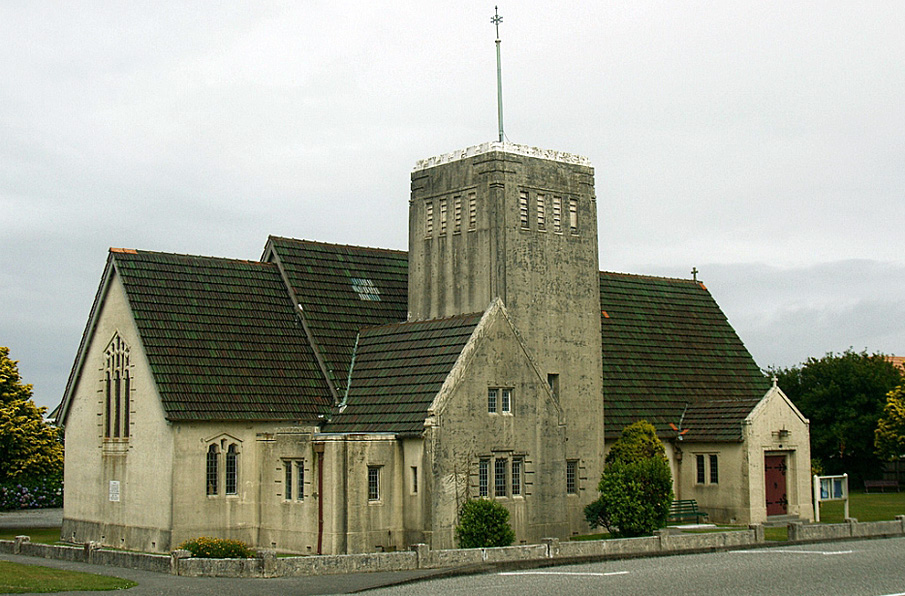
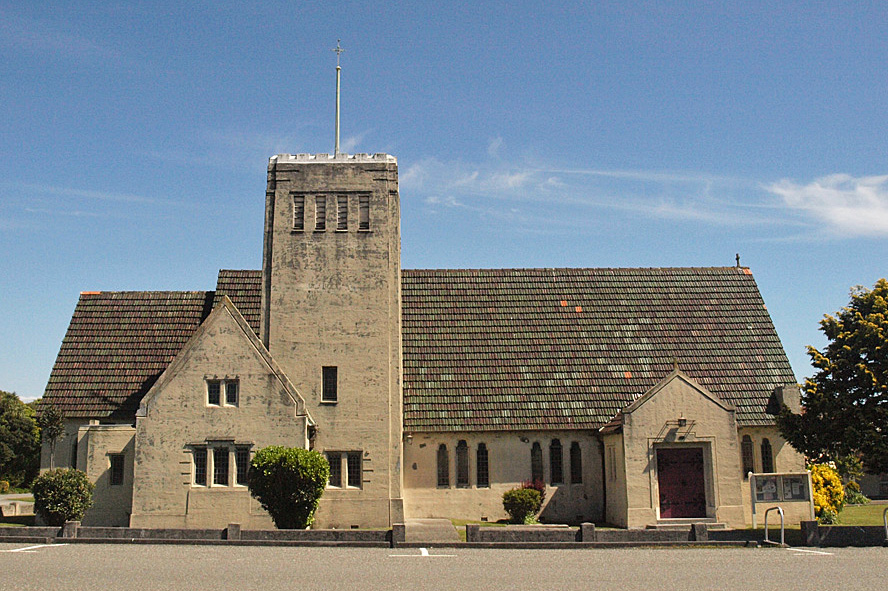
All Saints Church in Hokitika is a fine example of a 1930s reinforced concrete church and shows the use of new technology combined with nineteenth century ideals. This led to some simplifying of forms, which appear modern in conception and it is an important example of Harman's adaptability as an architect. Concrete was also a practical choice in terms of its cheapness and relative ease of construction. All Saints Church, in conjunction with St Andrew's Presbyterian Church, has given Hokitika two fine examples of reinforced concrete churches. It is one of only a handful of churches to be built under a Depression subsidy scheme. Today it is still used for Anglican worship.

List Entry Information
Status
Listed
List Entry Status
Historic Place Category 1
Access
Private/No Public Access
List Number
5012
Date Entered
28th June 1990
Date of Effect
28th June 1990
City/District Council
Westland District
Region
West Coast Region
Extent of List Entry
Extent includes the land described as Lot 3 DP 2480 (RT WS5B/1307), Westland Land District, and the building known as All Saints' Church (Anglican) thereon, and its fittings and fixtures.
Legal description
Lot 3 DP 2480 (RT WS5B/1307), Westland Land District
Status
Listed
List Entry Status
Historic Place Category 1
Access
Private/No Public Access
List Number
5012
Date Entered
28th June 1990
Date of Effect
28th June 1990
City/District Council
Westland District
Region
West Coast Region
Extent of List Entry
Extent includes the land described as Lot 3 DP 2480 (RT WS5B/1307), Westland Land District, and the building known as All Saints' Church (Anglican) thereon, and its fittings and fixtures.
Legal description
Lot 3 DP 2480 (RT WS5B/1307), Westland Land District
Why is this place significant?
Historic Significance
Historical Significance or Value Sited close to the Roman Catholic and Presbyterian churches of Hokitika, All Saints' is a handsome reminder of the "civilising" role played by the church in the development of the West Coast following the gold rushes of the mid-1860s.
Physical Significance
ARCHITECTURAL QUALITY: All Saints' Church, Hokitika, is an excellent example of R.S. Harman's work, even without the spire which was to have risen from the tower. Comparable in style and materials to his design for St James', Harewood (1935), All Saints' may also be favourably compared with the Arts and Crafts-inspired work of contemporaries such as Cecil Wood. The church illustrates Harman's understanding and skilful exploitation of the qualities inherent in reinforced concrete and realised in solid form his belief that "with a material such as concrete it is neither feasible nor desirable to imitate exactly features developed in wood or stone". In the design of All Saints' the architect achieves a careful balance between the horizontal and vertical elements within the external composition and thereby succeeds in making the building a landmark within the townscape at the same time as it is visually anchored to its site. One of a number of churches designed by Harman to replace wooden structures erected during the 1860s and 1870s, All Saints' also demonstrates the increasing popularity of concrete construction following the Napier Earthquake of 1931. TOWNSCAPE/LANDMARK VALUE: All Saints Church is a prominent landmark on the main street in a town which has very few medium or high-rise buildings.
Why is this place significant?
Historic Significance
Historical Significance or Value Sited close to the Roman Catholic and Presbyterian churches of Hokitika, All Saints' is a handsome reminder of the "civilising" role played by the church in the development of the West Coast following the gold rushes of the mid-1860s.
Physical Significance
ARCHITECTURAL QUALITY: All Saints' Church, Hokitika, is an excellent example of R.S. Harman's work, even without the spire which was to have risen from the tower. Comparable in style and materials to his design for St James', Harewood (1935), All Saints' may also be favourably compared with the Arts and Crafts-inspired work of contemporaries such as Cecil Wood. The church illustrates Harman's understanding and skilful exploitation of the qualities inherent in reinforced concrete and realised in solid form his belief that "with a material such as concrete it is neither feasible nor desirable to imitate exactly features developed in wood or stone". In the design of All Saints' the architect achieves a careful balance between the horizontal and vertical elements within the external composition and thereby succeeds in making the building a landmark within the townscape at the same time as it is visually anchored to its site. One of a number of churches designed by Harman to replace wooden structures erected during the 1860s and 1870s, All Saints' also demonstrates the increasing popularity of concrete construction following the Napier Earthquake of 1931. TOWNSCAPE/LANDMARK VALUE: All Saints Church is a prominent landmark on the main street in a town which has very few medium or high-rise buildings.
Construction Professional
Name
Harman, Richard Strachan De Renzy
Type
Architect
Biography
Not to be confused with his uncle R.D. Harman of Collins and Harman, Architects, R.S. Harman (1896-1953) was born and educated in Christchurch where he subsequently became one of the city's most competent ecclesiastical and residential architects. He served his articles with the local firm of Seager and Macleod (1914-16) and also attended classes at the Canterbury College School of Art during this time. After service in France during the First World War, he studied at the Royal College of Art, London before returning to New Zealand in 1920 to rejoin Seager's office. Between 1923 and 1926 Harman was once more in London undertaking further study as well as working for the Ancient Monuments Branch of His Majesty's Office of Works. On his return to Christchurch he entered into a short-lived partnership with Cecil Wood before establishing his own practice in 1928. Harman was closely associated with the Anglican Church throughout his career and almost all of his church designs were commissioned by the Anglican dioceses of Canterbury and Nelson. The Church of the Good Shepherd, Tekapo (1935) and St. John's Cathedral, Napier (1953) are among his most well-known ecclesiastical works, although the latter was not erected until after his death. During the late 1940s he worked as the consulting architect for Christchurch Cathedral, designing the Chapel of St Michael and St George in the south transept in 1949 and the reredos behind the High Altar in 1950. Harman was also an active member of the New Zealand Institute of Architects, becoming president of that organisation in 1949.
Name
Gurnsey, Frederick George
Type
Carver
Biography
Frederick George Gurnsey (1868 - 1953) was born in Wales. He was apprenticed to Harry Hems and Company, a leading ecclesiastical carving firm in Exeter, and worked for them once his apprenticeship was complete. Gurnsey visited New Zealand in 1904-1905 and returned in 1907 when he was appointed as an instructor at the Canterbury College School of Art in Christchurch. At the School of Art he taught carving, modelling, casting, enamelling and metalwork, and was the acting director of the school from September 1917 to April 1920. He resigned in 1923 to become a full-time carver. Gurnsey executed thousands of carvings, in both wood and stone, for churches, civic buildings, public monuments and various private commissions. Some of his more prominent carvings include the reredos in the Christchurch cathedral, his work in the Chapel of St Michael and St George, the carvings on the Bridge of Remembrance in Christchurch (1924), those on the Massey Memorial in Wellington (1930), and those in the Church of the Good Shepherd at Tekapo.(1935). During the Depression Gurnsey diversified into making domestic furniture. He has been described as 'one of the greatest European carvers ever to have worked in New Zealand', although due to his personal modesty and the way in which carving falls somewhere between fine arts and craft, his achievements have, until recently, largely been unrecognised. Confident with carving in both wood and stone, Gurnsey was responsible for many beautiful works, particularly in the South Island.
Construction Details
Start Year
1936
Type
Original Construction
Start Year
1935
Type
Designed
Type
Addition
Description
A community centre and parish offices have been constructed on the south side of the church. This is connected to the church by an entrance in the south-west corner
Start Year
1956
startYearCirca
Type
Modification
Description
Replacement of roofing tiles
Construction Materials
Church originally planned to forgo the spire in order to roof the church in slate. In 1936 it was pointed out that if they used Petrous Tiles instead of slate they would save £174. This was agreed to.Reinforced concrete foundations and brick cavity walls, tile roof on king post timber trusses, rimu floor and ceiling timbers. Walls finished with cement plaster. Rimu interior fittings and furnishings.
Notable Features
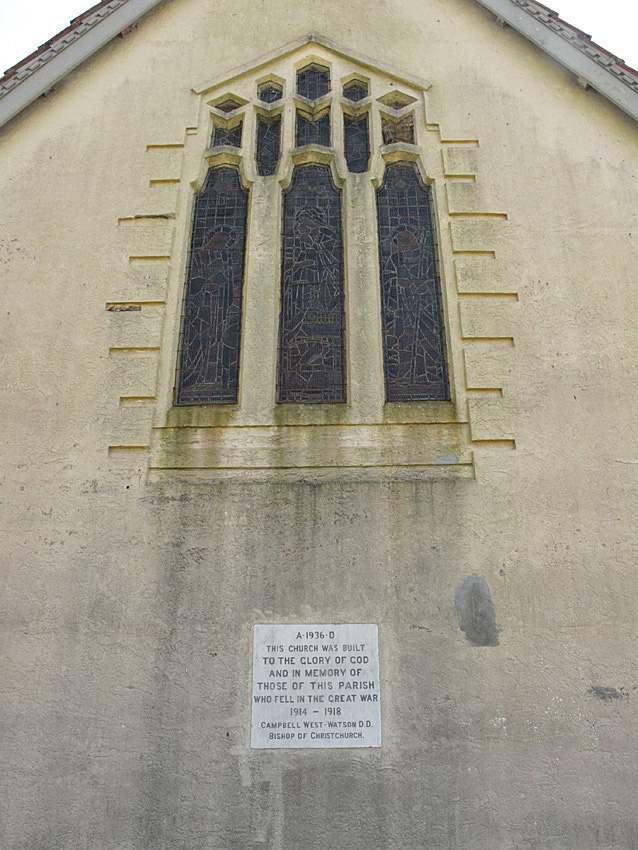
The Oamaru stone font was carved by noted Christchurch carver Frederick Gurnsey. The low concrete fence around two sides of the church was designed by Harman and constructed at the same time as the church. The stained glass window at the east end commemorates Louisa Ann Evans and was designed by F.V. Ellis ARCA (1892-1961). Ellis immigrated to New Zealand in 1921 for health reasons and later became head of the School of Art at the Wellington Technical College. He designed the occasional stained glass window during his early years in New Zealand and from around 1948 began to supply designs for Roy Miller of Miller Studios, a stained glass studio in Dunedin. The window Ellis designed for All Saints', Hokitika, has three main lights, which depict (from left to right) the Good Shepherd, Mother and Child and the Teacher. Above these are ten smaller lights which feature stars against a deep blue background and a cross. Stained glass window in chancel. The Oamaru stone altar.
Construction Professional
Name
Harman, Richard Strachan De Renzy
Type
Architect
Biography
Not to be confused with his uncle R.D. Harman of Collins and Harman, Architects, R.S. Harman (1896-1953) was born and educated in Christchurch where he subsequently became one of the city's most competent ecclesiastical and residential architects. He served his articles with the local firm of Seager and Macleod (1914-16) and also attended classes at the Canterbury College School of Art during this time. After service in France during the First World War, he studied at the Royal College of Art, London before returning to New Zealand in 1920 to rejoin Seager's office. Between 1923 and 1926 Harman was once more in London undertaking further study as well as working for the Ancient Monuments Branch of His Majesty's Office of Works. On his return to Christchurch he entered into a short-lived partnership with Cecil Wood before establishing his own practice in 1928. Harman was closely associated with the Anglican Church throughout his career and almost all of his church designs were commissioned by the Anglican dioceses of Canterbury and Nelson. The Church of the Good Shepherd, Tekapo (1935) and St. John's Cathedral, Napier (1953) are among his most well-known ecclesiastical works, although the latter was not erected until after his death. During the late 1940s he worked as the consulting architect for Christchurch Cathedral, designing the Chapel of St Michael and St George in the south transept in 1949 and the reredos behind the High Altar in 1950. Harman was also an active member of the New Zealand Institute of Architects, becoming president of that organisation in 1949.
Name
Gurnsey, Frederick George
Type
Carver
Biography
Frederick George Gurnsey (1868 - 1953) was born in Wales. He was apprenticed to Harry Hems and Company, a leading ecclesiastical carving firm in Exeter, and worked for them once his apprenticeship was complete. Gurnsey visited New Zealand in 1904-1905 and returned in 1907 when he was appointed as an instructor at the Canterbury College School of Art in Christchurch. At the School of Art he taught carving, modelling, casting, enamelling and metalwork, and was the acting director of the school from September 1917 to April 1920. He resigned in 1923 to become a full-time carver. Gurnsey executed thousands of carvings, in both wood and stone, for churches, civic buildings, public monuments and various private commissions. Some of his more prominent carvings include the reredos in the Christchurch cathedral, his work in the Chapel of St Michael and St George, the carvings on the Bridge of Remembrance in Christchurch (1924), those on the Massey Memorial in Wellington (1930), and those in the Church of the Good Shepherd at Tekapo.(1935). During the Depression Gurnsey diversified into making domestic furniture. He has been described as 'one of the greatest European carvers ever to have worked in New Zealand', although due to his personal modesty and the way in which carving falls somewhere between fine arts and craft, his achievements have, until recently, largely been unrecognised. Confident with carving in both wood and stone, Gurnsey was responsible for many beautiful works, particularly in the South Island.
Construction Details
Start Year
1936
Type
Original Construction
Start Year
1935
Type
Designed
Type
Addition
Description
A community centre and parish offices have been constructed on the south side of the church. This is connected to the church by an entrance in the south-west corner
Start Year
1956
startYearCirca
Type
Modification
Description
Replacement of roofing tiles
Construction Materials
Church originally planned to forgo the spire in order to roof the church in slate. In 1936 it was pointed out that if they used Petrous Tiles instead of slate they would save £174. This was agreed to.Reinforced concrete foundations and brick cavity walls, tile roof on king post timber trusses, rimu floor and ceiling timbers. Walls finished with cement plaster. Rimu interior fittings and furnishings.
Notable Features
The Oamaru stone font was carved by noted Christchurch carver Frederick Gurnsey. The low concrete fence around two sides of the church was designed by Harman and constructed at the same time as the church. The stained glass window at the east end commemorates Louisa Ann Evans and was designed by F.V. Ellis ARCA (1892-1961). Ellis immigrated to New Zealand in 1921 for health reasons and later became head of the School of Art at the Wellington Technical College. He designed the occasional stained glass window during his early years in New Zealand and from around 1948 began to supply designs for Roy Miller of Miller Studios, a stained glass studio in Dunedin. The window Ellis designed for All Saints', Hokitika, has three main lights, which depict (from left to right) the Good Shepherd, Mother and Child and the Teacher. Above these are ten smaller lights which feature stars against a deep blue background and a cross. Stained glass window in chancel. The Oamaru stone altar.
DESCRIPTION: The first Anglican church services to be held in Hokitika were conducted in the Magistrate's Court in 1865 and in the following year a wooden church was built on the church reserve in Fitzherbert Street. This building, renovated in 1882, served the parish for seventy years, before it was replaced by the present church which stands on a different part of the church grounds. A building fund for the new church had been established as early as 1919, at which time Edmund Wilson, an Invercargill architect, was engaged by the church vestry to draw up plans for a memorial church to commemorate the sacrifices of those parishioners who had died in the First World War. However, in August 1935 the vestry decided to dissolve its agreement with Wilson and approached a number of other architects, including Cecil Wood, Roy Lovell-Smith and R.S. Harman, asking them to submit drawings for consideration specifying concrete construction and a maximum cost of £4,000. The vestry chose Harman's design in preference to Lovell-Smith's (Wood declined to participate), and building began early in 1936. Erected by Messrs Williamson and Rose of Christchurch at a total cost of £4,142, the church was partly financed by a government subsidy offered by the Unemployment Board to encourage the construction of public buildings during the depression. On All Saints' Day (1 November) 1936 the church was consecrated by the Bishop of Christchurch, the Rt. Rev. C. West-Watson.
ARCHITECTURAL DESCRIPTION: The church is designed in a very free Gothic Revival style which marries the English Arts and Crafts principles of truth to materials and respect for craftsmanship with construction in reinforced concrete. Following the nineteenth-century Ecclesiological dictate of structural clarity, the building is a clearly articulated composition of chancel, transepts, tower, nave and entrance porch, although its cruciform shape is not immediately apparent to those inside the church. The massive appearance of the building is particularly enhanced by the tower, which serves as an entrance to both the church and the vestry as well as a visual counterpoint to the horizontal expanse of the gabled roofs over the nave and chancel. In a written description of the church Harman detailed a system of buttresses hidden within the cavity walls, but their existence cannot be confirmed without recourse to the plans, which have not been located. Excluding the doors, the only use of timber on the exterior is the weatherboarding set within the apex of the gable at the west end of the church; a mannerism also used by the architect in the design of St James', Harewood (1935). The exterior of the church is largely devoid of ornamentation, although a decorative effect is achieved by the arrangement of the fenestration and the use of highly original window-heads and integral mouldings, such as the horizontal indentations around the east, west, tower and transept windows, which relieve the sheer surface of the concrete. Running around two sides of the church yard is a concrete wall, also designed by Harman, which sets off the church from its immediate environment. Inside the church the steeply pitched roof is carried on king-post trusses. Seating for approximately two hundred people is provided in the nave and chancel, and the latter is clearly differentiated from the former by an octagonal chancel arch which, like the window tracery, has been simplified for construction in concrete. The window at the east end is the only one in the church to be filled with stained glass, and its tracery differs noticeably from that of the west window. The font stands below the latter on an octagonal base, while the organ is housed in the south transept and the vestry and a storeroom occupy the north. Once again ornamentation is kept to a minimum, and this serves to draw the viewer's attention to the east window which was designed by the Wellington artist, E.V. Ellis. MODIFICATIONS: c.1956 Replacement of roofing tiles.
Historical and Associated Iwi / Hapū / Whānau
Completion Date
4th September 2002
Report Written By
Melanie Lovell-Smith
Information Sources
Appendices to the Journals of the House of Representatives (AJHR)
Appendices to the Journals of the House of Representatives
Ciaran, 1998
Fiona Ciaran, Stained Glass Windows of Canterbury, New Zealand. A Catalogue Raisonne, Dunedin, 1998
Cyclopedia of New Zealand, 1906
Cyclopedia Company, Industrial, descriptive, historical, biographical facts, figures, illustrations, Wellington, N.Z, 1897-1908, Vol. 5, Nelson, Marlborough, Westland, 1906
Home and Building
Home and Building, 1 Apr 1975
Parr, 1951
S Parr, Canterbury Pilgrimage: the first hundred years of the Church of England in Canterbury, New Zealand, Christchurch, 1951
Plans
Architectural Drawings/Plans
Press
Press, 17 May 1915, p.9.
University of Canterbury
Church News
Church News
West Coast Supplement
Other Information
This historic place was registered under the Historic Places Act 1980. This report includes the text from the original Building Classification Committee report considered by the NZHPT Board at the time of registration. Please note that entry on the New Zealand Heritage List/Rarangi Korero identifies only the heritage values of the property concerned, and should not be construed as advice on the state of the property, or as a comment of its soundness or safety, including in regard to earthquake risk, safety in the event of fire, or insanitary conditions.
Historical and Associated Iwi / Hapū / Whānau
Completion Date
4th September 2002
Report Written By
Melanie Lovell-Smith
Information Sources
Appendices to the Journals of the House of Representatives (AJHR)
Appendices to the Journals of the House of Representatives
Ciaran, 1998
Fiona Ciaran, Stained Glass Windows of Canterbury, New Zealand. A Catalogue Raisonne, Dunedin, 1998
Cyclopedia of New Zealand, 1906
Cyclopedia Company, Industrial, descriptive, historical, biographical facts, figures, illustrations, Wellington, N.Z, 1897-1908, Vol. 5, Nelson, Marlborough, Westland, 1906
Home and Building
Home and Building, 1 Apr 1975
Parr, 1951
S Parr, Canterbury Pilgrimage: the first hundred years of the Church of England in Canterbury, New Zealand, Christchurch, 1951
Plans
Architectural Drawings/Plans
Press
Press, 17 May 1915, p.9.
University of Canterbury
Church News
Church News
West Coast Supplement
Other Information
This historic place was registered under the Historic Places Act 1980. This report includes the text from the original Building Classification Committee report considered by the NZHPT Board at the time of registration. Please note that entry on the New Zealand Heritage List/Rarangi Korero identifies only the heritage values of the property concerned, and should not be construed as advice on the state of the property, or as a comment of its soundness or safety, including in regard to earthquake risk, safety in the event of fire, or insanitary conditions.
Current Usages
Uses: Religion
Specific Usage: Church
Former Usages
General Usage: Religion
Specific Usage: Church
Current Usages
Uses: Religion
Specific Usage: Church
Former Usages
General Usage: Religion
Specific Usage: Church
Location
Stay up to date with Heritage this month

