

The War Memorial on Torea Street (State Highway 67) in Granity, between the road and the railway tracks that travel through the town, was built, in the [mid] 1920s, to memorialise those who were lost from the district during the First World War. It was unveiled on 21 March 1926. It was later altered to also commemorate those who died in the Second World War. In keeping with all war memorials, the Granity memorial has significance as a memorial to the soldiers from that community who fought and died in the First and Second World Wars, and has a real poignancy in the number of men listed from such a small district. It has added significance as an example of an unusual style of memorial built in New Zealand after the First World War.
Granity was one of only five towns in New Zealand to choose a ‘cupola’, a dome resting on pillars, as their First World War memorials. As noted by Jock Phillips and Chris McLean, historians of war memorials in New Zealand, such a memorial has connotations of a temple or shrine, as well as having classical and heroic connotations: ‘they are holy places where the memory of the dead is powerfully present’. Of the five, two are on the West Coast, the other being Hokitika.
The Granity memorial is built from pre-cast concrete. On the front is a white marble plaque, inscribed with twelve servicemen’s names and the statement that the memorial was built ‘In grateful remembrance of those who paid the supreme sacrifice in the Great War’. Above and below were two pieces of decorative carved marble. The one below still remains and represents a crossed sword and gun, while the one above has been removed since the late 1980s.
The memorial is built on a section of land that has been set aside for railway purposes since 1881 on a small grassed area surrounded on one side by a low concrete and stone wall, which is included in the registration, and a flagpole. It sits next to the local library and the bandstand.
After the Second World War, a new plaque was added to provide the names of the eight men from the district who died during the Second World War, saying that they died ‘for democracy and freedom’. The memorial continues to be used and decorated for Anzac services, and people march from the bandstand to the memorial at dawn on that day.
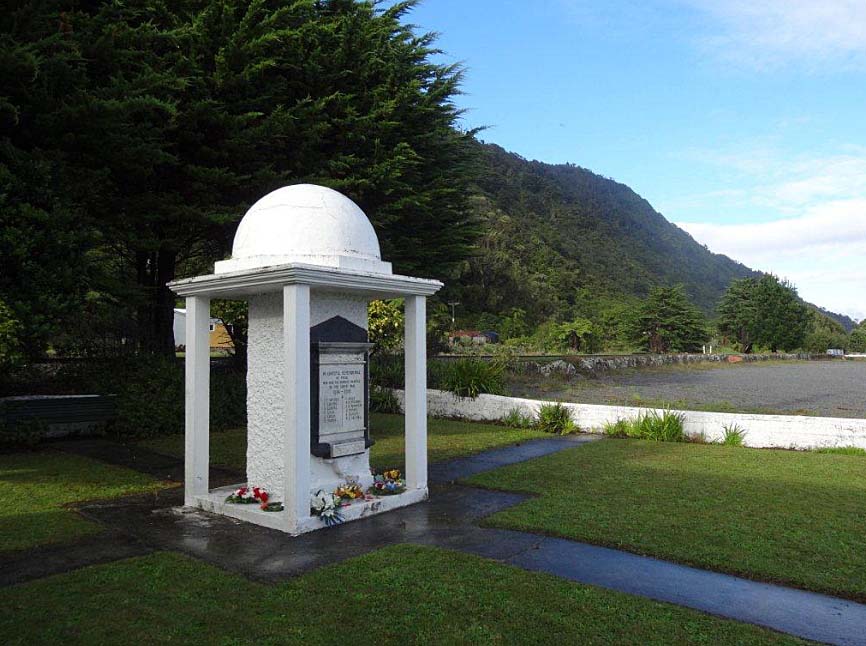
War Memorial | Robyn Burgess | 25/04/2013 | Heritage New Zealand Pouhere Taonga

War Memorial. October 1992. Original image submitted at time of registration | Ray Hooker (DoC) | Heritage New Zealand Pouhere Taonga

War Memorial | Robyn Burgess | 25/04/2013 | Heritage New Zealand Pouhere Taonga
War Memorial | Robyn Burgess | 25/04/2013 | Heritage New Zealand Pouhere Taonga
War Memorial. October 1992. Original image submitted at time of registration | Ray Hooker (DoC) | Heritage New Zealand Pouhere Taonga
War Memorial | Robyn Burgess | 25/04/2013 | Heritage New Zealand Pouhere Taonga

