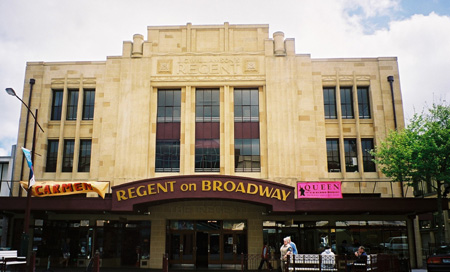
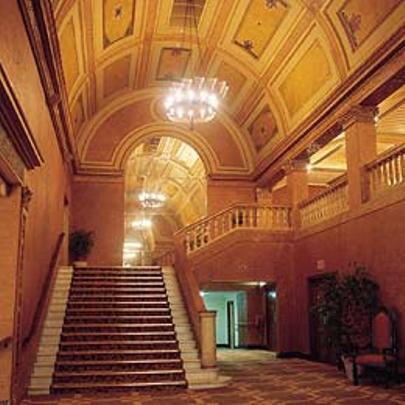
The Regent's plain, concrete facade was three storeys high and incorporated elements of the Art Deco style that was becoming increasingly popular. The Baroque interior was inspired by the lavish, hardtop picture palaces that were developed to lure patrons back to the theatre when cinema began to attract an increasing following. As the Regent was built during the Depression, the sense of opulence was created using faux-gold and similar materials, and the large stage and backstage area remained unfinished on opening night. The grand, marble staircase in the elaborate entrance lobby led to a mezzanine floor where the roof rafters were decorated with stencilled kowhaiwhai designs. The auditorium featured blue tinted windows inspired by the 'atmospheric' picture houses that were then in vogue. The auditorium, which seated up to 1600 patrons, also included a large fresco painted by chief artist and designer for J.C. Williamson, W. Colman.
The Regent was opened by the Mayor of Palmerston North in 1930, who pronounced that the opening of such a beautiful building marked an epoch in the history of the city. It was then the largest cinema in the area and the acoustics and sightlines were considered to be world class. Initially, formal dress was required of Regent patrons and reservations were necessary on Friday and Saturday nights. The Regent hosted live shows every three and a half weeks.
Despite the Regent's success, the Depression drove J.C. Williamson Ltd into financial difficulties. In 1946 the firm was taken over by Sir Robert Kerridge, a New Zealander who controlled 111 theatres throughout the country by 1949. From the 1960s the central role that the theatre had played in the community's cultural life began to lessen. With the arrival of television in 1963 and the extension of pub opening hours four years later, cinema attendances dropped. In the 1980s smaller, multiplex theatres began to cater for the smaller audiences and large, single screen cinemas like the Regent became dilapidated and run down.
In 1988 the Regent was placed on the market. One year later a public campaign was launched to 'Save the Regent'. Six thousand signatures were collected on a petition to save the building. In 1992 the Palmerston North City Council obtained ownership of the Regent by an agreement with the theatre's owners to exchange it for the Opera House. The Opera House was demolished shortly afterwards. The Council agreed to contribute $10,000,000 of the $12,700,000 required to restore the Regent to its former grandeur and to modernise it technically. $1,000,000 was provided by the New Zealand Lotteries Grants Board. The local community undertook the largest financial challenge in its history and raised the remaining $1,700,000 by 1997. The renovations commenced in 1996 and were completed in time for the reopening of the theatre in 1998.
The Regent Theatre in Palmerston North is of national significance as one of the few surviving, purpose-built Regent Theatres that were once common throughout the country. Its history provides great insight into the development, decline, and revival of live theatre and cinema in New Zealand. Architecturally interesting for its coherent use of a number of design styles, the theatre interior also illustrates the changing fashions of cinema through its incorporation of elements of the atmospheric picture house in a hard-top theatre. The theatre is noteworthy for its unusual use of Maori design as part of the décor. The excellence of the acoustics give the building technical significance. Held in demonstrably high regard by the citizens of Manawatu, the theatre is of great local importance as a centre of culture and community in Palmerston North.

List Entry Information
Status
Listed
List Entry Status
Historic Place Category 1
Access
Private/No Public Access
List Number
5104
Date Entered
16th November 1989
Date of Effect
16th November 1989
City/District Council
Palmerston North City
Region
Horizons (Manawatū-Whanganui) Region
Legal description
Lots 2-6 & 8 DP 9762
Status
Listed
List Entry Status
Historic Place Category 1
Access
Private/No Public Access
List Number
5104
Date Entered
16th November 1989
Date of Effect
16th November 1989
City/District Council
Palmerston North City
Region
Horizons (Manawatū-Whanganui) Region
Legal description
Lots 2-6 & 8 DP 9762
Why is this place significant?
Historic Significance
Historical Significance or Value The Regent Theatre has been a venue of live performance and cinema for nearly fifty years. As such it has played a significant role in the social life of Palmerston North. As a fine example of a 'picture palace' it has become an affectionately regarded institution in the city.
Physical Significance
ARCHITECTURAL QUALITY: Still in near original condition the Regent Theatre is a reminder of the heyday of the picture place era. This period of theatre design produced some extremely lavish buildings and while the Regent is somewhat restrained by comparison with the most indulgent of those, it is nevertheless an exuberant celebration of the art of theatre design. The attention to detail, the quality of the decoration and the grand but simple design mark this as one of New Zealand's best theatres. TOWNSCAPE/LANDMARK VALUE: Although nearby developments have begun to diminish the theatre's visual impact the Regent continues to dominate this area of Broadway.
Why is this place significant?
Historic Significance
Historical Significance or Value The Regent Theatre has been a venue of live performance and cinema for nearly fifty years. As such it has played a significant role in the social life of Palmerston North. As a fine example of a 'picture palace' it has become an affectionately regarded institution in the city.
Physical Significance
ARCHITECTURAL QUALITY: Still in near original condition the Regent Theatre is a reminder of the heyday of the picture place era. This period of theatre design produced some extremely lavish buildings and while the Regent is somewhat restrained by comparison with the most indulgent of those, it is nevertheless an exuberant celebration of the art of theatre design. The attention to detail, the quality of the decoration and the grand but simple design mark this as one of New Zealand's best theatres. TOWNSCAPE/LANDMARK VALUE: Although nearby developments have begun to diminish the theatre's visual impact the Regent continues to dominate this area of Broadway.
Construction Professional
Name
Hollinshed, Charles
Type
Architect
Biography
Hollinshed graduated from Sydney University in 1922, one of the first three graduates in architecture in Australia. With A.H. Walkely, Hollinshed practised in Melbourne and the firm specialised in theatre and cinema design. One of their best known designs was Her Majesty's Theatre, Melbourne (1934). Hollinshed also designed for Hoyts Limited (with Richard Gailey) the celebrated 'Spanish Gothic' Regent Theatre, Brisbane (1929), now demolished. Another Regent, Palmerston North, (1930) was designed for J.C. Williamson Limited.
Construction Details
Start Year
1930
Type
Original Construction
Start Year
1953
Type
Modification
Description
Alterations to the stage; structural additions to the fly tower
Start Year
1996
Finish Year
1998
Type
Refurbishment/renovation
Description
Renovations
Start Year
1954
Type
Modification
Description
Dressing room addition
Start Year
1959
Type
Modification
Description
Nibble nook added
Start Year
1959
Type
Modification
Description
Alterations to shops on Regent street side of the theatre
Start Year
1960
Type
Modification
Description
Backstage area converted into five shops
Construction Materials
The Regent Theatre is constructed from reinforced concrete, steel and timber framing. . The interior is finished with varnished oak and decorative plasterwork. The circle is partially cantilevered with rolled steel joists and wooden framing. The staircase is solid marble.
Notable Features
- The interior decoration; in particular, the plaster carving, the stencilled Kowhaiwhai design on the mezzanine ceiling, the coffered ceiling and the mural - The staircase - The outsize stage
Construction Professional
Name
Hollinshed, Charles
Type
Architect
Biography
Hollinshed graduated from Sydney University in 1922, one of the first three graduates in architecture in Australia. With A.H. Walkely, Hollinshed practised in Melbourne and the firm specialised in theatre and cinema design. One of their best known designs was Her Majesty's Theatre, Melbourne (1934). Hollinshed also designed for Hoyts Limited (with Richard Gailey) the celebrated 'Spanish Gothic' Regent Theatre, Brisbane (1929), now demolished. Another Regent, Palmerston North, (1930) was designed for J.C. Williamson Limited.
Construction Details
Start Year
1930
Type
Original Construction
Start Year
1953
Type
Modification
Description
Alterations to the stage; structural additions to the fly tower
Start Year
1996
Finish Year
1998
Type
Refurbishment/renovation
Description
Renovations
Start Year
1954
Type
Modification
Description
Dressing room addition
Start Year
1959
Type
Modification
Description
Nibble nook added
Start Year
1959
Type
Modification
Description
Alterations to shops on Regent street side of the theatre
Start Year
1960
Type
Modification
Description
Backstage area converted into five shops
Construction Materials
The Regent Theatre is constructed from reinforced concrete, steel and timber framing. . The interior is finished with varnished oak and decorative plasterwork. The circle is partially cantilevered with rolled steel joists and wooden framing. The staircase is solid marble.
Notable Features
- The interior decoration; in particular, the plaster carving, the stencilled Kowhaiwhai design on the mezzanine ceiling, the coffered ceiling and the mural - The staircase - The outsize stage
J.C. Williamson Limited, a successful Australian cinema and theatre chain, established its New Zealand operation in 1926. The Regent Theatre, Palmerston North is one of a number of Regents throughout New Zealand and Australia. The theatre was opened 4 July, 1930 with a dual purpose as a cinema and theatre. It has largely continued that function to this day. Williamsons's confidence in the success of the theatre was reflected in the considerable expense lavished on the interior. The Regent has hosted many live shows over its fifty year history as well as thousands of movies.
ARCHITECTURAL DESCRIPTION: The Regent Theatre is a large reinforced concrete building. The main auditorium seats 1600 people. The building has a relatively plain exterior but the principal facade, three storeys high, has touches of Art Deco decoration. The unadorned exterior belies the richness of the interior decoration. An eclectic mixture of styles embellish the interior but the predominant style is neo-Classical. The theatre is a typical example from the picture palace era of cinema design. The interior decoration is dominated by the use of arches both in the foyer and main auditorium. Stylised string courses, pilasters and capitals add visual interest to these arches. Elaborate friezes run across the front of the circle, beneath the cornice at ceiling level and below the circle. The friezes feature mock heraldic and foliated decoration. In the stalls the regularly spaced pilasters below the frieze feature a similar urn and foliation treatment reminiscent of Art Nouveau design. This frieze is bordered above by a cornice and below by a barley rope twist effect. This motif is repeated throughout the building particularly in the foyer. The ceiling is covered with rectangular lacunars alternately decorated with abstract heraldic-like designs. The stage, over three metres longer than normal, is augmented by a very large backstage area. The fly gallery is 21 metres above the stage. Below the ceiling and forward of the stage is a large fresco painted by Melbourne artist W. Colman in a Renaissance manner. The theatre foyer is a large space in its own right. A principal feature is the substantial vaulted marble staircase which passes an equally large mirror. This mirror and its arched mural opposite (also a mirror until it broke before opening night) echo the barrel-vault of the foyer ceiling. Behind a balustraded balcony is the mezzanine floor with its mostly original furnishings and fittings including a set of large ornate chairs. The plaster walls in both the foyer and main auditorium are finished with a mixture of sienna and flat beer. MODIFICATIONS: The building is, structurally, largely unaltered, however numerous alterations and modifications have taken place since its construction.
Historical and Associated Iwi / Hapū / Whānau
Completion Date
5th December 2002
Report Written By
Rebecca O'Brien
Information Sources
Belich, 2001
James Belich, 'Paradise Reforged: A History of the New Zealanders from the 1880s to the year 2000', Auckland, 2001
Murray North Ltd, 1989
Murrary North Ltd, A Heritage Assessment of the Regent Theatre, Palmerston North, for the Palmerston North City Corporation, Palmerston North, 1989
Sharp, 1969
Denis Sharp, The Picture Palace, Hugh Evelyn, London, 1969
Tzonis, 1987
A Tzonis & L Lefaire, Classical Architecture The Politics of Order, Halliday Lithograph, USA, 1987
Wittkower, 1974
Rudolph Wittkower, Gothic versus Classic, Thames and Hudson, London, 1974
Conservation Plan
Conservation Plan
Other Information
A fully referenced version of this report is available from the NZHPT Central Region Office Please note that entry on the New Zealand Heritage List/Rarangi Korero identifies only the heritage values of the property concerned, and should not be construed as advice on the state of the property, or as a comment of its soundness or safety, including in regard to earthquake risk, safety in the event of fire, or insanitary conditions.
Historical and Associated Iwi / Hapū / Whānau
Completion Date
5th December 2002
Report Written By
Rebecca O'Brien
Information Sources
Belich, 2001
James Belich, 'Paradise Reforged: A History of the New Zealanders from the 1880s to the year 2000', Auckland, 2001
Murray North Ltd, 1989
Murrary North Ltd, A Heritage Assessment of the Regent Theatre, Palmerston North, for the Palmerston North City Corporation, Palmerston North, 1989
Sharp, 1969
Denis Sharp, The Picture Palace, Hugh Evelyn, London, 1969
Tzonis, 1987
A Tzonis & L Lefaire, Classical Architecture The Politics of Order, Halliday Lithograph, USA, 1987
Wittkower, 1974
Rudolph Wittkower, Gothic versus Classic, Thames and Hudson, London, 1974
Conservation Plan
Conservation Plan
Other Information
A fully referenced version of this report is available from the NZHPT Central Region Office Please note that entry on the New Zealand Heritage List/Rarangi Korero identifies only the heritage values of the property concerned, and should not be construed as advice on the state of the property, or as a comment of its soundness or safety, including in regard to earthquake risk, safety in the event of fire, or insanitary conditions.
Current Usages
Uses: Civic Facilities
Specific Usage: Theatre
Former Usages
General Usage: Civic Facilities
Specific Usage: Opera House
General Usage: Civic Facilities
Specific Usage: Theatre
Web Links
description:
Current Usages
Uses: Civic Facilities
Specific Usage: Theatre
Former Usages
General Usage: Civic Facilities
Specific Usage: Opera House
General Usage: Civic Facilities
Specific Usage: Theatre
Web Links
description:
Location
Sign up to hear more
Get the latest heritage news, features and events delivered
straight to your inbox.

