

The Bank of New Zealand first opened a branch in Takaka in 1884, closing in 1890. It re-opened in 1910 in temporary premises. These events reflected the fluctuating nature of the local goldfields, and the later and more permanent development of the district as a whole.
The building designed by Charlesworth suffered only superficial damage in the 1929 Murchison earthquake. However it was severely damaged by fire in 1939 and major repairs were required.
The building was sold to its present owners in 1990. The bank still operates from these premises.
List Entry Information
Status
Listed
List Entry Status
Historic Place Category 1
Access
Private/No Public Access
List Number
5112
Date Entered
13th December 1990
Date of Effect
13th December 1990
City/District Council
Tasman District
Region
Tasman Region
Extent of List Entry
Extent includes part of the land described as Lot 1 DP 20246 (RT NL13B/1286), Nelson Land District and the building known as Bank of New Zealand (Former) thereon. Refer to the extent map tabled at the Rārangi Kōrero Committee meeting on 24 November 2021.
Legal description
Lot 1 DP 20246 (RT NL13B/1286), Nelson Land District
Status
Listed
List Entry Status
Historic Place Category 1
Access
Private/No Public Access
List Number
5112
Date Entered
13th December 1990
Date of Effect
13th December 1990
City/District Council
Tasman District
Region
Tasman Region
Extent of List Entry
Extent includes part of the land described as Lot 1 DP 20246 (RT NL13B/1286), Nelson Land District and the building known as Bank of New Zealand (Former) thereon. Refer to the extent map tabled at the Rārangi Kōrero Committee meeting on 24 November 2021.
Legal description
Lot 1 DP 20246 (RT NL13B/1286), Nelson Land District
Why is this place significant?
Historic Significance
Historical Significance or Value The Bank of New Zealand, an important establishment in this small town, has operated from this building for 75 years.
Physical Significance
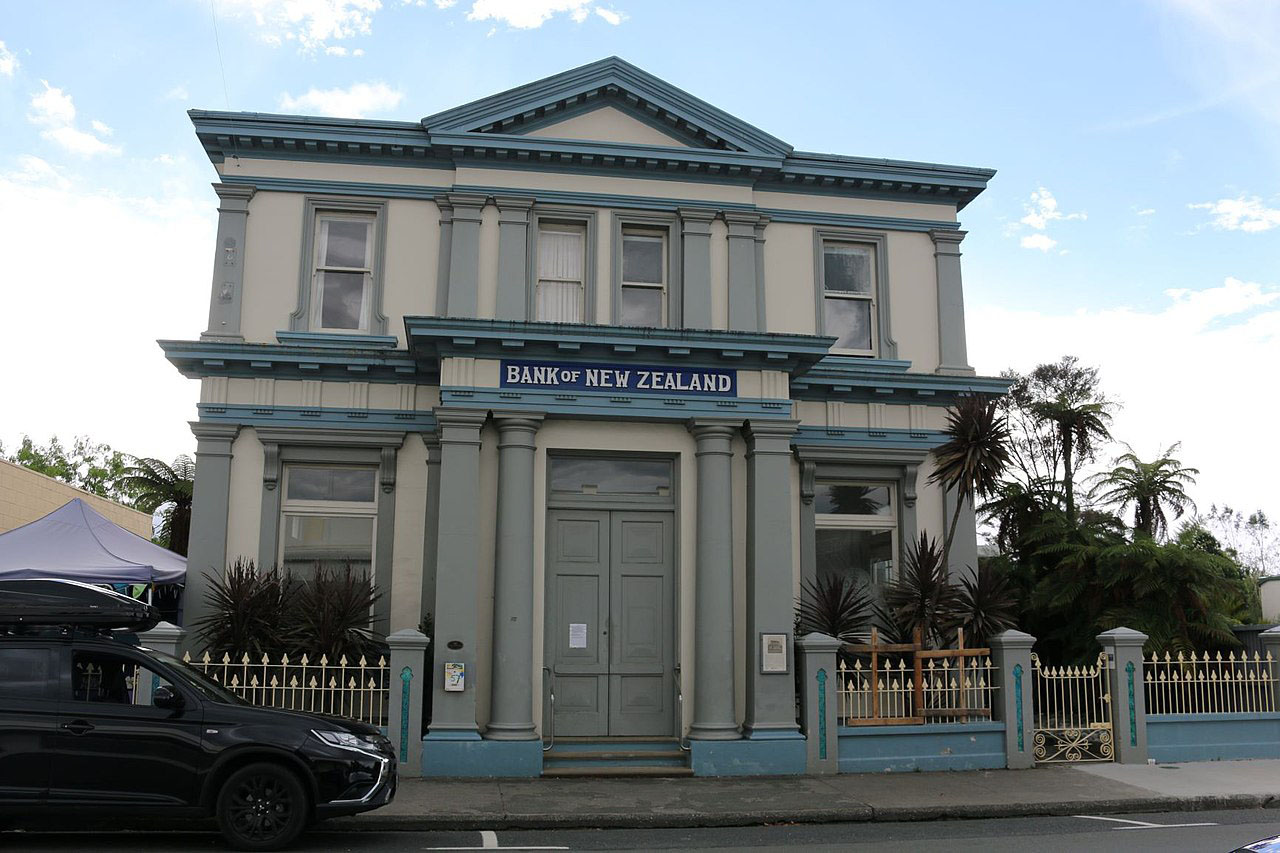
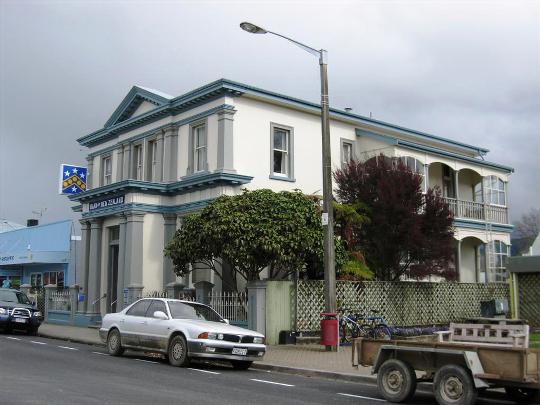
ARCHITECTURAL QUALITY: The Bank of New Zealand building is a fine example of Edwardian Classicism. This style was used often for public buildings in Edwardian New Zealand, and is characteristic of the buildings designed by Charlesworth, who was responsible for 17 provincial buildings for the bank, all in this style, both in wood and in concrete. The Takaka building is a relatively early example of construction in reinforced concrete. TOWNSCAPE/LANDMARK VALUE: The bank is one of the most prominent buildings in the main street of Takaka.
Why is this place significant?
Historic Significance
Historical Significance or Value The Bank of New Zealand, an important establishment in this small town, has operated from this building for 75 years.
Physical Significance
ARCHITECTURAL QUALITY: The Bank of New Zealand building is a fine example of Edwardian Classicism. This style was used often for public buildings in Edwardian New Zealand, and is characteristic of the buildings designed by Charlesworth, who was responsible for 17 provincial buildings for the bank, all in this style, both in wood and in concrete. The Takaka building is a relatively early example of construction in reinforced concrete. TOWNSCAPE/LANDMARK VALUE: The bank is one of the most prominent buildings in the main street of Takaka.
Construction Professional
Name
Charlesworth, Joshua
Type
Architect
Biography
Charlesworth (1861-1925) was born in Yorkshire and the first record of his practice in Wellington was in the New Zealand Post Office Directory of 1885-87. He won a competition for the design of the Home for the Aged and Needy in June, 1887, and in the same year won another for the design of the Nelson Town Hall. Charlesworth set up practice in Wellington in his early twenties, designing many institutional buildings and showing command of the revival styles of architecture. His work includes the Wellington Town Hall (1901), Brancepeth Station Homestead addition, Wairarapa (1905), Te Aro Post Office (1908), St Hilda's Church, Upper Hutt (1909), and seventeen branch banks for the Bank of New Zealand, situated throughout the country (1907-17). Charlesworth was elected a Fellow of the New Zealand Institute of Architects in 1905, and became a life member of the Institute. He was its vice-president in 1909-10, and was the first chairman of a society of architects which was formed in 1912. Charlesworth also belonged to the Yorkshire Society in Wellington and was its president for many years.
Construction Details
Start Year
1929
Type
Other
Description
Repairs following earthquake damage
Start Year
1939
Type
Other
Description
Repairs following fire
Type
Modification
Description
Periodic alterations internally, particularly to domestic areas.
Start Year
1914
Type
Original Construction
Construction Materials
Reinforced concrete foundations and superstructure. Timber framed internal walls and verandah. Corrugated galvanised roof cladding.
Notable Features
Classical detailing of street facade.
Construction Professional
Name
Charlesworth, Joshua
Type
Architect
Biography
Charlesworth (1861-1925) was born in Yorkshire and the first record of his practice in Wellington was in the New Zealand Post Office Directory of 1885-87. He won a competition for the design of the Home for the Aged and Needy in June, 1887, and in the same year won another for the design of the Nelson Town Hall. Charlesworth set up practice in Wellington in his early twenties, designing many institutional buildings and showing command of the revival styles of architecture. His work includes the Wellington Town Hall (1901), Brancepeth Station Homestead addition, Wairarapa (1905), Te Aro Post Office (1908), St Hilda's Church, Upper Hutt (1909), and seventeen branch banks for the Bank of New Zealand, situated throughout the country (1907-17). Charlesworth was elected a Fellow of the New Zealand Institute of Architects in 1905, and became a life member of the Institute. He was its vice-president in 1909-10, and was the first chairman of a society of architects which was formed in 1912. Charlesworth also belonged to the Yorkshire Society in Wellington and was its president for many years.
Construction Details
Start Year
1929
Type
Other
Description
Repairs following earthquake damage
Start Year
1939
Type
Other
Description
Repairs following fire
Type
Modification
Description
Periodic alterations internally, particularly to domestic areas.
Start Year
1914
Type
Original Construction
Construction Materials
Reinforced concrete foundations and superstructure. Timber framed internal walls and verandah. Corrugated galvanised roof cladding.
Notable Features
Classical detailing of street facade.
ARCHITECTURAL DESCRIPTION: This two-storeyed building is an example of Edwardian Classicism. It has a hipped roof with a gable to the street (east) facade, which is symmetrical about a central bay topped by the gable. At the ground floor this bay incorporates a projecting entrance foyer with double doors flanked by Tuscan columns and a pilaster with Tuscan detailing. Above this is a frieze with triglyphs and a cornice with guttae. At the first floor level two double-hung sash windows are flanked by pilasters, which appear to support a plain frieze and a cornice with dentils, which carries on across the facade to another pilaster at each corner. The gable has been treated as a pediment, also with dentils. On each side of the central bay at the first floor is a double hung sash window. Below these on the ground floor are larger fixed windows, each embossed with the bank coat of arms, with a fanlight above. Both of these ground floor windows have hood moulds, supported by brackets. While the facades are simply adorned, the north face has verandahs at each floor on the west end. These have segmental arches supported on wooden posts and are partly glazed. This emphasises the domestic use to which part of the building is devoted. A stairwell addition is the main feature of the west facade. The interior has seen many alterations. Half of the ground floor space is designed as the banking chamber. The rest provides for the living area of the manager's residence. The first floor has the bedrooms, a living room and bathroom. While some original joinery and fittings remain, these areas have been much altered. MODIFICATIONS: 1929 - Repairs following earthquake damage. 1939 - Repairs following fire. Date Unknown - Periodic alterations internally, particularly to domestic areas.
ARCHITECTURAL DESCRIPTION: This two-storeyed building is an example of Edwardian Classicism. It has a hipped roof with a gable to the street (east) facade, which is symmetrical about a central bay topped by the gable. At the ground floor this bay incorporates a projecting entrance foyer with double doors flanked by Tuscan columns and a pilaster with Tuscan detailing. Above this is a frieze with triglyphs and a cornice with guttae. At the first floor level two double-hung sash windows are flanked by pilasters, which appear to support a plain frieze and a cornice with dentils, which carries on across the facade to another pilaster at each corner. The gable has been treated as a pediment, also with dentils. On each side of the central bay at the first floor is a double hung sash window. Below these on the ground floor are larger fixed windows, each embossed with the bank coat of arms, with a fanlight above. Both of these ground floor windows have hood moulds, supported by brackets. While the facades are simply adorned, the north face has verandahs at each floor on the west end. These have segmental arches supported on wooden posts and are partly glazed. This emphasises the domestic use to which part of the building is devoted. A stairwell addition is the main feature of the west facade. The interior has seen many alterations. Half of the ground floor space is designed as the banking chamber. The rest provides for the living area of the manager's residence. The first floor has the bedrooms, a living room and bathroom. While some original joinery and fittings remain, these areas have been much altered. MODIFICATIONS: 1929 - Repairs following earthquake damage. 1939 - Repairs following fire. Date Unknown - Periodic alterations internally, particularly to domestic areas.
Historical and Associated Iwi / Hapū / Whānau
Information Sources
Dominion
Dominion, 16 Jul 1915, p. 9.
Land Information New Zealand (LINZ)
Land Information New Zealand
New Zealand Historic Places Trust (NZHPT)
New Zealand Historic Places Trust
Griffin, 1984
R H Griffin. BNZ Golden Bay Opened at Takaka 1884, BNZ Archives, Wellington, 1984.
Other Information
This historic place was registered under the Historic Places Act 1980. This report includes the text from the original Building Classification Committee report considered by the NZHPT Board at the time of registration. Please note that entry on the New Zealand Heritage List/Rarangi Korero identifies only the heritage values of the property concerned, and should not be construed as advice on the state of the property, or as a comment of its soundness or safety, including in regard to earthquake risk, safety in the event of fire, or insanitary conditions.
Historical and Associated Iwi / Hapū / Whānau
Information Sources
Dominion
Dominion, 16 Jul 1915, p. 9.
Land Information New Zealand (LINZ)
Land Information New Zealand
New Zealand Historic Places Trust (NZHPT)
New Zealand Historic Places Trust
Griffin, 1984
R H Griffin. BNZ Golden Bay Opened at Takaka 1884, BNZ Archives, Wellington, 1984.
Other Information
This historic place was registered under the Historic Places Act 1980. This report includes the text from the original Building Classification Committee report considered by the NZHPT Board at the time of registration. Please note that entry on the New Zealand Heritage List/Rarangi Korero identifies only the heritage values of the property concerned, and should not be construed as advice on the state of the property, or as a comment of its soundness or safety, including in regard to earthquake risk, safety in the event of fire, or insanitary conditions.
Former Usages
General Usage: Finance
Specific Usage: Bank
Former Usages
General Usage: Finance
Specific Usage: Bank
Location
Sign up to hear more
Get the latest heritage news, features and events delivered
straight to your inbox.
