Built in 1867, the Trout Hatchery that was constructed in Hardy Street, Nelson provides rare, early evidence of the late nineteenth-century trend towards the acclimatisation and propagation of English flora and fauna in New Zealand. From the 1860s, acclimatisation societies were established throughout the country by English emigrants who wished to recreate the environment and food sources they had known 'back home' while at the same time trialling crops, timber and animals that could improve their food supply and provide them with income. The Nelson Acclimatisation Society was established in 1863. Prompted by contemporary English experiments in the artificial reproduction of trout in fish hatcheries, the spread of the trout was one of the key areas on which Society chose to focus. In 1866 the secretary of the Society, Frederick Huddleston, wrote to the Nelson Provincial Council suggesting that a fish hatchery be established in the city to 'bring within our reach...an ample supply of wholesome and agreeable nourishment'. The council agreed to give the society all possible help 'to so praiseworthy an object' and Huddleston immediately began to construct a hatchery to plans he had obtained from the then leading English expert on the subject, Frank Buckland [1826-1880]. The following year Buckland was presented with a silver claret jug from the New Zealand government for his services to fish hatching.
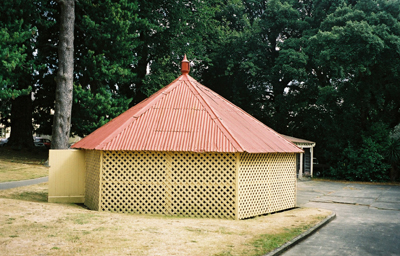
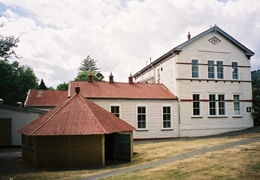
The Trout Hatchery was constructed under Huddleston's supervision near the Nelson Provincial Council Buildings. Completed in 1867, the structure, together with three ponds for holding the fish, cost just £180 2s 3d. Hatcheries were designed to protect ova from uneven temperatures, predators and light which hinder the hatching process. Buckland's hatchery is hexagonal in plan and constructed of timber. Covered in trelliswork, the hatchery was four metres high and featured a strong door and narrow window that allowed a dim light into the building. The corrugated iron roof was capped by a ventilator, which helped keep the building cool during hatching season. Originally, the centre of the hatchery was occupied by three large, lead trays lined with boiled gravel, according to Buckland's directions. The fish eggs were spread over the gravel and water was piped into the trays from a stream on the east side of the hatchery. The water flowed over the eggs and then out of the building and into the fish ponds constructed outside.
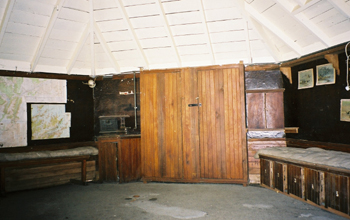
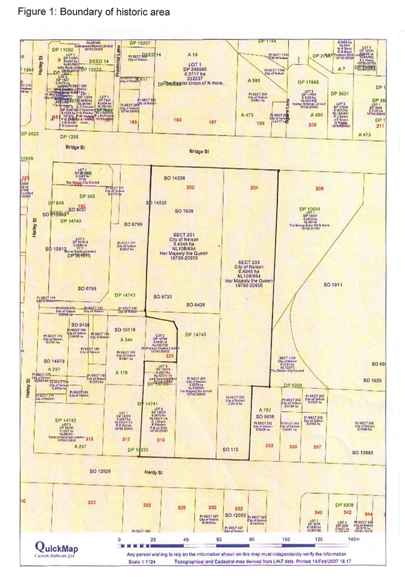
In 1868 Huddleston travelled to Australia to bring back the first brown trout ova. They would be hatched successfully in the new building and used to stock local streams. In 1874 Premier Sir Julius Vogel [1835-1899] tasted the fish at a public dinner and commented favourably on its flavour. Regulations by the Provincial Council protected the trout spawned by the Society and from 1876 licenses were required before fishing was permitted; a move that effectively prevented Maori from fishing for eels in their traditional grounds. In the 1890s, the society began meeting in the hatchery and, to accommodate this additional function, seating and a concrete floor were installed. By the early twentieth-century, the impetus that had driven acclimatisation began to wane as the negative impact of introducing foreign species into the New Zealand environment became better understood. However, the propagation of trout remained popular. The Trout Hatchery was used until 1929, when a new hatchery was constructed east of the building. The three fishponds were demolished but the hatchery was taken over by the Nelson Angler's Club and used as clubrooms until the 1970s. Used as a storage facility for several years after this date, the Trout Hatchery is now a recognised historic asset. Constructed on Crown land that was declared an historic reserve in 1991, the building is actively managed by the Department of Conservation.
The Trout Hatchery is of great national and international significance. It is a very rare, surviving example of a hatchery designed and constructed in the 1860s, the period when hatcheries were first being developed in both Europe and New Zealand. It is of particular interest as it was based on a design by Frank Buckland, who was instrumental in developing the artificial fish hatching process in England and is still commemorated annually in that country. The Trout Hatchery is of architectural and educational significance as it embodies nineteenth-century theories on the conditions necessary for hatching to take place. It is of considerable historical interest as tangible evidence of early settler aspirations to recreate 'a little England' in the New Zealand environment. It dates from an early period in the history of Pakeha settlement in New Zealand and forms part of a wider historical landscape of acclimatisation and propagation of foreign species in New Zealand, the legacy of which continues to impact severely on New Zealand's indigenous environment.