The northern South Island is known as Te Tau Ihu in Māori mythology: the prow of the waka from which the demigod Māui fished up Te Ika-a-Māui, the North Island. People have lived in the Tasman region since the 1300s. In the Golden Bay / Mohua district alone, archaeologists have recorded around 300 places where Māori were building pā, gardens, fishing settlements, urupā and middens. Placenames such as Tākaka, Parapara and Motueka are a legacy of the peoples’ Pacific Island ancestry.
In 1642, when Dutch explorer Abel Tasman’s ships arrived in Mohua, Ngāti Tūmatakōkiri were dominant in the area, having displaced earlier tribes. This first recorded encounter between Māori and Europeans, when 22 waka met Tasman’s two ships on the water, resulted in a violent clash and Tasman’s departure.
Around 1800, Ngāti Tūmatakōkiri were displaced by Ngāti Apa, Ngāti Kuia and Ngāi Tahu, with Ngāti Apa dominating the Golden Bay / Mohua district. Further changes occurred between 1828 and 1832, when taua of Tainui and Taranaki iwi came to Te Tau Ihu. A subsequent division of territory was determined, with Te Ātiawa, Ngāti Tama and Ngāti Rārua settling in Mohua. Today (2021) eight iwi are recognised as tangata whenua of Te Tau Ihu: Ngāti Tama ki Te Tau Ihu (of Tokomaru waka descent), Te Ātiawa o Te Waka-a-Māui (of Aotea or Kurahaupo), Ngāti Rārua, Ngāti Koata and Ngāti Toa Rangatira (of Tainui), and Ngāti Kuia, Rangitāne o Wairau, and Ngāti Apa ki te Rā Tō (of Kurahaupo).
The coastal area is important to all eight iwi. Onekaka, an inlet north of Tākaka at the mouth of the Ōtere River, was the location of a papakāinga under the gaze of the maunga Parapara which remains central to the lives and identities of Mohua hau kāinga Ngāti Tama ki Te Tau Ihu, Te Ātiawa o Te Waka-a-Māui, and Ngāti Rārua. Ngāti Kuia and Ngāti Apa also retain connections with Parapara and its coastal areas. Ancestral footprints are present in the archaeological remains of midden recorded around the Onekaka Inlet, signifying its importance as a mahinga kai. Onekaka was also an important communication point from which Te Ātiawa o Te Waka-a-Māui sent smoke signals to Motueka, the Marlborough Sounds and across to Taranaki.
A mineral-rich region
The many mineral resources of Te Tau Ihu have been appreciated and extracted by people for centuries. Pakohe (argillite) was used by Māori for tools and weapons; pounamu and flints were also important. Kōkōwai /red ochre (iron-rich haematite clay) from the Parapara-Onekaka area was highly valued as a body paint and decorative pigment, with spiritual associations to the blood of Papatūānuku. The story of Kaiwhakaruaki – a deadly taniwha who lived in the Parapara inlet, just north of Onekaka, and who was eventually defeated with a stratagem involving kōkōwai – may have deterred outsiders from taking too close an interest in the local mineral resources.
New Zealand Company colonists, who established the Nelson settlement in 1842, were also keen to capitalise on the mineral richness of the region. Copper and chromite were discovered in 1852 but proved to be scarce; gold was more plentiful, inspiring the name Golden Bay. Coal was mined between 1840 and 1913, but clay, limestone and marble were among the region’s more abundant minerals. The presence of iron ore in Golden Bay was also noted by European settlers, and in train with the Crown’s Waipounamu purchase, in 1852 superintendent of Nelson Mathew Richmond moved quickly to secure this important mineral deposit for the Crown, before Māori could realise its financial value. Richmond admitted his focus on minerals when negotiating the Waipounamu and Pakawau land purchases.
The backbone of the world we have built around us
Iron was a key element in industrial development, described as ‘the backbone of the world we have built around us.’ Utilised by people for at least 6000 years, around 2000 years ago its value as a resource increased when smelting technology advanced and ironworkers discovered it is a crucial ingredient in creating a much harder alloy: steel. Everyday life was especially transformed in the industrial revolution of the eighteenth and nineteenth centuries by the widespread employment of iron and steel for construction, machinery, tools and implements.
Iron mainly occurs as mineral ores, particularly as different types of iron oxides. The bulk of New Zealand’s iron prospecting has focused on exploiting titanomagnetite iron ore, readily available in the black ironsand found along the North Island’s west coast beaches. European settlers first attempted to smelt the ironsand in 1848 at New Plymouth, however the technicalities posed by the small grains of sand and the amount of titanium in the ore proved challenging. Efforts to extract the iron by smelting the sand in a blast furnace were repeatedly unsuccessful, for decades. The ore at Onekaka, in the form of rock-based limonite accessible from the ground surface, seemed to be a better way of starting an iron industry in New Zealand.
Exploiting the iron ore at Onekaka
The iron ore in Golden Bay lies in a belt between Onekaka and Parapara, parallel to the coast. It begins 1.2 kilometres inland of Parapara and stretches for 4.8 kilometres south into the hills behind Onekaka, 400 metres above sea level. The deposit consists mainly of limonite (limonitic iron ore, sometimes classed as ‘bog iron’), interspersed with patches of quartz and limestone. The ore deposits in the Onekaka-Parapara hills were used by enterprises such as the New Zealand Haematite Paint Company to produce red, yellow and orange pigments from the early 1870s. Their iron-oxide red paints became familiar throughout New Zealand from their use on all New Zealand Railways goods sheds and wagons, and many woolsheds and other buildings. Paint manufacturers continued to make use of the local oxide deposits until the early 1930s.
By 1874 the Nelson Provincial Council was promoting the potential benefits to the district’s population and income if the limonite deposits were developed into an iron smelting industry: the combination of limonite with limestone deposits, close to the coast, made this especially feasible. In the ensuing years, various companies formed to exploit the mineral, however were generally unsuccessful due to lack of capital. Most of these companies planned to smelt the iron elsewhere. The quality of the ore was demonstrated in 1891, when the Onehunga Iron Smelting Company successfully smelted 300 tons of the Onekaka limonite at their Auckland smelter, producing good quality pig iron bars. Hopes for a national industry rose even higher at the beginning of the twentieth century.
Onakaka Iron and Steel Company Limited
By 1920, however, New Zealand was still importing all of its pig iron (a crude state cast into bars directly from the blast furnace). That year, the Onakaka Iron and Steel Company Limited was incorporated. Bankrolled by wealthy Hawke’s Bay runholders including Mason and John Chambers, and Robert Donald Douglas McLean, the directors included the technical expertise of mining engineers. One, John Ambrose Heskett, had been central to ironsand smelting attempts in New Plymouth. After much perseverance, Heskett had had success–albeit on a small scale–developing the ‘Heskett Process’, which combined the sand with powdered coal to form lumps of ‘ferro-coke’ which could be smelted in a blast furnace. Heskett would become manager of the Onekaka Ironworks throughout its tenure as a private enterprise.
The Onakaka Iron and Steel Company acquired the prospecting leases of previous companies and secured a 53-acre site for their main works west of the Tākaka-Collingwood Highway, purchased from farmer Richard Scadden. A blast furnace was bought from the Taranaki Ironsand Company, via Heskett’s connections; this was part of over £42,000 expenditure on equipment. Construction of the ironworks began in early 1921, after more capital had been sought with a government loan.
Newspapers reported much excited attention. Politicians and commentators supported the endeavour as being vital to national security, and one that would ‘give birth to a new industry for New Zealand… From an economic point of view the value of this industry can hardly be exaggerated.’
Smelting began on 27 April 1922 and was judged to be ‘of splendid quality’. This must have provided only limited relief, as by then the price of pig iron had dropped dramatically: by 50 percent in just two years. A serious fire early in 1923 then caused a slight delay in getting up to full production.
Infrastructure
The raw materials necessary for smelting–the limonite ore and limestone–were obtained from adjacent open-cast pits 360 metres above the ironworks. Mining was done by hand, using explosives, air drills and sledgehammers. Workers lived in huts on site, walking the zigzag track down to the ironworks with relief at the end of their week-long shifts. The work was reportedly very tough and miserable.
The raw material was carried 2.4 kilometres downhill to the ironworks on an aerial ropeway, with buckets suspended from a wire cable. Buckets were emptied directly into a crusher. A belt conveyor moved the crushed and washed material to a bank of storage bins built into the hillside; these held the limonite, limestone, and coke that had been produced onsite by up to 30 beehive ovens. Trucks then loaded the correct mix of these three ingredients onto an inclined skipway, which fed into a hopper at the top of the blast furnace. The blast furnace was powered by three gas-fired boilers, which created steam to drive the blowers to superheat the material. The molten iron was tapped from the furnace at least twice a day, and cast into bars of pig iron weighing 50kg each (and from 1928-29 when a pipe plant was built, into pipes. The brittleness of cast iron made it most suitable for casting into bulky items). Fine ore rejects were processed for sale for gas purification; other waste was washed over the hillside.
Archaeologist Amanda Young has described the Onekaka Ironworks as being ‘essentially a town’, with its own post office, shop, engineering workshop, laboratory, and tennis court. A school was built nearby. The number of employees rose from 40 to around 150-170 people, who were housed in an accommodation camp nearby. The cookhouse was operated by Ngara and Dave Mason. Workers participated in the social life of the district, and the ironworks itself was something of a visitor attraction, especially at night when the furnace was tapped or slag was run off down the hill. Draughtsman and surveyor Graham Bell, who worked there in the late 1920s, reported that a number of Māori were employed at the ironworks, particularly at the coking ovens: ‘The work was semi-skilled, and they were proud of it. They were treated the same way as others and there were no racial distinctions or friction. Owen and I were welcome in their houses and got on well with them.’ More than one generation of the prominent Ward-Holmes family was employed at the ironworks, and Te Waari Ward-Holmes helped to build the Onekaka Wharf.
The wharf and tramline
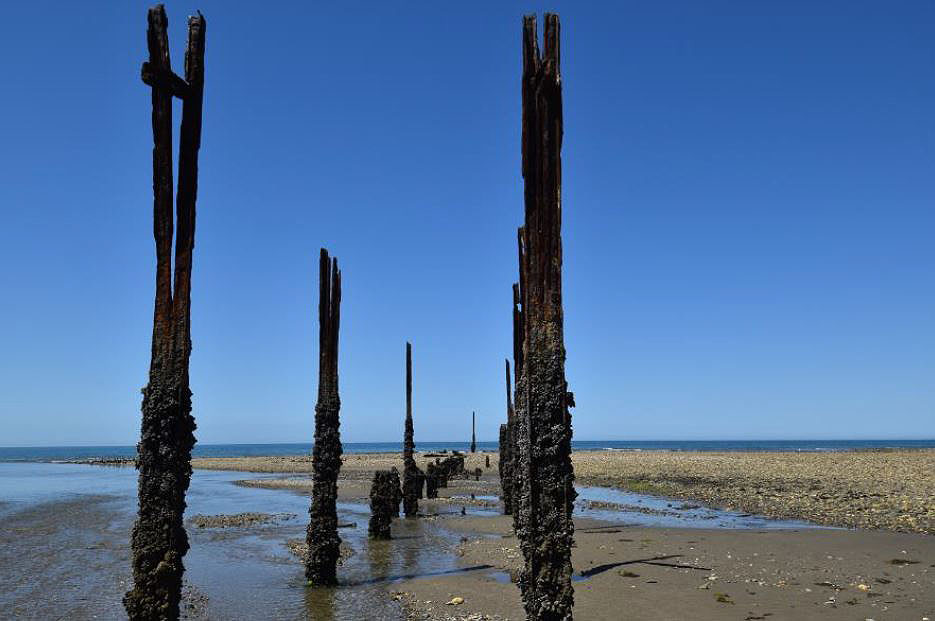
The proximity of the limonite ore so near to the coast suggested sea transportation was most efficient for getting the coal and infrastructure material to the ironworks, and the company’s iron products to domestic and international markets. Originally they used Skilton’s Wharf (built 1919) in the Onekaka Inlet, but the heavy loads soon demanded a purpose-built wharf. In 1923 the Onekaka Wharf was constructed, extending 1210 feet (368 metres) to deep water from the beach in front of long-time residents the Washbourns’ property. Designed by engineers Blair Mason, Lee & Owen, the wharf’s 12-inch thick birch and gum timber piles immediately came under attack from marine teredo borer, so piles were reinforced with reject tram rails from Wellington 22 months later.
In 1924 the company applied for permission to cross the main road with the construction of their tramline, designed by engineer James Bishop. The tramline, a steam-driven main-and-tail-haulage unit that could be converted to an endless ropeway, stretched along the length of the wharf before crossing the inlet on raised trestles, across farmland and passing under a concrete bridge built to carry the Tākaka-Collingwood Highway overhead. Coal was emptied directly into the tramline’s trucks from an elevated bin on the wharf; the tramline’s terminus at the ironworks was up an inclined ramp 54 feet (16 metres) high, so gravity could again assist with transferring each truck’s contents directly into the conveyor to the coking oven.
Challenge, diversification and expansion
Although government subsidies were increased in 1925, a slump in iron price in 1926 hit the company hard. Smelting operations were temporarily suspended due to the New Zealand market being flooded by cheaply imported pig iron from India. Heskett sought new markets in Australia, and newspapers reported on intense lobbying for increased state support, resulting in tariffs being imposed on imported iron. In an attempt to remain afloat and diversify the company installed a pipe-making plant in 1928-29. This required upgrades to the aerial ropeway, blast furnace, and coking ovens; extension of the wharf by 100 feet; and construction of a hydro-electric scheme.
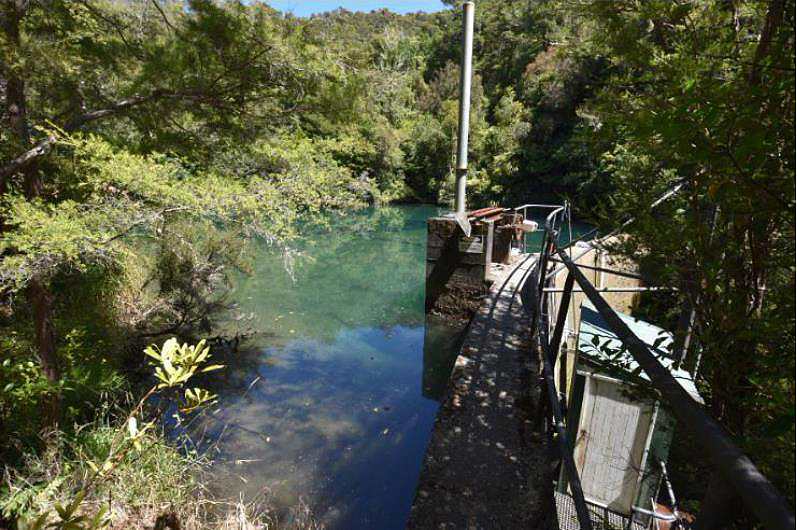
The ability to harness hydro-power was yet another advantage of the Onekaka site. The 10-metre high concrete arch dam, built in 1928-29, was located very near to the quarries, on the Onekaka River. An iron penstock took water from the dam 1.25 kilometres down to the power station, near the confluence of the river and Ironstone Creek. The Golden Bay Electric Power Board first applied to use power from the Onekaka Ironworks scheme in 1935, to meet growing demand for reticulated power. By 1937 the arrangement was in place, continuing until the Cobb Hydro-scheme became operational.
Perseverance unrewarded: the Company collapses
In 1930 the company’s application to extract coal from nearby Mount Burnett was approved, however that project was never fully realised as the coal seam soon ran out. The ironworks ‘seemed to be booming’, with pipes being sold throughout the country for sewage and water, and the Government Railway Workshops a longstanding customer of the iron, along with most of the country’s foundries. However, exporting was vital as plant capacity was 10,000 tons of iron per year, and local demand was only 4,000 tons. Australia was a good customer of the company’s soft iron–useful for stove-making–but by this time had imposed a duty of £3 per ton, which ate into profits.
The New Zealand market soon became saturated, and the Onekaka Ironworks couldn’t compete with cheaper iron produced overseas. The 1929 Depression also had a devastating effect. Soon after, the company was bankrupt, and went into liquidation in May 1931. Under the receivers, smelting continued sporadically but only until the end of May 1935, when the smelter was finally closed.
The State temporarily takes over
The Iron and Steel Industry Act 1937 authorised the government to establish a State steel industry. The Government was optimistic, still planning for an expanded iron and steel industry in Onekaka, even preparing to survey a surrounding town for a population of 2-3,000. The long-term plan was to smelt Taranaki ironsand at the ironworks, in addition to the limonite ore. The Onekaka Ironworks were duly acquired under the Public Works Act, and the company’s licence to occupy the Onekaka foreshore was revoked.
The ironworks assumed greater national significance with the outbreak of World War Two and were seen as a vital asset for self-sufficiency. In 1941 heavy machinery for the emergency reconditioning of the disused and deteriorated smelting equipment was shipped in. However, the war’s end saw the demand for pig iron drop, and re-surveying of the Onekaka ore deposits suggested there was not enough to justify the expenditure. The government decided to dispose of the ironworks.
The end of an era
A storm in 1945 damaged the Onekaka Wharf, and the state funded its repair. The wharf was still vital to local industry, being used to ship dolomite to fertiliser works at Huntly, as well as other local mineral products (fireclay, silica sand) to market. The Mt Burnett Coal Sales Company even arranged to buy the wharf in exchange for assistance with maintenance, however the deal fell through in 1950.
The government continued to spend money on the works until the early 1950s, by which time the smelter site was largely cleared. Before the smelter equipment was dismantled, however, the Onekaka ironworks featured one last time in the push to establish an efficient national steel industry. Exploitation of the West Coast’s titanomagnetite ironsand ore was back in focus, as international research now suggested the challenges of the titanium could be overcome with controlled slag composition and an electric arc furnace. The Department of Scientific and Industrial Research (DSIR) successfully trialled these methods at the Onekakā Ironworks in 1949, bringing in ironsand. However, electricity costs were still unfeasibly high, and it would be another 20 years until the ironsand steel industry got underway at Waikato North Head and Glenbrook in 1969.
In 1954 the main smelter site was officially alienated from the Crown estate, allowing its conversion into fee simple freehold properties. Subdivision ensued; by 2007 the change in use from industrial to residential was completed. The smelter buildings and equipment were either destroyed or dispersed around the district. The beehive coking ovens remained a feature of some pride for the locals, however the last of these reportedly disappeared in the 1980s.
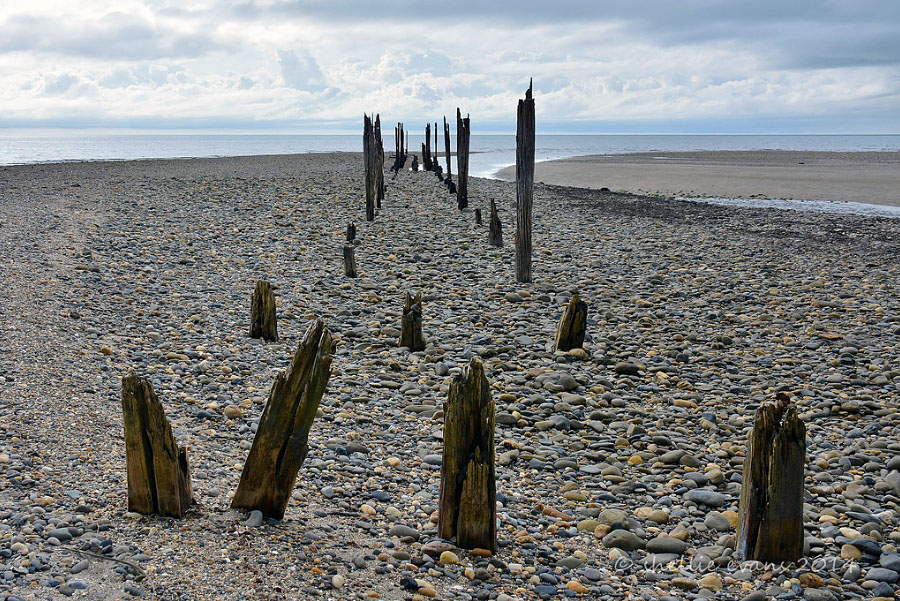
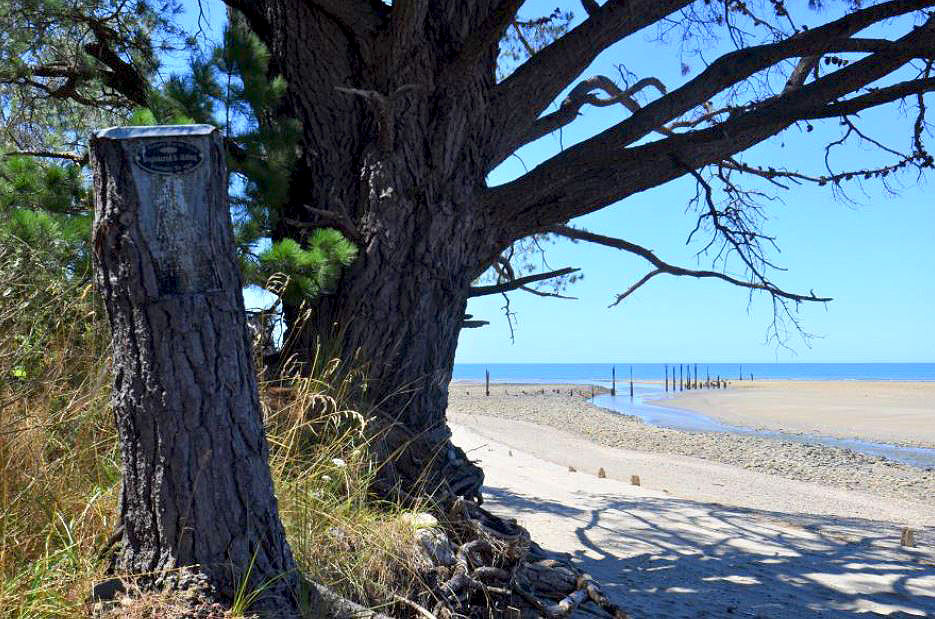
Lack of maintenance saw the wharf marked as a shipping hazard in the 1950s but demolition was deemed too expensive, so from 1965 onwards signage warned recreational fishers that access was at their own risk. Bays were gradually washed away by storms and piles became dangerously thin before the timber decking and superstructure fell off. The tramline all but disappeared, a few trestle piles crossing the Onekaka inlet the main reminder of its former route.
The Wharf: an evocative reminder of the ironworks
The deteriorated remains of the wharf are now the most readily visible remnant of the ironworks complex, and as such act as a memorial to the endeavour. The wharf has inspired artists, photographers, composers and poets since it was built. Golden Bay artist Enga Washbourn (1908-1988) painted it repeatedly through the mid-century decades, and her accomplished watercolours are also an interesting source of information about its changes from operational to abandoned. It also held special resonance for noted painter Doris Lusk (1916-1990), who discovered it in 1965 and returned frequently to paint many studies of the wharf throughout her life, once describing the structure as her ‘spiritual home’. Her paintings of Onekaka were important to the development of her experimental style with watercolours, and have been described by art historians as ‘deeply emotive… In Doris’ hands the wharf becomes a lost site, a place that’s purpose has rotted away with the evolution of economies and time.’ Lusk’s paintings inspired poet and founder of influential literary journal Landfall, Charles Brasch, to compose ‘Wharf at Onekaka’. In 1994 his poem was in turn set to music by composer David Griffiths. The wharf is promoted as one of the tourist attractions of the Nelson-Tasman region.