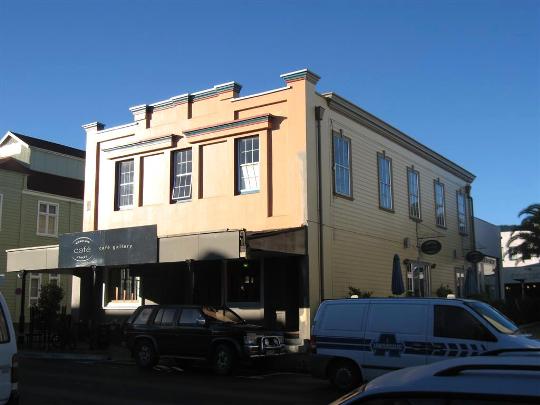
The former Morrison Sclanders and Co. Building, built in 1863, has historical significance for its association with one of Nelson’s earliest merchant companies. The firm operated for 60 years and its business and directors contributed to the development of the Nelson colony. The building also has architectural value as a design by William Beatson, whose oeuvre helped shape the character of Nelson’s built heritage landscape.
Twenty-five year old Glaswegian David Sclanders emigrated to Nelson in February 1842, among the first colonists to the fledgling settlement. He arrived with goods to sell, and immediately set up his trading stores at Auckland Point, later moving to Bridge Street. In London he had forged associations with the firm of Alexander Morrison & Co., and these links were important for his ongoing import-export, shipping, land agency and insurance business. Morrison and Sclanders also established the Bank of Nelson, which operated between 1848-1856. After David Sclanders returned to London in 1858, his nephew Alexander took over management and oversaw the business’ expansion through branches in Whanganui and Christchurch.
With business booming, the firm, known as Morrison Sclanders and Co. from around 1860, purchased a new site in Hardy Street in 1861 and contracted architect William Beatson to design warehouse premises with office and retail space. Beatson advertised for construction tenders in May 1863; James Henry won the contract. The building was completed by February 1864.
William Beatson (1807-1870), among the first practising architects to settle in Nelson, was one of only a few in New Zealand at that time who had trained at the Royal Academy in London. His designs for many of Nelson’s early churches, houses and commercial buildings showed innovation in having to adapt to the prevalence of timber as a building material. His drawings for the two-storeyed Morrison Sclanders and Co. warehouse demonstrate this, more strongly resembling traditional stone architecture with Italianate pilasters, corbelling, quoins and an ornate arched parapet with heraldic shield above the main entrance. The building that was actually built was a scaled-down version of this, with most of the ornamental features omitted. Double doors on the north elevation were flanked on each side by a multipaned window with bracketed sill. The west and east elevations featured five windows on each storey; quoins decorated each corner and a cornice hid the hipped roof from street view. An arched loggia sheltered the main entrance with three windows above; imitation keystones at the centre of each arch were echoed above each window in the building. The exterior weatherboards were ‘painted and sanded, not to imitate stone, but to preserve the work from atmospheric influences’.
Another of David Sclanders’ nephews, James, became the Nelson manager in 1874 and branched out into financing. Additional warehouse space (since demolished) was added to the rear of the original building in 1882. James Sclanders died in 1900, and in 1902 the firm was bought by stock and station agents Levin & Co., who traded from the site for many years. At some stage (probably early twentieth century) the northern façade was plastered and a new parapet was added; the loggia was replaced by a simple verandah with cast-iron posts. In 1964 the property was bought by the National Mortgage and Agency Company of New Zealand, then sold to neighbouring hardware merchants Wilkins and Field in 1975. It became part of the ‘Fashion Island’ (now ‘Morrison Square’) retail precinct development in 2007. The original firm is remembered by the ground floor tenants since 1998, Morri Street Café, and its location at the corner of Morrison Street, a roadway gifted to the city by Morrison Sclanders and Co. in 1865.
Twenty-five year old Glaswegian David Sclanders emigrated to Nelson in February 1842, among the first colonists to the fledgling settlement. He arrived with goods to sell, and immediately set up his trading stores at Auckland Point, later moving to Bridge Street. In London he had forged associations with the firm of Alexander Morrison & Co., and these links were important for his ongoing import-export, shipping, land agency and insurance business. Morrison and Sclanders also established the Bank of Nelson, which operated between 1848-1856. After David Sclanders returned to London in 1858, his nephew Alexander took over management and oversaw the business’ expansion through branches in Whanganui and Christchurch.
With business booming, the firm, known as Morrison Sclanders and Co. from around 1860, purchased a new site in Hardy Street in 1861 and contracted architect William Beatson to design warehouse premises with office and retail space. Beatson advertised for construction tenders in May 1863; James Henry won the contract. The building was completed by February 1864.
William Beatson (1807-1870), among the first practising architects to settle in Nelson, was one of only a few in New Zealand at that time who had trained at the Royal Academy in London. His designs for many of Nelson’s early churches, houses and commercial buildings showed innovation in having to adapt to the prevalence of timber as a building material. His drawings for the two-storeyed Morrison Sclanders and Co. warehouse demonstrate this, more strongly resembling traditional stone architecture with Italianate pilasters, corbelling, quoins and an ornate arched parapet with heraldic shield above the main entrance. The building that was actually built was a scaled-down version of this, with most of the ornamental features omitted. Double doors on the north elevation were flanked on each side by a multipaned window with bracketed sill. The west and east elevations featured five windows on each storey; quoins decorated each corner and a cornice hid the hipped roof from street view. An arched loggia sheltered the main entrance with three windows above; imitation keystones at the centre of each arch were echoed above each window in the building. The exterior weatherboards were ‘painted and sanded, not to imitate stone, but to preserve the work from atmospheric influences’.
Another of David Sclanders’ nephews, James, became the Nelson manager in 1874 and branched out into financing. Additional warehouse space (since demolished) was added to the rear of the original building in 1882. James Sclanders died in 1900, and in 1902 the firm was bought by stock and station agents Levin & Co., who traded from the site for many years. At some stage (probably early twentieth century) the northern façade was plastered and a new parapet was added; the loggia was replaced by a simple verandah with cast-iron posts. In 1964 the property was bought by the National Mortgage and Agency Company of New Zealand, then sold to neighbouring hardware merchants Wilkins and Field in 1975. It became part of the ‘Fashion Island’ (now ‘Morrison Square’) retail precinct development in 2007. The original firm is remembered by the ground floor tenants since 1998, Morri Street Café, and its location at the corner of Morrison Street, a roadway gifted to the city by Morrison Sclanders and Co. in 1865.