

In the early 1920s, the Lawrence and wider Tuapeka communities banded together to fund a memorial to commemorate the loss of those who had served their country, choosing a prominent site in Lawrence at the western edge of the town. The McKinlay family bought the land on which stood derelict the Commercial Hotel and neighbouring stables. The site was cleared, and a monument erected after fundraising by public subscription. The Tuapeka Fallen Soldiers Committee, of which J.B. McKinlay was president, organised the planning and construction of the memorial.
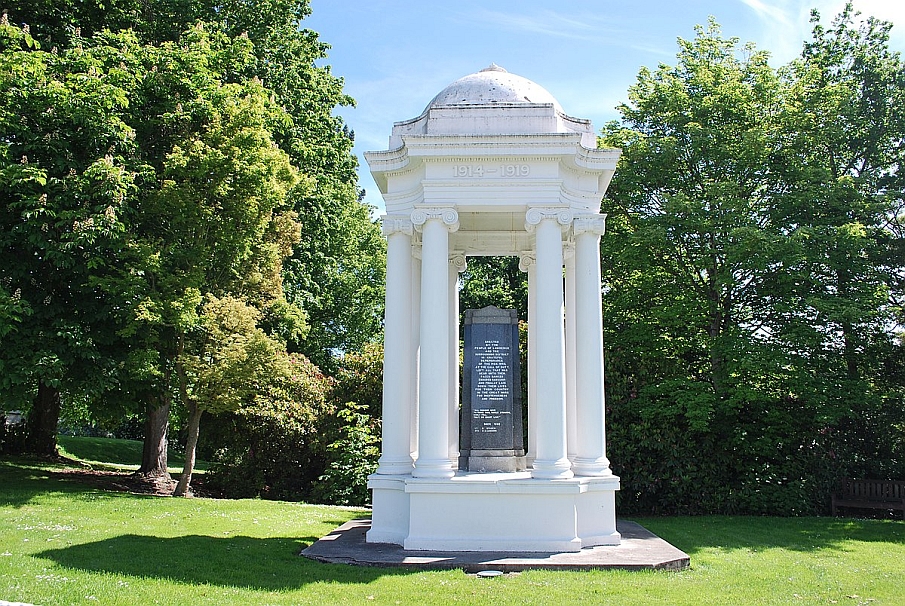
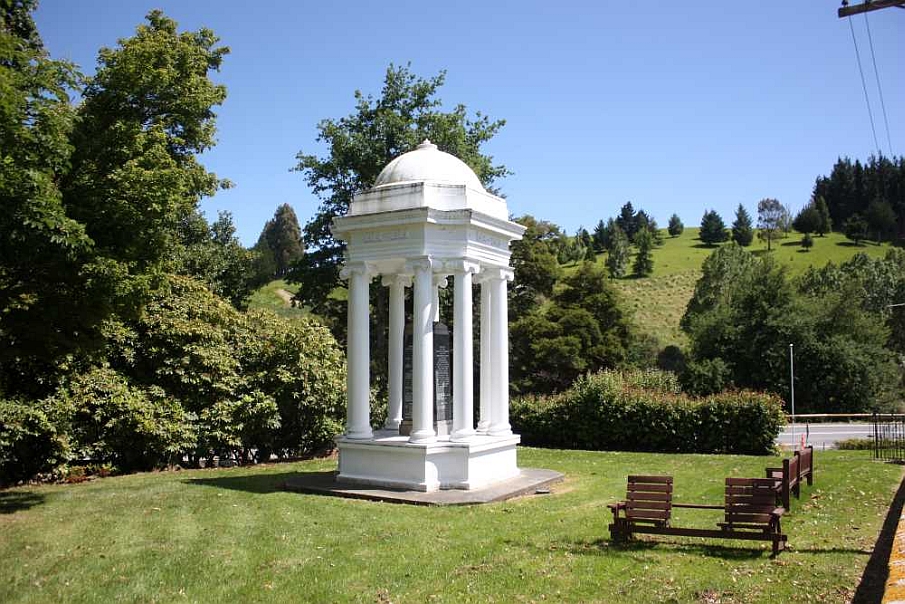
Designed by Dunedin architect Leslie Coombs, and built by A.E. Tilleyshort, the classically styled cupola-topped memorial shelters an obelisk inscribed with the names of those who lost their lives. The memorial is set within the Peace Garden, where a tree or shrub was planted for each soldier. On the corner, close to the main road, there is a flagpole where the flag is raised during Anzac Day services.
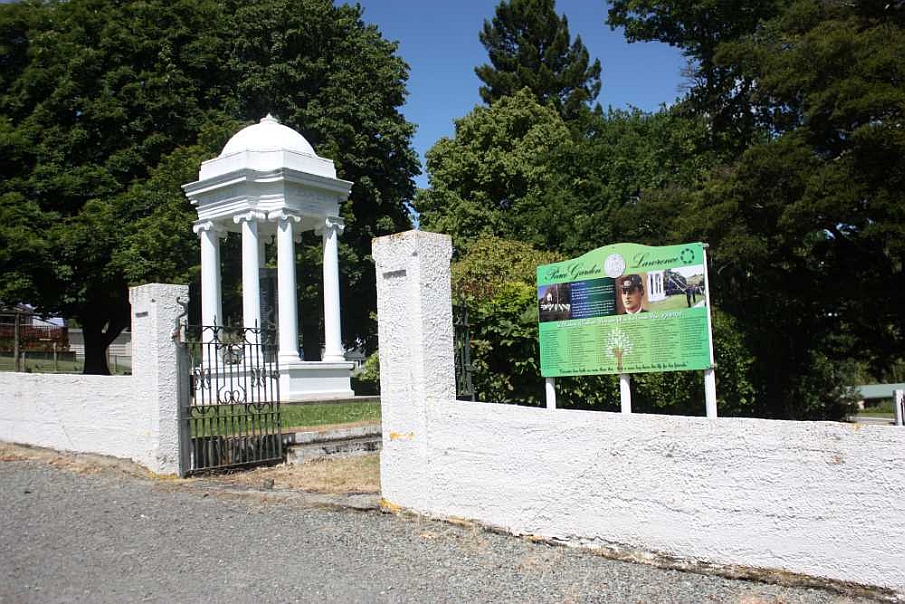
The paired columns beneath the memorial’s cupola rest on an octagonal base. Granite slabs mounted on the obelisk are inscribed with the names of those who died in the South African War, World War One, and World War Two. The inscription on the east face of the obelisk reads: ‘Erected by the people of Lawrence and the surrounding district in grateful remembrance of the men, who, at the call of duty, left all that was dear unto them, faced danger, endured hardship, and finally laid down their lives for their country in the great wars for righteousness and freedom.’ In relief, beneath the cornice, reads ‘1914-1919’ on the four faces of the monument. A stuccoed wall surrounds the garden. There are three gates into the garden – a pair in Art Nouveau style at the main entrance from Peel Street, a similar but smaller gate off Ross Place, and a single gate further south on Peel Street with an Art Deco sunburst motif.
In 2014, the Lawrence War Memorial and Peace Garden remains a prominent landmark in this small Clutha town.
List Entry Information
Status
Listed
List Entry Status
Historic Place Category 2
Access
Able to Visit
List Number
5183
Date Entered
17th September 1992
Date of Effect
17th September 1992
City/District Council
Clutha District
Region
Otago Region
Extent of List Entry
Extent includes the land described as Secs 1‐3, Pt Sec 1A, Sec 2A, Sec 2B, Blk I, Town of Lawrence (RTs OT8B/504, OT226/42, OT8B/6, OT301/80, and OT4A/48), Otago Land District, and the Peace Garden, War Memorial, wall and gates, thereon.
Legal description
Secs 1‐3, Pt Sec 1A, Sec 2A, Sec 2B, Blk I, Town of Lawrence (RTs OT8B/504, OT226/42, OT8B/6, OT301/80, and OT4A/48), Otago Land District
Status
Listed
List Entry Status
Historic Place Category 2
Access
Able to Visit
List Number
5183
Date Entered
17th September 1992
Date of Effect
17th September 1992
City/District Council
Clutha District
Region
Otago Region
Extent of List Entry
Extent includes the land described as Secs 1‐3, Pt Sec 1A, Sec 2A, Sec 2B, Blk I, Town of Lawrence (RTs OT8B/504, OT226/42, OT8B/6, OT301/80, and OT4A/48), Otago Land District, and the Peace Garden, War Memorial, wall and gates, thereon.
Legal description
Secs 1‐3, Pt Sec 1A, Sec 2A, Sec 2B, Blk I, Town of Lawrence (RTs OT8B/504, OT226/42, OT8B/6, OT301/80, and OT4A/48), Otago Land District
Why is this place significant?
Historic Significance
Historical Significance or Value The war memorial in Lawrence provides a visible reminder of the major impact both World War I and II had on small communities throughout New Zealand.
Physical Significance
ARCHITECTURAL QUALITY: The erection of war memorials was "arguably the largest act of artistic patronage that this society has ever indulged in" (C Maclean & J Phillips, 1990, p. 9). The Lawrence memorial is one of approximately five hundred in New Zealand which commemorate the sacrifices made during World War I and its form was clearly chosen because ornamental memorials were considered more expressive of the ideals of war than utilitarian ones, following that conflict. Most memorials to those who died in combat during World War I were erected by local communities and 'prominent intersections were the most popular choice of all for war memorials in small towns' (Ibid., p. 94). Memorials in garden settings were often enclosed by a fence or chain to indicate the sacred nature of the ground on which they stood. The form of the Lawrence War Memorial is an unusual one in New Zealand but it may also be seen in the memorials at Hokitika, Granity, Milton and Featherston. Associated with classical temple and shrine architecture, as well as triumphal Greek and Roman structures, the cupola style memorial at Lawrence is considered by Dr Jock Phillips to be a "very beautiful and distinctive (one, and) of considerable architectural merit" (Letter to author, 25 March 1991). TOWNSCAPE/LANDMARK VALUE: Overlooking State Highway 8 as it passes through Lawrence, the war memorial is a prominent feature of the township because of its size, site and white colouration.
Why is this place significant?
Historic Significance
Historical Significance or Value The war memorial in Lawrence provides a visible reminder of the major impact both World War I and II had on small communities throughout New Zealand.
Physical Significance
ARCHITECTURAL QUALITY: The erection of war memorials was "arguably the largest act of artistic patronage that this society has ever indulged in" (C Maclean & J Phillips, 1990, p. 9). The Lawrence memorial is one of approximately five hundred in New Zealand which commemorate the sacrifices made during World War I and its form was clearly chosen because ornamental memorials were considered more expressive of the ideals of war than utilitarian ones, following that conflict. Most memorials to those who died in combat during World War I were erected by local communities and 'prominent intersections were the most popular choice of all for war memorials in small towns' (Ibid., p. 94). Memorials in garden settings were often enclosed by a fence or chain to indicate the sacred nature of the ground on which they stood. The form of the Lawrence War Memorial is an unusual one in New Zealand but it may also be seen in the memorials at Hokitika, Granity, Milton and Featherston. Associated with classical temple and shrine architecture, as well as triumphal Greek and Roman structures, the cupola style memorial at Lawrence is considered by Dr Jock Phillips to be a "very beautiful and distinctive (one, and) of considerable architectural merit" (Letter to author, 25 March 1991). TOWNSCAPE/LANDMARK VALUE: Overlooking State Highway 8 as it passes through Lawrence, the war memorial is a prominent feature of the township because of its size, site and white colouration.
Construction Professional
Name
Coombs, Leslie D (1885-1952)
Type
Architect
Biography
Leslie Coombs was born and educated in Dunedin where he served his articles with J L Salmond. After working for Joshua Charlesworth in Wellington Coombs visited England in the early 1910s and then entered into a brief partnership with Edmund Anscombe on his return to Dunedin. In the mid-1920s Coombs again partnered with another architect, J H White, and it was at this time (1925-6) that he designed the Lawrence and Invercargill war memorials. With the exception of a nine year period spent working as the Building Surveyor for the Dunedin City Council (1932-41) Coombs spent most of his career in private practice designing educational, memorial, industrial and residential buildings, including Southland Girls' High School and the Science Building and War Memorial at Otago Boys' High School. Coombs promoted the establishment of the Architectural Students' Association and was the assessor of the 1920 design competition for Christchurch's Bridge of Remembrance. (Index of NZ Architects, University of Canterbury).
Name
A.E. Tillyshort
Type
Builder
Biography
No biography is currently available for this construction professional
Construction Details
Start Year
1924
Finish Year
1925
Type
Original Construction
Construction Materials
Concrete monument, sheltering a stone obelisk, stands in a garden setting enclosed by a stuccoed brick or concrete fence with wrought iron gates.
Notable Features
The inscription "1914 - 1919" may appear to be anomalous but this was in fact quite common on World War I memorials as it was not until 1919 that many of the soldiers who fought in that war returned to New Zealand.
Construction Professional
Name
Coombs, Leslie D (1885-1952)
Type
Architect
Biography
Leslie Coombs was born and educated in Dunedin where he served his articles with J L Salmond. After working for Joshua Charlesworth in Wellington Coombs visited England in the early 1910s and then entered into a brief partnership with Edmund Anscombe on his return to Dunedin. In the mid-1920s Coombs again partnered with another architect, J H White, and it was at this time (1925-6) that he designed the Lawrence and Invercargill war memorials. With the exception of a nine year period spent working as the Building Surveyor for the Dunedin City Council (1932-41) Coombs spent most of his career in private practice designing educational, memorial, industrial and residential buildings, including Southland Girls' High School and the Science Building and War Memorial at Otago Boys' High School. Coombs promoted the establishment of the Architectural Students' Association and was the assessor of the 1920 design competition for Christchurch's Bridge of Remembrance. (Index of NZ Architects, University of Canterbury).
Name
A.E. Tillyshort
Type
Builder
Biography
No biography is currently available for this construction professional
Construction Details
Start Year
1924
Finish Year
1925
Type
Original Construction
Construction Materials
Concrete monument, sheltering a stone obelisk, stands in a garden setting enclosed by a stuccoed brick or concrete fence with wrought iron gates.
Notable Features
The inscription "1914 - 1919" may appear to be anomalous but this was in fact quite common on World War I memorials as it was not until 1919 that many of the soldiers who fought in that war returned to New Zealand.
ARCHITECTURAL DESCRIPTION: The Lawrence War Memorial takes the form of a classical cupola supported by paired columns which rest upon an octagonal base. Overlooking the intersection of Ross Place and Peel Street, the memorial is the focal point of a garden to which access is provided by three gates. The main entrance to the Peace Garden is off Peel Street where paired gates in an Art Nouveau style are hung from brick or concrete supports. A single gate off Ross Place is in a similar style but another single gate further south along Peel Street would appear to have been erected at a later time as it features an Art Deco sun-burst motif. The memorial itself is 7.62 metres high and 4.88 metres wide. Ionic capitals crown the eight columns which support an entablature and the dome. Beneath the cornice which carries the drum of the dome is a frieze, decorated with an egg and dart moulding, and which bears the inscription '1914 - 1919' in relief on the four principal faces of the monument. The dome, which has a flat ceiling, shelters a stone obelisk upon which is carved a dedicatory inscription and the names of the local men who died in World War I and World War II. Near the monument, on a lower level of the Peace Garden, stands a flagpole which is used during ANZAC Day 'celebrations' at the site. MODIFICATIONS: The names of local men killed whilst serving in World War II were added to the monument at a later date.
ARCHITECTURAL DESCRIPTION: The Lawrence War Memorial takes the form of a classical cupola supported by paired columns which rest upon an octagonal base. Overlooking the intersection of Ross Place and Peel Street, the memorial is the focal point of a garden to which access is provided by three gates. The main entrance to the Peace Garden is off Peel Street where paired gates in an Art Nouveau style are hung from brick or concrete supports. A single gate off Ross Place is in a similar style but another single gate further south along Peel Street would appear to have been erected at a later time as it features an Art Deco sun-burst motif. The memorial itself is 7.62 metres high and 4.88 metres wide. Ionic capitals crown the eight columns which support an entablature and the dome. Beneath the cornice which carries the drum of the dome is a frieze, decorated with an egg and dart moulding, and which bears the inscription '1914 - 1919' in relief on the four principal faces of the monument. The dome, which has a flat ceiling, shelters a stone obelisk upon which is carved a dedicatory inscription and the names of the local men who died in World War I and World War II. Near the monument, on a lower level of the Peace Garden, stands a flagpole which is used during ANZAC Day 'celebrations' at the site. MODIFICATIONS: The names of local men killed whilst serving in World War II were added to the monument at a later date.
Historical and Associated Iwi / Hapū / Whānau
Completion Date
3rd March 2015
Report Written By
Heather Bauchop
Information Sources
MacLean, 1990
Chris MacLean and Jock Phillips, The Sorrow and the Pride: New Zealand War Memorials, Wellington, 1990
Mayhew, 1949
W.R. Mayhew, Tuapeka: The Land and Its People: A Social History of the Borough of Lawrence and its Surrounding Districts, Otago Centennial Historical Publications, Dunedin, 1949
Porter, 1983
Frances Porter (ed), Historic Buildings of Dunedin, South Island, Methuen, Auckland, 1983.
Coombs, 1918-19
Leslie Coombs, ‘Monuments’, in Proceedings 1918-19 Vol. No. II, New Zealand Institute of Architects, p. 36.
Other Information
Please note that entry on the New Zealand Heritage List/Rarangi Korero identifies only the heritage values of the property concerned, and should not be construed as advice on the state of the property, or as a comment of its soundness or safety, including in regard to earthquake risk, safety in the event of fire, or insanitary conditions. A fully referenced upgrade report is available on request from the Otago/Southland Office of Heritage New Zealand
Historical and Associated Iwi / Hapū / Whānau
Completion Date
3rd March 2015
Report Written By
Heather Bauchop
Information Sources
MacLean, 1990
Chris MacLean and Jock Phillips, The Sorrow and the Pride: New Zealand War Memorials, Wellington, 1990
Mayhew, 1949
W.R. Mayhew, Tuapeka: The Land and Its People: A Social History of the Borough of Lawrence and its Surrounding Districts, Otago Centennial Historical Publications, Dunedin, 1949
Porter, 1983
Frances Porter (ed), Historic Buildings of Dunedin, South Island, Methuen, Auckland, 1983.
Coombs, 1918-19
Leslie Coombs, ‘Monuments’, in Proceedings 1918-19 Vol. No. II, New Zealand Institute of Architects, p. 36.
Other Information
Please note that entry on the New Zealand Heritage List/Rarangi Korero identifies only the heritage values of the property concerned, and should not be construed as advice on the state of the property, or as a comment of its soundness or safety, including in regard to earthquake risk, safety in the event of fire, or insanitary conditions. A fully referenced upgrade report is available on request from the Otago/Southland Office of Heritage New Zealand
Current Usages
Uses: Commemoration
Specific Usage: Memorial - South African War
Uses: Commemoration
Specific Usage: Memorial - World War One
Uses: Commemoration
Specific Usage: Memorial - World War Two
Uses: Commemoration
Specific Usage: Memorial gate/fence/wall/arch
Web Links
description: The Memorials Register, New Zealand History Online, Ministry for Culture and Heritage.
Current Usages
Uses: Commemoration
Specific Usage: Memorial - South African War
Uses: Commemoration
Specific Usage: Memorial - World War One
Uses: Commemoration
Specific Usage: Memorial - World War Two
Uses: Commemoration
Specific Usage: Memorial gate/fence/wall/arch
Web Links
description: The Memorials Register, New Zealand History Online, Ministry for Culture and Heritage.
Location
Sign up to hear more
Get the latest heritage news, features and events delivered
straight to your inbox.
