

The land on which this building was built was originally part of an area reserved for the public buildings of the General Government in 1867, which included the County Council Offices, court buildings, the jail and police station, among services. The first court building was built in 1866. A new building was proposed to provide a suitable location for Supreme Court sittings. The first building was handed over to the postmaster general.
Dunedin architect David Ross designed the new building. He advertised for tenders for the construction of the stone and concrete court house in January 1874. The building was complete by the middle of 1875. The Otago Witness reported the new building had an ‘imposing appearance’ making it ‘quite an ornament to this leading goldfields town of Otago.’ With its mixed ‘Roman and Grecian style and handsome colonnade on its raised site above Lawrence’s main street, it was immediately a landmark. The contractor was Lawrence builder Alexander Humphrey for price of around £2,300.
Ross’ use of concrete was innovative. He experimented with making the roof of the colonnade from solid concrete, however his first attempt was unsuccessful, with the structure collapsing when the framing and supports were removed. He rebuilt the roof successfully. The court room was 44 feet by 22 feet [13.4 by 6.7 metres] with a high stud, lit by eight double side lights and two gable lights. The ventilation system was a special feature, with flues connecting the interior, the apertures covered with perforated zinc. The ventilator in the ceiling was an ornamental feature with floral mouldings. The bench and the jury box were at the east end of the hall on a raised platform. Behind the platform was the Judge’s retiring room. Other rooms accommodated the jury, witnesses, counsel, as well as a ‘semi-double apartment’ for the Clerk of the Bench and the Gold Receiver. A further chamber was used for a Land office and draughting room, connected to a strong room. The strong room was ten feet by six feet [3 by 1.8 metres]. The whole of the strong room was built of nine-inch concrete [23 centimetres]. All the corridors were laid with Portland cement. The interior fittings and linings were red beech milled at Tuapeka Mouth. The building was constructed of stone and brick, excepting the heads, lintels, cills, and mullions; also the colonnade, its component parts, pilasters, façade and roof, which were composed of Portland cement. The roof was covered with Welsh slates. Tenders for fittings were advertised in the Provincial Government Gazette in May 1876. The court was not occupied until late 1876. The survey offices occupied a wing of the building.
The court was closed on 31 March 1953. The building was occupied by various government department offices until it was sold to the Otago Presbyterian Board of Property in the 1970s. It has been vacant for some years. In later years, some of the interior fabric has been altered or removed. In 2015, it is largely vacant.
List Entry Information
Status
Listed
List Entry Status
Historic Place Category 1
Access
Private/No Public Access
List Number
5184
Date Entered
14th February 1991
Date of Effect
14th February 1991
City/District Council
Clutha District
Region
Otago Region
Extent of List Entry
Extent includes the land described as Sec 4 Blk LXVI Town of Lawrence (RT OT409/42), Otago Land District, and the building known as the Lawrence Court House (Former) thereon.
Legal description
Sec 4 Blk LXVI Town of Lawrence (RT OT409/42), Otago Land District
Status
Listed
List Entry Status
Historic Place Category 1
Access
Private/No Public Access
List Number
5184
Date Entered
14th February 1991
Date of Effect
14th February 1991
City/District Council
Clutha District
Region
Otago Region
Extent of List Entry
Extent includes the land described as Sec 4 Blk LXVI Town of Lawrence (RT OT409/42), Otago Land District, and the building known as the Lawrence Court House (Former) thereon.
Legal description
Sec 4 Blk LXVI Town of Lawrence (RT OT409/42), Otago Land District
Why is this place significant?
Historic Significance
Historical Significance or Value Lawrence became the commercial and administrative centre of the Tuapeka district following the discovery of gold in Gabriel's Gully in 1861. The town's former courthouse stands as a visible reminder of the crucial role played by the goldfield's wardens during the gold rush era and of Lawrence's importance as a mining and farming centre in the late nineteenth century.
Physical Significance
ARCHITECTURAL QUALITY: Within the context of late nineteenth century New Zealand public architecture this former courthouse is most unusual because it would appear to have been inspired by the Georgian and Regency style domestic and public buildings of eastern Australia. The courthouse in Windsor, New South Wales (Francis Greenway, 1819) may be cited as a particularly good example of the type of building which seems to have provided David Ross with a model, both with regard to planning and style, on which to base the Lawrence courthouse. Even the colour and treatment of the building's cement cladding recalls the sandstone commonly used for the construction of many early nineteenth century public buildings in the eastern states of Australia. In addition to the singular style of this building, David Ross' use of mass concrete for the construction of the colonnade is particularly significant. The development of monolithic concrete construction was still in its experimental phase during the 1870s in New Zealand and Ross may therefore be considered as a pioneer in this field. TOWNSCAPE/LANDMARK VALUE: Standing within the Colonsay Street Conservation Area the former Warden's Court makes a major contribution to the Lawrence streetscape both because of its prominent siting and unusual appearance. The building's importance within the townscape is further enhanced by its proximity to the former Post Office building which was designed by R.A. Lawson (c.1870).
Why is this place significant?
Historic Significance
Historical Significance or Value Lawrence became the commercial and administrative centre of the Tuapeka district following the discovery of gold in Gabriel's Gully in 1861. The town's former courthouse stands as a visible reminder of the crucial role played by the goldfield's wardens during the gold rush era and of Lawrence's importance as a mining and farming centre in the late nineteenth century.
Physical Significance
ARCHITECTURAL QUALITY: Within the context of late nineteenth century New Zealand public architecture this former courthouse is most unusual because it would appear to have been inspired by the Georgian and Regency style domestic and public buildings of eastern Australia. The courthouse in Windsor, New South Wales (Francis Greenway, 1819) may be cited as a particularly good example of the type of building which seems to have provided David Ross with a model, both with regard to planning and style, on which to base the Lawrence courthouse. Even the colour and treatment of the building's cement cladding recalls the sandstone commonly used for the construction of many early nineteenth century public buildings in the eastern states of Australia. In addition to the singular style of this building, David Ross' use of mass concrete for the construction of the colonnade is particularly significant. The development of monolithic concrete construction was still in its experimental phase during the 1870s in New Zealand and Ross may therefore be considered as a pioneer in this field. TOWNSCAPE/LANDMARK VALUE: Standing within the Colonsay Street Conservation Area the former Warden's Court makes a major contribution to the Lawrence streetscape both because of its prominent siting and unusual appearance. The building's importance within the townscape is further enhanced by its proximity to the former Post Office building which was designed by R.A. Lawson (c.1870).
Construction Professional
Name
Ross, David
Type
Architect
Biography
David Ross (1827-1908) was one of a significant number of architects who came to New Zealand from Australia in the early 1860s prompted by the news of the Otago gold rushes. Born in Scotland, Ross worked in Victoria in the late 1850s before settling in Dunedin in c.1862, whereupon he entered into a brief partnership with William Mason (1810-97). After establishing his own practice, Ross designed the Congregational Church (1863-64), Dunedin's oldest ecclesiastical building, Fernhill house (1867) which is now home to the Dunedin Club, and the central wing of the Otago Museum (1876-77). In the mid-1860s Ross worked briefly in Hokitika (1866) before returning to Dunedin and in 1870 he applied for a patent for the frames and apparatus required for the construction of works in concrete. This application lapsed but it is nevertheless significant as it places Ross at the forefront of the development of mass concrete construction in this country. In addition to his professional responsibilities David Ross was also a member of the first Dunedin City Council (1865-66) and in 1876 he became the first president of the joint Institute of Engineers and Architects in Otago. Ross may have returned to Australia in the early 1890s and it would appear that he spent the rest of his life living in the United States and Japan.
Name
Humphrey, Alexander
Type
Builder
Biography
Completed the malt house and kiln in 1874 at the Black Horse Brewery Site (Black Horse Brewery Site; Register no. 9598).
Construction Details
Start Year
1875
Type
Original Construction
Type
Modification
Description
Ceiling lowered in former courtroom to create second floor at clerestory level.
Type
Modification
Description
Removal of some interior fabric
Period
2000s
Start Year
1953
Type
Other
Description
Courthouse closed
Construction Materials
Brick structure with cement cladding, timber window sills and frames, corrugated iron roof. Mass concrete colonnade.
Notable Features
The concrete colonnade.
Construction Professional
Name
Ross, David
Type
Architect
Biography
David Ross (1827-1908) was one of a significant number of architects who came to New Zealand from Australia in the early 1860s prompted by the news of the Otago gold rushes. Born in Scotland, Ross worked in Victoria in the late 1850s before settling in Dunedin in c.1862, whereupon he entered into a brief partnership with William Mason (1810-97). After establishing his own practice, Ross designed the Congregational Church (1863-64), Dunedin's oldest ecclesiastical building, Fernhill house (1867) which is now home to the Dunedin Club, and the central wing of the Otago Museum (1876-77). In the mid-1860s Ross worked briefly in Hokitika (1866) before returning to Dunedin and in 1870 he applied for a patent for the frames and apparatus required for the construction of works in concrete. This application lapsed but it is nevertheless significant as it places Ross at the forefront of the development of mass concrete construction in this country. In addition to his professional responsibilities David Ross was also a member of the first Dunedin City Council (1865-66) and in 1876 he became the first president of the joint Institute of Engineers and Architects in Otago. Ross may have returned to Australia in the early 1890s and it would appear that he spent the rest of his life living in the United States and Japan.
Name
Humphrey, Alexander
Type
Builder
Biography
Completed the malt house and kiln in 1874 at the Black Horse Brewery Site (Black Horse Brewery Site; Register no. 9598).
Construction Details
Start Year
1875
Type
Original Construction
Type
Modification
Description
Ceiling lowered in former courtroom to create second floor at clerestory level.
Type
Modification
Description
Removal of some interior fabric
Period
2000s
Start Year
1953
Type
Other
Description
Courthouse closed
Construction Materials
Brick structure with cement cladding, timber window sills and frames, corrugated iron roof. Mass concrete colonnade.
Notable Features
The concrete colonnade.
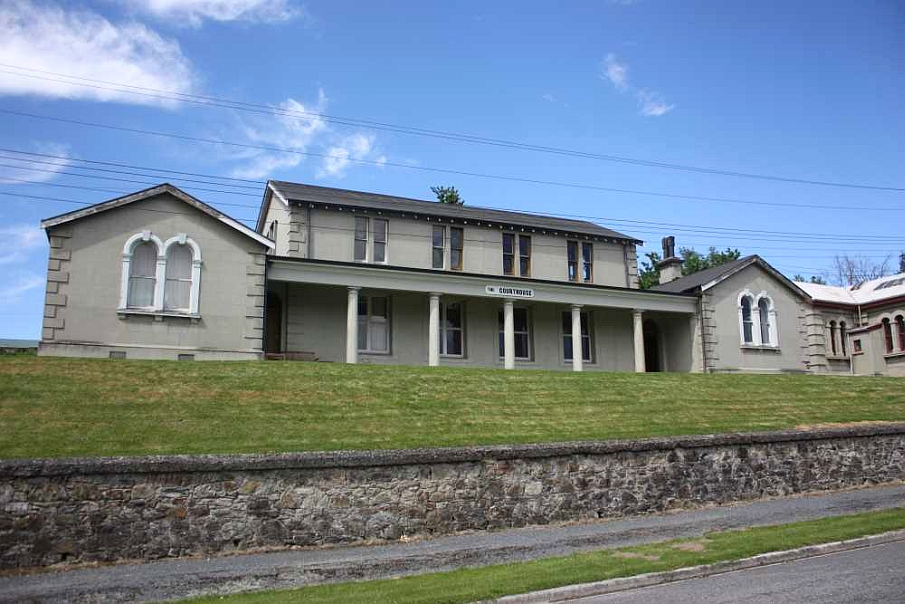
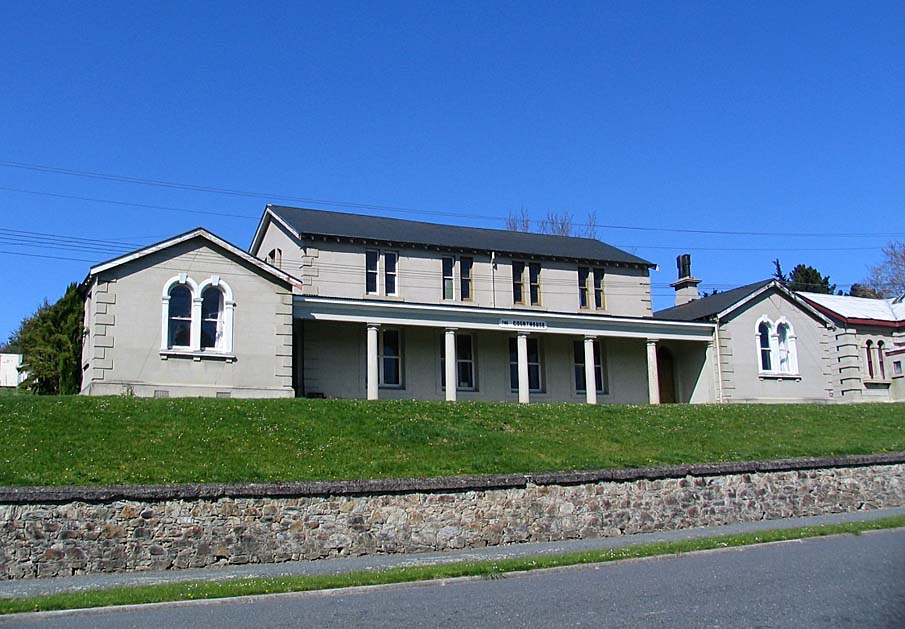
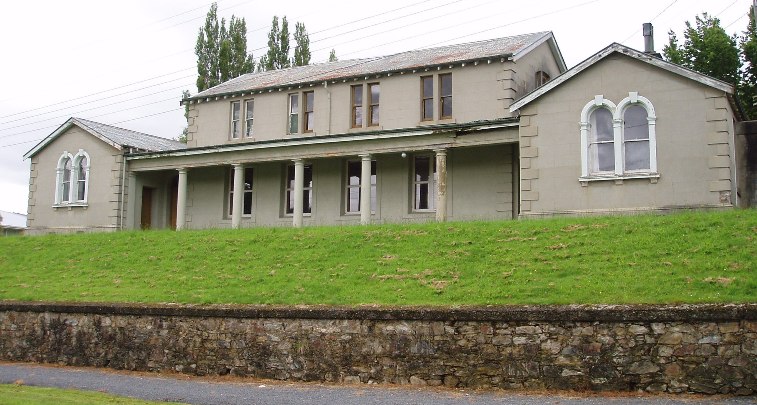
ARCHITECTURAL DESCRIPTION: The former Warden's Court at Lawrence stands on an elevated site overlooking the town's main thoroughfare to the north. Designed in the Australian Regency style, the building is symmetrical about a central courtroom, formerly lit by a clerestory (see below), which is flanked by single storey wings at the sides and rear. Five Doric columns form a colonnade which extends along the front of the building and is terminated by pilasters applied to the inner walls of the side wings. The entire building is clad in cement which has been excised to imitate masonry construction and quoins are also used on every elevation to convey this effect. Simple sash windows light the building but its austere rectilinearity is somewhat relieved by the paired arched windows which are set into the front elevations of the side wings and the three-part arched windows which pierce the gable ends of the former clerestory. External elements which give the building a vaguely domestic appearance include the eaves brackets beneath the gabled roofs of each wing and the panelled doors at the front and rear of the building which are crowned by arched fanlights. Access to the former courtroom is provided by two such doors at either end of the verandah which has a concrete floor and a timber lined ceiling. Beyond the courtroom two rooms are located in the rear wing, one of them a kitchen, and the intervening wall between these wings would appear to be constructed from a combination of brick and local schist. The east wing contains a single large room with toilet facilities at the rear, whereas the west wing is divided into three rooms, the front two of which have fireplaces. Projecting from the west end of the building are two small additions with lean-to roofs and in front of the former courthouse is a schist retaining wall with a concrete coping. MODIFICATIONS: Date unknown: Ceiling lowered in former courtroom to create second floor at clerestory level.
ARCHITECTURAL DESCRIPTION: The former Warden's Court at Lawrence stands on an elevated site overlooking the town's main thoroughfare to the north. Designed in the Australian Regency style, the building is symmetrical about a central courtroom, formerly lit by a clerestory (see below), which is flanked by single storey wings at the sides and rear. Five Doric columns form a colonnade which extends along the front of the building and is terminated by pilasters applied to the inner walls of the side wings. The entire building is clad in cement which has been excised to imitate masonry construction and quoins are also used on every elevation to convey this effect. Simple sash windows light the building but its austere rectilinearity is somewhat relieved by the paired arched windows which are set into the front elevations of the side wings and the three-part arched windows which pierce the gable ends of the former clerestory. External elements which give the building a vaguely domestic appearance include the eaves brackets beneath the gabled roofs of each wing and the panelled doors at the front and rear of the building which are crowned by arched fanlights. Access to the former courtroom is provided by two such doors at either end of the verandah which has a concrete floor and a timber lined ceiling. Beyond the courtroom two rooms are located in the rear wing, one of them a kitchen, and the intervening wall between these wings would appear to be constructed from a combination of brick and local schist. The east wing contains a single large room with toilet facilities at the rear, whereas the west wing is divided into three rooms, the front two of which have fireplaces. Projecting from the west end of the building are two small additions with lean-to roofs and in front of the former courthouse is a schist retaining wall with a concrete coping. MODIFICATIONS: Date unknown: Ceiling lowered in former courtroom to create second floor at clerestory level.
Historical and Associated Iwi / Hapū / Whānau
Completion Date
2nd December 2015
Report Written By
Heather Bauchop
Information Sources
Cyclopedia of New Zealand, 1905
Cyclopedia Company, Industrial, descriptive, historical, biographical facts, figures, illustrations, Wellington, N.Z, 1897-1908, Vol. 4 Otago and Southland, Cyclopedia Company, Christchurch, 1905
Knight, H. & N. Wales, 1988
Hardwicke Knight and Niel Wales, Buildings of Dunedin: An Illustrated Architectural Guide to New Zealand's Victorian City, John McIndoe, Dunedin, 1988
Lemon, 1979
Daphne Lemon, Stars in Orion, Tuapeka then and now, John McIndoe, Dunedin, 1979
Mayhew, 1949
W.R. Mayhew, Tuapeka: The Land and Its People: A Social History of the Borough of Lawrence and its Surrounding Districts, Otago Centennial Historical Publications, Dunedin, 1949
Stacpoole, 1976
John Stacpoole, Colonial Architecture in New Zealand, Wellington, 1976
Tuapeka Times
Tuapeka Times
University of Canterbury
University of Canterbury
Porter, 1983
Frances Porter (ed), Historic Buildings of Dunedin, South Island, Methuen, Auckland, 1983.
Freeland, 1968
J M Freeland, Architecture in Australia - A History, F.W. Cheshire, Melbourne, 1968
Herman, 1970
M Herman. The Early Australian Architects and Their Work, Angus and Robertson, Sydney, 1970
Leary, 1972
F & J Leary, Colonial Heritage - Historic Buildings of New South Wales, Angus and Robertson, Sydney, 1972
Saunders, 1966
D Saunders. (ed) Historic Buildings of Victoria, The Jacaranda Press, Melbourne, 1966
Other Information
This historic place was registered under the Historic Places Act 1980. This report includes the text from the original Building Classification Committee report considered by the NZHPT Board at the time of registration. Please note that entry on the New Zealand Heritage List/Rarangi Korero identifies only the heritage values of the property concerned, and should not be construed as advice on the state of the property, or as a comment of its soundness or safety, including in regard to earthquake risk, safety in the event of fire, or insanitary conditions. A fully referenced upgrade report is available on request from the Otago/Southland Office of Heritage New Zealand
Historical and Associated Iwi / Hapū / Whānau
Completion Date
2nd December 2015
Report Written By
Heather Bauchop
Information Sources
Cyclopedia of New Zealand, 1905
Cyclopedia Company, Industrial, descriptive, historical, biographical facts, figures, illustrations, Wellington, N.Z, 1897-1908, Vol. 4 Otago and Southland, Cyclopedia Company, Christchurch, 1905
Knight, H. & N. Wales, 1988
Hardwicke Knight and Niel Wales, Buildings of Dunedin: An Illustrated Architectural Guide to New Zealand's Victorian City, John McIndoe, Dunedin, 1988
Lemon, 1979
Daphne Lemon, Stars in Orion, Tuapeka then and now, John McIndoe, Dunedin, 1979
Mayhew, 1949
W.R. Mayhew, Tuapeka: The Land and Its People: A Social History of the Borough of Lawrence and its Surrounding Districts, Otago Centennial Historical Publications, Dunedin, 1949
Stacpoole, 1976
John Stacpoole, Colonial Architecture in New Zealand, Wellington, 1976
Tuapeka Times
Tuapeka Times
University of Canterbury
University of Canterbury
Porter, 1983
Frances Porter (ed), Historic Buildings of Dunedin, South Island, Methuen, Auckland, 1983.
Freeland, 1968
J M Freeland, Architecture in Australia - A History, F.W. Cheshire, Melbourne, 1968
Herman, 1970
M Herman. The Early Australian Architects and Their Work, Angus and Robertson, Sydney, 1970
Leary, 1972
F & J Leary, Colonial Heritage - Historic Buildings of New South Wales, Angus and Robertson, Sydney, 1972
Saunders, 1966
D Saunders. (ed) Historic Buildings of Victoria, The Jacaranda Press, Melbourne, 1966
Other Information
This historic place was registered under the Historic Places Act 1980. This report includes the text from the original Building Classification Committee report considered by the NZHPT Board at the time of registration. Please note that entry on the New Zealand Heritage List/Rarangi Korero identifies only the heritage values of the property concerned, and should not be construed as advice on the state of the property, or as a comment of its soundness or safety, including in regard to earthquake risk, safety in the event of fire, or insanitary conditions. A fully referenced upgrade report is available on request from the Otago/Southland Office of Heritage New Zealand
Current Usages
Uses: Accommodation
Specific Usage: House
Uses: Vacant
Specific Usage: Vacant
Former Usages
General Usage: Accommodation
Specific Usage: House
General Usage: Law Enforcement
Specific Usage: Courthouse
Current Usages
Uses: Accommodation
Specific Usage: House
Uses: Vacant
Specific Usage: Vacant
Former Usages
General Usage: Accommodation
Specific Usage: House
General Usage: Law Enforcement
Specific Usage: Courthouse
Location
Sign up to hear more
Get the latest heritage news, features and events delivered
straight to your inbox.
