

Unsurprisingly, given the lure of gold, banks opened up their doors in Lawrence in the 1860s. The Union Bank of Australia, with R. Pryde as agent, opened in 1864. In 1865, the Bank of New South Wales opened its new buildings on the corner of Ross Place and Peel Street, while the Bank of New Zealand opened its premises further up Peel Street. In the early years, Peel Street was the business centre because of problems with flooding on Ross Place. Dunedin architectural partnership Mason and Clayton tendered for the erection of the new premises in April 1865.
The Bank of New South Wales was the first bank established in Australia, opening in Sydney in 1817. During the nineteenth century it opened branches throughout Australia and New Zealand. The bank expanded with the gold rushes, seeing the opportunity to set up gold buying agents in response to the needs of miners and merchants on the goldfields. In 1982 it merged with the Commercial Bank of Australia to form Westpac Banking Corporation.
By 1929, the old bank building was out of date. The Bank of New South Wales erected new premises, including a manager’s residence, on its existing site in 1929. Dunedin architectural partnership Mason and Wales designed the building, while O’Driscoll brothers were the contractors. The plans show the ground floor with its mix of public and private spaces. The entrance to the banking chamber was through the angled entrance on the corner of Peel Street and Ross Place. The banking chamber consisted of the public space with the counter and the teller’s office, the gold office, manager’s office, additional office space and strong room. There was also a kitchen, dining room and maid’s bedroom. Upstairs were a living room, bedroom, bathroom, and three bedrooms.
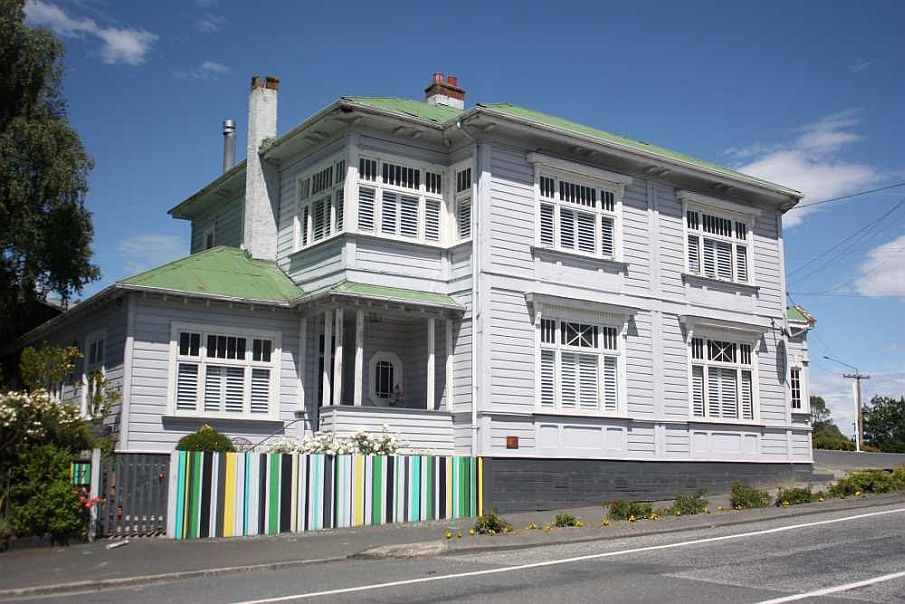
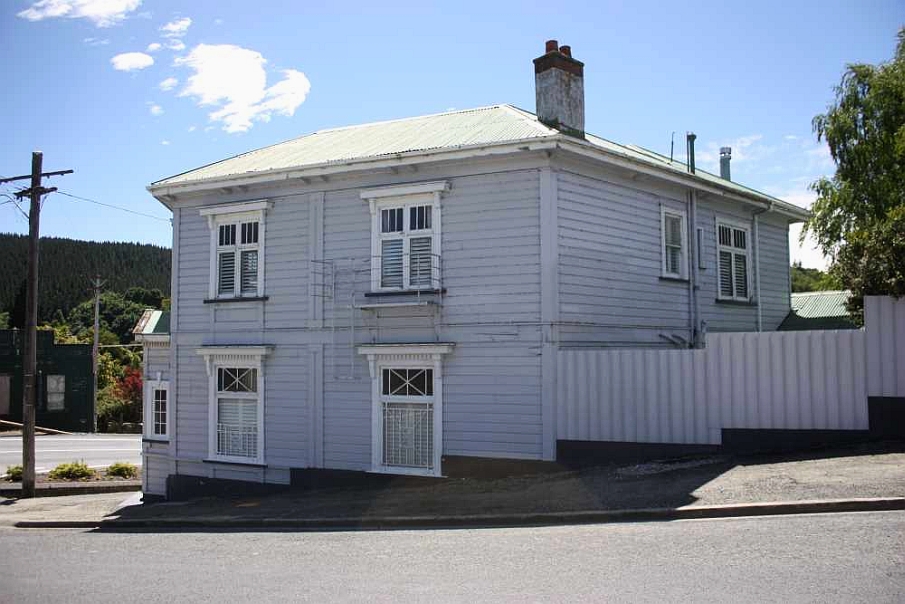
The former Bank of New South Wales occupies a prominent site on the corner of Ross Place and Peel Street. It is one of the few remaining commercial buildings that remind us that Peel Street was Lawrence’s first commercial centre. It is a wedge-shaped two-storey timber building, with a single storey portion to the rear. It has an angulated formal entrance on the narrow corner of the wedge with a small projecting gable and double timber doors. It is clad in weatherboard, with timber casement windows, with multi-paned top lights. The structure sits on piles with concrete foundation walls. The roof is corrugated iron. The windows have small decorative caps supported on corbels providing architectural detailing. Alterations were made to the banking chamber in 1970.
The Bank of New South Wales closed in the early 1970s. In 1971 the building was sold and converted for use as a private residence. In 2015, it remains a private home.


List Entry Information
Status
Listed
List Entry Status
Historic Place Category 2
Access
Private/No Public Access
List Number
5216
Date Entered
19th April 1990
Date of Effect
19th April 1990
City/District Council
Clutha District
Region
Otago Region
Extent of List Entry
Extent includes the land described as Pt Sec 1 and Pt Sec 1A Blk II TN OF Lawrence (RTs OT225/247 and OT69/117), Otago Land District, and the building known as the Bank of New South Wales (Former), thereon.
Legal description
Pt Sec 1 and Pt Sec 1A Blk II TN OF Lawrence (RTs OT225/247 and OT69/117), Otago Land District
Status
Listed
List Entry Status
Historic Place Category 2
Access
Private/No Public Access
List Number
5216
Date Entered
19th April 1990
Date of Effect
19th April 1990
City/District Council
Clutha District
Region
Otago Region
Extent of List Entry
Extent includes the land described as Pt Sec 1 and Pt Sec 1A Blk II TN OF Lawrence (RTs OT225/247 and OT69/117), Otago Land District, and the building known as the Bank of New South Wales (Former), thereon.
Legal description
Pt Sec 1 and Pt Sec 1A Blk II TN OF Lawrence (RTs OT225/247 and OT69/117), Otago Land District
Construction Professional
Name
O'Driscoll Bros
Type
Builder
Biography
No biography is currently available for this construction professional
Name
Mason & Wales Architects Ltd
Type
Architectural Partnership
Biography
Mason and Wales Architects Ltd is the oldest architectural practice in New Zealand, having been founded by William Mason (1810-1897) in 1862 Dunedin. Mason was born in England, studied under Peter Nicholson and worked under Thomas Telford and Edward Blore. In 1838 he immigrated to New South Wales, and came to New Zealand in 1840. Having spent 22 years in Auckland he went to Dunedin at the time of the gold discoveries and was elected the first mayor of Dunedin in 1865. He was active in politics as well as in architecture. Mason was in partnership firstly with David Ross (1827-1908) and William Henry Clayton (1823-1877) and he took in N.Y.A. Wales (1832-1903) when Clayton left the firm to become Colonial Architect in Wellington. Wales had worked as a clerk of works and was very competent in all aspects of construction. The firm was responsible for many of Dunedin's early important buildings such as the Post Office (later known as the Exchange Building), Princes Street (1864-68), the Exhibition Building (later the Dunedin Hospital), Great King Street (1864), St Matthew's Church, Stafford Street (1873), and the Wains Hotel, Princes Street (1878). Mason and Wales designed the Abbotsford Farm Steading (1871) at Outram, Otago (NZHPT Reg. No. 7579). This farm steading was designed for James Shand, a prominent land owner, politician and businessman in the area. Mason and Wales designed another farm steading for Shand at his property Berkeley in 1881 (demolished 1981). In 1881, Mason and Wales also designed a plain concrete Chicory Kiln (NZHPT Reg. No. 3359, Cat II) at Inch Clutha, South Otago for Gregg and Coy. Mason and Wales continues today. N.Y.A. Wales (b.1927) is a fourth generation director of the firm. WALES, Nathaniel Young Armstrong (1832-1903) Wales was born in Northumberland, England, and educated at Jedburgh, Scotland. He immigrated to Australia in 1854 and found employment as a carpenter working on the buildings for the first exhibition held in Melbourne. He arrived in Dunedin about 1863, and was a clerk of works for William Mason on the old Bank of New Zealand Building (1862-64), the Post Office Building (1864-68) and the Port Chalmers Graving Dock (1868-72). Wales entered partnership with William Mason in 1871. The firm of Mason and Wales was responsible for many fine buildings in Dunedin including Bishopscourt (1873), St Matthew's Church (1873), Government Life Insurance Building (1897) and Wains Hotel (1878). Wales had military and political interests and was a Member of Parliament for some years. He occupied a seat on the Dunedin Harbour Board and was a Dunedin City Councillor. In 1895 he was elected Mayor of Dunedin. In 1900 he was elected a Fellow of the Royal Institute of British Architects.
Construction Details
Start Year
1929
startYearCirca
Type
Original Construction
Start Year
1970
Type
Other
Description
Bank is closed
Construction Professional
Name
O'Driscoll Bros
Type
Builder
Biography
No biography is currently available for this construction professional
Name
Mason & Wales Architects Ltd
Type
Architectural Partnership
Biography
Mason and Wales Architects Ltd is the oldest architectural practice in New Zealand, having been founded by William Mason (1810-1897) in 1862 Dunedin. Mason was born in England, studied under Peter Nicholson and worked under Thomas Telford and Edward Blore. In 1838 he immigrated to New South Wales, and came to New Zealand in 1840. Having spent 22 years in Auckland he went to Dunedin at the time of the gold discoveries and was elected the first mayor of Dunedin in 1865. He was active in politics as well as in architecture. Mason was in partnership firstly with David Ross (1827-1908) and William Henry Clayton (1823-1877) and he took in N.Y.A. Wales (1832-1903) when Clayton left the firm to become Colonial Architect in Wellington. Wales had worked as a clerk of works and was very competent in all aspects of construction. The firm was responsible for many of Dunedin's early important buildings such as the Post Office (later known as the Exchange Building), Princes Street (1864-68), the Exhibition Building (later the Dunedin Hospital), Great King Street (1864), St Matthew's Church, Stafford Street (1873), and the Wains Hotel, Princes Street (1878). Mason and Wales designed the Abbotsford Farm Steading (1871) at Outram, Otago (NZHPT Reg. No. 7579). This farm steading was designed for James Shand, a prominent land owner, politician and businessman in the area. Mason and Wales designed another farm steading for Shand at his property Berkeley in 1881 (demolished 1981). In 1881, Mason and Wales also designed a plain concrete Chicory Kiln (NZHPT Reg. No. 3359, Cat II) at Inch Clutha, South Otago for Gregg and Coy. Mason and Wales continues today. N.Y.A. Wales (b.1927) is a fourth generation director of the firm. WALES, Nathaniel Young Armstrong (1832-1903) Wales was born in Northumberland, England, and educated at Jedburgh, Scotland. He immigrated to Australia in 1854 and found employment as a carpenter working on the buildings for the first exhibition held in Melbourne. He arrived in Dunedin about 1863, and was a clerk of works for William Mason on the old Bank of New Zealand Building (1862-64), the Post Office Building (1864-68) and the Port Chalmers Graving Dock (1868-72). Wales entered partnership with William Mason in 1871. The firm of Mason and Wales was responsible for many fine buildings in Dunedin including Bishopscourt (1873), St Matthew's Church (1873), Government Life Insurance Building (1897) and Wains Hotel (1878). Wales had military and political interests and was a Member of Parliament for some years. He occupied a seat on the Dunedin Harbour Board and was a Dunedin City Councillor. In 1895 he was elected Mayor of Dunedin. In 1900 he was elected a Fellow of the Royal Institute of British Architects.
Construction Details
Start Year
1929
startYearCirca
Type
Original Construction
Start Year
1970
Type
Other
Description
Bank is closed
Historical and Associated Iwi / Hapū / Whānau
Completion Date
13th July 2015
Report Written By
Heather Bauchop
Information Sources
Mayhew, 1949
W.R. Mayhew, Tuapeka: The Land and Its People: A Social History of the Borough of Lawrence and its Surrounding Districts, Otago Centennial Historical Publications, Dunedin, 1949
Other Information
This place was identified as significant under previous legislation with different information requirements. It remains significant under the current legislation. There is opportunity under our legislation and policies to add to this information. Further information about this place may be available from the Otago/Southland Office of Heritage New Zealand Pouhere Taonga. Please note that entry on the New Zealand Heritage List/Rarangi Korero identifies only the heritage values of the property concerned, and should not be construed as advice on the state of the property, or as a comment of its soundness or safety, including in regard to earthquake risk, safety in the event of fire, or insanitary conditions. A fully referenced upgrade report is available on request from the Otago/Southland Office of Heritage New Zealand
Historical and Associated Iwi / Hapū / Whānau
Completion Date
13th July 2015
Report Written By
Heather Bauchop
Information Sources
Mayhew, 1949
W.R. Mayhew, Tuapeka: The Land and Its People: A Social History of the Borough of Lawrence and its Surrounding Districts, Otago Centennial Historical Publications, Dunedin, 1949
Other Information
This place was identified as significant under previous legislation with different information requirements. It remains significant under the current legislation. There is opportunity under our legislation and policies to add to this information. Further information about this place may be available from the Otago/Southland Office of Heritage New Zealand Pouhere Taonga. Please note that entry on the New Zealand Heritage List/Rarangi Korero identifies only the heritage values of the property concerned, and should not be construed as advice on the state of the property, or as a comment of its soundness or safety, including in regard to earthquake risk, safety in the event of fire, or insanitary conditions. A fully referenced upgrade report is available on request from the Otago/Southland Office of Heritage New Zealand
Current Usages
Uses: Accommodation
Specific Usage: House
Former Usages
General Usage: Finance
Specific Usage: Bank
Current Usages
Uses: Accommodation
Specific Usage: House
Former Usages
General Usage: Finance
Specific Usage: Bank
Location
Sign up to hear more
Get the latest heritage news, features and events delivered
straight to your inbox.
