

Draper Allan Fitch was the first owner of this land on Ross Place, the main business street of Lawrence. It is not clear if Fitch built on this section, as he had draperies both in Clyde (Dunstan as it was called) and Wetherstons in the mid-1860s. He sold his Lawrence section bootmaker David Johnston in 1874. David Johnston (1823-1917) was an Irish-born bootmaker. He came to new Zealand in the 1850s, first settling in Auckland and carrying on his bootmaker’s trade. He followed gold to Otago in the 1860s, settling first in Wetherston where he established his bootmaker’s business and moving to Lawrence. He was active in local politics and civic affairs.
David Johnston had a wooden house and shop on this land. These were destroyed by fire in May 1879. Johnston rebuilt in brick in more permanent materials in 1880. The Tuapeka Times gives a detailed description of Johnston’s stylish new shop and residence. Johnston extended the size of his store and quarried stone from the rear of the section to make space. The shop had a frontage of 23 feet (7 metres), with decorative features including balustrades and fluted pilasters with Corinthian capitals. The foundations and back wall were stone, while the side and partition walls were brick. The street front had two large plate glass windows and a central door. Johnston’s shop was ‘lined with boards in alternate colors and ceiled in panels painted white the styles are of a cream-color and the cornices are tinted French grey and pink.’ The apartment behind was panelled with native timbers – beech, rimu and kauri, and was lit by a skylight with etched and stained glass. The sitting room had an ornate plaster ceiling rose. The door handles were crystal, while other finishings wree gilt. Behind the sitting room were a kitchen and bedroom. Andrew Stevenson of Blue Spur completed the masonry work. George Robinson made the pilasters, while P Robertson of Lawrence completed the carpentry.
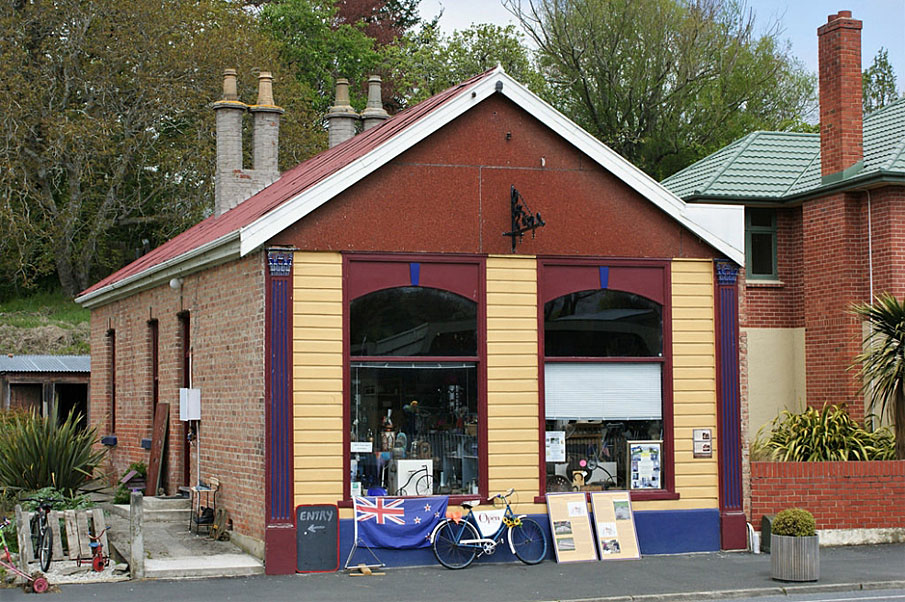
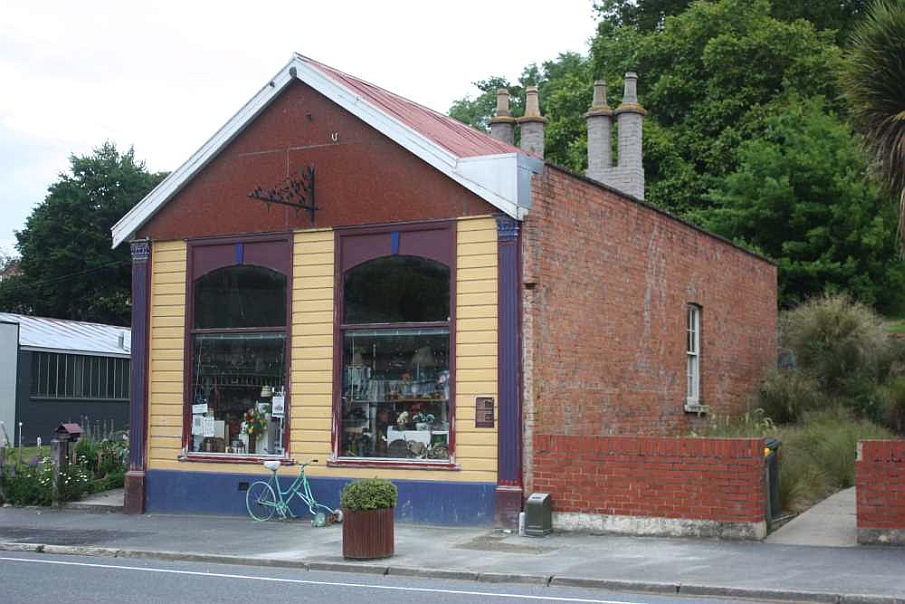
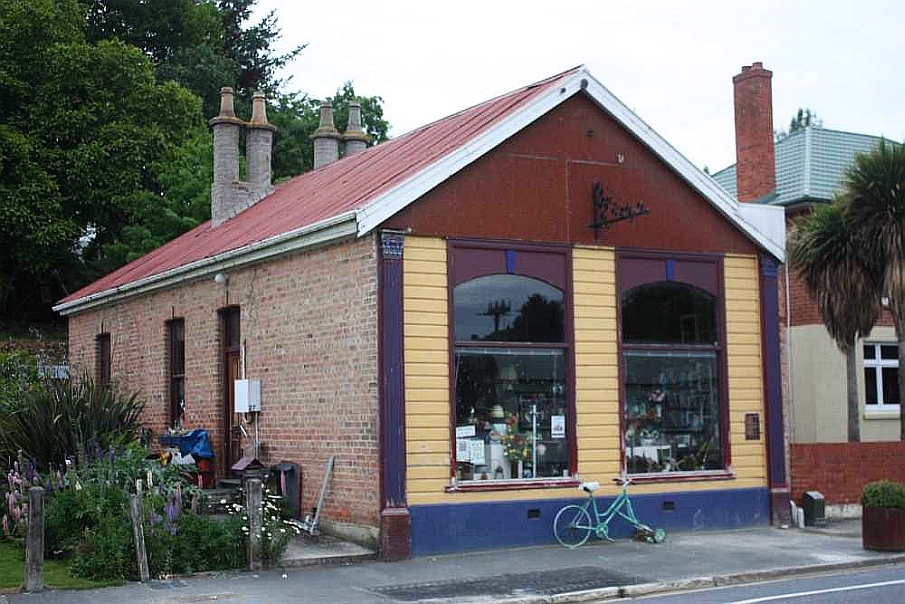
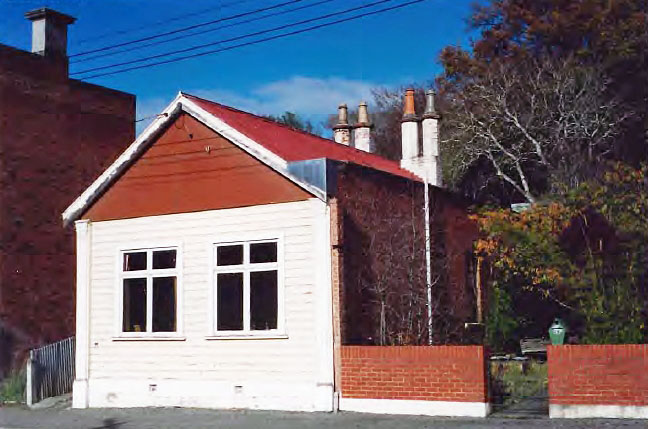
After Johnston’s death the premises were sold to another bootmaker David McIntosh. The land was transferred under the powers of the Rating Act to merchant James McKinlay in 1952. It had a number of changes of ownership in the 1950s and 1960s. In later years the shop was converted for residential purposes. The shop frontage was been replaced with weatherboards and a pair of casement windows with top lights. In 2001 the shop front was reinstated and the building converted to a gallery.
The shop is rectangular in plan with a single gable roof. The original window and door apertures exist on the side elevation. The shop front has timber-framed, plate-glass shop-front windows with arches and keystone references. The building has a pair of unusual octagonal-shaped brick chimneys on either side of the corrugated iron roof. The building contributes to the streetscape through its scale and form.
In 2015, the building continues to serve as retail premises.
List Entry Information
Status
Listed
List Entry Status
Historic Place Category 2
Access
Private/No Public Access
List Number
5237
Date Entered
19th April 1990
Date of Effect
19th April 1990
City/District Council
Clutha District
Region
Otago Region
Extent of List Entry
Extent includes part of the land described as Pt Sec 11 and Pt Sec 12 Blk II Town of Lawrence (RT OT2C/534), Otago Land District, and the building known as David Johnston’s Boot Shop (Former), thereon. Refer to the extent map tabled at the Heritage New Zealand Board meeting on 3 September 2015.
Legal description
Pt Sec 11 and Pt Sec 12 Blk II Town of Lawrence (RT OT2C/534), Otago Land District
Status
Listed
List Entry Status
Historic Place Category 2
Access
Private/No Public Access
List Number
5237
Date Entered
19th April 1990
Date of Effect
19th April 1990
City/District Council
Clutha District
Region
Otago Region
Extent of List Entry
Extent includes part of the land described as Pt Sec 11 and Pt Sec 12 Blk II Town of Lawrence (RT OT2C/534), Otago Land District, and the building known as David Johnston’s Boot Shop (Former), thereon. Refer to the extent map tabled at the Heritage New Zealand Board meeting on 3 September 2015.
Legal description
Pt Sec 11 and Pt Sec 12 Blk II Town of Lawrence (RT OT2C/534), Otago Land District
Construction Professional
Name
Andrew Stevenson
Type
Stonemason
Biography
No biography is currently available for this construction professional
Name
P. Robinson
Type
Sculptor
Biography
No biography is currently available for this construction professional
Name
Robinson, George
Type
Builder
Biography
George Robinson (1796-1876) was born in North Devon and served a building apprenticeship in Plymouth before emigrating to New Plymouth in 1841. He was an early New Plymouth settler and builder of the first section of St Mary’s Anglican Church. He also supervised the Frederick Thatcher-designed second and third additions to St Mary’s and was therefore familiar with church architecture. He additionally built the Colonial Hospital (now the Gables) (1846-48). He is believed to have both designed and built some of the principal buildings in New Plymouth following Thatcher's departure in 1848. As Robinson died in 1876, St John’s Anglican Church at Omata would have been one of his last buildings.
Construction Details
Start Year
1880
Type
Original Construction
Start Year
1879
Type
Other
Description
Previous shop destroyed by fire
Type
Modification
Description
converted to residence and shop front altered
Period
Unknown
Start Year
2001
Type
Modification
Description
Shop front reinstated
Construction Professional
Name
Andrew Stevenson
Type
Stonemason
Biography
No biography is currently available for this construction professional
Name
P. Robinson
Type
Sculptor
Biography
No biography is currently available for this construction professional
Name
Robinson, George
Type
Builder
Biography
George Robinson (1796-1876) was born in North Devon and served a building apprenticeship in Plymouth before emigrating to New Plymouth in 1841. He was an early New Plymouth settler and builder of the first section of St Mary’s Anglican Church. He also supervised the Frederick Thatcher-designed second and third additions to St Mary’s and was therefore familiar with church architecture. He additionally built the Colonial Hospital (now the Gables) (1846-48). He is believed to have both designed and built some of the principal buildings in New Plymouth following Thatcher's departure in 1848. As Robinson died in 1876, St John’s Anglican Church at Omata would have been one of his last buildings.
Construction Details
Start Year
1880
Type
Original Construction
Start Year
1879
Type
Other
Description
Previous shop destroyed by fire
Type
Modification
Description
converted to residence and shop front altered
Period
Unknown
Start Year
2001
Type
Modification
Description
Shop front reinstated
Historical and Associated Iwi / Hapū / Whānau
Completion Date
25th June 2015
Report Written By
Heather Bauchop
Information Sources
Tuapeka Times
Tuapeka Times
Other Information
This place was identified as significant under previous legislation with different information requirements. It remains significant under the current legislation. There is opportunity under our legislation and policies to add to this information. Further information about this place may be available from the Otago/Southland Office of Heritage New Zealand Pouhere Taonga. Please note that entry on the New Zealand Heritage List/Rarangi Korero identifies only the heritage values of the property concerned, and should not be construed as advice on the state of the property, or as a comment of its soundness or safety, including in regard to earthquake risk, safety in the event of fire, or insanitary conditions. A fully referenced upgrade report is available on request from the Otago/Southland Office of Heritage New Zealand
Historical and Associated Iwi / Hapū / Whānau
Completion Date
25th June 2015
Report Written By
Heather Bauchop
Information Sources
Tuapeka Times
Tuapeka Times
Other Information
This place was identified as significant under previous legislation with different information requirements. It remains significant under the current legislation. There is opportunity under our legislation and policies to add to this information. Further information about this place may be available from the Otago/Southland Office of Heritage New Zealand Pouhere Taonga. Please note that entry on the New Zealand Heritage List/Rarangi Korero identifies only the heritage values of the property concerned, and should not be construed as advice on the state of the property, or as a comment of its soundness or safety, including in regard to earthquake risk, safety in the event of fire, or insanitary conditions. A fully referenced upgrade report is available on request from the Otago/Southland Office of Heritage New Zealand
Current Usages
Uses: Trade
Specific Usage: Shop
Former Usages
General Usage: Accommodation
Specific Usage: House
Current Usages
Uses: Trade
Specific Usage: Shop
Former Usages
General Usage: Accommodation
Specific Usage: House
Location
Sign up to hear more
Get the latest heritage news, features and events delivered
straight to your inbox.
