DonateMembershipVisit Heritage
  • Tūrangawaewae
    Places
  • Tira Māori
    Māori Heritage
  • Poutairangahia
    Archaeology
  • Rauemi
    Resources
  • Mō Tātou
    About Us
  • New Zealand Heritage List
  • Nominate and submit
  • Explore the List
  • National Historic Landmarks
  • Plaques
  • Rainbow List Project
  • Lost heritage
  • Visit Heritage
  • Our properties
  • Turnbull House Project
  • Collections
  • Shop
  • Tohu Whenua
  • Tira Māori
  • Conserving Māori heritage
  • Marae built heritage
  • Māori heritage on the List
  • Hinemihi—Te Hokinga Mai
  • What is archaeology?
  • Is there a site on my property?
  • What are my legal requirements?
  • Affecting an archaeological site
  • Declaring an archaeological site
  • Archaeology FAQs
  • Archaeology Digital Library
  • Archaeology guidelines and templates
  • Resources
  • Funding
  • Publications
  • Sustainable management guides
  • Disaster recovery
  • Podcasts & digital resources
  • Education Hub
  • Conservation plans
  • About
  • Board
  • Māori Heritage Council
  • Senior Staff
  • Offices
  • Contact us
  • Careers
  • Covenants
  • Fast-track
  • Corporate documents
  • Currently consulting on
  • Our submissions
  • News
  • Covid-19 response
Quick links
Rārangi Kōrero | The List
Explore the List
National Historic Landmarks
Ngā Manawhenua o Aotearoa me ōna Kōrero Tūturu
Quick links
Tapuwae
A Vision for Places of Māori Heritage
Funding for Māori Heritage
Resources
Quick links
Archaeological Authority Portal
Applying for an archaeological authority
Archaeology FAQs
Browse the most frequently asked questions about archaeological authorities and the archaeological process.
Quick links
Quick links
News
News Keep up to date with Heritage New Zealand Pouhere Taonga
Membership
Membership Find out more and sign up today
DonateMembershipVisit Heritage
  • Tūrangawaewae
    Places
  • Tira Māori
    Māori Heritage
  • Poutairangahia
    Archaeology
  • Rauemi
    Resources
  • Mō Tātou
    About Us
  • New Zealand Heritage List
  • Nominate and submit
  • Explore the List
  • National Historic Landmarks
  • Plaques
  • Rainbow List Project
  • Lost heritage
  • Visit Heritage
  • Our properties
  • Turnbull House Project
  • Collections
  • Shop
  • Tohu Whenua
  • Tira Māori
  • Conserving Māori heritage
  • Marae built heritage
  • Māori heritage on the List
  • Hinemihi—Te Hokinga Mai
  • What is archaeology?
  • Is there a site on my property?
  • What are my legal requirements?
  • Affecting an archaeological site
  • Declaring an archaeological site
  • Archaeology FAQs
  • Archaeology Digital Library
  • Archaeology guidelines and templates
  • Resources
  • Funding
  • Publications
  • Sustainable management guides
  • Disaster recovery
  • Podcasts & digital resources
  • Education Hub
  • Conservation plans
  • About
  • Board
  • Māori Heritage Council
  • Senior Staff
  • Offices
  • Contact us
  • Careers
  • Covenants
  • Fast-track
  • Corporate documents
  • Currently consulting on
  • Our submissions
  • News
  • Covid-19 response
Quick links
Rārangi Kōrero | The List
Explore the List
National Historic Landmarks
Ngā Manawhenua o Aotearoa me ōna Kōrero Tūturu
Quick links
Tapuwae
A Vision for Places of Māori Heritage
Funding for Māori Heritage
Resources
Quick links
Archaeological Authority Portal
Applying for an archaeological authority
Archaeology FAQs
Browse the most frequently asked questions about archaeological authorities and the archaeological process.
Quick links
Quick links
News
News Keep up to date with Heritage New Zealand Pouhere Taonga
Membership
Membership Find out more and sign up today
  • Places
  • Nominate and submit
  • National Historic Landmarks
  • Places
  • Nominate and submit
  • National Historic Landmarks
  • Tira Māori
  • Conserving Māori heritage
  • Marae built heritage
  • Tira Māori
  • Conserving Māori heritage
  • Marae built heritage
  • Archaeological authorities
  • Archaeology Digital Library
  • Archaeological authorities
  • Archaeology Digital Library
  • All resources
  • Publications
  • Funding
  • All resources
  • Publications
  • Funding
  • FAQs
  • FAQs
Follow us on:
Places
  • Places
  • Nominate and submit
  • National Historic Landmarks
Tira Māori
  • Tira Māori
  • Conserving Māori heritage
  • Marae built heritage
Archaeology
  • Archaeological authorities
  • Archaeology Digital Library
Resources
  • All resources
  • Publications
  • Funding
FAQs
  • FAQs
Follow us on
HomePrivacyTerms and conditionsAbout this site
© Heritage New Zealand Pouhere Taonga 2026.
 
Brooklands Homestead

71 Brookland Road, GOODWOOD

Private

Historic Place Category 2

List No. 5238

Quick links:
List GalleryLocationDetails
Designed in 1867 by one of New Zealand's pre-eminent nineteenth century architects, R.A. Lawson, for his brother-in-law James Paterson Hepburn’s Brooklands estate, this Scottish baronial-style residence is a landmark building at Goodwood, North Otago. Brooklands homestead has architectural significance as an example of Lawson’s residential designs and historical significance for its association with the early Brooklands farm.

Scottish-born merchant William Dalrymple took up land at Goodwood in 1854. Shortly afterwards, in 1856, he set his sights on being a runholder and offered Brooklands (as he called the estate) for sale – 410 acres [166 hectares] of open land, 100 acres [40 hectares] of timbered land, a ‘comfortable Dwelling-house’ and a ‘Labourers Cottage.’ In 1857, George Hepburn (1803-1883) bought Brooklands for his sons James and George. Hepburn brought his wife and family of eight from Fifeshire to Dunedin in 1850, becoming a prominent businessman, churchman and politician. George Hepburn’s letters mention ‘[t]here is also a very good dwelling house, weather boarded and lined, consisting of three rooms below and four small bedrooms above. There is also a very good clay house at a little distance for the men servants. Indeed a very great deal of work has been done during the last two years, the proprietor fancying it to be a homestead for him and his family.’ George and James moved in and set about erecting new farm buildings, including a stone barn in 1859 (Register No. 5228).

James Hepburn commissioned R.A. Lawson to design a new residence. Lawson advertised for tenders in January 1867. The house was one-and-a-half storeys, with five small bedrooms on the first floor, and two living rooms with a lean-to kitchen, scullery and bathroom on the ground floor. In style, Brooklands House is similar to Lawson’s Park’s School in Dunedin (Register No. 2172). Built of locally quarried limestone, the ‘elegant and substantial house’ was later rough cast. The roof was slate (later replaced with corrugated iron).

The Hepburn boys did not get to live long lives at Brooklands. George Hepburn Junior died at Brooklands in 1862, David Hepburn in 1870 and James Paterson Hepburn in 1875. The youngest brother Andrew and his wife Janet lived at Brooklands in the early years of their marriage until around 1878. After James’ death, Brooklands was put up for sale. The sale notice described the estate: ‘together with the improvements, consisting of a substantially built two-storey Stone Dwelling House, Stone Barn, large Stable, &c.’ James Kilgour bought and leased Brooklands to his son Alexander. The farm was subdivided in 1906 – the plan showing the homestead surrounded by hedges, and near to the house, a shed and a stable. Closer to the road are a cow byre, yards and stable. In 1907, Frank McCallum bought the homestead block. Brooklands remained in the McCallum family until around 1984. The house was known locally as ‘The Castle’. When Duncan McCallum died the property was sold. In 2014, Brooklands House remains a private residence.
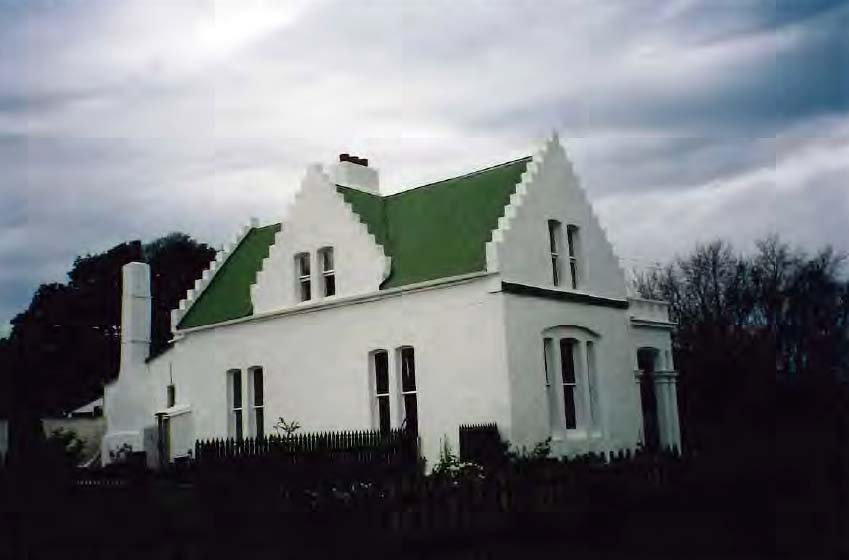
Brooklands Homestead. November 1994. Original image submitted at time of registration | L Galer | NZHPT Field Record Form Collection

List Entry Information

Overview

Status
Listed

List Entry Status
Historic Place Category 2

Access
Private/No Public Access

List Number
5238

Date Entered
19th April 1990

Date of Effect
19th April 1990

City/District Council
Waitaki District

Region
Otago Region

Extent of List Entry

Extent includes the land described as Lot 1 DP 21900 (RT OT13C/833), Otago Land District and the building known as Brooklands Homestead thereon. The extent does not include other buildings and structures on the land.

Legal description

Lot 1 DP 21900 (RT OT13C/833), Otago Land District

Detailed List Entry

Construction Professional

Name

Lawson, Robert Arthur

Type

Architect

Biography

Born in Scotland, Lawson (1833-1902) began his professional career in Perth. At the age of 25 he moved to Melbourne and was engaged in goldmining and journalism before resuming architectural practice. In 1862 Lawson sailed for Dunedin, where his sketch plans had won the competition for the design of First Church. This was built 1867-73. Lawson went on to become one of the most important architects in New Zealand. First Church is regarded as his masterpiece and one of the finest nineteenth century churches in New Zealand. He was also responsible for the design of the Trinity Church (now Fortune Theatre), Dunedin (1869-70), the East Taieri Presbyterian Church (1870), and Knox Church, Dunedin (1874). He designed Park's School (1864) and the ANZ Bank (originally Union Bank, 1874). In Oamaru he designed the Bank of Otago (later National Bank building, 1870) and the adjoining Bank of New South Wales (now Forrester Gallery, 1881). See also: Ledgerwood, Norman, 2013. 'R.A. Lawson: Victorian Architect of Dunedin'. Historic Cemeteries Conservation NZ.

Construction Details

Start Year

1867

Type

Original Construction

Construction Materials

Oamaru stone

Reference

Completion Date

22nd April 2014

Report Written By

Heather Bauchop

Information Sources

Ledgerwood (2013)

Norman Ledgerwood, R.A. Lawson: Victorian Architect of Dunedin, Historic Cemeteries Conservation Trust of New Zealand, Dunedin, 2013

Hutton, 2010

Don Barrie Hutton (ed), The Journal of George Hepburn On His Voyage from Scotland to Otago in 1850…with extracts from his letters written from Otago, revised edition, D B Hutton, Christchurch, 2010.

Report Written By

This place was identified as significant under previous legislation with different information requirements. It remains significant under the current legislation. There is opportunity under our legislation and policies to add to this information. Further information about this place may be available from the Otago/Southland Office of Heritage New Zealand Pouhere Taonga. A fully referenced upgrade report is available on request from the Otago/Southland Area Office of Heritage New Zealand. Please note that entry on the New Zealand Heritage List/Rarangi Korero identifies only the heritage values of the property concerned, and should not be construed as advice on the state of the property, or as a comment of its soundness or safety, including in regard to earthquake risk, safety in the event of fire, or insanitary conditions.

Further Information

Current Usages

Uses: Accommodation

Specific Usage: House

Former Usages

Themes

Web Links

Overview

Status

Listed

List Entry Status

Historic Place Category 2

Access

Private/No Public Access

List Number

5238

Date Entered

19th April 1990

Date of Effect

19th April 1990

City/District Council

Waitaki District

Region

Otago Region

Extent of List Entry

Extent includes the land described as Lot 1 DP 21900 (RT OT13C/833), Otago Land District and the building known as Brooklands Homestead thereon. The extent does not include other buildings and structures on the land.

Legal description

Lot 1 DP 21900 (RT OT13C/833), Otago Land District

Status

Listed

List Entry Status

Historic Place Category 2

Access

Private/No Public Access

List Number

5238

Date Entered

19th April 1990

Date of Effect

19th April 1990

City/District Council

Waitaki District

Region

Otago Region

Extent of List Entry

Extent includes the land described as Lot 1 DP 21900 (RT OT13C/833), Otago Land District and the building known as Brooklands Homestead thereon. The extent does not include other buildings and structures on the land.

Legal description

Lot 1 DP 21900 (RT OT13C/833), Otago Land District

Construction Information

Construction Professional

Name

Lawson, Robert Arthur

Type

Architect

Biography

Born in Scotland, Lawson (1833-1902) began his professional career in Perth. At the age of 25 he moved to Melbourne and was engaged in goldmining and journalism before resuming architectural practice. In 1862 Lawson sailed for Dunedin, where his sketch plans had won the competition for the design of First Church. This was built 1867-73. Lawson went on to become one of the most important architects in New Zealand. First Church is regarded as his masterpiece and one of the finest nineteenth century churches in New Zealand. He was also responsible for the design of the Trinity Church (now Fortune Theatre), Dunedin (1869-70), the East Taieri Presbyterian Church (1870), and Knox Church, Dunedin (1874). He designed Park's School (1864) and the ANZ Bank (originally Union Bank, 1874). In Oamaru he designed the Bank of Otago (later National Bank building, 1870) and the adjoining Bank of New South Wales (now Forrester Gallery, 1881). See also: Ledgerwood, Norman, 2013. 'R.A. Lawson: Victorian Architect of Dunedin'. Historic Cemeteries Conservation NZ.

Construction Details

Start Year

1867

Type

Original Construction

Construction Materials

Oamaru stone

Construction Professional

Name

Lawson, Robert Arthur

Type

Architect

Biography

Born in Scotland, Lawson (1833-1902) began his professional career in Perth. At the age of 25 he moved to Melbourne and was engaged in goldmining and journalism before resuming architectural practice. In 1862 Lawson sailed for Dunedin, where his sketch plans had won the competition for the design of First Church. This was built 1867-73. Lawson went on to become one of the most important architects in New Zealand. First Church is regarded as his masterpiece and one of the finest nineteenth century churches in New Zealand. He was also responsible for the design of the Trinity Church (now Fortune Theatre), Dunedin (1869-70), the East Taieri Presbyterian Church (1870), and Knox Church, Dunedin (1874). He designed Park's School (1864) and the ANZ Bank (originally Union Bank, 1874). In Oamaru he designed the Bank of Otago (later National Bank building, 1870) and the adjoining Bank of New South Wales (now Forrester Gallery, 1881). See also: Ledgerwood, Norman, 2013. 'R.A. Lawson: Victorian Architect of Dunedin'. Historic Cemeteries Conservation NZ.

Construction Details

Start Year

1867

Type

Original Construction

Construction Materials

Oamaru stone

Reference

Historical and Associated Iwi / Hapū / Whānau

Completion Date

22nd April 2014

Report Written By

Heather Bauchop

Information Sources

Ledgerwood (2013)

Norman Ledgerwood, R.A. Lawson: Victorian Architect of Dunedin, Historic Cemeteries Conservation Trust of New Zealand, Dunedin, 2013

Hutton, 2010

Don Barrie Hutton (ed), The Journal of George Hepburn On His Voyage from Scotland to Otago in 1850…with extracts from his letters written from Otago, revised edition, D B Hutton, Christchurch, 2010.

Other Information

This place was identified as significant under previous legislation with different information requirements. It remains significant under the current legislation. There is opportunity under our legislation and policies to add to this information. Further information about this place may be available from the Otago/Southland Office of Heritage New Zealand Pouhere Taonga. A fully referenced upgrade report is available on request from the Otago/Southland Area Office of Heritage New Zealand. Please note that entry on the New Zealand Heritage List/Rarangi Korero identifies only the heritage values of the property concerned, and should not be construed as advice on the state of the property, or as a comment of its soundness or safety, including in regard to earthquake risk, safety in the event of fire, or insanitary conditions.

Historical and Associated Iwi / Hapū / Whānau

Completion Date

22nd April 2014

Report Written By

Heather Bauchop

Information Sources

Ledgerwood (2013)

Norman Ledgerwood, R.A. Lawson: Victorian Architect of Dunedin, Historic Cemeteries Conservation Trust of New Zealand, Dunedin, 2013

Hutton, 2010

Don Barrie Hutton (ed), The Journal of George Hepburn On His Voyage from Scotland to Otago in 1850…with extracts from his letters written from Otago, revised edition, D B Hutton, Christchurch, 2010.

Other Information

This place was identified as significant under previous legislation with different information requirements. It remains significant under the current legislation. There is opportunity under our legislation and policies to add to this information. Further information about this place may be available from the Otago/Southland Office of Heritage New Zealand Pouhere Taonga. A fully referenced upgrade report is available on request from the Otago/Southland Area Office of Heritage New Zealand. Please note that entry on the New Zealand Heritage List/Rarangi Korero identifies only the heritage values of the property concerned, and should not be construed as advice on the state of the property, or as a comment of its soundness or safety, including in regard to earthquake risk, safety in the event of fire, or insanitary conditions.

Further Information

Current Usages

Uses: Accommodation

Specific Usage: House

Current Usages

Uses: Accommodation

Specific Usage: House

Location

Loading
Related listings
Brooklands Barn. Original image submitted at time of registration
Brooklands Barn
Brooklands Barn. Original image submitted at time of registration
Brooklands Barn
Stay up to date with Heritage this month