DonateMembershipVisit Heritage
  • Tūrangawaewae
    Places
  • Tira Māori
    Māori Heritage
  • Poutairangahia
    Archaeology
  • Rauemi
    Resources
  • Mō Tātou
    About Us
  • New Zealand Heritage List
  • Nominate and submit
  • Explore the List
  • National Historic Landmarks
  • Plaques
  • Rainbow List Project
  • Lost heritage
  • Visit Heritage
  • Our properties
  • Turnbull House Project
  • Collections
  • Shop
  • Tohu Whenua
  • Tira Māori
  • Conserving Māori heritage
  • Marae built heritage
  • Māori heritage on the List
  • Hinemihi—Te Hokinga Mai
  • What is archaeology?
  • Is there a site on my property?
  • What are my legal requirements?
  • Affecting an archaeological site
  • Declaring an archaeological site
  • Archaeology FAQs
  • Archaeology Digital Library
  • Archaeology guidelines and templates
  • Resources
  • Funding
  • Publications
  • Sustainable management guides
  • Disaster recovery
  • Podcasts & digital resources
  • Education Hub
  • Conservation plans
  • About
  • Board
  • Māori Heritage Council
  • Senior Staff
  • Offices
  • Contact us
  • Careers
  • Covenants
  • Fast-track
  • Corporate documents
  • Currently consulting on
  • Our submissions
  • News
  • Covid-19 response
Quick links
Rārangi Kōrero | The List
Explore the List
National Historic Landmarks
Ngā Manawhenua o Aotearoa me ōna Kōrero Tūturu
Quick links
Tapuwae
A Vision for Places of Māori Heritage
Funding for Māori Heritage
Resources
Quick links
Archaeological Authority Portal
Applying for an archaeological authority
Archaeology FAQs
Browse the most frequently asked questions about archaeological authorities and the archaeological process.
Quick links
Quick links
News
News Keep up to date with Heritage New Zealand Pouhere Taonga
Membership
Membership Find out more and sign up today
DonateMembershipVisit Heritage
  • Tūrangawaewae
    Places
  • Tira Māori
    Māori Heritage
  • Poutairangahia
    Archaeology
  • Rauemi
    Resources
  • Mō Tātou
    About Us
  • New Zealand Heritage List
  • Nominate and submit
  • Explore the List
  • National Historic Landmarks
  • Plaques
  • Rainbow List Project
  • Lost heritage
  • Visit Heritage
  • Our properties
  • Turnbull House Project
  • Collections
  • Shop
  • Tohu Whenua
  • Tira Māori
  • Conserving Māori heritage
  • Marae built heritage
  • Māori heritage on the List
  • Hinemihi—Te Hokinga Mai
  • What is archaeology?
  • Is there a site on my property?
  • What are my legal requirements?
  • Affecting an archaeological site
  • Declaring an archaeological site
  • Archaeology FAQs
  • Archaeology Digital Library
  • Archaeology guidelines and templates
  • Resources
  • Funding
  • Publications
  • Sustainable management guides
  • Disaster recovery
  • Podcasts & digital resources
  • Education Hub
  • Conservation plans
  • About
  • Board
  • Māori Heritage Council
  • Senior Staff
  • Offices
  • Contact us
  • Careers
  • Covenants
  • Fast-track
  • Corporate documents
  • Currently consulting on
  • Our submissions
  • News
  • Covid-19 response
Quick links
Rārangi Kōrero | The List
Explore the List
National Historic Landmarks
Ngā Manawhenua o Aotearoa me ōna Kōrero Tūturu
Quick links
Tapuwae
A Vision for Places of Māori Heritage
Funding for Māori Heritage
Resources
Quick links
Archaeological Authority Portal
Applying for an archaeological authority
Archaeology FAQs
Browse the most frequently asked questions about archaeological authorities and the archaeological process.
Quick links
Quick links
News
News Keep up to date with Heritage New Zealand Pouhere Taonga
Membership
Membership Find out more and sign up today
  • Places
  • Nominate and submit
  • National Historic Landmarks
  • Places
  • Nominate and submit
  • National Historic Landmarks
  • Tira Māori
  • Conserving Māori heritage
  • Marae built heritage
  • Tira Māori
  • Conserving Māori heritage
  • Marae built heritage
  • Archaeological authorities
  • Archaeology Digital Library
  • Archaeological authorities
  • Archaeology Digital Library
  • All resources
  • Publications
  • Funding
  • All resources
  • Publications
  • Funding
  • FAQs
  • FAQs
Follow us on:
Places
  • Places
  • Nominate and submit
  • National Historic Landmarks
Tira Māori
  • Tira Māori
  • Conserving Māori heritage
  • Marae built heritage
Archaeology
  • Archaeological authorities
  • Archaeology Digital Library
Resources
  • All resources
  • Publications
  • Funding
FAQs
  • FAQs
Follow us on
HomePrivacyTerms and conditionsAbout this site
© Heritage New Zealand Pouhere Taonga 2026.
 
Nixon Monument

2 Piki Thompson Way and Great South Road, Otahuhu, AUCKLAND

Public

Historic Place Category 2

List No. 531

Quick links:
List GalleryLocationDetails
Prominently located at the Mangere and Great South Road junction, Otahuhu, the Nixon Monument is of particular significance as one of three monuments nationally that reflect the early evolution of war memorials in New Zealand. The obelisk incorporating four squat columns resting on a tall base commemorates Marmaduke George Nixon (c.1813-64) the Colonel who commanded the Colonial Defence Force and Royal Cavalry Volunteers. Nixon was the first well-known local leader to fall in the New Zealand Wars (1843-72). It also commemorates the Waikato War Campaign (1863-4) and memorialises those in the Colonial Defence Force who fell at Rangiaowhia (Te Awamutu). The Great South Road location was particularly significant for the local fencible communities of Onehunga, Howick and Panmure, and the volunteers who served under Nixon.

After much debate the obelisk was funded by public subscription and erected on a site to the north of the stockyards, an important venue and meeting place for the local farming community. The Otahuhu site was provided by Edmund Foley, other Auckland and Domain sites having been rejected following prolonged discussions. An obelisk inspired by ‘Cleopatra’s Needle’ at Thebes in Egypt, the final design incorporated three commemorative headstones. The design by architect Edmund Rumsey was constructed by builder W. Cameron of Cook Street, Auckland, using Oamaru stone for a total cost of £660. The structure raised on three blue-stone steps of solid masonry from quarries at Newmarket had a square wrought iron railing around the base. Nearing the fourth anniversary of Nixon’s death, the monument was unveiled by the Governor General Sir George Ferguson Bowen at a public ceremony on 13 May 1868, an event incorporating Masonic ritual.

The north-facing stone of the memorial records that Nixon died aged 50 from wounds sustained on 21 February 1864, at Rangiaowhia. Born in Malta, and Sandhurst-trained, Nixon served 21 years with the 39th Regiment of Foot (sixteen in India) prior to his arrival in New Zealand. Nixon and fellow Regimental officer Captain Theodore Haultain the commander of a company of military pensioners in New Zealand, became members of the House of Representatives, and gained the New Zealand Medal in the New Zealand Wars (1860-66) having already been awarded the Maharajpore Star (1843) prior to their arrival in New Zealand.

The east-facing stone commemorates the men who served Queen and Country in the Maori War Waikato Campaign. That facing west, memorialises those of the Colonial Defence Force who fell at Rangiaowhia on 21 and 22 February 1864, namely Corporals Edward McHale, Horatio Alexander and Joseph Thomas Little.

Nixons’ remains lie directly below the north side of the monument, having been exhumed from Auckland’s Symonds Street Cemetery during Southern Motorway works in the 1960s; cremated and reinterred at the Otahuhu site on ANZAC day 25 April 1968. Together with the original gravestone from the cemetery (with added wording to identify the re-interment), a small brass plaque was more recently attached to the monument. Conservation works undertaken in 1992 included removal of the wrought iron surrounds.
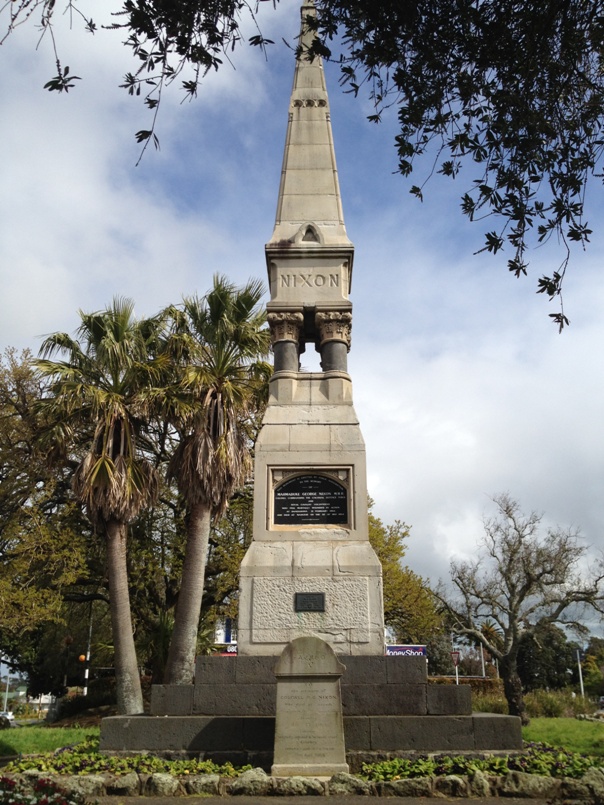
Nixon Monument, Auckland | Antony Matthews | 24/09/2012 | Antony Matthews

List Entry Information

Overview

Status
Listed

List Entry Status
Historic Place Category 2

Access
Able to Visit

List Number
531

Date Entered
26th November 1981

Date of Effect
26th November 1981

City/District Council
Auckland Council

Region
Auckland Council

Extent of List Entry

Extent includes the land described as Pt Lot 13 DP 19310 (RT NA491/164, NZ Gazette 1984, p.3529) and part of the land described as Legal Road, North Auckland Land District, and the structure known as Nixon Monument thereon. Refer to the extent map tabled at the Heritage New Zealand Board meeting on 3 September 2015.

Legal description

Pt Lot 13 DP 19310 (RT NA491/164, NZ Gazette 1984, p.3529) and Legal Road, North Auckland Land District

Detailed List Entry

Construction Professional

Name

W. Cameron

Type

Builder

Biography

No biography is currently available for this construction professional

Name

Rumsey, Edward

Type

Architect

Biography

Rumsey was an English born architect who had studied under the High Victorian Gothic Revivalist Sir George Gilbert Scott. Rumsey came to New Zealand to supervise the Gothic Revival styled Supreme Court Building, Auckland (1865) which he had designed. He remained in New Zealand for several years, practising in both Auckland and Dunedin. He worked on St Andrew's Anglican Church, Epsom (1867), though the Reverend John Kinder was responsible for the design of this building, and also on the Church of St Peter in the Forest, Bombay (1869) and the much larger St Luke's Church, Oamaru (1865). The design of the Oriental Hotel, Dunedin (1863), has been attributed to him.

Construction Details

Start Year

1868

Type

Other

Description

Unveiled

Start Year

1968

Type

Other

Description

Reinterment of Marmaduke George Nixon’s remains & Original grave marker from Symonds Street Cemetery moved to the site.

Start Year

1992

Type

Modification

Description

Stone masonry repairs, replacement of marble monument stones; removal or wrought iron railings.

Reference

Completion Date

30th June 2015

Report Written By

Ian Lawlor

Information Sources

Prickett, 2002

N. Prickett, 'The Archaeology of New Zealand Shore Whaling', Department of Conservation, Wellington, 2002.

Ritchie, 2001

Neville Ritchie, The Waikato War of 1863-64: A Guide to the Main Events and Sites, Te Awamutu, 2001

Te Ara - The Encyclopedia of New Zealand

www.TeAra.govt.nz

Journal of the Auckland-Waikato Historical Societies

Journal of the Auckland-Waikato Historical Societies

Cowan, 1955

The New Zealand Wars: A History of the Maori Campaigns and the Pioneering Period: Volume 1: 1845-1864. R.E Owen. Wellington.

Phillips & Maclean, 1990.

Phillips, Jock and Chris Maclean, The Sorrow and the Pride: New Zealand War Memorials, Department of Internal Affairs, Historical Branch, Wellington, 1990.

Anon, 1948

A Century of Progress, 1848-1948: A Souvenir of Otahuhu, Otahuhu, 1948

Otahuhu-Tamaki Historical Society Inc

Howard, G. (Ed), Otahuhu-Tamaki Historical Society Inc., A Passing Parade: A Recollection of 150 Years in Otahuhu, 1998, pp. 24-5 and photo on back cover.

Report Written By

This place was identified as significant under previous legislation with different information requirements. It remains significant under the current legislation. There is opportunity under our legislation and policies to add to this information. Further information about this place may be available from the Northern Regional Office of Heritage New Zealand Pouhere Taonga. Please note that entry on the New Zealand Heritage List/Rarangi Korero identifies only the heritage values of the property concerned, and should not be construed as advice on the state of the property, or as a comment of its soundness or safety, including in regard to earthquake risk, safety in the event of fire, or insanitary conditions. A fully referenced upgrade report is available on request from the Northern Region Office of Heritage New Zealand

Further Information

Current Usages

Uses: Civic Facilities

Specific Usage: Statue/public art

Uses: Commemoration

Specific Usage: Memorial - New Zealand Wars

Uses: Commemoration

Specific Usage: Memorial - Particular person or group

Uses: Funerary Sites

Specific Usage: Headstone

Uses: Funerary Sites

Specific Usage: Isolated Grave/Burial Site

Former Usages

Themes

New Zealand Wars

Web Links

Overview

Status

Listed

List Entry Status

Historic Place Category 2

Access

Able to Visit

List Number

531

Date Entered

26th November 1981

Date of Effect

26th November 1981

City/District Council

Auckland Council

Region

Auckland Council

Extent of List Entry

Extent includes the land described as Pt Lot 13 DP 19310 (RT NA491/164, NZ Gazette 1984, p.3529) and part of the land described as Legal Road, North Auckland Land District, and the structure known as Nixon Monument thereon. Refer to the extent map tabled at the Heritage New Zealand Board meeting on 3 September 2015.

Legal description

Pt Lot 13 DP 19310 (RT NA491/164, NZ Gazette 1984, p.3529) and Legal Road, North Auckland Land District

Status

Listed

List Entry Status

Historic Place Category 2

Access

Able to Visit

List Number

531

Date Entered

26th November 1981

Date of Effect

26th November 1981

City/District Council

Auckland Council

Region

Auckland Council

Extent of List Entry

Extent includes the land described as Pt Lot 13 DP 19310 (RT NA491/164, NZ Gazette 1984, p.3529) and part of the land described as Legal Road, North Auckland Land District, and the structure known as Nixon Monument thereon. Refer to the extent map tabled at the Heritage New Zealand Board meeting on 3 September 2015.

Legal description

Pt Lot 13 DP 19310 (RT NA491/164, NZ Gazette 1984, p.3529) and Legal Road, North Auckland Land District

Construction Information

Construction Professional

Name

W. Cameron

Type

Builder

Biography

No biography is currently available for this construction professional

Name

Rumsey, Edward

Type

Architect

Biography

Rumsey was an English born architect who had studied under the High Victorian Gothic Revivalist Sir George Gilbert Scott. Rumsey came to New Zealand to supervise the Gothic Revival styled Supreme Court Building, Auckland (1865) which he had designed. He remained in New Zealand for several years, practising in both Auckland and Dunedin. He worked on St Andrew's Anglican Church, Epsom (1867), though the Reverend John Kinder was responsible for the design of this building, and also on the Church of St Peter in the Forest, Bombay (1869) and the much larger St Luke's Church, Oamaru (1865). The design of the Oriental Hotel, Dunedin (1863), has been attributed to him.

Construction Details

Start Year

1868

Type

Other

Description

Unveiled

Start Year

1968

Type

Other

Description

Reinterment of Marmaduke George Nixon’s remains & Original grave marker from Symonds Street Cemetery moved to the site.

Start Year

1992

Type

Modification

Description

Stone masonry repairs, replacement of marble monument stones; removal or wrought iron railings.

Construction Professional

Name

W. Cameron

Type

Builder

Biography

No biography is currently available for this construction professional

Name

Rumsey, Edward

Type

Architect

Biography

Rumsey was an English born architect who had studied under the High Victorian Gothic Revivalist Sir George Gilbert Scott. Rumsey came to New Zealand to supervise the Gothic Revival styled Supreme Court Building, Auckland (1865) which he had designed. He remained in New Zealand for several years, practising in both Auckland and Dunedin. He worked on St Andrew's Anglican Church, Epsom (1867), though the Reverend John Kinder was responsible for the design of this building, and also on the Church of St Peter in the Forest, Bombay (1869) and the much larger St Luke's Church, Oamaru (1865). The design of the Oriental Hotel, Dunedin (1863), has been attributed to him.

Construction Details

Start Year

1868

Type

Other

Description

Unveiled

Start Year

1968

Type

Other

Description

Reinterment of Marmaduke George Nixon’s remains & Original grave marker from Symonds Street Cemetery moved to the site.

Start Year

1992

Type

Modification

Description

Stone masonry repairs, replacement of marble monument stones; removal or wrought iron railings.

Reference

Historical and Associated Iwi / Hapū / Whānau

Completion Date

30th June 2015

Report Written By

Ian Lawlor

Information Sources

Prickett, 2002

N. Prickett, 'The Archaeology of New Zealand Shore Whaling', Department of Conservation, Wellington, 2002.

Ritchie, 2001

Neville Ritchie, The Waikato War of 1863-64: A Guide to the Main Events and Sites, Te Awamutu, 2001

Te Ara - The Encyclopedia of New Zealand

www.TeAra.govt.nz

Journal of the Auckland-Waikato Historical Societies

Journal of the Auckland-Waikato Historical Societies

Cowan, 1955

The New Zealand Wars: A History of the Maori Campaigns and the Pioneering Period: Volume 1: 1845-1864. R.E Owen. Wellington.

Phillips & Maclean, 1990.

Phillips, Jock and Chris Maclean, The Sorrow and the Pride: New Zealand War Memorials, Department of Internal Affairs, Historical Branch, Wellington, 1990.

Anon, 1948

A Century of Progress, 1848-1948: A Souvenir of Otahuhu, Otahuhu, 1948

Otahuhu-Tamaki Historical Society Inc

Howard, G. (Ed), Otahuhu-Tamaki Historical Society Inc., A Passing Parade: A Recollection of 150 Years in Otahuhu, 1998, pp. 24-5 and photo on back cover.

Other Information

This place was identified as significant under previous legislation with different information requirements. It remains significant under the current legislation. There is opportunity under our legislation and policies to add to this information. Further information about this place may be available from the Northern Regional Office of Heritage New Zealand Pouhere Taonga. Please note that entry on the New Zealand Heritage List/Rarangi Korero identifies only the heritage values of the property concerned, and should not be construed as advice on the state of the property, or as a comment of its soundness or safety, including in regard to earthquake risk, safety in the event of fire, or insanitary conditions. A fully referenced upgrade report is available on request from the Northern Region Office of Heritage New Zealand

Historical and Associated Iwi / Hapū / Whānau

Completion Date

30th June 2015

Report Written By

Ian Lawlor

Information Sources

Prickett, 2002

N. Prickett, 'The Archaeology of New Zealand Shore Whaling', Department of Conservation, Wellington, 2002.

Ritchie, 2001

Neville Ritchie, The Waikato War of 1863-64: A Guide to the Main Events and Sites, Te Awamutu, 2001

Te Ara - The Encyclopedia of New Zealand

www.TeAra.govt.nz

Journal of the Auckland-Waikato Historical Societies

Journal of the Auckland-Waikato Historical Societies

Cowan, 1955

The New Zealand Wars: A History of the Maori Campaigns and the Pioneering Period: Volume 1: 1845-1864. R.E Owen. Wellington.

Phillips & Maclean, 1990.

Phillips, Jock and Chris Maclean, The Sorrow and the Pride: New Zealand War Memorials, Department of Internal Affairs, Historical Branch, Wellington, 1990.

Anon, 1948

A Century of Progress, 1848-1948: A Souvenir of Otahuhu, Otahuhu, 1948

Otahuhu-Tamaki Historical Society Inc

Howard, G. (Ed), Otahuhu-Tamaki Historical Society Inc., A Passing Parade: A Recollection of 150 Years in Otahuhu, 1998, pp. 24-5 and photo on back cover.

Other Information

This place was identified as significant under previous legislation with different information requirements. It remains significant under the current legislation. There is opportunity under our legislation and policies to add to this information. Further information about this place may be available from the Northern Regional Office of Heritage New Zealand Pouhere Taonga. Please note that entry on the New Zealand Heritage List/Rarangi Korero identifies only the heritage values of the property concerned, and should not be construed as advice on the state of the property, or as a comment of its soundness or safety, including in regard to earthquake risk, safety in the event of fire, or insanitary conditions. A fully referenced upgrade report is available on request from the Northern Region Office of Heritage New Zealand

Further Information

Current Usages

Uses: Civic Facilities

Specific Usage: Statue/public art

Uses: Commemoration

Specific Usage: Memorial - New Zealand Wars

Uses: Commemoration

Specific Usage: Memorial - Particular person or group

Uses: Funerary Sites

Specific Usage: Headstone

Uses: Funerary Sites

Specific Usage: Isolated Grave/Burial Site

Themes

New Zealand Wars

Current Usages

Uses: Civic Facilities

Specific Usage: Statue/public art

Uses: Commemoration

Specific Usage: Memorial - New Zealand Wars

Uses: Commemoration

Specific Usage: Memorial - Particular person or group

Uses: Funerary Sites

Specific Usage: Headstone

Uses: Funerary Sites

Specific Usage: Isolated Grave/Burial Site

Themes

New Zealand Wars

Location

Loading
Related listings
Otahuhu World War One Memorial. Taken c.1986
Otahuhu World War One Memorial
Otahuhu World War One Memorial. Taken c.1986
Otahuhu World War One Memorial
Stay up to date with Heritage this month