DonateMembershipVisit Heritage
  • Tūrangawaewae
    Places
  • Tira Māori
    Māori Heritage
  • Poutairangahia
    Archaeology
  • Rauemi
    Resources
  • Mō Tātou
    About Us
  • New Zealand Heritage List
  • Nominate and submit
  • Explore the List
  • National Historic Landmarks
  • Plaques
  • Rainbow List Project
  • Lost heritage
  • Visit Heritage
  • Our properties
  • Turnbull House Project
  • Collections
  • Shop
  • Tohu Whenua
  • Tira Māori
  • Conserving Māori heritage
  • Marae built heritage
  • Māori heritage on the List
  • Hinemihi—Te Hokinga Mai
  • What is archaeology?
  • Is there a site on my property?
  • What are my legal requirements?
  • Affecting an archaeological site
  • Declaring an archaeological site
  • Archaeology FAQs
  • Archaeology Digital Library
  • Archaeology guidelines and templates
  • Resources
  • Funding
  • Publications
  • Sustainable management guides
  • Disaster recovery
  • Podcasts & digital resources
  • Education Hub
  • Conservation plans
  • About
  • Board
  • Māori Heritage Council
  • Senior Staff
  • Offices
  • Contact us
  • Careers
  • Covenants
  • Fast-track
  • Corporate documents
  • Currently consulting on
  • Our submissions
  • News
  • Covid-19 response
Quick links
Rārangi Kōrero | The List
Explore the List
National Historic Landmarks
Ngā Manawhenua o Aotearoa me ōna Kōrero Tūturu
Quick links
Tapuwae
A Vision for Places of Māori Heritage
Funding for Māori Heritage
Resources
Quick links
Archaeological Authority Portal
Applying for an archaeological authority
Archaeology FAQs
Browse the most frequently asked questions about archaeological authorities and the archaeological process.
Quick links
Quick links
News
News Keep up to date with Heritage New Zealand Pouhere Taonga
Membership
Membership Find out more and sign up today
DonateMembershipVisit Heritage
  • Tūrangawaewae
    Places
  • Tira Māori
    Māori Heritage
  • Poutairangahia
    Archaeology
  • Rauemi
    Resources
  • Mō Tātou
    About Us
  • New Zealand Heritage List
  • Nominate and submit
  • Explore the List
  • National Historic Landmarks
  • Plaques
  • Rainbow List Project
  • Lost heritage
  • Visit Heritage
  • Our properties
  • Turnbull House Project
  • Collections
  • Shop
  • Tohu Whenua
  • Tira Māori
  • Conserving Māori heritage
  • Marae built heritage
  • Māori heritage on the List
  • Hinemihi—Te Hokinga Mai
  • What is archaeology?
  • Is there a site on my property?
  • What are my legal requirements?
  • Affecting an archaeological site
  • Declaring an archaeological site
  • Archaeology FAQs
  • Archaeology Digital Library
  • Archaeology guidelines and templates
  • Resources
  • Funding
  • Publications
  • Sustainable management guides
  • Disaster recovery
  • Podcasts & digital resources
  • Education Hub
  • Conservation plans
  • About
  • Board
  • Māori Heritage Council
  • Senior Staff
  • Offices
  • Contact us
  • Careers
  • Covenants
  • Fast-track
  • Corporate documents
  • Currently consulting on
  • Our submissions
  • News
  • Covid-19 response
Quick links
Rārangi Kōrero | The List
Explore the List
National Historic Landmarks
Ngā Manawhenua o Aotearoa me ōna Kōrero Tūturu
Quick links
Tapuwae
A Vision for Places of Māori Heritage
Funding for Māori Heritage
Resources
Quick links
Archaeological Authority Portal
Applying for an archaeological authority
Archaeology FAQs
Browse the most frequently asked questions about archaeological authorities and the archaeological process.
Quick links
Quick links
News
News Keep up to date with Heritage New Zealand Pouhere Taonga
Membership
Membership Find out more and sign up today
  • Places
  • Nominate and submit
  • National Historic Landmarks
  • Places
  • Nominate and submit
  • National Historic Landmarks
  • Tira Māori
  • Conserving Māori heritage
  • Marae built heritage
  • Tira Māori
  • Conserving Māori heritage
  • Marae built heritage
  • Archaeological authorities
  • Archaeology Digital Library
  • Archaeological authorities
  • Archaeology Digital Library
  • All resources
  • Publications
  • Funding
  • All resources
  • Publications
  • Funding
  • FAQs
  • FAQs
Follow us on:
Places
  • Places
  • Nominate and submit
  • National Historic Landmarks
Tira Māori
  • Tira Māori
  • Conserving Māori heritage
  • Marae built heritage
Archaeology
  • Archaeological authorities
  • Archaeology Digital Library
Resources
  • All resources
  • Publications
  • Funding
FAQs
  • FAQs
Follow us on
HomePrivacyTerms and conditionsAbout this site
© Heritage New Zealand Pouhere Taonga 2026.
 
Aida Konditorei

181 Cuba Street, WELLINGTON

Private

Historic Place Category 2

List No. 5341

Quick links:
List GalleryLocationDetails
Built 1916.
Although modified by present occupants the building retains its original Art Nouveau facade on the first floor. Few examples of Art Nouveau exist in the C.B.D. as good as this.
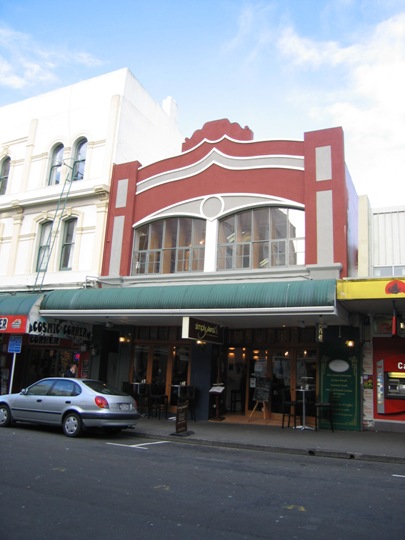
Aida Konditorei | Anika Klee | 14/05/2009 | NZ Historic Places Trust

List Entry Information

Overview

Status
Listed

List Entry Status
Historic Place Category 2

Access
Private/No Public Access

List Number
5341

Date Entered
22nd August 1991

Date of Effect
22nd August 1991

City/District Council
Wellington City

Region
Wellington Region

Legal description

Pt Sec 153 Town of Wellington

Detailed List Entry

Construction Professional

Name

Bennie, James

Type

Architect

Biography

Bennie was born in Ayrshire, Scotland, immigrated to New Zealand in 1880 and settled in Brunnertown near Greymouth. In the early 1890s he attended the Working Men's College in Melbourne, Australia, where he studied under artist and architect Thomas Searell. On completion of his studies he returned to Greymouth and set up in practice as an architect. In 1902 Bennie moved to Wellington and went into practice with E C Farr before establishing his own practice in 1905. Some of Bennie's designs include the Albermarle Hotel, Wellington (1905), the Carnegie Library at Levin (1910), the Karori Methodist Church (1912), and the Oriental Bay Tea Kiosk (1912, demolished 1978). He designed a number of theatres including Kings (1910), Queens (1916), the Crown (1916) and Paramount (1917), all in Wellington and was also responsible for the design of many houses including the Wedge, Glenbervie Terrace (1906) and Bennie house, Salamanca road (1907) both in Wellington. He also had an interest in prefabricated house design. Bennie was an inaugural member of the New Zealand Institute of Architects, founded in 1905, and was later elected a Fellow. He retired in 1935 and his son Malcolm took over the Wellington practice. [Source: an advertisment in the Evening Post, Volume LXIV, Issue 58, 5 September 1902, Page 7 confirms that Bennie entered into partnership with E C Farr on 14 August 1902].

Construction Details

Start Year

1916

Type

Original Construction

Start Year

1935

Type

Modification

Description

Remodelled in Art Deco

Construction Materials

Reinforced concrete with brick infill walls; two storey

Notable Features

Flowing lines moulded into tripart pediment, slightly arched windows

Reference

Completion Date

22nd August 1991

Report Written By

Mary O'Keeffe

Report Written By

This place was identified as significant under previous legislation with different information requirements. It remains significant under the current legislation. There is opportunity under our legislation and policies to add to this information. Further information about this place may be available from the Central Regional Office of Heritage New Zealand Pouhere Taonga. A copy of the original report is available from the NZHPT Central region office Please note that entry on the New Zealand Heritage List/Rarangi Korero identifies only the heritage values of the property concerned, and should not be construed as advice on the state of the property, or as a comment of its soundness or safety, including in regard to earthquake risk, safety in the event of fire, or insanitary conditions. This historic place was registered under the Historic Places Act 1980. The following text is from the original Proposal for Classification report considered by the NZHPT Board at the time of registration.

Further Information

Current Usages

Former Usages

General Usage:: Trade

Specific Usage: Restaurant/cafe/tearoom

Themes

Web Links

Overview

Status

Listed

List Entry Status

Historic Place Category 2

Access

Private/No Public Access

List Number

5341

Date Entered

22nd August 1991

Date of Effect

22nd August 1991

City/District Council

Wellington City

Region

Wellington Region

Legal description

Pt Sec 153 Town of Wellington

Status

Listed

List Entry Status

Historic Place Category 2

Access

Private/No Public Access

List Number

5341

Date Entered

22nd August 1991

Date of Effect

22nd August 1991

City/District Council

Wellington City

Region

Wellington Region

Legal description

Pt Sec 153 Town of Wellington

Construction Information

Construction Professional

Name

Bennie, James

Type

Architect

Biography

Bennie was born in Ayrshire, Scotland, immigrated to New Zealand in 1880 and settled in Brunnertown near Greymouth. In the early 1890s he attended the Working Men's College in Melbourne, Australia, where he studied under artist and architect Thomas Searell. On completion of his studies he returned to Greymouth and set up in practice as an architect. In 1902 Bennie moved to Wellington and went into practice with E C Farr before establishing his own practice in 1905. Some of Bennie's designs include the Albermarle Hotel, Wellington (1905), the Carnegie Library at Levin (1910), the Karori Methodist Church (1912), and the Oriental Bay Tea Kiosk (1912, demolished 1978). He designed a number of theatres including Kings (1910), Queens (1916), the Crown (1916) and Paramount (1917), all in Wellington and was also responsible for the design of many houses including the Wedge, Glenbervie Terrace (1906) and Bennie house, Salamanca road (1907) both in Wellington. He also had an interest in prefabricated house design. Bennie was an inaugural member of the New Zealand Institute of Architects, founded in 1905, and was later elected a Fellow. He retired in 1935 and his son Malcolm took over the Wellington practice. [Source: an advertisment in the Evening Post, Volume LXIV, Issue 58, 5 September 1902, Page 7 confirms that Bennie entered into partnership with E C Farr on 14 August 1902].

Construction Details

Start Year

1916

Type

Original Construction

Start Year

1935

Type

Modification

Description

Remodelled in Art Deco

Construction Materials

Reinforced concrete with brick infill walls; two storey

Notable Features

Flowing lines moulded into tripart pediment, slightly arched windows

Construction Professional

Name

Bennie, James

Type

Architect

Biography

Bennie was born in Ayrshire, Scotland, immigrated to New Zealand in 1880 and settled in Brunnertown near Greymouth. In the early 1890s he attended the Working Men's College in Melbourne, Australia, where he studied under artist and architect Thomas Searell. On completion of his studies he returned to Greymouth and set up in practice as an architect. In 1902 Bennie moved to Wellington and went into practice with E C Farr before establishing his own practice in 1905. Some of Bennie's designs include the Albermarle Hotel, Wellington (1905), the Carnegie Library at Levin (1910), the Karori Methodist Church (1912), and the Oriental Bay Tea Kiosk (1912, demolished 1978). He designed a number of theatres including Kings (1910), Queens (1916), the Crown (1916) and Paramount (1917), all in Wellington and was also responsible for the design of many houses including the Wedge, Glenbervie Terrace (1906) and Bennie house, Salamanca road (1907) both in Wellington. He also had an interest in prefabricated house design. Bennie was an inaugural member of the New Zealand Institute of Architects, founded in 1905, and was later elected a Fellow. He retired in 1935 and his son Malcolm took over the Wellington practice. [Source: an advertisment in the Evening Post, Volume LXIV, Issue 58, 5 September 1902, Page 7 confirms that Bennie entered into partnership with E C Farr on 14 August 1902].

Construction Details

Start Year

1916

Type

Original Construction

Start Year

1935

Type

Modification

Description

Remodelled in Art Deco

Construction Materials

Reinforced concrete with brick infill walls; two storey

Notable Features

Flowing lines moulded into tripart pediment, slightly arched windows

Reference

Historical and Associated Iwi / Hapū / Whānau

Completion Date

22nd August 1991

Report Written By

Mary O'Keeffe

Other Information

This place was identified as significant under previous legislation with different information requirements. It remains significant under the current legislation. There is opportunity under our legislation and policies to add to this information. Further information about this place may be available from the Central Regional Office of Heritage New Zealand Pouhere Taonga. A copy of the original report is available from the NZHPT Central region office Please note that entry on the New Zealand Heritage List/Rarangi Korero identifies only the heritage values of the property concerned, and should not be construed as advice on the state of the property, or as a comment of its soundness or safety, including in regard to earthquake risk, safety in the event of fire, or insanitary conditions. This historic place was registered under the Historic Places Act 1980. The following text is from the original Proposal for Classification report considered by the NZHPT Board at the time of registration.

Historical and Associated Iwi / Hapū / Whānau

Completion Date

22nd August 1991

Report Written By

Mary O'Keeffe

Other Information

This place was identified as significant under previous legislation with different information requirements. It remains significant under the current legislation. There is opportunity under our legislation and policies to add to this information. Further information about this place may be available from the Central Regional Office of Heritage New Zealand Pouhere Taonga. A copy of the original report is available from the NZHPT Central region office Please note that entry on the New Zealand Heritage List/Rarangi Korero identifies only the heritage values of the property concerned, and should not be construed as advice on the state of the property, or as a comment of its soundness or safety, including in regard to earthquake risk, safety in the event of fire, or insanitary conditions. This historic place was registered under the Historic Places Act 1980. The following text is from the original Proposal for Classification report considered by the NZHPT Board at the time of registration.

Further Information

Former Usages

General Usage: Trade

Specific Usage: Restaurant/cafe/tearoom

Former Usages

General Usage: Trade

Specific Usage: Restaurant/cafe/tearoom

Location
Loading
Related listings
Cuba Street Historic Area
Stay up to date with Heritage this month
