List Entry Information
Status
Listed
List Entry Status
Historic Place Category 2
Access
Private/No Public Access
List Number
5343
Date Entered
22nd August 1991
Date of Effect
22nd August 1991
City/District Council
Wellington City
Region
Wellington Region
Legal description
Lot 1 DP 15207
Status
Listed
List Entry Status
Historic Place Category 2
Access
Private/No Public Access
List Number
5343
Date Entered
22nd August 1991
Date of Effect
22nd August 1991
City/District Council
Wellington City
Region
Wellington Region
Legal description
Lot 1 DP 15207
Construction Professional
Name
Dawson, Joseph McClatchie
Type
Architect
Biography
J M Dawson (1877-1956) was born in the Wairarapa. His father was a contractor in this district and Dawson's education included a background in construction work. In 1900 he left New Zealand and travelled to South Africa, England and Australia, returning in 1906 to establish his own architectural practice in Wellington. His buildings include the T.G. McCarthy Building, Willis Street (1913), Hatricks Motor Garage (now Manthel Motors), corner Taranaki and Wakefield Streets (1913), and the Hope Gibbons Building, Dixon Street (1925). Dawson was an inaugural member of the New Zealand Institute of Architects, formed in 1905, and became a Fellow of the Institute in 1913. He was its president from 1938-1940. Having appointed Jack Ian King (1900-1972) as his first partner in 1929 Dawson entered semi-retirement in 1946, retiring in 1948. The firm he founded continues as King and Dawson.
Construction Details
Start Year
1928
Type
Original Construction
Description
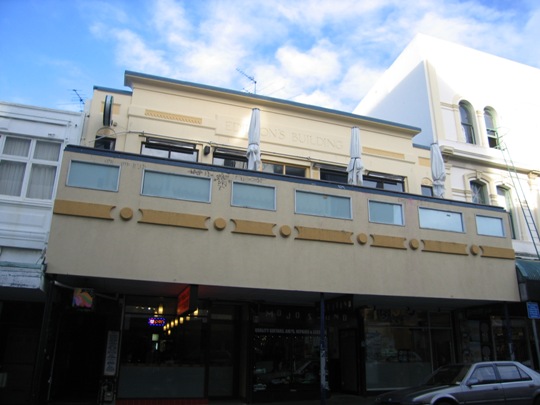
Stripped classical
Construction Materials
Concrete; two storey
Notable Features
Symmetrical facade (first floor), careful detailing in the window treatment (now enclosed), minimal decoration in from of motifs and friezes.
Construction Professional
Name
Dawson, Joseph McClatchie
Type
Architect
Biography
J M Dawson (1877-1956) was born in the Wairarapa. His father was a contractor in this district and Dawson's education included a background in construction work. In 1900 he left New Zealand and travelled to South Africa, England and Australia, returning in 1906 to establish his own architectural practice in Wellington. His buildings include the T.G. McCarthy Building, Willis Street (1913), Hatricks Motor Garage (now Manthel Motors), corner Taranaki and Wakefield Streets (1913), and the Hope Gibbons Building, Dixon Street (1925). Dawson was an inaugural member of the New Zealand Institute of Architects, formed in 1905, and became a Fellow of the Institute in 1913. He was its president from 1938-1940. Having appointed Jack Ian King (1900-1972) as his first partner in 1929 Dawson entered semi-retirement in 1946, retiring in 1948. The firm he founded continues as King and Dawson.
Construction Details
Start Year
1928
Type
Original Construction
Description
Stripped classical
Construction Materials
Concrete; two storey
Notable Features
Symmetrical facade (first floor), careful detailing in the window treatment (now enclosed), minimal decoration in from of motifs and friezes.
Historical and Associated Iwi / Hapū / Whānau
Completion Date
22nd August 1991
Report Written By
Mary O'Keeffe
Other Information
This place was identified as significant under previous legislation with different information requirements. It remains significant under the current legislation. There is opportunity under our legislation and policies to add to this information. Further information about this place may be available from the Central Regional Office of Heritage New Zealand Pouhere Taonga. A copy of the original report is available from the NZHPT Central region office Please note that entry on the New Zealand Heritage List/Rarangi Korero identifies only the heritage values of the property concerned, and should not be construed as advice on the state of the property, or as a comment of its soundness or safety, including in regard to earthquake risk, safety in the event of fire, or insanitary conditions. This historic place was registered under the Historic Places Act 1980. The following text is from the original Proposal for Classification report considered by the NZHPT Board at the time of registration.
Historical and Associated Iwi / Hapū / Whānau
Completion Date
22nd August 1991
Report Written By
Mary O'Keeffe
Other Information
This place was identified as significant under previous legislation with different information requirements. It remains significant under the current legislation. There is opportunity under our legislation and policies to add to this information. Further information about this place may be available from the Central Regional Office of Heritage New Zealand Pouhere Taonga. A copy of the original report is available from the NZHPT Central region office Please note that entry on the New Zealand Heritage List/Rarangi Korero identifies only the heritage values of the property concerned, and should not be construed as advice on the state of the property, or as a comment of its soundness or safety, including in regard to earthquake risk, safety in the event of fire, or insanitary conditions. This historic place was registered under the Historic Places Act 1980. The following text is from the original Proposal for Classification report considered by the NZHPT Board at the time of registration.
Former Usages
General Usage: Trade
Specific Usage: Shop
Former Usages
General Usage: Trade
Specific Usage: Shop
Location