DonateMembershipVisit Heritage
  • Tūrangawaewae
    Places
  • Tira Māori
    Māori Heritage
  • Poutairangahia
    Archaeology
  • Rauemi
    Resources
  • Mō Tātou
    About Us
  • New Zealand Heritage List
  • Nominate and submit
  • Explore the List
  • National Historic Landmarks
  • Plaques
  • Rainbow List Project
  • Lost heritage
  • Visit Heritage
  • Our properties
  • Turnbull House Project
  • Collections
  • Shop
  • Tohu Whenua
  • Tira Māori
  • Conserving Māori heritage
  • Marae built heritage
  • Māori heritage on the List
  • Hinemihi—Te Hokinga Mai
  • What is archaeology?
  • Is there a site on my property?
  • What are my legal requirements?
  • Affecting an archaeological site
  • Declaring an archaeological site
  • Archaeology FAQs
  • Archaeology Digital Library
  • Archaeology guidelines and templates
  • Resources
  • Funding
  • Publications
  • Sustainable management guides
  • Disaster recovery
  • Podcasts & digital resources
  • Education Hub
  • Conservation plans
  • About
  • Board
  • Māori Heritage Council
  • Senior Staff
  • Offices
  • Contact us
  • Careers
  • Covenants
  • Fast-track
  • Corporate documents
  • Currently consulting on
  • Our submissions
  • News
  • Covid-19 response
Quick links
Rārangi Kōrero | The List
Explore the List
National Historic Landmarks
Ngā Manawhenua o Aotearoa me ōna Kōrero Tūturu
Quick links
Tapuwae
A Vision for Places of Māori Heritage
Funding for Māori Heritage
Resources
Quick links
Archaeological Authority Portal
Applying for an archaeological authority
Archaeology FAQs
Browse the most frequently asked questions about archaeological authorities and the archaeological process.
Quick links
Quick links
News
News Keep up to date with Heritage New Zealand Pouhere Taonga
Membership
Membership Find out more and sign up today
DonateMembershipVisit Heritage
  • Tūrangawaewae
    Places
  • Tira Māori
    Māori Heritage
  • Poutairangahia
    Archaeology
  • Rauemi
    Resources
  • Mō Tātou
    About Us
  • New Zealand Heritage List
  • Nominate and submit
  • Explore the List
  • National Historic Landmarks
  • Plaques
  • Rainbow List Project
  • Lost heritage
  • Visit Heritage
  • Our properties
  • Turnbull House Project
  • Collections
  • Shop
  • Tohu Whenua
  • Tira Māori
  • Conserving Māori heritage
  • Marae built heritage
  • Māori heritage on the List
  • Hinemihi—Te Hokinga Mai
  • What is archaeology?
  • Is there a site on my property?
  • What are my legal requirements?
  • Affecting an archaeological site
  • Declaring an archaeological site
  • Archaeology FAQs
  • Archaeology Digital Library
  • Archaeology guidelines and templates
  • Resources
  • Funding
  • Publications
  • Sustainable management guides
  • Disaster recovery
  • Podcasts & digital resources
  • Education Hub
  • Conservation plans
  • About
  • Board
  • Māori Heritage Council
  • Senior Staff
  • Offices
  • Contact us
  • Careers
  • Covenants
  • Fast-track
  • Corporate documents
  • Currently consulting on
  • Our submissions
  • News
  • Covid-19 response
Quick links
Rārangi Kōrero | The List
Explore the List
National Historic Landmarks
Ngā Manawhenua o Aotearoa me ōna Kōrero Tūturu
Quick links
Tapuwae
A Vision for Places of Māori Heritage
Funding for Māori Heritage
Resources
Quick links
Archaeological Authority Portal
Applying for an archaeological authority
Archaeology FAQs
Browse the most frequently asked questions about archaeological authorities and the archaeological process.
Quick links
Quick links
News
News Keep up to date with Heritage New Zealand Pouhere Taonga
Membership
Membership Find out more and sign up today
  • Places
  • Nominate and submit
  • National Historic Landmarks
  • Places
  • Nominate and submit
  • National Historic Landmarks
  • Tira Māori
  • Conserving Māori heritage
  • Marae built heritage
  • Tira Māori
  • Conserving Māori heritage
  • Marae built heritage
  • Archaeological authorities
  • Archaeology Digital Library
  • Archaeological authorities
  • Archaeology Digital Library
  • All resources
  • Publications
  • Funding
  • All resources
  • Publications
  • Funding
  • FAQs
  • FAQs
Follow us on:
Places
  • Places
  • Nominate and submit
  • National Historic Landmarks
Tira Māori
  • Tira Māori
  • Conserving Māori heritage
  • Marae built heritage
Archaeology
  • Archaeological authorities
  • Archaeology Digital Library
Resources
  • All resources
  • Publications
  • Funding
FAQs
  • FAQs
Follow us on
HomePrivacyTerms and conditionsAbout this site
© Heritage New Zealand Pouhere Taonga 2026.
 
Morgan’s Buildings

197-199 Cuba Street and 149-151 Vivian Street (State Highway 1), Te Aro, WELLINGTON

Private

Historic Place Category 2

List No. 5360

Quick links:
List GalleryLocationDetails
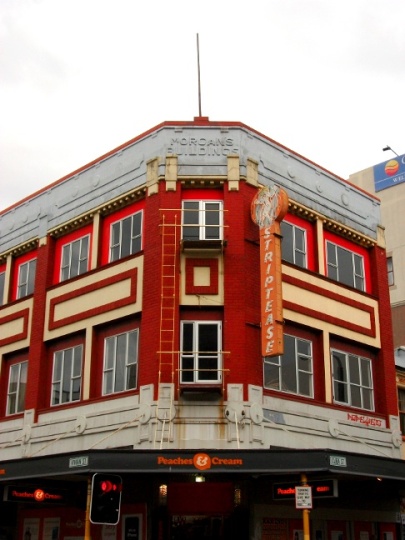
Morgan’s Buildings, located on the corner of Cuba and Vivian Street, was designed by architect Llewellyn Piper and built in 1922 by Fletcher Construction Company Ltd. It has architectural significance as a good example of the transitional stripped classical style of the inter-war period, contributing to the heritage values of the Cuba Street Historic Area (List No. 7209). It also has historical significance for its long-standing use as a commercial building as well as its role in the development of Wellington’s red-light district the 60s and 70s.

Te-Whanganui-ā-Tara has a long history of Māori settlement. Early inhabitants of the Wellington area were primarily iwi of Kurahaupō waka descent. By the late eighteenth century, Ngāti Ira of Hawke’s Bay had migrated south and intermarried with Ngāi Tara. Upheaval in the 1820s and 1830s saw Taranaki, Taumarunui and Kawhia iwi leading taua (war parties) south into Wellington. Iwi associated with these heke include Te Ātiawa, Ngāti Toa, and Ngāti Tama. In 1824, Te Aro Pā, from which this area gains its name, was built on the foreshore by Ngāti Mutunga, with Taranaki iwi and Ngāti Ruanui subsequently occupying it. This land was not included in the original 1839 Port Nicholson Purchase, however, in 1844 a deed was signed which effectively brought Te Aro Pā into the New Zealand Company’s procurement.

Cuba Street itself is located on what would have been cultivation land for the Te Aro Kāinga. The street, named for the New Zealand Company Ship which arrived in Te-Whanganui-a-Tara in January 1840, began to be developed in the 1840s. Morgan’s Buildings was built in 1922 for Mr H. Morgan, on a site previously occupied by the National Bank, which opened new premises across the road.

The building is an example of stripped classical architecture. Stylistic features include minimal ornamentation on the spandrels and parapet as well as a dentil detail above the top floor windows. In 1928, a fire left the second and third floor with extensive damage to the interior. The windows are not authentic but were replaced close to their original appearance while the building was undergoing seismic strengthening in 2012. The top two storeys retain much of the original 1922 style whereas the ground floor has been renovated to accommodate a new shop front.

Morgan’s Buildings was built to accommodate three shops on the ground floor and a billiards hall located on the upper floors. It was bought in 1923 by F.R. Cooper, director of F. Cooper Ltd, one of the earliest seed merchant and nursery businesses in New Zealand. Upon his death in 1925, the ownership of the building passed to the Cooper Building Co. Ltd. Various tenants proceeded to occupy the space, until it was sold in 1937. A long-term tenant of the building, occupying the ground floor retail space from 1937, was Janis Hairstylists and Tobacconist. The business remained in the premises until the 1980s.

The building also had strong ties to the Vivian Street Red Light District. The second floor was occupied by Club Exotic, a strip club later renamed The Club Exotique, from the 1960s to the early 1990s. This was owned by Emmanuel Papadopoulos, who employed trans women at the club. These included the important Māori, LGBTQ+ and sex work activists Carmen Rupe in the 1960s and Georgina Beyer in the 1970s. As of 2022, Venetian-style restaurant Ombra occupies the ground floor with the upper floors holding office space.
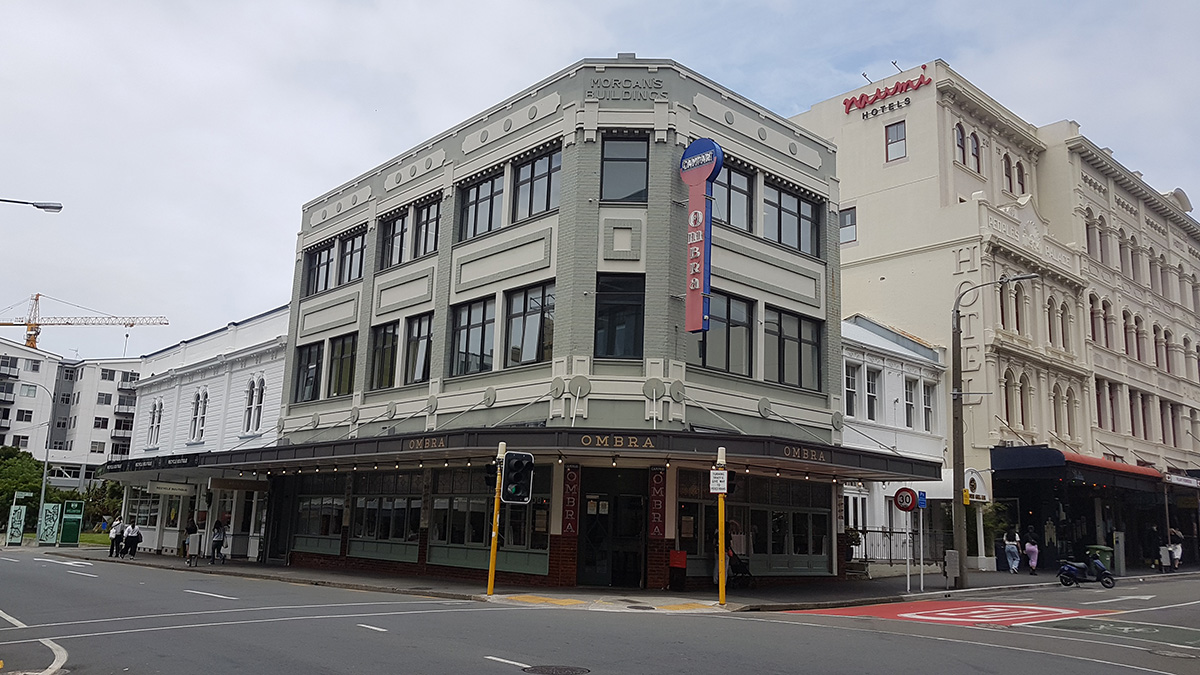
Morgan's Buildings, cnr Cuba and Vivian Streets, Wellington | Chris Horwell | 13/12/2021 | Heritage New Zealand Pouhere Taonga
Morgan's Buildings, crn Cuba and Vivian Streets, Wellington | 04/03/2009 | Heritage New Zealand Pouhere Taonga
Morgan's Buildings, cnr Cuba and Vivian Streets, Wellington | Chris Horwell | 13/12/2021 | Heritage New Zealand Pouhere Taonga
Morgan's Buildings, crn Cuba and Vivian Streets, Wellington | 04/03/2009 | Heritage New Zealand Pouhere Taonga

List Entry Information

Overview

Status
Listed

List Entry Status
Historic Place Category 2

Access
Private/No Public Access

List Number
5360

Date Entered
22nd August 1991

Date of Effect
22nd August 1991

City/District Council
Wellington City

Region
Wellington Region

Extent of List Entry

Extent includes the land described as Pt Sec 128 Town of Wellington (RT WN115/100), Wellington Land District and the building known as Morgan’s Buildings thereon.

Legal description

Pt Sec 128 Town of Wellington (RT WN115/100), Wellington Land District

Detailed List Entry

Construction Professional

Name

Piper, Llewellyn

Type

Architect

Biography

No biography is currently available for this construction professional

Name

Fletcher Construction Company

Type

Builder

Biography

Fletcher Construction Company was founded by Scottish-born James Fletcher (1886 - 1974), the son of a builder. Six months after his arrival in Dunedin in 1908, Fletcher formed a house-building partnership with Bert Morris. They soon moved into larger-scale construction work, building the St Kilda Town Hall (1911), and the main dormitory block and Ross Chapel at Knox College (1912). Fletcher's brothers, William, Andrew and John joined the business in 1911, which then became known as Fletcher Brothers. A branch was opened in Invercargill. While holidaying in Auckland in 1916, James tendered for the construction of the the Auckland City Markets. By 1919 the company, then known as Fletcher Construction, was firmly established in Auckland and Wellington. Notable landmarks constructed by the company during the Depression included the Auckland University College Arts Building (completed 1926); Landmark House (the former Auckland Electric Power Board Building, 1927); Auckland Civic Theatre (1929); the Chateau Tongariro (1929); and the Dominion Museum, Wellington (1934). Prior to the election of the first Labour Government, Fletcher (a Reform supporter) had advised the Labour Party on housing policy as hbe believed in large-scale planning and in the inter-dependence of government and business. However, he declined an approach by Prime Minister Michael Joseph Savage in December 1935 to sell the company to the government, when the latter wanted to ensure the large-scale production of rental state housing. Although Fletchers ultimately went on to build many of New Zealand's state houses, for several years Residential Construction Ltd (the subsidiary established to undertake their construction) sustained heavy financial losses. Fletcher Construction became a public company, Fletcher Holdings, in 1940. Already Fletchers' interests were wide ranging: brickyards, engineering shops, joinery factories, marble quarries, structural steel plants and other enterprises had been added the original construction firm. Further expansion could only be undertaken with outside capital. During the Second World War James Fletcher, having retired as chairman of Fletcher Holdings, was seconded to the newly created position of Commissioner of State Construction which he held during 1942 and 1943. Directly responsible to Prime Minister Peter Fraser, Fletcher had almost complete control over the deployment of workers and resources. He also became the Commissioner of the Ministry of Works, set up in 1943, a position he held until December 1945. In 1981 Fletcher Holdings; Tasman Pulp and Paper; and Challenge Corporation amalgamated to form Fletcher Challenge Ltd, at that time New Zealand's largest company. Williamson Construction Company - main contract

Construction Details

Start Year

1922

Type

Original Construction

Description

Stripped classical

Start Year

2012

Finish Year

2013

Type

Structural upgrade

Description

(seismic strengthening)

Start Year

2012

Finish Year

2013

Type

Refurbishment/renovation

Description

replacing windows and new shop front

Start Year

1928

Type

Damaged

Description

(Fire) Refurbishment/renovation

Construction Materials

Reinforced concrete columns & beams, exposed & rendered brick; three storey

Notable Features

Series of shallow bays set within plain brick piers, rendered brick panels and parapets

Reference

Completion Date

26th April 2022

Report Written By

Jenna McNaughton

Information Sources

Wellington City Council, 2012

Wellington City Council, “Morgan’s Building”, Heritage Inventory Report, 2012, https://wellingtoncityheritage.org.nz/buildings/1-150/89-1-morgan, accessed Jan 12 2022

Resonance Walking Tour

Resonance Walking Tour, YouTube video, presented by Gareth Watkins and Roger Smith, 2020, https://www.pridenz.com/resonance_walk_tour.html, accessed 12 Jan 2022

Report Written By

This place was identified as significant under previous legislation with different information requirements. It remains significant under the current legislation. There is opportunity under our legislation and policies to add to this information. Further information about this place may be available from the Central Regional Office of Heritage New Zealand Pouhere Taonga. A fully referenced copy of the upgrade report is available on request from the Central Regional Office of Heritage New Zealand Pouhere Taonga Please note that entry on the New Zealand Heritage List/Rarangi Korero identifies only the heritage values of the property concerned, and should not be construed as advice on the state of the property, or as a comment of its soundness or safety, including in regard to earthquake risk, safety in the event of fire, or insanitary conditions.

Further Information

Current Usages

Uses: Trade

Specific Usage: Office building/Offices

Uses: Trade

Specific Usage: Restaurant/cafe/tearoom

Former Usages

General Usage:: Trade

Specific Usage: Retail and Commercial - other

General Usage:: Trade

Specific Usage: Shop

Themes

Rainbow List

Web Links

Overview

Status

Listed

List Entry Status

Historic Place Category 2

Access

Private/No Public Access

List Number

5360

Date Entered

22nd August 1991

Date of Effect

22nd August 1991

City/District Council

Wellington City

Region

Wellington Region

Extent of List Entry

Extent includes the land described as Pt Sec 128 Town of Wellington (RT WN115/100), Wellington Land District and the building known as Morgan’s Buildings thereon.

Legal description

Pt Sec 128 Town of Wellington (RT WN115/100), Wellington Land District

Status

Listed

List Entry Status

Historic Place Category 2

Access

Private/No Public Access

List Number

5360

Date Entered

22nd August 1991

Date of Effect

22nd August 1991

City/District Council

Wellington City

Region

Wellington Region

Extent of List Entry

Extent includes the land described as Pt Sec 128 Town of Wellington (RT WN115/100), Wellington Land District and the building known as Morgan’s Buildings thereon.

Legal description

Pt Sec 128 Town of Wellington (RT WN115/100), Wellington Land District

Construction Information

Construction Professional

Name

Piper, Llewellyn

Type

Architect

Biography

No biography is currently available for this construction professional

Name

Fletcher Construction Company

Type

Builder

Biography

Fletcher Construction Company was founded by Scottish-born James Fletcher (1886 - 1974), the son of a builder. Six months after his arrival in Dunedin in 1908, Fletcher formed a house-building partnership with Bert Morris. They soon moved into larger-scale construction work, building the St Kilda Town Hall (1911), and the main dormitory block and Ross Chapel at Knox College (1912). Fletcher's brothers, William, Andrew and John joined the business in 1911, which then became known as Fletcher Brothers. A branch was opened in Invercargill. While holidaying in Auckland in 1916, James tendered for the construction of the the Auckland City Markets. By 1919 the company, then known as Fletcher Construction, was firmly established in Auckland and Wellington. Notable landmarks constructed by the company during the Depression included the Auckland University College Arts Building (completed 1926); Landmark House (the former Auckland Electric Power Board Building, 1927); Auckland Civic Theatre (1929); the Chateau Tongariro (1929); and the Dominion Museum, Wellington (1934). Prior to the election of the first Labour Government, Fletcher (a Reform supporter) had advised the Labour Party on housing policy as hbe believed in large-scale planning and in the inter-dependence of government and business. However, he declined an approach by Prime Minister Michael Joseph Savage in December 1935 to sell the company to the government, when the latter wanted to ensure the large-scale production of rental state housing. Although Fletchers ultimately went on to build many of New Zealand's state houses, for several years Residential Construction Ltd (the subsidiary established to undertake their construction) sustained heavy financial losses. Fletcher Construction became a public company, Fletcher Holdings, in 1940. Already Fletchers' interests were wide ranging: brickyards, engineering shops, joinery factories, marble quarries, structural steel plants and other enterprises had been added the original construction firm. Further expansion could only be undertaken with outside capital. During the Second World War James Fletcher, having retired as chairman of Fletcher Holdings, was seconded to the newly created position of Commissioner of State Construction which he held during 1942 and 1943. Directly responsible to Prime Minister Peter Fraser, Fletcher had almost complete control over the deployment of workers and resources. He also became the Commissioner of the Ministry of Works, set up in 1943, a position he held until December 1945. In 1981 Fletcher Holdings; Tasman Pulp and Paper; and Challenge Corporation amalgamated to form Fletcher Challenge Ltd, at that time New Zealand's largest company. Williamson Construction Company - main contract

Construction Details

Start Year

1922

Type

Original Construction

Description

Stripped classical

Start Year

2012

startYearCirca

Finish Year

2013

Type

Structural upgrade

Description

(seismic strengthening)

Start Year

2012

startYearCirca

Finish Year

2013

Type

Refurbishment/renovation

Description

replacing windows and new shop front

Start Year

1928

Type

Damaged

Description

(Fire) Refurbishment/renovation

Construction Materials

Reinforced concrete columns & beams, exposed & rendered brick; three storey

Notable Features

Series of shallow bays set within plain brick piers, rendered brick panels and parapets

Construction Professional

Name

Piper, Llewellyn

Type

Architect

Biography

No biography is currently available for this construction professional

Name

Fletcher Construction Company

Type

Builder

Biography

Fletcher Construction Company was founded by Scottish-born James Fletcher (1886 - 1974), the son of a builder. Six months after his arrival in Dunedin in 1908, Fletcher formed a house-building partnership with Bert Morris. They soon moved into larger-scale construction work, building the St Kilda Town Hall (1911), and the main dormitory block and Ross Chapel at Knox College (1912). Fletcher's brothers, William, Andrew and John joined the business in 1911, which then became known as Fletcher Brothers. A branch was opened in Invercargill. While holidaying in Auckland in 1916, James tendered for the construction of the the Auckland City Markets. By 1919 the company, then known as Fletcher Construction, was firmly established in Auckland and Wellington. Notable landmarks constructed by the company during the Depression included the Auckland University College Arts Building (completed 1926); Landmark House (the former Auckland Electric Power Board Building, 1927); Auckland Civic Theatre (1929); the Chateau Tongariro (1929); and the Dominion Museum, Wellington (1934). Prior to the election of the first Labour Government, Fletcher (a Reform supporter) had advised the Labour Party on housing policy as hbe believed in large-scale planning and in the inter-dependence of government and business. However, he declined an approach by Prime Minister Michael Joseph Savage in December 1935 to sell the company to the government, when the latter wanted to ensure the large-scale production of rental state housing. Although Fletchers ultimately went on to build many of New Zealand's state houses, for several years Residential Construction Ltd (the subsidiary established to undertake their construction) sustained heavy financial losses. Fletcher Construction became a public company, Fletcher Holdings, in 1940. Already Fletchers' interests were wide ranging: brickyards, engineering shops, joinery factories, marble quarries, structural steel plants and other enterprises had been added the original construction firm. Further expansion could only be undertaken with outside capital. During the Second World War James Fletcher, having retired as chairman of Fletcher Holdings, was seconded to the newly created position of Commissioner of State Construction which he held during 1942 and 1943. Directly responsible to Prime Minister Peter Fraser, Fletcher had almost complete control over the deployment of workers and resources. He also became the Commissioner of the Ministry of Works, set up in 1943, a position he held until December 1945. In 1981 Fletcher Holdings; Tasman Pulp and Paper; and Challenge Corporation amalgamated to form Fletcher Challenge Ltd, at that time New Zealand's largest company. Williamson Construction Company - main contract

Construction Details

Start Year

1922

Type

Original Construction

Description

Stripped classical

Start Year

2012

startYearCirca

Finish Year

2013

Type

Structural upgrade

Description

(seismic strengthening)

Start Year

2012

startYearCirca

Finish Year

2013

Type

Refurbishment/renovation

Description

replacing windows and new shop front

Start Year

1928

Type

Damaged

Description

(Fire) Refurbishment/renovation

Construction Materials

Reinforced concrete columns & beams, exposed & rendered brick; three storey

Notable Features

Series of shallow bays set within plain brick piers, rendered brick panels and parapets

Reference

Historical and Associated Iwi / Hapū / Whānau

Completion Date

26th April 2022

Report Written By

Jenna McNaughton

Information Sources

Wellington City Council, 2012

Wellington City Council, “Morgan’s Building”, Heritage Inventory Report, 2012, https://wellingtoncityheritage.org.nz/buildings/1-150/89-1-morgan, accessed Jan 12 2022

Resonance Walking Tour

Resonance Walking Tour, YouTube video, presented by Gareth Watkins and Roger Smith, 2020, https://www.pridenz.com/resonance_walk_tour.html, accessed 12 Jan 2022

Other Information

This place was identified as significant under previous legislation with different information requirements. It remains significant under the current legislation. There is opportunity under our legislation and policies to add to this information. Further information about this place may be available from the Central Regional Office of Heritage New Zealand Pouhere Taonga. A fully referenced copy of the upgrade report is available on request from the Central Regional Office of Heritage New Zealand Pouhere Taonga Please note that entry on the New Zealand Heritage List/Rarangi Korero identifies only the heritage values of the property concerned, and should not be construed as advice on the state of the property, or as a comment of its soundness or safety, including in regard to earthquake risk, safety in the event of fire, or insanitary conditions.

Historical and Associated Iwi / Hapū / Whānau

Completion Date

26th April 2022

Report Written By

Jenna McNaughton

Information Sources

Wellington City Council, 2012

Wellington City Council, “Morgan’s Building”, Heritage Inventory Report, 2012, https://wellingtoncityheritage.org.nz/buildings/1-150/89-1-morgan, accessed Jan 12 2022

Resonance Walking Tour

Resonance Walking Tour, YouTube video, presented by Gareth Watkins and Roger Smith, 2020, https://www.pridenz.com/resonance_walk_tour.html, accessed 12 Jan 2022

Other Information

This place was identified as significant under previous legislation with different information requirements. It remains significant under the current legislation. There is opportunity under our legislation and policies to add to this information. Further information about this place may be available from the Central Regional Office of Heritage New Zealand Pouhere Taonga. A fully referenced copy of the upgrade report is available on request from the Central Regional Office of Heritage New Zealand Pouhere Taonga Please note that entry on the New Zealand Heritage List/Rarangi Korero identifies only the heritage values of the property concerned, and should not be construed as advice on the state of the property, or as a comment of its soundness or safety, including in regard to earthquake risk, safety in the event of fire, or insanitary conditions.

Further Information

Current Usages

Uses: Trade

Specific Usage: Office building/Offices

Uses: Trade

Specific Usage: Restaurant/cafe/tearoom

Former Usages

General Usage: Trade

Specific Usage: Retail and Commercial - other

General Usage: Trade

Specific Usage: Shop

Themes

Rainbow List

Current Usages

Uses: Trade

Specific Usage: Office building/Offices

Uses: Trade

Specific Usage: Restaurant/cafe/tearoom

Former Usages

General Usage: Trade

Specific Usage: Retail and Commercial - other

General Usage: Trade

Specific Usage: Shop

Themes

Rainbow List

Location

Loading
Related listings
Cuba Street Historic Area
Stay up to date with Heritage this month