Te-Whanganui-ā-Tara has a long history of Māori settlement. Early inhabitants of the Wellington area were primarily iwi of Kurahaupō waka descent. By the late eighteenth century, Ngāti Ira of Hawke’s Bay had migrated south and intermarried with Ngāi Tara. Upheaval in the 1820s and 1830s prompted taua (war parties) and heke (migration) south into Wellington. Iwi associated with these heke include Te Ātiawa, Ngāti Toa, and Ngāti Tama. In 1824, Te Aro Pā, from which this area gains its name, was built on the foreshore by Ngāti Mutunga, with Taranaki iwi and Ngāti Ruanui subsequently occupying it (List No. 7771). In 1844, a deed was signed which effectively brought Te Aro Pā into the New Zealand Company’s purchase. In 1840, William Mein Smith, company surveyor, laid out the town plan. Cuba Street itself is located on what would have been cultivation land for Te Aro Kāinga. The Hallenstein Bros building sits on the current culvert for the Waimapihi Stream, which was directed underground during the nineteenth century. The street, named for the New Zealand Company Ship which arrived in Te Whanganui-a-Tara in January 1840, began to be developed in the 1840s. The first residence and shop–a drapers–was erected in 1845.
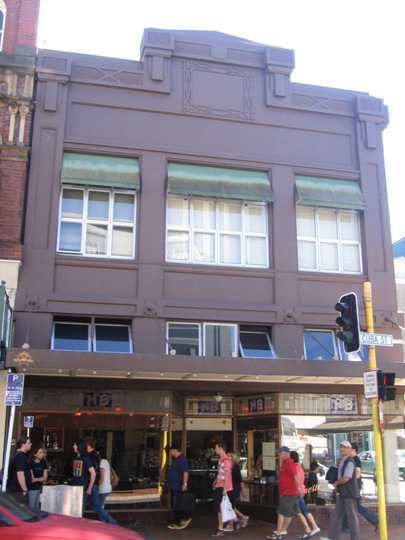
The building was constructed during the inter-war period and is noted for its stripped, transitional architectural style. Constructed of reinforced concrete with brick masonry infill, the building is two and a half storeys, with a tall, stepped parapet. The original arrangement of the building suited the functionality of the New Zealand Clothing company factory, located on the second floor, with the fenestration allowing for maximum lighting in the work space. The large ground floor windows, featuring stained-glass leadlighting detailed with the initials ‘HB’, and front door remain of the original shopfront. The building was damaged during the 1942 Wairarapa earthquake and some reinforcement was undertaken as a result of this. The original steel framed windows were replaced in the 1960s.
Hallenstein Brothers occupied the purpose-built premises for nearly 50 years until 1967. The next tenant, Krazy Rick’s, operated a popular junk shop at the premises for 28 years. After closing in 1995, the Krazy Lounge café occupied the space until 2006 and Ernesto’s café until 2011. The building was earthquake strengthened in 2011 and, in 2017, a balcony was added to the exterior of the first floor to increase commercial space, since occupied by a cocktail lounge. The Pastaria 1154 restaurant has used the ground floor since 2017, and the roof space has been converted into a roof top bar, currently (2022) occupied by Ascot.
List Entry Information
Status
Listed
List Entry Status
Historic Place Category 2
Access
Private/No Public Access
List Number
5361
Date Entered
22nd August 1991
Date of Effect
22nd August 1991
City/District Council
Wellington City
Region
Wellington Region
Extent of List Entry
Extent includes the land described as Lot 2 DP 88682 (RT WN56B/441), Wellington Land District, and the building known as Hallenstein Brothers Building (Former) thereon.
Legal description
Lot 2 DP 88682 (RT WN56B/441), Wellington Land District
Status
Listed
List Entry Status
Historic Place Category 2
Access
Private/No Public Access
List Number
5361
Date Entered
22nd August 1991
Date of Effect
22nd August 1991
City/District Council
Wellington City
Region
Wellington Region
Extent of List Entry
Extent includes the land described as Lot 2 DP 88682 (RT WN56B/441), Wellington Land District, and the building known as Hallenstein Brothers Building (Former) thereon.
Legal description
Lot 2 DP 88682 (RT WN56B/441), Wellington Land District
Construction Professional
Name
Edwin Royden Wells
Type
Architect
Biography
Edwin Royden Wells (1887-1950), born and raised in Canterbury. Practised as an architect and in 1912 he became registered and was working in partnership with F.H Forge in Gisborne. The partnership dissovled in 1914. Wells served as a lieutenant in World War One and returned to Wellington and married Lynette Katherine MacKenzie. In 1919 he worked as an architect for Fletcher Construction in the 1920s and was responsible for the design of a number of buildings including the building at 132 Cuba Street. He established a private practice in 1921 and continued into the 1940s. He died aged 63 in 1950. See WCC Public Report for the Francis Holmes Building, dated August 2012.
Name
Fletcher Construction Company
Type
Builder
Biography
Fletcher Construction Company was founded by Scottish-born James Fletcher (1886 - 1974), the son of a builder. Six months after his arrival in Dunedin in 1908, Fletcher formed a house-building partnership with Bert Morris. They soon moved into larger-scale construction work, building the St Kilda Town Hall (1911), and the main dormitory block and Ross Chapel at Knox College (1912). Fletcher's brothers, William, Andrew and John joined the business in 1911, which then became known as Fletcher Brothers. A branch was opened in Invercargill. While holidaying in Auckland in 1916, James tendered for the construction of the the Auckland City Markets. By 1919 the company, then known as Fletcher Construction, was firmly established in Auckland and Wellington. Notable landmarks constructed by the company during the Depression included the Auckland University College Arts Building (completed 1926); Landmark House (the former Auckland Electric Power Board Building, 1927); Auckland Civic Theatre (1929); the Chateau Tongariro (1929); and the Dominion Museum, Wellington (1934). Prior to the election of the first Labour Government, Fletcher (a Reform supporter) had advised the Labour Party on housing policy as hbe believed in large-scale planning and in the inter-dependence of government and business. However, he declined an approach by Prime Minister Michael Joseph Savage in December 1935 to sell the company to the government, when the latter wanted to ensure the large-scale production of rental state housing. Although Fletchers ultimately went on to build many of New Zealand's state houses, for several years Residential Construction Ltd (the subsidiary established to undertake their construction) sustained heavy financial losses. Fletcher Construction became a public company, Fletcher Holdings, in 1940. Already Fletchers' interests were wide ranging: brickyards, engineering shops, joinery factories, marble quarries, structural steel plants and other enterprises had been added the original construction firm. Further expansion could only be undertaken with outside capital. During the Second World War James Fletcher, having retired as chairman of Fletcher Holdings, was seconded to the newly created position of Commissioner of State Construction which he held during 1942 and 1943. Directly responsible to Prime Minister Peter Fraser, Fletcher had almost complete control over the deployment of workers and resources. He also became the Commissioner of the Ministry of Works, set up in 1943, a position he held until December 1945. In 1981 Fletcher Holdings; Tasman Pulp and Paper; and Challenge Corporation amalgamated to form Fletcher Challenge Ltd, at that time New Zealand's largest company. Williamson Construction Company - main contract
Construction Details
Start Year
1920
Type
Original Construction
Description
Stripped Classical
Start Year
1943
Type
Structural upgrade
Description
Reinstate earthquake damage, strengthen concrete columns
Start Year
1962
Type
Refurbishment/renovation
Description
Mezzanine floor
Start Year
1966
Type
Modification
Description
Windows replaced
Start Year
1996
Type
Modification
Start Year
1996
Type
Refurbishment/renovation
Description
Retiling of ground floor facade
Start Year
1999
Type
Addition
Description
Deck facing Ghuznee Street
Start Year
2014
Type
Structural upgrade
Description
Earthquake strengthening and refurbishment
Start Year
2017
Type
Addition
Description
Verandah facing Ghuznee Street and Cuba Street
Construction Materials
Concrete beams and columns with brick infill
Notable Features
Heavy, stepped parapet with decorative motif, functional nature of fenestration for maximum lighting
Construction Professional
Name
Edwin Royden Wells
Type
Architect
Biography
Edwin Royden Wells (1887-1950), born and raised in Canterbury. Practised as an architect and in 1912 he became registered and was working in partnership with F.H Forge in Gisborne. The partnership dissovled in 1914. Wells served as a lieutenant in World War One and returned to Wellington and married Lynette Katherine MacKenzie. In 1919 he worked as an architect for Fletcher Construction in the 1920s and was responsible for the design of a number of buildings including the building at 132 Cuba Street. He established a private practice in 1921 and continued into the 1940s. He died aged 63 in 1950. See WCC Public Report for the Francis Holmes Building, dated August 2012.
Name
Fletcher Construction Company
Type
Builder
Biography
Fletcher Construction Company was founded by Scottish-born James Fletcher (1886 - 1974), the son of a builder. Six months after his arrival in Dunedin in 1908, Fletcher formed a house-building partnership with Bert Morris. They soon moved into larger-scale construction work, building the St Kilda Town Hall (1911), and the main dormitory block and Ross Chapel at Knox College (1912). Fletcher's brothers, William, Andrew and John joined the business in 1911, which then became known as Fletcher Brothers. A branch was opened in Invercargill. While holidaying in Auckland in 1916, James tendered for the construction of the the Auckland City Markets. By 1919 the company, then known as Fletcher Construction, was firmly established in Auckland and Wellington. Notable landmarks constructed by the company during the Depression included the Auckland University College Arts Building (completed 1926); Landmark House (the former Auckland Electric Power Board Building, 1927); Auckland Civic Theatre (1929); the Chateau Tongariro (1929); and the Dominion Museum, Wellington (1934). Prior to the election of the first Labour Government, Fletcher (a Reform supporter) had advised the Labour Party on housing policy as hbe believed in large-scale planning and in the inter-dependence of government and business. However, he declined an approach by Prime Minister Michael Joseph Savage in December 1935 to sell the company to the government, when the latter wanted to ensure the large-scale production of rental state housing. Although Fletchers ultimately went on to build many of New Zealand's state houses, for several years Residential Construction Ltd (the subsidiary established to undertake their construction) sustained heavy financial losses. Fletcher Construction became a public company, Fletcher Holdings, in 1940. Already Fletchers' interests were wide ranging: brickyards, engineering shops, joinery factories, marble quarries, structural steel plants and other enterprises had been added the original construction firm. Further expansion could only be undertaken with outside capital. During the Second World War James Fletcher, having retired as chairman of Fletcher Holdings, was seconded to the newly created position of Commissioner of State Construction which he held during 1942 and 1943. Directly responsible to Prime Minister Peter Fraser, Fletcher had almost complete control over the deployment of workers and resources. He also became the Commissioner of the Ministry of Works, set up in 1943, a position he held until December 1945. In 1981 Fletcher Holdings; Tasman Pulp and Paper; and Challenge Corporation amalgamated to form Fletcher Challenge Ltd, at that time New Zealand's largest company. Williamson Construction Company - main contract
Construction Details
Start Year
1920
Type
Original Construction
Description
Stripped Classical
Start Year
1943
Type
Structural upgrade
Description
Reinstate earthquake damage, strengthen concrete columns
Start Year
1962
Type
Refurbishment/renovation
Description
Mezzanine floor
Start Year
1966
Type
Modification
Description
Windows replaced
Start Year
1996
Type
Modification
Start Year
1996
Type
Refurbishment/renovation
Description
Retiling of ground floor facade
Start Year
1999
Type
Addition
Description
Deck facing Ghuznee Street
Start Year
2014
Type
Structural upgrade
Description
Earthquake strengthening and refurbishment
Start Year
2017
Type
Addition
Description
Verandah facing Ghuznee Street and Cuba Street
Construction Materials
Concrete beams and columns with brick infill
Notable Features
Heavy, stepped parapet with decorative motif, functional nature of fenestration for maximum lighting
Historical and Associated Iwi / Hapū / Whānau
Completion Date
11th May 2022
Report Written By
Jenna McNaughton and Blyss Wagstaff
Information Sources
WCC, 2012
Wellington City Council, ‘Hallenstein Brothers Building (Former)’ Heritage Inventory report, 2012, https://www.wellingtoncityheritage.org.nz/buildings/1-150/81-1-hallenstein-brothers-building?q=, accessed 09 Dec 2021
Wellington City Archives Online
Wellington City Council
Wellington City Archives Online
Wellington City Council
Other Information
This place was identified as significant under previous legislation with different information requirements. It remains significant under the current legislation. There is opportunity under our legislation and policies to add to this information. Further information about this place may be available from the Central Regional Office of Heritage New Zealand Pouhere Taonga. A fully referenced copy of the upgrade report is available on request from the Central Regional Office of Heritage New Zealand Pouhere Taonga Please note that entry on the New Zealand Heritage List/Rarangi Korero identifies only the heritage values of the property concerned, and should not be construed as advice on the state of the property, or as a comment of its soundness or safety, including in regard to earthquake risk, safety in the event of fire, or insanitary conditions.
Historical and Associated Iwi / Hapū / Whānau
Completion Date
11th May 2022
Report Written By
Jenna McNaughton and Blyss Wagstaff
Information Sources
WCC, 2012
Wellington City Council, ‘Hallenstein Brothers Building (Former)’ Heritage Inventory report, 2012, https://www.wellingtoncityheritage.org.nz/buildings/1-150/81-1-hallenstein-brothers-building?q=, accessed 09 Dec 2021
Wellington City Archives Online
Wellington City Council
Wellington City Archives Online
Wellington City Council
Other Information
This place was identified as significant under previous legislation with different information requirements. It remains significant under the current legislation. There is opportunity under our legislation and policies to add to this information. Further information about this place may be available from the Central Regional Office of Heritage New Zealand Pouhere Taonga. A fully referenced copy of the upgrade report is available on request from the Central Regional Office of Heritage New Zealand Pouhere Taonga Please note that entry on the New Zealand Heritage List/Rarangi Korero identifies only the heritage values of the property concerned, and should not be construed as advice on the state of the property, or as a comment of its soundness or safety, including in regard to earthquake risk, safety in the event of fire, or insanitary conditions.
Former Usages
General Usage: Accommodation
Specific Usage: House
General Usage: Trade
Specific Usage: Restaurant/cafe/tearoom
General Usage: Trade
Specific Usage: Shop
Former Usages
General Usage: Accommodation
Specific Usage: House
General Usage: Trade
Specific Usage: Restaurant/cafe/tearoom
General Usage: Trade
Specific Usage: Shop
Location
Stay up to date with Heritage this month


