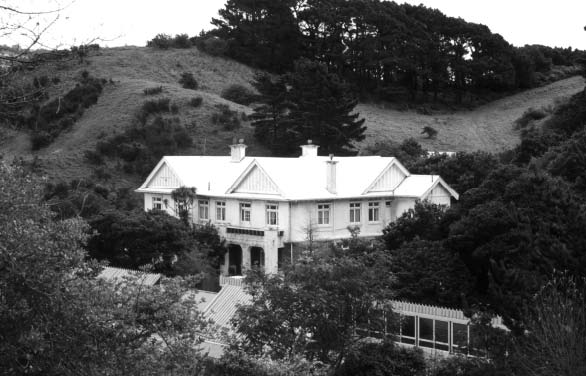
The Ewart Hospital Nurses’ Home (Former) is located at 2 Coromandel Street, on the edge of Wellington’s town belt, and was officially opened by the Governor-General Lord Islington (1866-1936) on 23 November 1910 in association with the city’s new Infectious Diseases hospital, later known as Ewart Hospital. The Arts and Crafts style hospital and nurses’ home were designed by Crichton and McKay, the architectural firm responsible for a number of early twentieth century hospital buildings in New Zealand. The accompanying hospital has since been demolished, making the nurses’ home an important surviving example of this architectural style in a hospital context. The nurses’ home has a strong association with developments in New Zealand’s medical history, including the treatment and prevention of infectious diseases and the provision of abortion services.
Prior to the development of vaccinations that enabled the prevention of many common but life-threatening infectious diseases, and different types of antibiotics to treat them, isolation was seen as the best method to curb the spread of diseases such as diphtheria, scarlet fever, influenza and tuberculosis. Separate ‘fever wards’ had existed at Wellington’s hospital since 1881, but by 1908 these facilities were considered inadequate, so it was decided to build a standalone infectious diseases or ‘fever’ hospital away from the main hospital grounds. On 24 March 1910, the Minister of Hospitals affixed a tablet to the in-progress building and remarked on Wellington’s particular need for such a facility, given the density of the city’s housing and the number of people living in each house, making isolation at home while infectious very difficult.
The combined nurses’ home and administration facility was constructed from cavity brick work, with a stucco plaster finish on the upper exterior level. It resembled a large, comfortable two-storey home and featured two prominent half-timbered gables facing the street, each above an open loggia with an entrance door. The original layout included matron and doctor’s rooms on the ground floor, along with a dispensary, kitchen, and dining room. Fifteen bedrooms occupied the first floor, two with separate access for male residents. The building also had facilities for disinfecting and changing garments, with bathrooms attached, for staff to use before entering the building proper.
An ‘L’ shaped wing providing 15 extra bedrooms was added around 1930 and the building continued to provide accommodation for medical staff for many years. However, following the closure of both the 1910 infectious diseases hospital (later demolished) and a later ‘fever’ hospital built further up the hill (List No. 5376), use of the nurses’ home decreased. Following changes to abortion law in New Zealand, the nurse’s home was renamed Parkview Clinic in 1980 and used as an abortion facility, where protests were frequently held by both anti-abortion groups, and those staging counter protests. In one instance 16 people were arrested during a conflict between protesters and the site received a bomb threat in 1998. The building has remained vacant since abortion services were transferred to the new Wellington Regional Hospital in 2009.