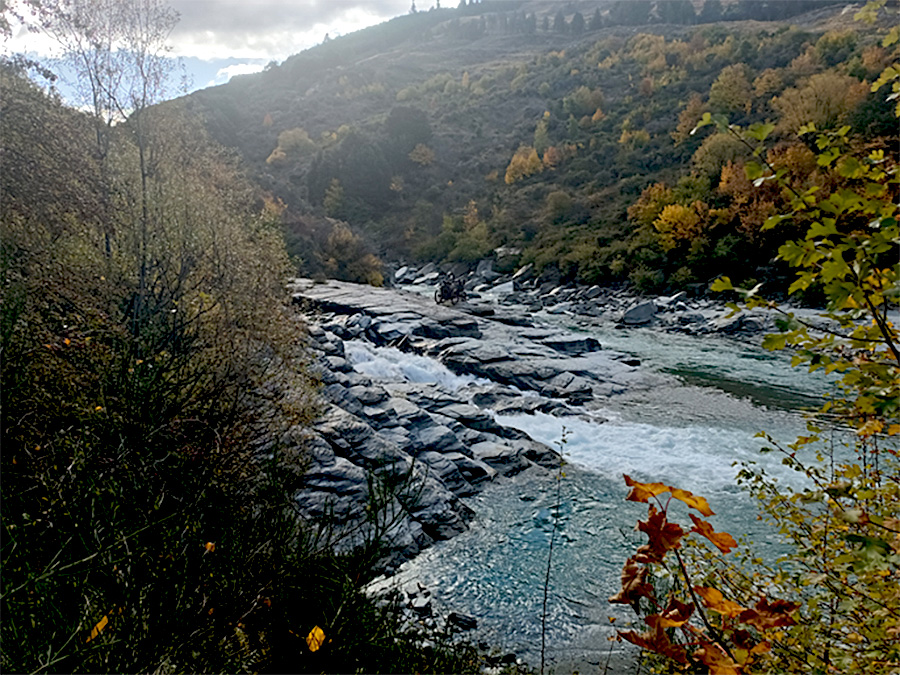
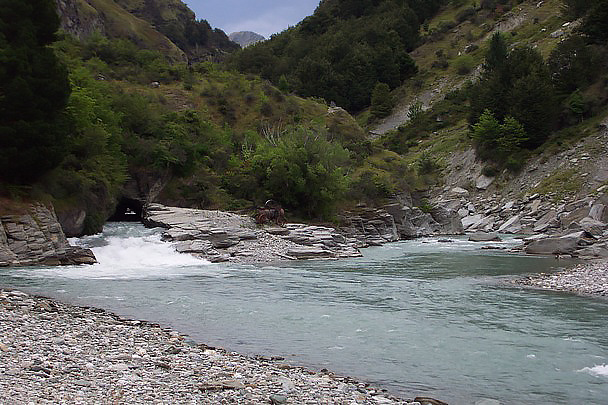
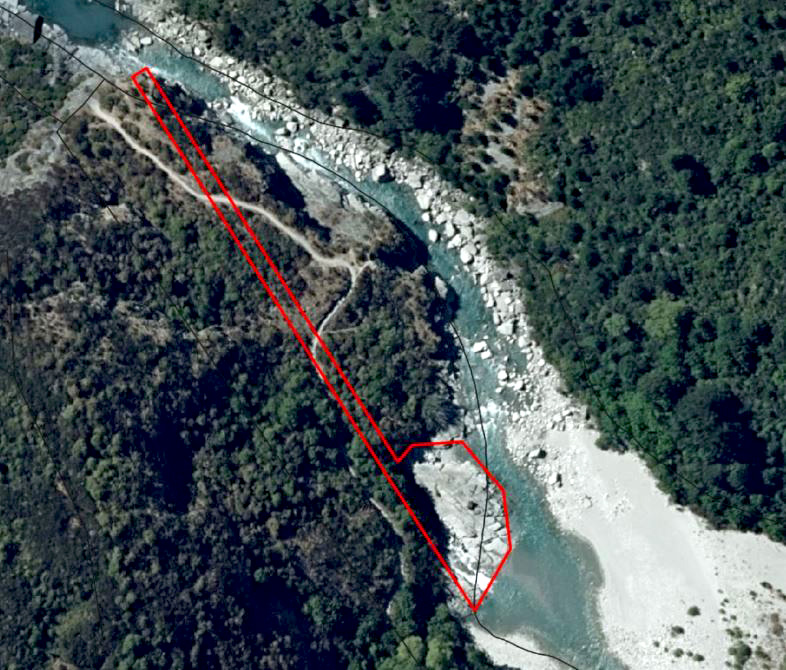
The Oxenbridge Tunnel was constructed from 1906 by the Oxenbridge Brothers (Bert and Edmund) as part of a method to extract gold from the beneath the Shotover rapids. As an example of the increasingly inventive (and often failing) methods undertaken for the extraction of gold, as well as an enduring feature of the landscape, the mining tunnel has been assessed as having historic, technological, and aesthetic significance.
Ngāi Tahu whānui had developed a complex series of trails throughout Te Waipounamu over generations of occupation, connecting kainga with one another and to mahinga kai (food gathering places) and other significant tribal resources. These ara tawhito (traditional travel routes) became the arteries of economic and social life and formed the relationships between people and places. This includes the routes leading to and from Whakatipu Wai Māori (Lake Wakatipu). Kimiākau (the Shotover River) was such an artery of life – being an important mahinga kai, as well as ara tawhito. In 1862 a large gold rush on the Shotover River, at the time dubbed ‘the richest river in the world’, turned a quiet piece of paradise into a seething mass of prospectors. Miners undertook various methods to part the gold from the land and water – including the panning of river gravels, alluvial mining along riverbanks, and dredging – as time passed, the returns from remaining gold deposits lessened to the extent that miners had to become inventive with methods to provide better access to deposits just out of reach, beneath the roiling waters of the Shotover rapids. A series of rapids above Arthurs Point had been dubbed by early miners as ‘the Jeweller’s Shop’, fabled for the bounty of gold that could be extracted but for the treacherous water flow.
The Oxenbridge Brothers started an ambitious operation, to divert a large part of the Shotover away from the ‘Jeweller’s Shop’ through a tunnel in a bend of the Shotover, from 1906. By October of 1907, it was reported that 180 ft (55 m) of the total expected length of 550 ft (168 m) had been excavated. At this time, the expected dimensions of the tunnel were 10 ft (3 m) high and 12 ft (3.7 m) wide. By 1909 it had been discovered that the original dimensions would not be enough to allow for a large enough volume of water to pass through; as such further work had to be undertaken to widen the tunnel by 3 ft (0.9m) and deepen it by 2 ft (0.6 m). The continuing financial pressure (without any significant return) this extra work created led to the incorporation of The Arthurs Point Gold Mining Company Limited in October 1909 – a total of 2000 shares were allotted at this time, providing what was hoped to be the necessary finance for continuing work. However, the first return from the tunnel project did not occur until 1911; the amount returned was in no way adequate to help the company pay its debt to creditors or shareholders. By August 1912, the company was put into liquidation.
There is no evidence that the tunnel was used for mining purposes following 1912. The Oxenbridge Brothers moved to mine farther up the Shotover, eventually being successful enough to sell up to a consortium for a handsome sum. By the late-20th century the tunnel, along with the rest of this part of the Shotover, was mostly used for tourism purposes, particularly rafting ventures. The 1995 death of an American tourist led to the filling in of the ‘Toaster’, the farthest north of the two original outlet channels from the tunnel exit. As of 2023, the tunnel is still part of the flow of the Shotover River, and primarily used by rafting companies.
Ngāi Tahu whānui had developed a complex series of trails throughout Te Waipounamu over generations of occupation, connecting kainga with one another and to mahinga kai (food gathering places) and other significant tribal resources. These ara tawhito (traditional travel routes) became the arteries of economic and social life and formed the relationships between people and places. This includes the routes leading to and from Whakatipu Wai Māori (Lake Wakatipu). Kimiākau (the Shotover River) was such an artery of life – being an important mahinga kai, as well as ara tawhito. In 1862 a large gold rush on the Shotover River, at the time dubbed ‘the richest river in the world’, turned a quiet piece of paradise into a seething mass of prospectors. Miners undertook various methods to part the gold from the land and water – including the panning of river gravels, alluvial mining along riverbanks, and dredging – as time passed, the returns from remaining gold deposits lessened to the extent that miners had to become inventive with methods to provide better access to deposits just out of reach, beneath the roiling waters of the Shotover rapids. A series of rapids above Arthurs Point had been dubbed by early miners as ‘the Jeweller’s Shop’, fabled for the bounty of gold that could be extracted but for the treacherous water flow.
The Oxenbridge Brothers started an ambitious operation, to divert a large part of the Shotover away from the ‘Jeweller’s Shop’ through a tunnel in a bend of the Shotover, from 1906. By October of 1907, it was reported that 180 ft (55 m) of the total expected length of 550 ft (168 m) had been excavated. At this time, the expected dimensions of the tunnel were 10 ft (3 m) high and 12 ft (3.7 m) wide. By 1909 it had been discovered that the original dimensions would not be enough to allow for a large enough volume of water to pass through; as such further work had to be undertaken to widen the tunnel by 3 ft (0.9m) and deepen it by 2 ft (0.6 m). The continuing financial pressure (without any significant return) this extra work created led to the incorporation of The Arthurs Point Gold Mining Company Limited in October 1909 – a total of 2000 shares were allotted at this time, providing what was hoped to be the necessary finance for continuing work. However, the first return from the tunnel project did not occur until 1911; the amount returned was in no way adequate to help the company pay its debt to creditors or shareholders. By August 1912, the company was put into liquidation.
There is no evidence that the tunnel was used for mining purposes following 1912. The Oxenbridge Brothers moved to mine farther up the Shotover, eventually being successful enough to sell up to a consortium for a handsome sum. By the late-20th century the tunnel, along with the rest of this part of the Shotover, was mostly used for tourism purposes, particularly rafting ventures. The 1995 death of an American tourist led to the filling in of the ‘Toaster’, the farthest north of the two original outlet channels from the tunnel exit. As of 2023, the tunnel is still part of the flow of the Shotover River, and primarily used by rafting companies.