Quick links


Quick links
Quick links
Quick links
Quick links
Quick links
Churton Memorial
Emily Place and Shortland Street, Emily Place Reserve, AUCKLAND
Public
Historic Place Category 2
List No. 563
Quick links:
List GalleryLocationDetails
Emily Place and Shortland Street, Emily Place Reserve, AUCKLAND
Public
Historic Place Category 2
List No. 563
List Entry Information
Status
Listed
List Entry Status
Historic Place Category 2
Access
Able to Visit
List Number
563
Date Entered
24th June 2005
Date of Effect
24th June 2005
City/District Council
Auckland Council
Region
Auckland Council
Extent of List Entry
The registration includes part of the land in RT NA24B/1307 (as shown on Map C in Appendix 4) and the memorial, its fixtures and fittings, thereon. The area of registration extends one metre beyond the edge of the lowermost step in all directions.
Legal description
Part of Crown Grant 287A (1G.441) (RT NA24B/1307)
Status
Listed
List Entry Status
Historic Place Category 2
Access
Able to Visit
List Number
563
Date Entered
24th June 2005
Date of Effect
24th June 2005
City/District Council
Auckland Council
Region
Auckland Council
Extent of List Entry
The registration includes part of the land in RT NA24B/1307 (as shown on Map C in Appendix 4) and the memorial, its fixtures and fittings, thereon. The area of registration extends one metre beyond the edge of the lowermost step in all directions.
Legal description
Part of Crown Grant 287A (1G.441) (RT NA24B/1307)
Why is this place significant?
Cultural Significance
The Churton Memorial has cultural significance as a long-standing public monument, maintained for approximately 100 years. The place can be considered to have some spiritual significance as the site of early Anglican services in Auckland.
Historic Significance
Historical Significance or Value The memorial has historical importance for marking the site of the first Anglican church in colonial Auckland, and for reflecting twentieth-century commemoration of colonial history and religion.
Why is this place Category 1 / Category 2?
Detail Of Assessed Criteria
(a) The extent to which the place reflects important or representative aspects of New Zealand history The Churton Memorial reflects past attitudes to monument-building, the use of public space and history. It also reflects the prominence of the Anglican Church in early colonial society and the presence of a military garrison in Auckland. (b) The association of the place with events, persons, or ideas of importance in New Zealand history The monument is associated with the Reverend John Churton, a colonial chaplain and prominent member of early colonial society. (e)The community association with, or public esteem for, the place The monument has a long history of association with the local community, having been raised by public subscription and maintained as a public monument for approximately 100 years. (f) The potential of the place for public education The Churton Memorial has considerable potential for public education about nineteenth and early twentieth-century history, being located in a public park in Auckland city centre. (h)The symbolic or commemorative value of the place The monument has high commemorative value as a monument to a prominent member of the Anglican clergy in New Zealand, and to the foundation of St Paul's Church, the first Anglican church in the colonial capital of Auckland. (k) The extent to which the place forms part of a wider historical and cultural complex or historical and cultural landscape The Churton Memorial is part of a broader historical and cultural landscape, being located in a reserve created at the same date as the memorial, and close to several notable historic buildings in both Shortland Street and Princes Street. These include the Northern Club (NZHPT registration # 663, Category I historic place), the former Synagogue (NZHPT registration # 578, Category I historic place), the Old Arts Building, University of Auckland (NZHPT registration # 25, Category I historic place) and the former Television New Zealand Studios (NZHPT registration # 660, Category I historic place). Albert Park in Princes Street also contains several commemorative monuments created at a similar time to the Churton Memorial, including the Sir George Grey Statue (NZHPT registration # 109, Category I historic place) and the Queen Victoria Statue (NZHPT Registration # 633, Category II historic place).
Why is this place significant?
Cultural Significance
The Churton Memorial has cultural significance as a long-standing public monument, maintained for approximately 100 years. The place can be considered to have some spiritual significance as the site of early Anglican services in Auckland.
Historic Significance
Historical Significance or Value The memorial has historical importance for marking the site of the first Anglican church in colonial Auckland, and for reflecting twentieth-century commemoration of colonial history and religion.
Why is this place Category 1 / Category 2?
Detail Of Assessed Criteria
(a) The extent to which the place reflects important or representative aspects of New Zealand history The Churton Memorial reflects past attitudes to monument-building, the use of public space and history. It also reflects the prominence of the Anglican Church in early colonial society and the presence of a military garrison in Auckland. (b) The association of the place with events, persons, or ideas of importance in New Zealand history The monument is associated with the Reverend John Churton, a colonial chaplain and prominent member of early colonial society. (e)The community association with, or public esteem for, the place The monument has a long history of association with the local community, having been raised by public subscription and maintained as a public monument for approximately 100 years. (f) The potential of the place for public education The Churton Memorial has considerable potential for public education about nineteenth and early twentieth-century history, being located in a public park in Auckland city centre. (h)The symbolic or commemorative value of the place The monument has high commemorative value as a monument to a prominent member of the Anglican clergy in New Zealand, and to the foundation of St Paul's Church, the first Anglican church in the colonial capital of Auckland. (k) The extent to which the place forms part of a wider historical and cultural complex or historical and cultural landscape The Churton Memorial is part of a broader historical and cultural landscape, being located in a reserve created at the same date as the memorial, and close to several notable historic buildings in both Shortland Street and Princes Street. These include the Northern Club (NZHPT registration # 663, Category I historic place), the former Synagogue (NZHPT registration # 578, Category I historic place), the Old Arts Building, University of Auckland (NZHPT registration # 25, Category I historic place) and the former Television New Zealand Studios (NZHPT registration # 660, Category I historic place). Albert Park in Princes Street also contains several commemorative monuments created at a similar time to the Churton Memorial, including the Sir George Grey Statue (NZHPT registration # 109, Category I historic place) and the Queen Victoria Statue (NZHPT Registration # 633, Category II historic place).
Construction Details
Start Year
1941
Type
Modification
Description
Brass plaque attached to obelisk
Start Year
1968
Type
Modification
Description
Obelisk temporarily removed
Type
Modification
Description
Drinking fountains decommissioned and filled in
Type
Other
Description
Site of St Paul's Church (1841), and first Churton Memorial (circa 1855), both demolished in 1885
Start Year
1908
Finish Year
1909
Type
Original Construction
Description
Incorporating slate inscription from the circa1855 memorial
Construction Materials
Coromandel granite obelisk, base and steps, with inscribed slate tablet and brass plaque.
Construction Details
Start Year
1941
Type
Modification
Description
Brass plaque attached to obelisk
Start Year
1968
Type
Modification
Description
Obelisk temporarily removed
Type
Modification
Description
Drinking fountains decommissioned and filled in
Type
Other
Description
Site of St Paul's Church (1841), and first Churton Memorial (circa 1855), both demolished in 1885
Start Year
1908
Finish Year
1909
Type
Original Construction
Description
Incorporating slate inscription from the circa1855 memorial
Construction Materials
Coromandel granite obelisk, base and steps, with inscribed slate tablet and brass plaque.
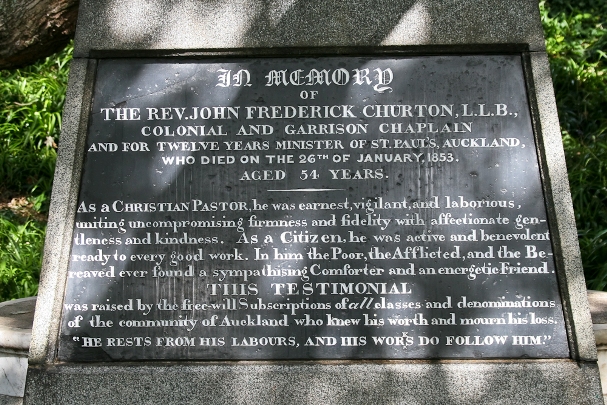
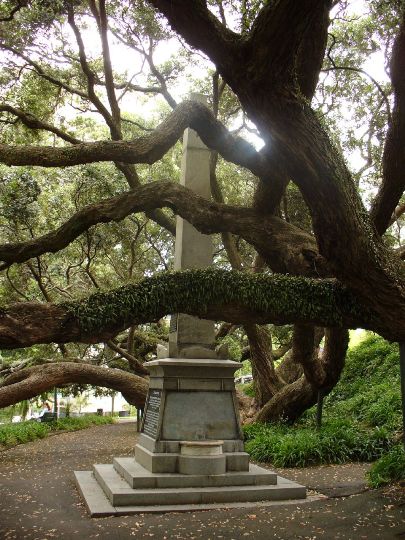
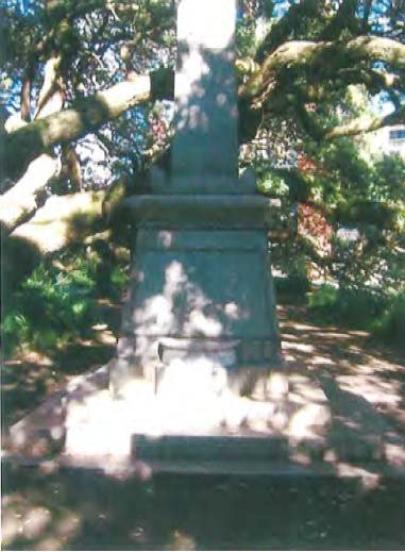
The Churton Memorial lies in a small public reserve in Emily Place, in the eastern part of the central business district of Auckland. The reserve is located at the northern end of Princes Street, at the top of a long slope running down towards what had been the colonial foreshore. The memorial is situated on a flat terrace in the southern part of the reserve, with a flight of steps leading down from its base towards the northern apex of the park. The monument is surrounded by mature pohutukawa, which are among several large trees in the reserve. The memorial is approximately seven metres high, and consists of a tall obelisk and rectangular base, sitting on top of three shallow steps. All of these elements are constructed of Coromandel granite. The obelisk is rectangular in profile, tapering to a point at the top. The base has semi-circular basins on its eastern and western faces, which were originally used as drinking fountains but which have since been infilled with concrete. A slate tablet in the northern face of the base has been salvaged from an earlier monument on the same site and dates to circa 1855. This reads: 'IN MEMORY OF THE REV. JOHN FREDERICK CHURTON, L.L.B., COLONIAL AND GARRISON CHAPLAIN AND FOR TWELVE YEARS MINISTER OF ST. PAUL'S, AUCKLAND WHO DIED ON THE 26TH OF JANUARY, 1853 AGED 54 YEARS. As a Christian Pastor, he was earnest, vigilant and laborious, uniting uncompromising firmness and fidelity with affectionate gentleness and kindness. As a Citizen, he was active and benevolent ready to every good work. In him the Poor, the Afflicted, and the Bereaved ever found a sympathising Comforter and an energetic Friend. THIS TESTIMONIAL Was raised by the free-will Subscriptions of all classes and denominations of the community of Auckland, who knew his worth and mourn his loss. HE RESTS FROM HIS LABOURS, AND HIS WORKS DO FOLLOW HIM.' In the final line of the inscription the word 'WORKS' was initially spelled 'WORS'. The 'K' has been added above with a caret between the 'R' and 'S'. The northern face of the monument also contains a brass plaque, which has been added at a later date. This commemorates the centenary of the laying of the foundation stone of St Paul's Church, which occupied the site during the early colonial period, and states: 'THIS TABLET COMMEMORATES THE CENTENARY OF THE LAYING OF THE FOUNDATION STONE OF ST. PAUL'S CHURCH ON THIS SITE, 28 JULY, 1841, BY HIS EXCELLENCY CAPTAIN WM HOBSON, R.N., FIRST GOVERNOR OF NEW ZEALAND UNVEILED - 27TH JULY, 1941, BY HIS EXCELLENCY MARSHALL OF THE ROYAL AIR FORCE SIR CYRIL NEWALL GCB, OM, GGMC, CBE, AM GOVERNOR GENERAL OF NEW ZEALAND' It is thought unlikely that there are surviving buried archaeological deposits associated with the church or earlier monument on the site as the land was levelled down during the creation of Emily Place Reserve.
The Churton Memorial lies in a small public reserve in Emily Place, in the eastern part of the central business district of Auckland. The reserve is located at the northern end of Princes Street, at the top of a long slope running down towards what had been the colonial foreshore. The memorial is situated on a flat terrace in the southern part of the reserve, with a flight of steps leading down from its base towards the northern apex of the park. The monument is surrounded by mature pohutukawa, which are among several large trees in the reserve. The memorial is approximately seven metres high, and consists of a tall obelisk and rectangular base, sitting on top of three shallow steps. All of these elements are constructed of Coromandel granite. The obelisk is rectangular in profile, tapering to a point at the top. The base has semi-circular basins on its eastern and western faces, which were originally used as drinking fountains but which have since been infilled with concrete. A slate tablet in the northern face of the base has been salvaged from an earlier monument on the same site and dates to circa 1855. This reads: 'IN MEMORY OF THE REV. JOHN FREDERICK CHURTON, L.L.B., COLONIAL AND GARRISON CHAPLAIN AND FOR TWELVE YEARS MINISTER OF ST. PAUL'S, AUCKLAND WHO DIED ON THE 26TH OF JANUARY, 1853 AGED 54 YEARS. As a Christian Pastor, he was earnest, vigilant and laborious, uniting uncompromising firmness and fidelity with affectionate gentleness and kindness. As a Citizen, he was active and benevolent ready to every good work. In him the Poor, the Afflicted, and the Bereaved ever found a sympathising Comforter and an energetic Friend. THIS TESTIMONIAL Was raised by the free-will Subscriptions of all classes and denominations of the community of Auckland, who knew his worth and mourn his loss. HE RESTS FROM HIS LABOURS, AND HIS WORKS DO FOLLOW HIM.' In the final line of the inscription the word 'WORKS' was initially spelled 'WORS'. The 'K' has been added above with a caret between the 'R' and 'S'. The northern face of the monument also contains a brass plaque, which has been added at a later date. This commemorates the centenary of the laying of the foundation stone of St Paul's Church, which occupied the site during the early colonial period, and states: 'THIS TABLET COMMEMORATES THE CENTENARY OF THE LAYING OF THE FOUNDATION STONE OF ST. PAUL'S CHURCH ON THIS SITE, 28 JULY, 1841, BY HIS EXCELLENCY CAPTAIN WM HOBSON, R.N., FIRST GOVERNOR OF NEW ZEALAND UNVEILED - 27TH JULY, 1941, BY HIS EXCELLENCY MARSHALL OF THE ROYAL AIR FORCE SIR CYRIL NEWALL GCB, OM, GGMC, CBE, AM GOVERNOR GENERAL OF NEW ZEALAND' It is thought unlikely that there are surviving buried archaeological deposits associated with the church or earlier monument on the site as the land was levelled down during the creation of Emily Place Reserve.
Historical and Associated Iwi / Hapū / Whānau
Information Sources
Auckland Star
Auckland Star
New Zealand Herald
New Zealand Herald, 12 July 1932, p. 6; 28 September 1933, p. 6.
Scholefield, 1940
G. H. Scholefield, A Dictionary of New Zealand Biography, Department of Internal Affairs, Wellington, 1940
Weekly News
Weekly News
Auckland City Council
Auckland City Council
Other Information
A fully referenced registration report is available from the NZHPT Northern Region office Please note that entry on the New Zealand Heritage List/Rarangi Korero identifies only the heritage values of the property concerned, and should not be construed as advice on the state of the property, or as a comment of its soundness or safety, including in regard to earthquake risk, safety in the event of fire, or insanitary conditions.
Historical and Associated Iwi / Hapū / Whānau
Information Sources
Auckland Star
Auckland Star
New Zealand Herald
New Zealand Herald, 12 July 1932, p. 6; 28 September 1933, p. 6.
Scholefield, 1940
G. H. Scholefield, A Dictionary of New Zealand Biography, Department of Internal Affairs, Wellington, 1940
Weekly News
Weekly News
Auckland City Council
Auckland City Council
Other Information
A fully referenced registration report is available from the NZHPT Northern Region office Please note that entry on the New Zealand Heritage List/Rarangi Korero identifies only the heritage values of the property concerned, and should not be construed as advice on the state of the property, or as a comment of its soundness or safety, including in regard to earthquake risk, safety in the event of fire, or insanitary conditions.
Current Usages
Uses: Commemoration
Specific Usage: Memorial - Particular person or group
Former Usages
General Usage: Commemoration
Specific Usage: Memorial - Particular person or group
Current Usages
Uses: Commemoration
Specific Usage: Memorial - Particular person or group
Former Usages
General Usage: Commemoration
Specific Usage: Memorial - Particular person or group
Location
Get the latest heritage news, features and events delivered
straight to your inbox.