

List Entry Information
Status
Listed
List Entry Status
Historic Place Category 1
Access
Private/No Public Access
List Number
567
Date Entered
21st September 1989
Date of Effect
21st September 1989
City/District Council
Auckland Council
Region
Auckland Council
Status
Listed
List Entry Status
Historic Place Category 1
Access
Private/No Public Access
List Number
567
Date Entered
21st September 1989
Date of Effect
21st September 1989
City/District Council
Auckland Council
Region
Auckland Council
Why is this place significant?
Historic Significance
Historical Significance or Value This historic place was registered under the Historic Places Act 1980. This report includes the text from the original Building Classification Committee report considered by the NZHPT Board at the time of registration. This terrace of houses was built in 1899 as a rental investment by the Dilworth Trust Board. The Trust had been established by James Dilworth in 1894 and his will provided for the establishment of a boys school on his property but not before the Trust had funds in hand to finance the building and an annual income for its operation. The school was established in 1906. Dilworth came to Auckland from Scotland in 1841 by way of Australia. He became a prominent landowner, businessman and politician. The terrace houses were designed for the relatively 'well off', and were large for the standards of the time. Many of the units were occupied by notable industrial and commercial persons of Auckland. For three years the noted photographer Henry Winkleman resided in No.5. From 1910-30 less affluent and non-professional persons acquired or lived in the houses. After World War II the premises became run-down, overcrowded and notorious. Some 300 persons are believed to have been crammed into the terrace at that time. In 1965 in the face of a threatened demolition order by the City Council, the buildings were renovated into 28 flats in order to reduce the total number of inhabitants. Since 1983 work has been continuing to return the terrace to eight quality dwellings.
Physical Significance
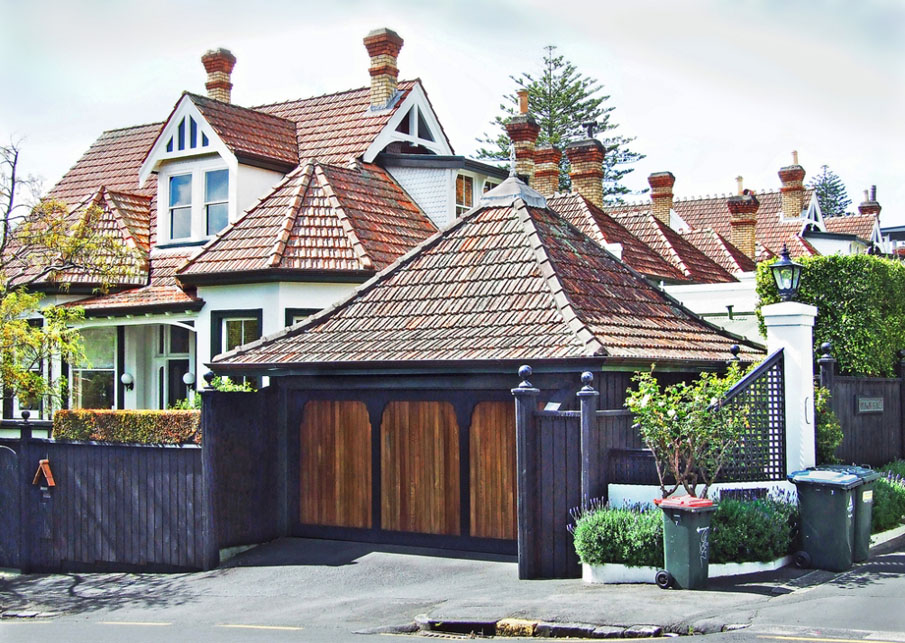
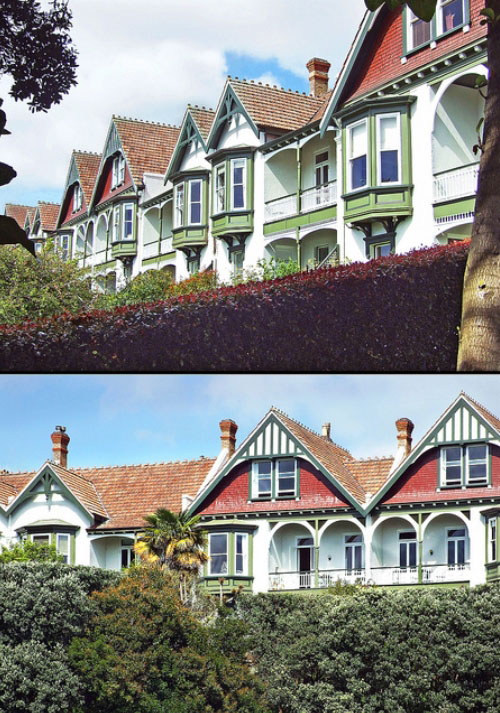
This historic place was registered under the Historic Places Act 1980. This report includes the text from the original Building Classification Committee report considered by the NZHPT Board at the time of registration. ARCHITECTURAL SIGNIFICANCE: This Edwardian terrace of houses is a fine example of a building type which is relatively uncommon in New Zealand. There was no shortage of land in the cities so detached housing was the most common form. The design reflects the English tradition of siting houses on a rise with a main garden facade overlooking the view. Rows of multi-storey housing facing the sea were a feature of English coastal towns and generally were not found in the colonies. Deliberate symmetry was a feature of the Queen Anne style. Georgian and Victorian terrace housing on the other hand generally consisted of repeats of one basic unit and its mirror image. Mahoney has used differently sized gables, and hence differently sized units to create variation within the row. Terrace housing tended to have a similar form and plan layout. The main portion is generally two or three storeys. The single storey outhouses are back-to-back and form the backyards. The sloping site of the terraces, the private gardens overlooking St Georges Bay and the position of the right of way meant that the main entrances were through these yards. The design elements such as two storey verandahs, tiled roof and varying gables were probably taken from drawings of designs of Queen Anne style villas in English periodicals such as the Building News. TOWNSCAPE: The houses are visually prominent, being sited on the cliff above the Stand and the railway yards. The houses look east over the harbour. This terrace of houses has a desired landmark quality when viewed from the waterfront. Dilworth Terrace affords a splendid streetscape.
Why is this place significant?
Historic Significance
Historical Significance or Value This historic place was registered under the Historic Places Act 1980. This report includes the text from the original Building Classification Committee report considered by the NZHPT Board at the time of registration. This terrace of houses was built in 1899 as a rental investment by the Dilworth Trust Board. The Trust had been established by James Dilworth in 1894 and his will provided for the establishment of a boys school on his property but not before the Trust had funds in hand to finance the building and an annual income for its operation. The school was established in 1906. Dilworth came to Auckland from Scotland in 1841 by way of Australia. He became a prominent landowner, businessman and politician. The terrace houses were designed for the relatively 'well off', and were large for the standards of the time. Many of the units were occupied by notable industrial and commercial persons of Auckland. For three years the noted photographer Henry Winkleman resided in No.5. From 1910-30 less affluent and non-professional persons acquired or lived in the houses. After World War II the premises became run-down, overcrowded and notorious. Some 300 persons are believed to have been crammed into the terrace at that time. In 1965 in the face of a threatened demolition order by the City Council, the buildings were renovated into 28 flats in order to reduce the total number of inhabitants. Since 1983 work has been continuing to return the terrace to eight quality dwellings.
Physical Significance
This historic place was registered under the Historic Places Act 1980. This report includes the text from the original Building Classification Committee report considered by the NZHPT Board at the time of registration. ARCHITECTURAL SIGNIFICANCE: This Edwardian terrace of houses is a fine example of a building type which is relatively uncommon in New Zealand. There was no shortage of land in the cities so detached housing was the most common form. The design reflects the English tradition of siting houses on a rise with a main garden facade overlooking the view. Rows of multi-storey housing facing the sea were a feature of English coastal towns and generally were not found in the colonies. Deliberate symmetry was a feature of the Queen Anne style. Georgian and Victorian terrace housing on the other hand generally consisted of repeats of one basic unit and its mirror image. Mahoney has used differently sized gables, and hence differently sized units to create variation within the row. Terrace housing tended to have a similar form and plan layout. The main portion is generally two or three storeys. The single storey outhouses are back-to-back and form the backyards. The sloping site of the terraces, the private gardens overlooking St Georges Bay and the position of the right of way meant that the main entrances were through these yards. The design elements such as two storey verandahs, tiled roof and varying gables were probably taken from drawings of designs of Queen Anne style villas in English periodicals such as the Building News. TOWNSCAPE: The houses are visually prominent, being sited on the cliff above the Stand and the railway yards. The houses look east over the harbour. This terrace of houses has a desired landmark quality when viewed from the waterfront. Dilworth Terrace affords a splendid streetscape.
Construction Professional
Name
Mahoney, Thomas
Type
Architect
Biography
Thomas Mahoney (1854/5?-1923) was the eldest son of Edward Mahoney, a leading Auckland architect. Thomas joined his father's firm, Edward Mahoney and Sons, in 1878 and was followed soon after by his younger brother Robert. The firm was responsible for a wide range of designs including domestic buildings, commercial and public buildings, churches and hotels. They won a competition for the design of the Auckland Customhouse in 1888, and were also responsible for the design of The Pah (now Monte Cecilia Convent), Hillsborough (1887), the Elliot Street facade of Smith and Caughey's Building (1910) and Wrights Building, Auckland (1911). Thomas was secretary of the Auckland Institute of Architects in 1885, president in 1883, and treasurer in 1902. In 1907 he was president of the Auckland branch of the New Zealand Institute of Architects.
Construction Details
Start Year
1899
Type
Original Construction
Start Year
1900
Type
Modification
Description
One bedroom and bathroom converted to a single bedroom and the bathroom carried under the stairs (House 4)
Start Year
1907
Type
Other
Description
Separate water connections provided to each house
Start Year
1966
Type
Modification
Description
The terrace is divided into 28 flats in an effort to reduce the number of residents and comply with a health department requisition on the property for repairs.
Start Year
1983
Type
Modification
Description
Work commenced to convert the flats back into the original eight houses.
Construction Materials
The terrace of houses have plastered brick facades. The party walls are brick. The non-structural internal portions are timber. The roof is tiled and the ridge has a terracotta cresting. The verandah and truss detail of the shingled gables is timber.
Notable Features
Several of the houses still have the original coal ranges in the kitchen. These stoves were manufactured by Nicholas Bros., Auckland.
Construction Professional
Name
Mahoney, Thomas
Type
Architect
Biography
Thomas Mahoney (1854/5?-1923) was the eldest son of Edward Mahoney, a leading Auckland architect. Thomas joined his father's firm, Edward Mahoney and Sons, in 1878 and was followed soon after by his younger brother Robert. The firm was responsible for a wide range of designs including domestic buildings, commercial and public buildings, churches and hotels. They won a competition for the design of the Auckland Customhouse in 1888, and were also responsible for the design of The Pah (now Monte Cecilia Convent), Hillsborough (1887), the Elliot Street facade of Smith and Caughey's Building (1910) and Wrights Building, Auckland (1911). Thomas was secretary of the Auckland Institute of Architects in 1885, president in 1883, and treasurer in 1902. In 1907 he was president of the Auckland branch of the New Zealand Institute of Architects.
Construction Details
Start Year
1899
Type
Original Construction
Start Year
1900
Type
Modification
Description
One bedroom and bathroom converted to a single bedroom and the bathroom carried under the stairs (House 4)
Start Year
1907
Type
Other
Description
Separate water connections provided to each house
Start Year
1966
Type
Modification
Description
The terrace is divided into 28 flats in an effort to reduce the number of residents and comply with a health department requisition on the property for repairs.
Start Year
1983
Type
Modification
Description
Work commenced to convert the flats back into the original eight houses.
Construction Materials
The terrace of houses have plastered brick facades. The party walls are brick. The non-structural internal portions are timber. The roof is tiled and the ridge has a terracotta cresting. The verandah and truss detail of the shingled gables is timber.
Notable Features
Several of the houses still have the original coal ranges in the kitchen. These stoves were manufactured by Nicholas Bros., Auckland.
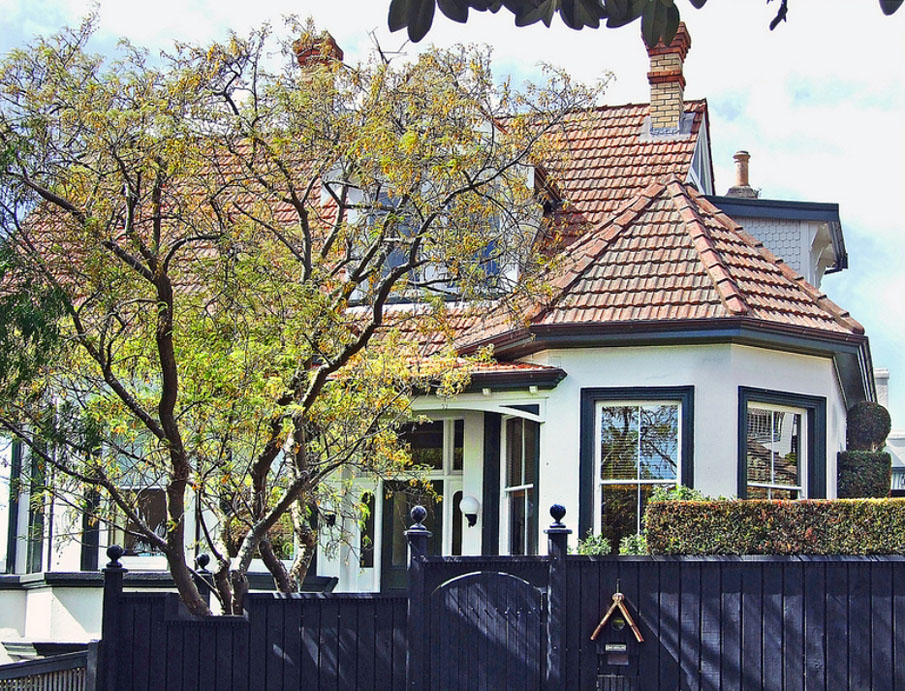
This historic place was registered under the Historic Places Act 1980. This report includes the text from the original Building Classification Committee report considered by the NZHPT Board at the time of registration. ARCHITECTURAL DESCRIPTION (STYLE): The terrace of eight Queen Anne style houses faces what was originally St Georges Bay. The main facade features eight gables, the four larger gables correspond to the three storey houses and the four smaller gables correspond to the two storey houses. The gables disguise the fact that the main ridge of the tiled roof steps down towards Augustus Terrace. The shingled larger gables occur at both ends and a pair occur in the centre. The apex has a half timbered detail, below which is a pair of double hung windows. Beneath the gable is an oriel window of first floor level (as the major rooms and main entrance from the right of way occurred at this level). Beside this, (but still beneath the gable) is a two storey verandah. At first floor level this has two semicircular wooden arches which rest on a central turned verandah post. The lower storey does not have the arch detail but has a slightly curved verandah beam, and as it is virtually at the garden level there is no balustrade. The smaller gables feature the same oriel window detail as the larger gables. These smaller gables are paired and their apexes have a timber truss with a central post and curved struts. The two storey verandah detail which separates the pairs of gables incorporates the same curved verandah beam as the lower level of verandah beneath the Gables. Again the upper level has a balustrade and the lower is open to the garden. The house facing Augustus Terrace (No 1) has bay windows facing the street, with a dormer window between. The elevation to the right-of-way is far less ornate and the houses at one time had small fenced yards formed by back-to-back outhouses. Here the main gables have a truss detail at the apex. The arched doorways featured a transom window and doors with coloured glass panes. MODIFICATIONS: 1902 - A sewer was provided in the street and water closets installed 1913 - Installation of hot water service 1926 - Houses appear as an "apartment" in the street directories 1961 - The land is leased and the improvements sold to the lessee. According to the Trust Board there is no record in their archive of the letting of individual rooms prior to this. 1988 -House 1 is in three flats but was renovated in 1970s. House 8 has three flats and a storeroom. The remaining 6 houses have been returned to largely original condition. In some cases skylights have been added over the stairs and extra bathrooms added, however, the interior layout remain virtually intact. Seven of the original outhouses have been replaced with garages. House 8 still has its original outhouse but this is in extremely poor condition.
This historic place was registered under the Historic Places Act 1980. This report includes the text from the original Building Classification Committee report considered by the NZHPT Board at the time of registration. ARCHITECTURAL DESCRIPTION (STYLE): The terrace of eight Queen Anne style houses faces what was originally St Georges Bay. The main facade features eight gables, the four larger gables correspond to the three storey houses and the four smaller gables correspond to the two storey houses. The gables disguise the fact that the main ridge of the tiled roof steps down towards Augustus Terrace. The shingled larger gables occur at both ends and a pair occur in the centre. The apex has a half timbered detail, below which is a pair of double hung windows. Beneath the gable is an oriel window of first floor level (as the major rooms and main entrance from the right of way occurred at this level). Beside this, (but still beneath the gable) is a two storey verandah. At first floor level this has two semicircular wooden arches which rest on a central turned verandah post. The lower storey does not have the arch detail but has a slightly curved verandah beam, and as it is virtually at the garden level there is no balustrade. The smaller gables feature the same oriel window detail as the larger gables. These smaller gables are paired and their apexes have a timber truss with a central post and curved struts. The two storey verandah detail which separates the pairs of gables incorporates the same curved verandah beam as the lower level of verandah beneath the Gables. Again the upper level has a balustrade and the lower is open to the garden. The house facing Augustus Terrace (No 1) has bay windows facing the street, with a dormer window between. The elevation to the right-of-way is far less ornate and the houses at one time had small fenced yards formed by back-to-back outhouses. Here the main gables have a truss detail at the apex. The arched doorways featured a transom window and doors with coloured glass panes. MODIFICATIONS: 1902 - A sewer was provided in the street and water closets installed 1913 - Installation of hot water service 1926 - Houses appear as an "apartment" in the street directories 1961 - The land is leased and the improvements sold to the lessee. According to the Trust Board there is no record in their archive of the letting of individual rooms prior to this. 1988 -House 1 is in three flats but was renovated in 1970s. House 8 has three flats and a storeroom. The remaining 6 houses have been returned to largely original condition. In some cases skylights have been added over the stairs and extra bathrooms added, however, the interior layout remain virtually intact. Seven of the original outhouses have been replaced with garages. House 8 still has its original outhouse but this is in extremely poor condition.
Historical and Associated Iwi / Hapū / Whānau
Completion Date
18th April 1989
Information Sources
Cyclopedia of New Zealand
Cyclopedia Company, Industrial, descriptive, historical, biographical facts, figures, illustrations, Wellington, N.Z, 1897-1908
Wises Post Office Directories
Wises Post Office Directories
New Zealand Herald
New Zealand Herald, 12 July 1932, p. 6; 28 September 1933, p. 6.
Pearce, 1986
G. L. Pearce, A Heritage in Trust, Auckland, 1986 Auckland Dilworth Trust Board
Berry, 1977
J Berry, Dilworth School, The First 70 Years 1906-1976 (1977 publ. Dilworth Trust Board)
Fraser, 1920
M. Fraser, An Inquiry into Prices in New Zealand 1891-1919, 1920 Government Printer
Rose, 1973
J Rose, Akarana - The Ports of Auckland, Auckland 1973
Auckland Metro
Auckland Metro
Lee, 1985
G.H. Lee, "Dilworth Terrace Houses 1842-1985" (Research Essay for BTP, 1985, held at the Auckland School of Architecture Library)
Other Information
A copy of this report is available from the NZHPT Northern Region office Please note that entry on the New Zealand Heritage List/Rarangi Korero identifies only the heritage values of the property concerned, and should not be construed as advice on the state of the property, or as a comment of its soundness or safety, including in regard to earthquake risk, safety in the event of fire, or insanitary conditions.
Historical and Associated Iwi / Hapū / Whānau
Completion Date
18th April 1989
Information Sources
Cyclopedia of New Zealand
Cyclopedia Company, Industrial, descriptive, historical, biographical facts, figures, illustrations, Wellington, N.Z, 1897-1908
Wises Post Office Directories
Wises Post Office Directories
New Zealand Herald
New Zealand Herald, 12 July 1932, p. 6; 28 September 1933, p. 6.
Pearce, 1986
G. L. Pearce, A Heritage in Trust, Auckland, 1986 Auckland Dilworth Trust Board
Berry, 1977
J Berry, Dilworth School, The First 70 Years 1906-1976 (1977 publ. Dilworth Trust Board)
Fraser, 1920
M. Fraser, An Inquiry into Prices in New Zealand 1891-1919, 1920 Government Printer
Rose, 1973
J Rose, Akarana - The Ports of Auckland, Auckland 1973
Auckland Metro
Auckland Metro
Lee, 1985
G.H. Lee, "Dilworth Terrace Houses 1842-1985" (Research Essay for BTP, 1985, held at the Auckland School of Architecture Library)
Other Information
A copy of this report is available from the NZHPT Northern Region office Please note that entry on the New Zealand Heritage List/Rarangi Korero identifies only the heritage values of the property concerned, and should not be construed as advice on the state of the property, or as a comment of its soundness or safety, including in regard to earthquake risk, safety in the event of fire, or insanitary conditions.
Current Usages
Uses: Accommodation
Specific Usage: House
Former Usages
General Usage: Accommodation
Specific Usage: House
Current Usages
Uses: Accommodation
Specific Usage: House
Former Usages
General Usage: Accommodation
Specific Usage: House
Location
Sign up to hear more
Get the latest heritage news, features and events delivered
straight to your inbox.
