

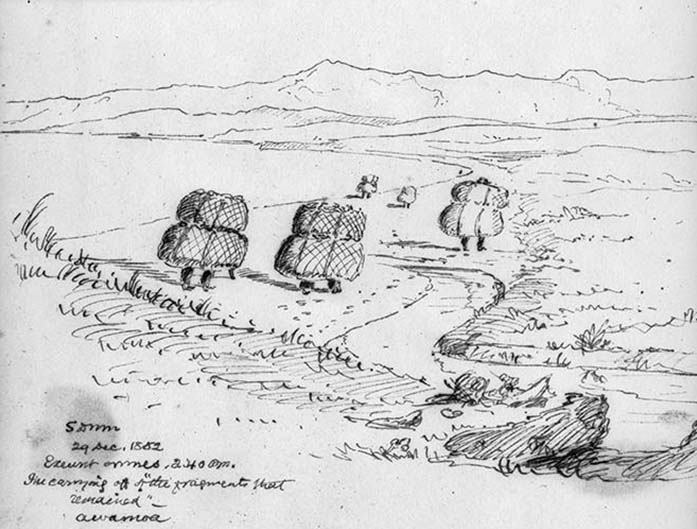
According to archaeologist Jill Hamel, Awamoa was the first recorded archaeological investigation in New Zealand. Mantell had noted umu on a trip through the area in late 1852, and revisited the Awamoa over Christmas in 1852 to investigate the site, setting up camp at the river mouth. He describes ‘[t]he old surface in which the umus had been excavated was buried under a foot of alluvial deposit – beneath this the old sandy soil was blackened by the mixture of charcoal, large lumps of which were scattered among the chaotic mess.’ Around the umu, Mantell found ‘relics of their dinner equipage in the shape of large and small fragments of flint, totally different from any in the neighbourhood [he suspected they came from inland regions].’ Mantell sketched the scene, and shows the digging party carrying away loads of moa bones from Awamoa in North Otago on 29 December 1852. Mantell applied the name Awamoa (which means moa river) to a creek that was originally called Awakokomaka.’ Mantell conducted a number of New Zealand's earliest archaeological digs, removing hundreds of moa bones and accompanying artefacts. The information gained was minimal, as little attempt was made to record the details of material before it was removed.
In 1853 Walter Mantell described his investigations in letters to his father, and published them in The New Zealand Spectator and Cook’s Strait Guardian on 27 August 1853. Mantell had earlier retrieved moa bones at Waikouaiti in Otago and Waingongoro in South Taranaki, but it was his dig at Awamoa that was recorded in some detail, describing the large number of moa bones, oven stones and stone tools from the North Otago site he named Awamoa.’ Here, for the first time in a published account, Mantell stated that moa and their eggs and been consumed by the people he described as the ‘extinct aboriginal tribe of Waitaha.’ What Mantell described was, Hamel writes, ‘a wholly typical assemblage of material from an Otago coastal moa hunting site.’ He found bones of Aptornis (extinct giant rail), takahe, Nestor (probably kaka), kiwi, shags, ducks, dogs, rat, seals and two species of moa as well as large quantities of moa egg shell.
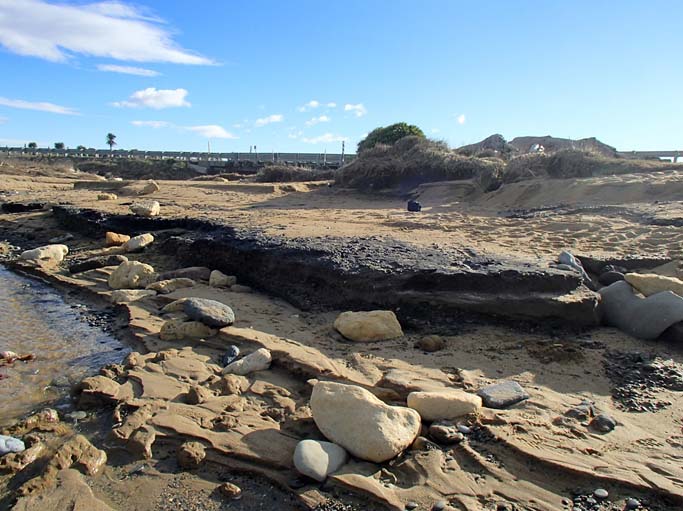
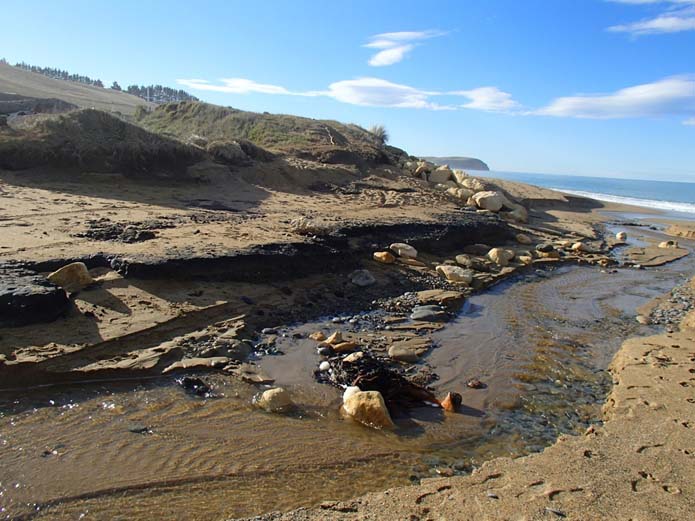
In later years, the site has been subject to coastal erosion and some damage from fossickers. Monitoring on the site in May and July 2014 on the western side of the road did not provide further evidence of the moa hunter camp. The groundwork excavations did confirm in more detail the sequence of natural stratigraphy accumulated across the site. The absence of further cultural material on the western side of the road suggests that the Awamoa site (J41/3) may be limited to a zone along the western edge of the Awamoa Creek with just occasional outlying deposits, such as the hangi found by Hamel in 2005, scattered further west of the creek edge and centrally within the Old Bones Backpackers site. The inland section now lies under mown grass and the curtilage of a back packer’s lodge.
List Entry Information
Status
Listed
List Entry Status
Historic Place Category 2
Access
Private/No Public Access
List Number
5688
Date Entered
11th March 1985
Date of Effect
11th March 1985
City/District Council
Waitaki District
Region
Otago Region
Extent of List Entry
Extent includes part of the land described as road reserve and as Sec 55 BLK VI Oamaru SD (RT OTB1/1278), Otago Land District, and the archaeological site known as the Awamoa Moa Hunting Site/Awakokomaka thereon. Refer to the extent map tabled at the Rārangi Kōrero Committee meeting on 8 March 2018.
Legal description
Sec 55 BLK VI Oamaru SD (RT OTB1/1278), Otago Land District
Status
Listed
List Entry Status
Historic Place Category 2
Access
Private/No Public Access
List Number
5688
Date Entered
11th March 1985
Date of Effect
11th March 1985
City/District Council
Waitaki District
Region
Otago Region
Extent of List Entry
Extent includes part of the land described as road reserve and as Sec 55 BLK VI Oamaru SD (RT OTB1/1278), Otago Land District, and the archaeological site known as the Awamoa Moa Hunting Site/Awakokomaka thereon. Refer to the extent map tabled at the Rārangi Kōrero Committee meeting on 8 March 2018.
Legal description
Sec 55 BLK VI Oamaru SD (RT OTB1/1278), Otago Land District
Construction Details
Type
Other
Description
Moa hunter occupation
Period
c. 1300-1400
Start Year
1852
Type
Other
Description
Site first recorded and excavated by Walter Mantell
Construction Details
Type
Other
Description
Moa hunter occupation
Period
c. 1300-1400
Start Year
1852
Type
Other
Description
Site first recorded and excavated by Walter Mantell
Historical and Associated Iwi / Hapū / Whānau
Public NZAA Number
J41/3
Completion Date
17th January 2018
Report Written By
Heather Bauchop
Information Sources
Archaeology in New Zealand
Archaeology in New Zealand
Archaeological Authority
Archaeological authority 2014-901 for extension to sauna & massage facility, granted 10 Apr 2014.
Archaeological Report
Jill Hamel, ‘Heritage values at Awamoa estuary,’ Report to Montgomery Watson Harza for Waitaki District Council, May 2002
Hamel, 2005
J.Hamel, “ A Hangi at Awamoa”, report to the NZHPT, 2005
Other Information
This place was identified as significant under previous legislation with different information requirements. It remains significant under the current legislation. There is opportunity under our legislation and policies to add to this information. Further information about this place may be available from the Otago/Southland Office of Heritage New Zealand Pouhere Taonga. Please note that entry on the New Zealand Heritage List/Rarangi Korero identifies only the heritage values of the property concerned, and should not be construed as advice on the state of the property, or as a comment of its soundness or safety, including in regard to earthquake risk, safety in the event of fire, or insanitary conditions. A fully referenced upgrade report is available on request from the Otago/Southland Area Office of Heritage New Zealand
Historical and Associated Iwi / Hapū / Whānau
Public NZAA Number
J41/3
Completion Date
17th January 2018
Report Written By
Heather Bauchop
Information Sources
Archaeology in New Zealand
Archaeology in New Zealand
Archaeological Authority
Archaeological authority 2014-901 for extension to sauna & massage facility, granted 10 Apr 2014.
Archaeological Report
Jill Hamel, ‘Heritage values at Awamoa estuary,’ Report to Montgomery Watson Harza for Waitaki District Council, May 2002
Hamel, 2005
J.Hamel, “ A Hangi at Awamoa”, report to the NZHPT, 2005
Other Information
This place was identified as significant under previous legislation with different information requirements. It remains significant under the current legislation. There is opportunity under our legislation and policies to add to this information. Further information about this place may be available from the Otago/Southland Office of Heritage New Zealand Pouhere Taonga. Please note that entry on the New Zealand Heritage List/Rarangi Korero identifies only the heritage values of the property concerned, and should not be construed as advice on the state of the property, or as a comment of its soundness or safety, including in regard to earthquake risk, safety in the event of fire, or insanitary conditions. A fully referenced upgrade report is available on request from the Otago/Southland Area Office of Heritage New Zealand
Former Usages
General Usage: Maori
Specific Usage: Animal/bird butchery
General Usage: Maori
Specific Usage: Midden
General Usage: Maori
Specific Usage: Occupational site - temporary
General Usage: Ruin
Specific Usage: Misc Archaeological
Themes
Of Significance to Maori
Former Usages
General Usage: Maori
Specific Usage: Animal/bird butchery
General Usage: Maori
Specific Usage: Midden
General Usage: Maori
Specific Usage: Occupational site - temporary
General Usage: Ruin
Specific Usage: Misc Archaeological
Themes
Of Significance to Maori
Location
Sign up to hear more
Get the latest heritage news, features and events delivered
straight to your inbox.
