

List Entry Information
Status
Listed
List Entry Status
Historic Place Category 1
Access
Able to Visit
List Number
5966
Date Entered
20th June 1985
Date of Effect
20th June 1985
City/District Council
New Plymouth District
Region
Taranaki Region
Extent of List Entry
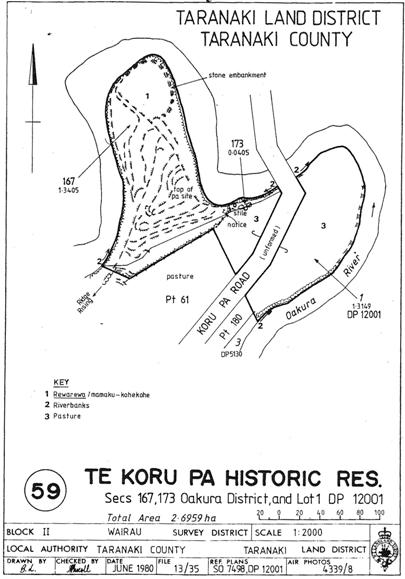
Extent includes the land described as Secs 1-2 SO 494368 (RT 810456) Taranaki Land District, and the archaeological site known as Te Koru Pā (NZAA site P19/53) thereon. Refer to the extent map tabled at the Rārangi Kōrero Committee meeting on 30 May 2019. Note that the extent does not include Legal Road (Koru Hill Pa Road) as shown within the contiguous boundary provided on the extent map.
Legal description
Secs 1-2 SO 494368 (RT 810456), Taranaki Land District
Location Description
Te Koru Pa is located 19 kilometres south west of New Plymouth at the end of Surrey Hill Road on a bend in the Oakura River, on the true left bank, 4km from the sea.
Status
Listed
List Entry Status
Historic Place Category 1
Access
Able to Visit
List Number
5966
Date Entered
20th June 1985
Date of Effect
20th June 1985
City/District Council
New Plymouth District
Region
Taranaki Region
Extent of List Entry
Extent includes the land described as Secs 1-2 SO 494368 (RT 810456) Taranaki Land District, and the archaeological site known as Te Koru Pā (NZAA site P19/53) thereon. Refer to the extent map tabled at the Rārangi Kōrero Committee meeting on 30 May 2019. Note that the extent does not include Legal Road (Koru Hill Pa Road) as shown within the contiguous boundary provided on the extent map.
Legal description
Secs 1-2 SO 494368 (RT 810456), Taranaki Land District
Location Description
Te Koru Pa is located 19 kilometres south west of New Plymouth at the end of Surrey Hill Road on a bend in the Oakura River, on the true left bank, 4km from the sea.
Why is this place significant?
Cultural Significance
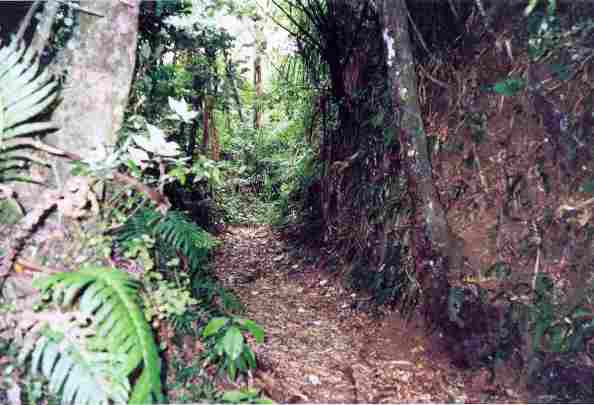
Te Koru Pa is of cultural, traditional and spiritual significance to the Ngati Tairi hapu. It also possesses significance to the people of Oakura and visitors to the area. To get to Te Koru Pa involves a journey, a drive down a minor road and then a walk to the Reserve entrance. By the time a visitor reaches the pa they are aware of its significance and the narrow entrance ditch emphasises the importance of the site. The lintel being carved by local iwi for the entrance to the site will show the continuing social significance of Te Koru the 21st century.
Historic Significance
Historical Significance or Value Te Koru Pa was possibly one of the earliest Maori settlements in Taranaki. Its location is similar to other pa sites in the area in that it was situated along the old bush edge marking the inner boundary of the land settled prior to the arrival of the Pakeha. It is historically important because in 1927 local Maori gifted the pa to the crown for public education. Te Koru Pa is significant as it is not only in remarkable condition but there is also an extensive history of use known about the site so it has particular relevance in the known history of the Taranaki area. A rare, elaborate paepae was found at the site in 1898 showing a good example of Taranaki art.The significance of the pa has been recognised nationally since being turned into a Crown Reserve.
Physical Significance
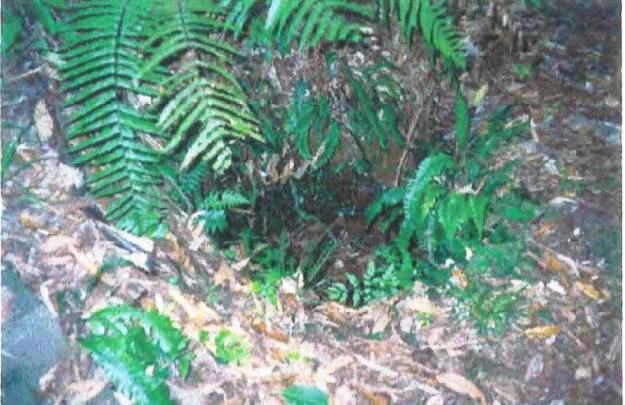
Te Koru Pa is one of the most important and intact pa sites remaining in Taranaki. It has formidable fortifications and is notable for its steep scarps, deep ditches, many levels of terrace, surviving stone revetting, and the large number of rua which remain. The Department of Lands and Surveys described the site as a "remarkable feat of engineering" because it rises eight terraces to the summit of the pa, 24m above the river.
Why is this place Category 1 / Category 2?
Detail Of Assessed Criteria
(a) The extent to which the place reflects important or representative aspects of New Zealand history. Te Koru Pa represents an important site in the early 19th Century inter-tribal wars beginning with the attack on Te Koru by warriors from Rewarewa Pa and Puketapu Pa of the Te Atiawa iwi. (b) The association of the place with events, persons, or ideas of importance in New Zealand history. Te Koru Pa is associated with both events and persons of importance in New Zealand history. The attack on the pa site by members of the Te Atiawa iwi from Rewarewa Pa and Puketapu Pa was responsible for initiating what has been described as "one of the bloodiest periods in Taranaki's history." The site is also associated with the important ethnologist/anthropologists WH and HD Skinner, Elsdon Best, and S Percy-Smith, all of whom visited, surveyed and recorded information about Te Koru Pa. c) The potential of the place to provide knowledge of New Zealand history. Te Koru Pa has high potential to provide information about the history of New Zealand. The visible features provide much detail about the defensive nature of the site and the size and quantity of the rua pits indicate that a sizable population was based here, probably supported by the cultivation of kumara. More information could be obtained by archaeological excavation but this is discouraged since excavation is itself a destructive process. It is considered preferable to base interpretation on the visible features rather than an intrusive excavation. d) The importance of the place to the tangata whenua. Te Koru Pa has cultural, traditional, spiritual, and social values for Ngati Tairi Hapu. The hapu has a strong link with the site through oral tradition. e) The community association with, or public esteem for, the place. Te Koru Pa is held in high esteem by both the academic community and the public. The site was the subject of research by eminent academics throughout the twentieth century and continues to attract scholars today. Gifted to the Crown by Maori for the purposes of public education, the site is appreciated by the wider public for the insight it provides into the early settlement of New Zealand by Maori. (f) The potential of the place for public education. Through active management of Te Koru, DOC continues to place new information signs and plans to help visitors understand the history and significance of the site. (g) The technical accomplishment or value, or design of the place. Te Koru Pa is one of the most important and intact pa sites remaining in Taranaki. It has formidable fortifications and the defences were not breached until 1805. The site is notable for its steep scarps, deep ditches, many levels of terrace and its surviving stone revetting. (i) The importance of identifying historic places known to date from early periods of New Zealand settlement. The DOC Conservation Plan suggests that the pa dates from circa 1500 AD. This is what is suggested to be the earliest period of pa site construction in New Zealand. (j) The importance of identifying rare types of historic places. An early pa in such good condition is a rare historic place. However, the significance of Te Koru is increased with the presence of revetting on the stone scarps. Other stone scarps have been recognised in Taranaki but Nigel Prickett who has under taken extensive archaeological survey within Taranaki describes Te Koru as the "most notable". (k) The extent to which the place forms part of a wider historical and cultural complex or historical and cultural landscape. Te Koru Pa is set within an historical landscape. A short distance from the reserve are two other pa sites on either side of the Oakura River, and there is another small pa just to the south on the flanks of the Kaitake Range within Egmont National Park.
Why is this place significant?
Cultural Significance
Te Koru Pa is of cultural, traditional and spiritual significance to the Ngati Tairi hapu. It also possesses significance to the people of Oakura and visitors to the area. To get to Te Koru Pa involves a journey, a drive down a minor road and then a walk to the Reserve entrance. By the time a visitor reaches the pa they are aware of its significance and the narrow entrance ditch emphasises the importance of the site. The lintel being carved by local iwi for the entrance to the site will show the continuing social significance of Te Koru the 21st century.
Historic Significance
Historical Significance or Value Te Koru Pa was possibly one of the earliest Maori settlements in Taranaki. Its location is similar to other pa sites in the area in that it was situated along the old bush edge marking the inner boundary of the land settled prior to the arrival of the Pakeha. It is historically important because in 1927 local Maori gifted the pa to the crown for public education. Te Koru Pa is significant as it is not only in remarkable condition but there is also an extensive history of use known about the site so it has particular relevance in the known history of the Taranaki area. A rare, elaborate paepae was found at the site in 1898 showing a good example of Taranaki art.The significance of the pa has been recognised nationally since being turned into a Crown Reserve.
Physical Significance
Te Koru Pa is one of the most important and intact pa sites remaining in Taranaki. It has formidable fortifications and is notable for its steep scarps, deep ditches, many levels of terrace, surviving stone revetting, and the large number of rua which remain. The Department of Lands and Surveys described the site as a "remarkable feat of engineering" because it rises eight terraces to the summit of the pa, 24m above the river.
Why is this place Category 1 / Category 2?
Detail Of Assessed Criteria
(a) The extent to which the place reflects important or representative aspects of New Zealand history. Te Koru Pa represents an important site in the early 19th Century inter-tribal wars beginning with the attack on Te Koru by warriors from Rewarewa Pa and Puketapu Pa of the Te Atiawa iwi. (b) The association of the place with events, persons, or ideas of importance in New Zealand history. Te Koru Pa is associated with both events and persons of importance in New Zealand history. The attack on the pa site by members of the Te Atiawa iwi from Rewarewa Pa and Puketapu Pa was responsible for initiating what has been described as "one of the bloodiest periods in Taranaki's history." The site is also associated with the important ethnologist/anthropologists WH and HD Skinner, Elsdon Best, and S Percy-Smith, all of whom visited, surveyed and recorded information about Te Koru Pa. c) The potential of the place to provide knowledge of New Zealand history. Te Koru Pa has high potential to provide information about the history of New Zealand. The visible features provide much detail about the defensive nature of the site and the size and quantity of the rua pits indicate that a sizable population was based here, probably supported by the cultivation of kumara. More information could be obtained by archaeological excavation but this is discouraged since excavation is itself a destructive process. It is considered preferable to base interpretation on the visible features rather than an intrusive excavation. d) The importance of the place to the tangata whenua. Te Koru Pa has cultural, traditional, spiritual, and social values for Ngati Tairi Hapu. The hapu has a strong link with the site through oral tradition. e) The community association with, or public esteem for, the place. Te Koru Pa is held in high esteem by both the academic community and the public. The site was the subject of research by eminent academics throughout the twentieth century and continues to attract scholars today. Gifted to the Crown by Maori for the purposes of public education, the site is appreciated by the wider public for the insight it provides into the early settlement of New Zealand by Maori. (f) The potential of the place for public education. Through active management of Te Koru, DOC continues to place new information signs and plans to help visitors understand the history and significance of the site. (g) The technical accomplishment or value, or design of the place. Te Koru Pa is one of the most important and intact pa sites remaining in Taranaki. It has formidable fortifications and the defences were not breached until 1805. The site is notable for its steep scarps, deep ditches, many levels of terrace and its surviving stone revetting. (i) The importance of identifying historic places known to date from early periods of New Zealand settlement. The DOC Conservation Plan suggests that the pa dates from circa 1500 AD. This is what is suggested to be the earliest period of pa site construction in New Zealand. (j) The importance of identifying rare types of historic places. An early pa in such good condition is a rare historic place. However, the significance of Te Koru is increased with the presence of revetting on the stone scarps. Other stone scarps have been recognised in Taranaki but Nigel Prickett who has under taken extensive archaeological survey within Taranaki describes Te Koru as the "most notable". (k) The extent to which the place forms part of a wider historical and cultural complex or historical and cultural landscape. Te Koru Pa is set within an historical landscape. A short distance from the reserve are two other pa sites on either side of the Oakura River, and there is another small pa just to the south on the flanks of the Kaitake Range within Egmont National Park.
Construction Materials
Earth and river boulders in remains of archaeological site. Wood probably used for defences and houses.
Notable Features
Large-scale artificial defences Numerous rua Stone revetting
Construction Materials
Earth and river boulders in remains of archaeological site. Wood probably used for defences and houses.
Notable Features
Large-scale artificial defences Numerous rua Stone revetting
Maori tradition states that the pa was built circa 1000AD by Nga Mahanga a Tairi, a hapu of Taranaki. Nga Mahanga a Tairi occupied the site for generations. The first recorded history of Te Koru Pa being defeated comes from between 1800-1805 when 800 to 1000 members from the two sub tribes of Te Atiawa from the Rewarewa Pa, at the mouth of the Waiwakaiko River, and from Puketapu, where Bell Block is now situated, attacked and over-ran Te Koru Pa. The chiefs of Te Koru Pa were Mona and Tu-Makaru. Mona was killed in hand to hand fighting but Tu-Makaru killed two Te Atiawa with one thrust of his tao(double headed spear) and managed to escape. The Department of Land and Survey's 1975 Information sheet emphasises that this defeat led to "one of the bloodiest periods in Taranaki's history." The two victorious hapu quarrelled over which had been the most brave and they returned, upset; to their pas. In 1810 Nga Mahanga a Tairi avenged their earlier defeat by capturing Rewarewa Pa after a savage battle. Puketapu still angered by the earlier quarrel refused to aid Rewarewa. However, Nga Mahanga a Tairi; full of their success at Rewarewa Pa; tried to attack another Te Atiawa stronghold on the banks of Huatoki Stream but they were "decisively beaten." The aggression in Taranaki region continued. Te Koru Pa was possibly evacuated in 1826 due to the threat of a Waikato invasion.
Maori tradition states that the pa was built circa 1000AD by Nga Mahanga a Tairi, a hapu of Taranaki. Nga Mahanga a Tairi occupied the site for generations. The first recorded history of Te Koru Pa being defeated comes from between 1800-1805 when 800 to 1000 members from the two sub tribes of Te Atiawa from the Rewarewa Pa, at the mouth of the Waiwakaiko River, and from Puketapu, where Bell Block is now situated, attacked and over-ran Te Koru Pa. The chiefs of Te Koru Pa were Mona and Tu-Makaru. Mona was killed in hand to hand fighting but Tu-Makaru killed two Te Atiawa with one thrust of his tao(double headed spear) and managed to escape. The Department of Land and Survey's 1975 Information sheet emphasises that this defeat led to "one of the bloodiest periods in Taranaki's history." The two victorious hapu quarrelled over which had been the most brave and they returned, upset; to their pas. In 1810 Nga Mahanga a Tairi avenged their earlier defeat by capturing Rewarewa Pa after a savage battle. Puketapu still angered by the earlier quarrel refused to aid Rewarewa. However, Nga Mahanga a Tairi; full of their success at Rewarewa Pa; tried to attack another Te Atiawa stronghold on the banks of Huatoki Stream but they were "decisively beaten." The aggression in Taranaki region continued. Te Koru Pa was possibly evacuated in 1826 due to the threat of a Waikato invasion.
Te Koru Pa is a large complex, pre-European pa, representing a regional tribal citadel. It is in a relatively undisturbed condition and is notable for its steep scarps, deep ditches, terracing, stone revetting and numerous rua. An elaborate paepae, adze and stone pounder have also been recovered from the site. The pa has been described as a "remarkable feat of engineering" as it rises eight terraces to the summit, 24 metres above the river.
Te Koru Pa is a large complex, pre-European pa, representing a regional tribal citadel. It is in a relatively undisturbed condition and is notable for its steep scarps, deep ditches, terracing, stone revetting and numerous rua. An elaborate paepae, adze and stone pounder have also been recovered from the site. The pa has been described as a "remarkable feat of engineering" as it rises eight terraces to the summit, 24 metres above the river.
Historical and Associated Iwi / Hapū / Whānau
Public NZAA Number
P19/53
Completion Date
27th January 2005
Report Written By
Jo Wylie
Information Sources
Auckland Institute & Museum
Auckland Institute & Museum
Best, 1975
Elsdon Best. 'The Pa Maori', Second Edition, 1975.
Pishief, 2002
Elizabeth Pishief, 'Archaeological Assessment of Te Koru Pa for New Plymouth Area Office, Department of Conservation', Unpublished report, 2002.
Conservation Plan
Conservation Plan
Other Information
Hapu - Ngati Tairi Hapu, Taranaki Historic Reserve - NZ Gazette 1982 p.4184 A fully referenced version of this report is available from the NZHPT Central Region office Please note that entry on the New Zealand Heritage List/Rarangi Korero identifies only the heritage values of the property concerned, and should not be construed as advice on the state of the property, or as a comment of its soundness or safety, including in regard to earthquake risk, safety in the event of fire, or insanitary conditions.
Historical and Associated Iwi / Hapū / Whānau
Public NZAA Number
P19/53
Completion Date
27th January 2005
Report Written By
Jo Wylie
Information Sources
Auckland Institute & Museum
Auckland Institute & Museum
Best, 1975
Elsdon Best. 'The Pa Maori', Second Edition, 1975.
Pishief, 2002
Elizabeth Pishief, 'Archaeological Assessment of Te Koru Pa for New Plymouth Area Office, Department of Conservation', Unpublished report, 2002.
Conservation Plan
Conservation Plan
Other Information
Hapu - Ngati Tairi Hapu, Taranaki Historic Reserve - NZ Gazette 1982 p.4184 A fully referenced version of this report is available from the NZHPT Central Region office Please note that entry on the New Zealand Heritage List/Rarangi Korero identifies only the heritage values of the property concerned, and should not be construed as advice on the state of the property, or as a comment of its soundness or safety, including in regard to earthquake risk, safety in the event of fire, or insanitary conditions.
Current Usages
Uses: Civic Facilities
Specific Usage: Historic or recreation reserve
Former Usages
General Usage: Maori
Specific Usage: Pā
General Usage: Maori
Specific Usage: Site of historical event
Themes
Of Significance to Maori
Current Usages
Uses: Civic Facilities
Specific Usage: Historic or recreation reserve
Former Usages
General Usage: Maori
Specific Usage: Pā
General Usage: Maori
Specific Usage: Site of historical event
Themes
Of Significance to Maori
Location
Sign up to hear more
Get the latest heritage news, features and events delivered
straight to your inbox.
