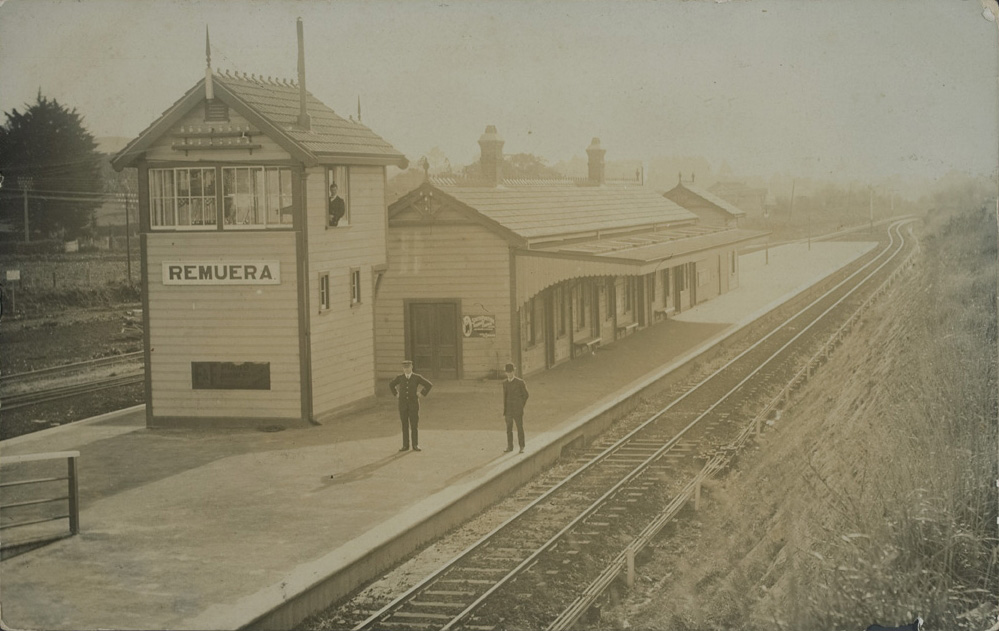
The single-line track of the Auckland-Onehunga railway was opened in 1873. Although Remuera had been associated with the settlement of wealthy Aucklanders since the middle of the nineteenth century, the introduction of the railway increased Remuera’s popularity for less well-off city workers. By 1903, the minister for railways recognised the need for increased accommodation at stations along the line. Planned duplication of the line necessitated the redesign and repositioning of the Remuera station. Work on the platform, buildings and signal box was underway by mid-1907. By September, a photograph shows the new buildings as very nearly complete; and by November 1907 the assistant engineer, John K. Lowe was able to advise his superiors that ‘the new Station Building at Remuera is now completed’. The signal box was completed soon afterwards, in 1908.
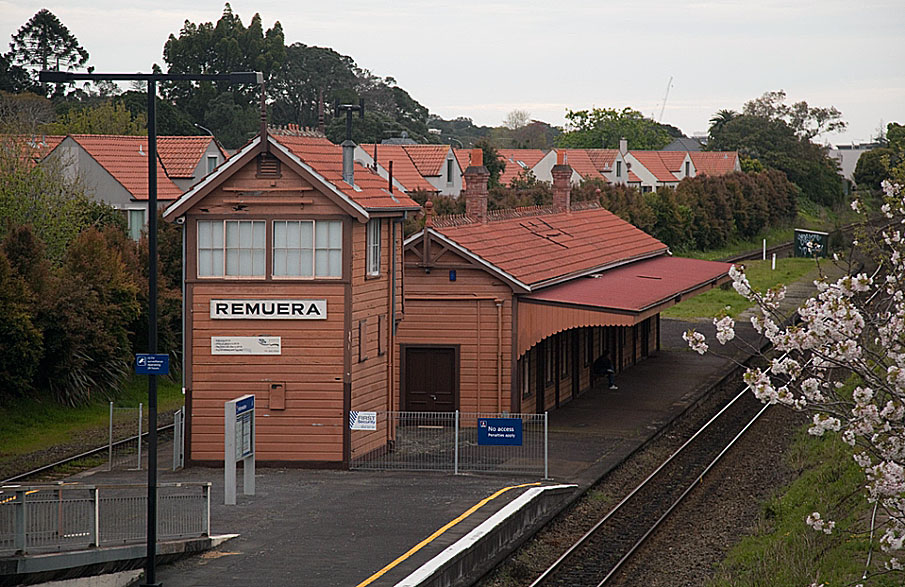
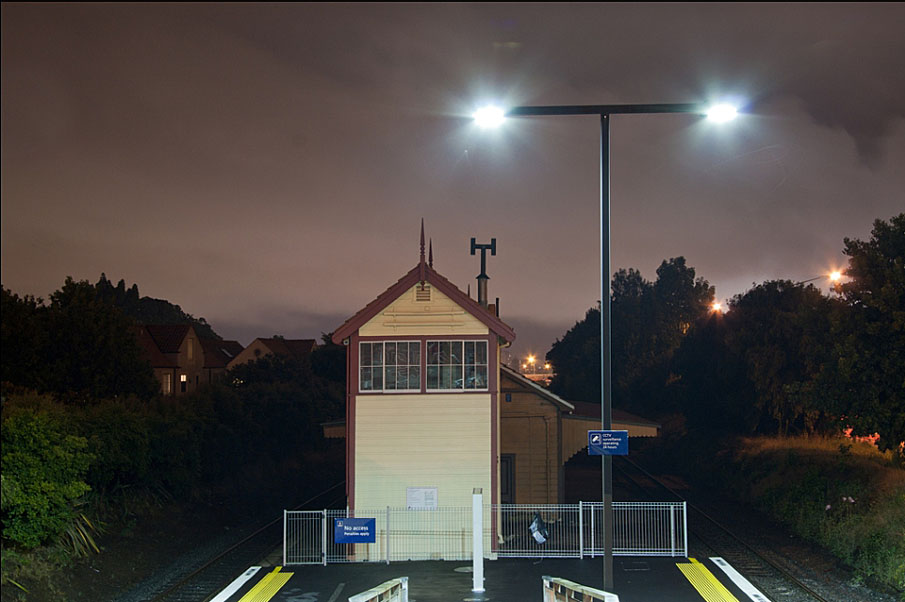
The station in 1908 consisted of the main building, with toilet facilities and ‘lamp room’ to the northwest and the signal box to the northeast. The twin tracks split to run along either side of the platform creating an island from which this type of station acquired their name. Access to the platforms was along a ramp from the Market Road bridge. Rusticated weatherboarding, Marseille tiled roof with distinctive ‘H’ and ‘I’ cresting, and decorative finials, symmetrical fenestration including double-hung sash windows formed a part of the design of the timber-framed main building. The verandahs had corrugated-iron roofs, supported by cast-iron brackets. Each platform elevation had a symmetrical arrangement of fenestration, including double-hung sash windows. The signal box had two storeys, with the upper level as the lever floor; it was similarly clad as the station building.
The subsequent history of the Remuera station is one of steady decline. In 1942 it ceased to be an officered station. The construction of the motorway in the mid-1960s took away more traffic, with freight services to the station ending in 1979. The toilets and ‘lamp room’ were demolished in 1982, and the signal box was made obsolete by automatic points in 1987. The remaining buildings were in danger of removal; however, work by the Remuera Railway Preservation Trust in the early 1990s restored much of the buildings’ fabric. In 2010, the extension of the platform necessitated the lifting of both buildings onto new foundations. Works in 2012 updated the signage and seating. As of 2015, the Remuera Railway Station still services the transport needs of many Aucklanders.

List Entry Information
Status
Listed
List Entry Status
Historic Place Category 1
Access
Private/No Public Access
List Number
634
Date Entered
3rd March 1995
Date of Effect
3rd March 1995
City/District Council
Auckland Council
Region
Auckland Council
Extent of List Entry
Extent includes part of the land described as Railway Land (PROC 2216, NZ Gazette 1906, p.2281), North Auckland Land District, as shown on SO 13803, and the buildings and structures known as Remuera Railway Station and Signal Box thereon, including the main station building, signal box and platform.
Legal description
Railway Land (PROC 2216, NZ Gazette 1906, p.2281), North Auckland Land District
Status
Listed
List Entry Status
Historic Place Category 1
Access
Private/No Public Access
List Number
634
Date Entered
3rd March 1995
Date of Effect
3rd March 1995
City/District Council
Auckland Council
Region
Auckland Council
Extent of List Entry
Extent includes part of the land described as Railway Land (PROC 2216, NZ Gazette 1906, p.2281), North Auckland Land District, as shown on SO 13803, and the buildings and structures known as Remuera Railway Station and Signal Box thereon, including the main station building, signal box and platform.
Legal description
Railway Land (PROC 2216, NZ Gazette 1906, p.2281), North Auckland Land District
Why is this place significant?
Cultural Significance
Cultural/Social: The present Remuera station continues to be used, as it has been for 87 years, by suburban rail commuters. It is an important reminder of the role played by the rail system in the country's communication, rapid urbanisation and development. It also illustrates the rise and partial decline of rail in New Zealand's economy and general life. Traditional: As a station stop, Remuera has been in use for around 120 years, 87 of which have been with the present station buildings. The continuity of use of suburban rail services at Remuera shows no sign of abating at present.
Historic Significance
Historical Significance or Value Remuera Station illustrates the important role railways played in the communication and development in New Zealand. It is typical of many smaller suburban stations that started as small utilitarian structures but were later replaced by something far grander around the turn of the century. Like many other small stations, Remuera experienced decline after WW2 but during the 1970's was used as a major freight depot. The station now only serves suburban passenger trains.
Physical Significance
Aesthetic: This is a fine example of an Edwardian island station and signal box with a purpose built garden located on the island platform. The Remuera station is easily seen from the Auckland motorway and is a prominent landmark. It has considerable townscape value. Architectural: Remuera is New Zealand's finest remaining example of an island station and, outside the four main centre stations, one of the finest in the country. It is in virtually original condition and augmented by an equally fine signal box, designed and built to a similar style. It exemplifies well the Edwardian Domestic Revival style favoured by George Troup during this period. The station was finished to a particularly high standard. Technological: Remuera Station was purpose designed as an island station, ie, having control over two railway lines through its signalling system. The mechanical semaphore signalling system which was introduced throughout the country by NZ railways at around the time Remuera was built, was a major technological advance in the system of "safe working" railway lines in order to prevent accidents and facilitate traffic. Colour light signals replaced the semaphore system in 1925. The development of the two railway line system in itself doubled the carrying capacity of the Newmarket-Penrose line.
Why is this place Category 1 / Category 2?
Detail Of Assessed Criteria
g) The technical accomplishment or value, or design of the place: Remuera station and signal box , 1907-08, is considered the best example in New Zealand of a Troup period timber 'Island Stations' built between 1900 and 1914. J.D. Mahoney comments that Troup stations "...covered a wider range of options...and embodied current fashions and practices of the domestic building scene which had always been borrowed for the railway station in New Zealand. Such decorative items as finials and eaves brackets and fascia boards came from the house..." Remuera's design incorporates Queen Anne gables, cast iron and timber finials, original Marseilles tiling and tiled roof-ridge cresting. It was built with fashionable refinement in mind and an eye on the class of commuter who would use the station. The near original interior features a pressed zinc Wunderlich ceiling and built in office furniture. j) The importance of identifying rare types of historic places: Island stations, once common rail structures, are now very rare. Remuera is not only the best example remaining but of the five stations built on the Auckland-Penrose line for the 1909 track duplication, it is only one of two left - (the other one, Newmarket is believed to be destined for demolition in the near future). Remuera is also rare in its integrity, in that virtually all of the building's original fabric remains. New Zealand's rail buildings were regularly adapted, altered, added to or demolished, according to the requirements of the time. Remuera shares a rare distinction with few others, in its relatively unaltered state. Conclusion: Remuera Station and Signal Box, is recommended for registration as a Category I as a place of special and outstanding historical and cultural heritage significance and value. It is an excellent example of an early New Zealand railway station. The Edwardian station is architecturally interesting but its real significance lies in the fact that there are few places where station and signal box (both in relatively original condition) survive in close proximity to one another. A preservation trust has now been set up to look after the two buildings and restoration is underway.
Why is this place significant?
Cultural Significance
Cultural/Social: The present Remuera station continues to be used, as it has been for 87 years, by suburban rail commuters. It is an important reminder of the role played by the rail system in the country's communication, rapid urbanisation and development. It also illustrates the rise and partial decline of rail in New Zealand's economy and general life. Traditional: As a station stop, Remuera has been in use for around 120 years, 87 of which have been with the present station buildings. The continuity of use of suburban rail services at Remuera shows no sign of abating at present.
Historic Significance
Historical Significance or Value Remuera Station illustrates the important role railways played in the communication and development in New Zealand. It is typical of many smaller suburban stations that started as small utilitarian structures but were later replaced by something far grander around the turn of the century. Like many other small stations, Remuera experienced decline after WW2 but during the 1970's was used as a major freight depot. The station now only serves suburban passenger trains.
Physical Significance
Aesthetic: This is a fine example of an Edwardian island station and signal box with a purpose built garden located on the island platform. The Remuera station is easily seen from the Auckland motorway and is a prominent landmark. It has considerable townscape value. Architectural: Remuera is New Zealand's finest remaining example of an island station and, outside the four main centre stations, one of the finest in the country. It is in virtually original condition and augmented by an equally fine signal box, designed and built to a similar style. It exemplifies well the Edwardian Domestic Revival style favoured by George Troup during this period. The station was finished to a particularly high standard. Technological: Remuera Station was purpose designed as an island station, ie, having control over two railway lines through its signalling system. The mechanical semaphore signalling system which was introduced throughout the country by NZ railways at around the time Remuera was built, was a major technological advance in the system of "safe working" railway lines in order to prevent accidents and facilitate traffic. Colour light signals replaced the semaphore system in 1925. The development of the two railway line system in itself doubled the carrying capacity of the Newmarket-Penrose line.
Why is this place Category 1 / Category 2?
Detail Of Assessed Criteria
g) The technical accomplishment or value, or design of the place: Remuera station and signal box , 1907-08, is considered the best example in New Zealand of a Troup period timber 'Island Stations' built between 1900 and 1914. J.D. Mahoney comments that Troup stations "...covered a wider range of options...and embodied current fashions and practices of the domestic building scene which had always been borrowed for the railway station in New Zealand. Such decorative items as finials and eaves brackets and fascia boards came from the house..." Remuera's design incorporates Queen Anne gables, cast iron and timber finials, original Marseilles tiling and tiled roof-ridge cresting. It was built with fashionable refinement in mind and an eye on the class of commuter who would use the station. The near original interior features a pressed zinc Wunderlich ceiling and built in office furniture. j) The importance of identifying rare types of historic places: Island stations, once common rail structures, are now very rare. Remuera is not only the best example remaining but of the five stations built on the Auckland-Penrose line for the 1909 track duplication, it is only one of two left - (the other one, Newmarket is believed to be destined for demolition in the near future). Remuera is also rare in its integrity, in that virtually all of the building's original fabric remains. New Zealand's rail buildings were regularly adapted, altered, added to or demolished, according to the requirements of the time. Remuera shares a rare distinction with few others, in its relatively unaltered state. Conclusion: Remuera Station and Signal Box, is recommended for registration as a Category I as a place of special and outstanding historical and cultural heritage significance and value. It is an excellent example of an early New Zealand railway station. The Edwardian station is architecturally interesting but its real significance lies in the fact that there are few places where station and signal box (both in relatively original condition) survive in close proximity to one another. A preservation trust has now been set up to look after the two buildings and restoration is underway.
Construction Professional
Name
Chief Engineer Bagge
Type
Designer
Biography
No biography is currently available for this construction professional
Name
Troup, George Alexander
Type
Architect
Biography
G A Troup (1863-1941) was born in London in 1863 and educated in Scotland. He trained as an architect and engineer under C E Calvert of Edinburgh and came to New Zealand in 1884. After a short time with the Survey Department in Otago he became a draughtsman for New Zealand Railways in Dunedin and then, from 1888, in Wellington. Troup became Chief Draughtsman in 1894. He designed many station buildings throughout the county, some of which are still in use today; these buildings form an important part of New Zealand's landscape. His best known building is the Dunedin Railway Station (1904-07). He also designed the head office building in Wellington for Railways (1901, now demolished). Troup became a Fellow of the Royal Institute of British Architects in 1907. After World War I he was promoted to head the newly established Architectural Branch of New Zealand Railways. On retirement from Railways in 1925 he entered local body politics and was Mayor of Wellington from 1927 to 1931. Troup was prominent in the Presbyterian Church and founded the Presbyterian Young Men's Bible Class Union. He was an elder of the church for 47 years and also served on the governing bodies of several Wellington secondary schools. Education was a life-long interest and he was keenly involved in the training of engineering cadets in New Zealand Railways. Troup was knighted in 1937 and died in 1941. Last updated 1 October 2014 See also: James Veitch. 'Troup, George Alexander', Dictionary of New Zealand Biography, first published in 1993. Te Ara - the Encyclopedia of New Zealand, https://teara.govt.nz/en/biographies/2t49/troup-george-alexander
Construction Details
Start Year
1907
Type
Original Construction
Description
Original construction - Station Building, Toilets and Lamp Room
Start Year
1908
Type
Original Construction
Description
Original construction - Signal Box
Start Year
1982
Type
Partial Demolition
Description
Demolition - Toilets and Lamp Room
Start Year
1994
startYearCirca
Type
Restoration
Description
Restoration undertaken by Remuera Railway Preservation Trust
Start Year
2010
Type
Modification
Description
Platform extended, remaining buildings lifted onto new foundations
Construction Professional
Name
Chief Engineer Bagge
Type
Designer
Biography
No biography is currently available for this construction professional
Name
Troup, George Alexander
Type
Architect
Biography
G A Troup (1863-1941) was born in London in 1863 and educated in Scotland. He trained as an architect and engineer under C E Calvert of Edinburgh and came to New Zealand in 1884. After a short time with the Survey Department in Otago he became a draughtsman for New Zealand Railways in Dunedin and then, from 1888, in Wellington. Troup became Chief Draughtsman in 1894. He designed many station buildings throughout the county, some of which are still in use today; these buildings form an important part of New Zealand's landscape. His best known building is the Dunedin Railway Station (1904-07). He also designed the head office building in Wellington for Railways (1901, now demolished). Troup became a Fellow of the Royal Institute of British Architects in 1907. After World War I he was promoted to head the newly established Architectural Branch of New Zealand Railways. On retirement from Railways in 1925 he entered local body politics and was Mayor of Wellington from 1927 to 1931. Troup was prominent in the Presbyterian Church and founded the Presbyterian Young Men's Bible Class Union. He was an elder of the church for 47 years and also served on the governing bodies of several Wellington secondary schools. Education was a life-long interest and he was keenly involved in the training of engineering cadets in New Zealand Railways. Troup was knighted in 1937 and died in 1941. Last updated 1 October 2014 See also: James Veitch. 'Troup, George Alexander', Dictionary of New Zealand Biography, first published in 1993. Te Ara - the Encyclopedia of New Zealand, https://teara.govt.nz/en/biographies/2t49/troup-george-alexander
Construction Details
Start Year
1907
Type
Original Construction
Description
Original construction - Station Building, Toilets and Lamp Room
Start Year
1908
Type
Original Construction
Description
Original construction - Signal Box
Start Year
1982
Type
Partial Demolition
Description
Demolition - Toilets and Lamp Room
Start Year
1994
startYearCirca
Type
Restoration
Description
Restoration undertaken by Remuera Railway Preservation Trust
Start Year
2010
Type
Modification
Description
Platform extended, remaining buildings lifted onto new foundations
Historical and Associated Iwi / Hapū / Whānau
Completion Date
30th April 2015
Report Written By
Andrew Winter
Information Sources
Archives New Zealand (Auck)
Archives New Zealand (Auckland)
Dictionary of New Zealand Biography
Yonge, 1985
J Yonge, New Zealand Railways and Tramways Atlas, Quail, Exeter, 1985
Green, 1973
Brett Green (ed.) 1973 Auckland to Onehunga Railway Centennial 1873-1973 , Railway Enthusiasts Society, Auckland
Salmond Reed Architects, 2009
Salmond Reed Architects Limited, ‘Auckland Metro Rail Network Electrification Heritage Assessment’, September 2009
Works Consultancy Services Ltd, 1992
Works Consultancy Services Limited, ‘Remuera Railway Station: Conservation Plan’, 1992, Auckland
Other Information
Please note that entry on the New Zealand Heritage List/Rarangi Korero identifies only the heritage values of the property concerned, and should not be construed as advice on the state of the property, or as a comment of its soundness or safety, including in regard to earthquake risk, safety in the event of fire, or insanitary conditions. A copy of the original report is available from the NZHPT Northern Region office
Historical and Associated Iwi / Hapū / Whānau
Completion Date
30th April 2015
Report Written By
Andrew Winter
Information Sources
Archives New Zealand (Auck)
Archives New Zealand (Auckland)
Dictionary of New Zealand Biography
Yonge, 1985
J Yonge, New Zealand Railways and Tramways Atlas, Quail, Exeter, 1985
Green, 1973
Brett Green (ed.) 1973 Auckland to Onehunga Railway Centennial 1873-1973 , Railway Enthusiasts Society, Auckland
Salmond Reed Architects, 2009
Salmond Reed Architects Limited, ‘Auckland Metro Rail Network Electrification Heritage Assessment’, September 2009
Works Consultancy Services Ltd, 1992
Works Consultancy Services Limited, ‘Remuera Railway Station: Conservation Plan’, 1992, Auckland
Other Information
Please note that entry on the New Zealand Heritage List/Rarangi Korero identifies only the heritage values of the property concerned, and should not be construed as advice on the state of the property, or as a comment of its soundness or safety, including in regard to earthquake risk, safety in the event of fire, or insanitary conditions. A copy of the original report is available from the NZHPT Northern Region office
Current Usages
Uses: Transport
Specific Usage: Railway signals/ signal box
Uses: Transport
Specific Usage: Railway station/ platform/ refreshment room
Themes
North Island Main Trunk Line
Current Usages
Uses: Transport
Specific Usage: Railway signals/ signal box
Uses: Transport
Specific Usage: Railway station/ platform/ refreshment room
Themes
North Island Main Trunk Line
Location
Stay up to date with Heritage this month

