

Early occupants of the Kikowhakarere area included Te Patukirikiri, who migrated to Hauraki at the time of Kapeatua. Te Patukirikiri intermarried with pre-existing Ngāti Huarere and also incoming groups associated with Marutūāhu, notably Ngāti Tamaterā. Coastal settlement included a pā overlooking the south end of Kikowhakarere Bay, at the head of which - according to Tainui traditions - conflict between Marutūāhu peoples and other groups occurred. The bay is also significant to Ngāi Tai, being where the rangatira Te Whatatau set his wife Te Kaweau ashore for refusing to provide huamanu (bird eggs) to his relatives from Torere. Due to its extensive kauri forests, Hauraki became one of the first regions in Aotearoa to experience widespread contact between Māori and Europeans. Kikowhakarere was a place of early encounter, the HMS Coromandel obtaining timber spars there in 1820-21. Its leading rangatira in the 1840s, Pāora Te Putu (?-1861) of Ngāti Tamaterā, Te Patukirikiri and Ngāti Tamatepō may have signed Te Tiriti o Waitangi at Karaka Bay (1840), and subsequently set up enterprises to trade with newly-arrived European populations at Auckland and elsewhere.8 In this, he was assisted by John Callaway (1818-1904), a Cornish emigrant with boat-building skills.9 Callaway helped erect a flour mill for Te Putu at Kikowhakarere in 1848-9, and also constructed vessels during the period when Te Putu’s coastal trading fleet formed one of the largest in northern Aotearoa New Zealand.
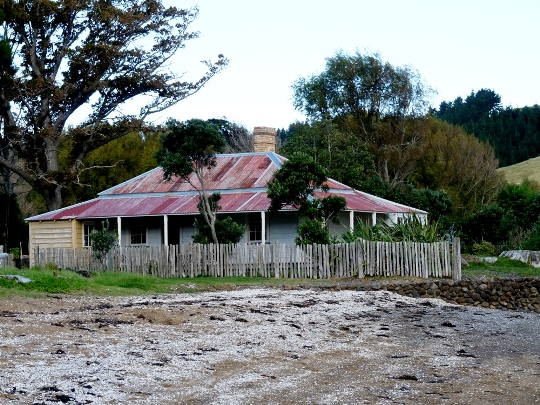
Situated near the foreshore, Callaway’s kauri-built residence was created before 1858 and possibly as early as 1849, when he founded a nearby mechanical sawmill. However, it more likely post-dates his marriage to Huihana Te Arawaere (c.1837-1883) of Ngaere hapū of Ngāi te Rangi in circa 1852, subsequently accommodating what became a multi-generational, bicultural family. Of Georgian-influenced design with a hipped roof, skillion and verandahs on two sides, the house incorporated an unusually large front parlour, rear living area or kitchen, and three small bedrooms. Other nineteenth-century structures on the property (since removed) included a rear outbuilding and boatbuilding sheds. Initially functioning in a Māori landscape, the complex formed part of a small hamlet or kāinga of housing for European sawyers and carpenters, which fronted a road - Calloway Lane - servicing the mills. Following Te Putu’s death and the opening up of Hauraki land to Europeans in the 1860s, Callaway sold the sawmill (1867), formally purchased the house property (1870) and focussed on boatbuilding and goldmining as nearby Coromandel township took over Kikowhakarere’s industrial and commercial mantle. Likely partly brought up at the property, John and Huihana’s son Wāta Te Wahahuia (1873-1926) is credited with later becoming the first Māori soldier to participate in the South African War - the earliest overseas conflict in which New Zealand forces were engaged - where he served with distinction.
From perhaps the mid-1870s, Callaway House became the residence of Wāta’s eldest sister Mere (Mary; 1853/4-1918) and her husband, George Yeoland. It may have previously been briefly occupied by the young family of Thomas Henry Maning (1848-1896), a goldminer and nephew of the Native Land Court judge Frederick Maning. Noted for its scenery, Kikowhakarere attracted visiting artists such as John Kinder and Alfred Sharpe, a phenomenon that extended into the twentieth century.
Between the 1930s and 1970s, tenants included the watercolourist Herbert Rogers (c.1875-1945) and then potter Warren Tippett (1941-94) - considered ‘a seminal figure in the history of New Zealand studio ceramics’. Photographed at the house by renowned photographer Marti Friedlander, Tippett later relocated to Australia; experimented with vibrant glazes; and joined Sydney’s Rainbow community. Residential alterations included converting a bedroom into a small kitchen (1925) and adding an eastern room, possibly in the 1950s.22 In 2001, substantial renovations occurred.
Still in use as a private dwelling, the house retains many important features including its early external appearance and layout, heavy framing, and unusual surviving elements such as extensive 1869-70 wallpaper in the front parlour.
List Entry Information
Status
Listed
List Entry Status
Historic Place Category 2
Access
Private/No Public Access
List Number
707
Date Entered
25th November 1982
Date of Effect
25th November 1982
City/District Council
Thames-Coromandel District
Region
Waikato Region
Extent of List Entry
Extent includes part of Lot 1 DPS 85425 (RT SA67C/698), South Auckland Land District, and the building known as Callaway House (Former) thereon.
Legal description
Lot 1 DPS 85425 (RT SA67C/698), South Auckland Land District
Status
Listed
List Entry Status
Historic Place Category 2
Access
Private/No Public Access
List Number
707
Date Entered
25th November 1982
Date of Effect
25th November 1982
City/District Council
Thames-Coromandel District
Region
Waikato Region
Extent of List Entry
Extent includes part of Lot 1 DPS 85425 (RT SA67C/698), South Auckland Land District, and the building known as Callaway House (Former) thereon.
Legal description
Lot 1 DPS 85425 (RT SA67C/698), South Auckland Land District
Construction Professional
Name
John Callaway
Type
Builder
Biography
Construction Details
Start Year
1858
startYearCirca
Type
Original Construction
Description
Original construction of main residence
Period
Pre-1858
Start Year
1896
startYearCirca
Type
Additional building added to site
Description
Construction of outbuilding and boatbuilding sheds
Period
Pre-1896
Start Year
1917
Type
Modification
Description
Timber roof shingles replaced by corrugated iron
Start Year
1925
Type
Modification
Description
Rear W. bedroom converted to kitchen; outbuilding replaced by washhouse
Start Year
1950
startYearCirca
Type
Modification
Description
Bathroom and front E. room added, and enclosure of widened verandah
Period
1950s
Start Year
1997
startYearCirca
Type
Modification
Description
Timber floor of verandah replaced by concrete
Period
Pre-1997
Start Year
2001
Type
Modification
Description
Renovation work including rebuilding of verandah and back-to-back chimney; replacement of 1925 washhouse with new bathroom block and connecting passage; and replacement of rotted timbers including weatherboards, some wall and other framing, and rear floors.
Start Year
2021
Type
Modification
Description
Replacement of corrugated iron roof
Construction Professional
Name
John Callaway
Type
Builder
Biography
Construction Details
Start Year
1858
startYearCirca
Type
Original Construction
Description
Original construction of main residence
Period
Pre-1858
Start Year
1896
startYearCirca
Type
Additional building added to site
Description
Construction of outbuilding and boatbuilding sheds
Period
Pre-1896
Start Year
1917
Type
Modification
Description
Timber roof shingles replaced by corrugated iron
Start Year
1925
Type
Modification
Description
Rear W. bedroom converted to kitchen; outbuilding replaced by washhouse
Start Year
1950
startYearCirca
Type
Modification
Description
Bathroom and front E. room added, and enclosure of widened verandah
Period
1950s
Start Year
1997
startYearCirca
Type
Modification
Description
Timber floor of verandah replaced by concrete
Period
Pre-1997
Start Year
2001
Type
Modification
Description
Renovation work including rebuilding of verandah and back-to-back chimney; replacement of 1925 washhouse with new bathroom block and connecting passage; and replacement of rotted timbers including weatherboards, some wall and other framing, and rear floors.
Start Year
2021
Type
Modification
Description
Replacement of corrugated iron roof
Historical and Associated Iwi / Hapū / Whānau
Completion Date
22nd December 2023
Report Written By
Martin Jones
Information Sources
Algie, 1997
Algie, William and Marija, ‘Conservation Plan: Callaway House’, Apr 1997.
Carter, 1970
Carter, E. A., ‘John Callaway’, Auckland-Waikato Historical Journal, Vol. 17, Sep 1970, pp.20-23.
Dwight, 2010
Dwight, Mike, Walter Callaway: A Māori Warrior of the Boer War, [Thames], 2010.
Elliott, 2021
Elliott, Moyra, The Greatest Show: Warren Tippett’s pots from a life less ordinary, [Auckland], 2021.
Other Information
This place was identified as significant under previous legislation with different information requirements. It remains significant under the current legislation. There is opportunity under our legislation and policies to add to this information. Further information about this place may be available from the Northern Regional Office of Heritage New Zealand Pouhere Taonga. A fully referenced copy of the Upgrade Report is available upon request from the Northern Regional Office of Heritage New Zealand Pouhere Taonga Please note that entry on the New Zealand Heritage List/Rarangi Korero identifies only the heritage values of the property concerned, and should not be construed as advice on the state of the property, or as a comment of its soundness or safety, including in regard to earthquake risk, safety in the event of fire, or insanitary conditions.
Historical and Associated Iwi / Hapū / Whānau
Completion Date
22nd December 2023
Report Written By
Martin Jones
Information Sources
Algie, 1997
Algie, William and Marija, ‘Conservation Plan: Callaway House’, Apr 1997.
Carter, 1970
Carter, E. A., ‘John Callaway’, Auckland-Waikato Historical Journal, Vol. 17, Sep 1970, pp.20-23.
Dwight, 2010
Dwight, Mike, Walter Callaway: A Māori Warrior of the Boer War, [Thames], 2010.
Elliott, 2021
Elliott, Moyra, The Greatest Show: Warren Tippett’s pots from a life less ordinary, [Auckland], 2021.
Other Information
This place was identified as significant under previous legislation with different information requirements. It remains significant under the current legislation. There is opportunity under our legislation and policies to add to this information. Further information about this place may be available from the Northern Regional Office of Heritage New Zealand Pouhere Taonga. A fully referenced copy of the Upgrade Report is available upon request from the Northern Regional Office of Heritage New Zealand Pouhere Taonga Please note that entry on the New Zealand Heritage List/Rarangi Korero identifies only the heritage values of the property concerned, and should not be construed as advice on the state of the property, or as a comment of its soundness or safety, including in regard to earthquake risk, safety in the event of fire, or insanitary conditions.
Current Usages
Uses: Accommodation
Specific Usage: House
Former Usages
General Usage: Accommodation
Specific Usage: House
Current Usages
Uses: Accommodation
Specific Usage: House
Former Usages
General Usage: Accommodation
Specific Usage: House
Location
Sign up to hear more
Get the latest heritage news, features and events delivered
straight to your inbox.
