Quick links


Quick links
Quick links
Quick links
Quick links
Quick links
1280 Chorlton Road, LITTLE AKALOA
Private
Historic Place Category 1
List No. 7094

List Entry Information
Status
Listed
List Entry Status
Historic Place Category 1
Access
Private/No Public Access
List Number
7094
Date Entered
17th December 1993
Date of Effect
17th December 1993
City/District Council
Christchurch City
Region
Canterbury Region
Extent of List Entry
Extent includes part of the land described as Pt Res 90 (RT CB774/34), Canterbury Land District and the building known as St Luke's Church (Anglican) thereon. The lychgate, entrance gates and cemetery are not included within the extent.
Legal description
Pt RES 90 (RT CB774/34), Canterbury Land District
Status
Listed
List Entry Status
Historic Place Category 1
Access
Private/No Public Access
List Number
7094
Date Entered
17th December 1993
Date of Effect
17th December 1993
City/District Council
Christchurch City
Region
Canterbury Region
Extent of List Entry
Extent includes part of the land described as Pt Res 90 (RT CB774/34), Canterbury Land District and the building known as St Luke's Church (Anglican) thereon. The lychgate, entrance gates and cemetery are not included within the extent.
Legal description
Pt RES 90 (RT CB774/34), Canterbury Land District
Why is this place significant?
Historic Significance
Historical Significance or Value St Luke's Church demonstrates the faith and commitment shared by the residents of Little Akaloa and Menzies Bay. It is a monument to the memory of J.H. Menzies and is the realisation of this Pakeha's fascination with Maori decorative art.
Physical Significance
ARCHITECTURAL QUALITY: St Luke's Church demonstrates the continuing influence of the Gothic Revival upon ecclesiastical architecture in twentieth century New Zealand. It differs in that it is extensively decorated with painting, carving and leadlighting inspired by Maori art. It is a fine example of a traditionally European church design to incorporate Maori decorative motifs, the earliest known example being Rangiatea Church, Otaki (1848-51). St Luke's Church, however, is exceptional in that it is the earliest known example of a Pakeha designer using Maori decorative motifs for a Pakeha congregation. There was no Maori collaboration. TOWNSCAPE/LANDMARK VALUE: The buff colouring of the exterior walls and grey of the Welsh slates mean that St Luke's Church harmoniously accords with its secluded setting. Together with the lichgate, memorial fence and gates and the cemetery, this church enhances and is enhanced by the site which overlooks Little Akaloa Bay on a rise above the village.
Why is this place significant?
Historic Significance
Historical Significance or Value St Luke's Church demonstrates the faith and commitment shared by the residents of Little Akaloa and Menzies Bay. It is a monument to the memory of J.H. Menzies and is the realisation of this Pakeha's fascination with Maori decorative art.
Physical Significance
ARCHITECTURAL QUALITY: St Luke's Church demonstrates the continuing influence of the Gothic Revival upon ecclesiastical architecture in twentieth century New Zealand. It differs in that it is extensively decorated with painting, carving and leadlighting inspired by Maori art. It is a fine example of a traditionally European church design to incorporate Maori decorative motifs, the earliest known example being Rangiatea Church, Otaki (1848-51). St Luke's Church, however, is exceptional in that it is the earliest known example of a Pakeha designer using Maori decorative motifs for a Pakeha congregation. There was no Maori collaboration. TOWNSCAPE/LANDMARK VALUE: The buff colouring of the exterior walls and grey of the Welsh slates mean that St Luke's Church harmoniously accords with its secluded setting. Together with the lichgate, memorial fence and gates and the cemetery, this church enhances and is enhanced by the site which overlooks Little Akaloa Bay on a rise above the village.
Construction Professional
Name
Menzies, John Henry
Type
Architect
Biography
John Henry Menzies (1839-1919) was born in Liverpool but of Scottish descent and immigrated to New Zealand in 1860. He farmed initially in Southland before settling on Banks' Peninsula. In 1878 Menzies bought McIntosh Bay, renaming it after himself, and built a homestead there the following year. This house and the second Glen Mona homestead were destroyed by fire but the third homestead (1930) remains extant. He also built a house for his eldest son William at Menzies Bay in 1894 called 'Rehutai'. Menzies was largely responsible for the design, construction, decoration and financing of St Luke's Church at Little Akaloa (1905-6). He had been obsessed with wood carving from an early age and was particularly fascinated by Maori decorative art. The interior of St Luke's Church is a permanent reminder of this fascination and the carving in both wood and stone is particularly fine given that Menzies does not appear to have had any formal training. In 1910 he published a pioneering text, Maori Patterns Painted and Carved.
Construction Details
Start Year
1905
Type
Original Construction
Construction Materials
Concrete foundations and floor; unreinforced concrete external walls; exposed timber roof structure with slate cladding.
Notable Features
Carving in wood and stone using Maori decorative motifs.
Construction Professional
Name
Menzies, John Henry
Type
Architect
Biography
John Henry Menzies (1839-1919) was born in Liverpool but of Scottish descent and immigrated to New Zealand in 1860. He farmed initially in Southland before settling on Banks' Peninsula. In 1878 Menzies bought McIntosh Bay, renaming it after himself, and built a homestead there the following year. This house and the second Glen Mona homestead were destroyed by fire but the third homestead (1930) remains extant. He also built a house for his eldest son William at Menzies Bay in 1894 called 'Rehutai'. Menzies was largely responsible for the design, construction, decoration and financing of St Luke's Church at Little Akaloa (1905-6). He had been obsessed with wood carving from an early age and was particularly fascinated by Maori decorative art. The interior of St Luke's Church is a permanent reminder of this fascination and the carving in both wood and stone is particularly fine given that Menzies does not appear to have had any formal training. In 1910 he published a pioneering text, Maori Patterns Painted and Carved.
Construction Details
Start Year
1905
Type
Original Construction
Construction Materials
Concrete foundations and floor; unreinforced concrete external walls; exposed timber roof structure with slate cladding.
Notable Features
Carving in wood and stone using Maori decorative motifs.
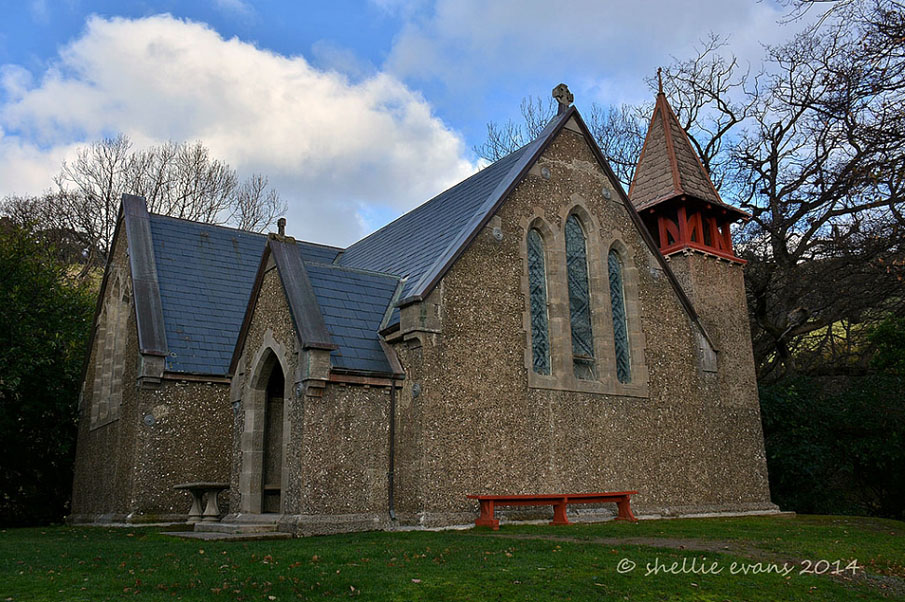
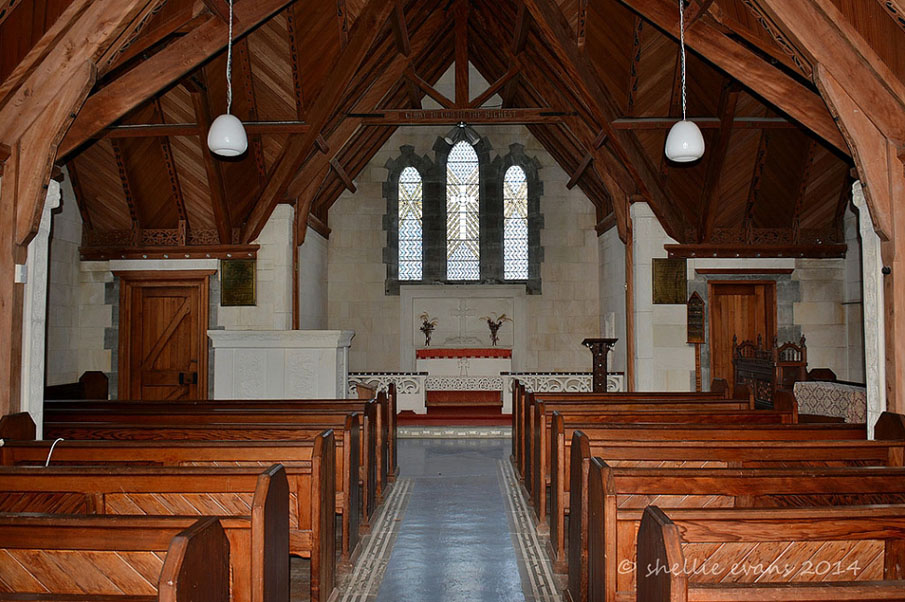
ARCHITECTURAL DESCRIPTION: St Luke's Church is a small Gothic Revival building with a traditional Latin cross plan. The liturgical west end has an entrance porch to the north and a bell tower to the south, the latter with open timber braces supporting a turret roof. A vestry opens off the south transept and, like the nave, transepts and entrance porch, has a gabled roof. The smoothness of the slate roof cladding, modillioned eaves and quoined window surrounds is contrasted by the textured surface of the exterior walls which displays a course aggregate including fragments of sea shells. The interior of St Luke's is dominated by decorative Maori motifs on various members of the roof structure, in the carved limestone and furniture and in the leaded glass windows. The king-post roof trusses are offset by painted inscriptions on the purlins and painted kowhaiwhai on the rafters. The totara roof is lined with rimu sarking machined to simulate raupo stems and at the crossing Oamaru limestone columns feature geometric capitals based on Maori motifs. The altar, altar rails, pulpit, baptismal font, chancel niche for communion and a cross behind the altar are all carved from limestone using decorative Maori detailing. Inlaid patterns in the concrete floor of the aisle and transepts also follow this theme. The carving is particularly complemented by the simple geometric design of the leaded stained glass triple lancets. The wooden lectern, the altar rails and the carved wall-plates are inset with paua, and wooden pews further enrich the interior. A relief panel in the rear wall specifies F.A. Acourt as the chief worker in wood and stone and J.H. Menzies as the principal designer and carver, assisted by C.F. Acourt, A.H. Stace, D.J. Waghorn and J. Bennett. MODIFICATIONS: 1955: Walls tied with steel rods Marseilles tile roofing replaced with Welsh slates 1958-59: New lighting installed
ARCHITECTURAL DESCRIPTION: St Luke's Church is a small Gothic Revival building with a traditional Latin cross plan. The liturgical west end has an entrance porch to the north and a bell tower to the south, the latter with open timber braces supporting a turret roof. A vestry opens off the south transept and, like the nave, transepts and entrance porch, has a gabled roof. The smoothness of the slate roof cladding, modillioned eaves and quoined window surrounds is contrasted by the textured surface of the exterior walls which displays a course aggregate including fragments of sea shells. The interior of St Luke's is dominated by decorative Maori motifs on various members of the roof structure, in the carved limestone and furniture and in the leaded glass windows. The king-post roof trusses are offset by painted inscriptions on the purlins and painted kowhaiwhai on the rafters. The totara roof is lined with rimu sarking machined to simulate raupo stems and at the crossing Oamaru limestone columns feature geometric capitals based on Maori motifs. The altar, altar rails, pulpit, baptismal font, chancel niche for communion and a cross behind the altar are all carved from limestone using decorative Maori detailing. Inlaid patterns in the concrete floor of the aisle and transepts also follow this theme. The carving is particularly complemented by the simple geometric design of the leaded stained glass triple lancets. The wooden lectern, the altar rails and the carved wall-plates are inset with paua, and wooden pews further enrich the interior. A relief panel in the rear wall specifies F.A. Acourt as the chief worker in wood and stone and J.H. Menzies as the principal designer and carver, assisted by C.F. Acourt, A.H. Stace, D.J. Waghorn and J. Bennett. MODIFICATIONS: 1955: Walls tied with steel rods Marseilles tile roofing replaced with Welsh slates 1958-59: New lighting installed
Historical and Associated Iwi / Hapū / Whānau
Information Sources
Church News
Church News
Menzies, 1910
Menzies, John Henry. Maori Patterns Painted and Carved, Smith and Anthony Ltd, Christchurch, 1910.
Thornton, 1987
G G Thornton, Early Concrete Buildings in New Zealand, Manuscript, 1987
Other Information
This historic place was registered under the Historic Places Act 1993. The assessment below is the text from the original Proposal for Registration report considered by the NZHPT Board at the time of registration. Please note that entry on the New Zealand Heritage List/Rarangi Korero identifies only the heritage values of the property concerned, and should not be construed as advice on the state of the property, or as a comment of its soundness or safety, including in regard to earthquake risk, safety in the event of fire, or insanitary conditions.
Historical and Associated Iwi / Hapū / Whānau
Information Sources
Church News
Church News
Menzies, 1910
Menzies, John Henry. Maori Patterns Painted and Carved, Smith and Anthony Ltd, Christchurch, 1910.
Thornton, 1987
G G Thornton, Early Concrete Buildings in New Zealand, Manuscript, 1987
Other Information
This historic place was registered under the Historic Places Act 1993. The assessment below is the text from the original Proposal for Registration report considered by the NZHPT Board at the time of registration. Please note that entry on the New Zealand Heritage List/Rarangi Korero identifies only the heritage values of the property concerned, and should not be construed as advice on the state of the property, or as a comment of its soundness or safety, including in regard to earthquake risk, safety in the event of fire, or insanitary conditions.
Former Usages
General Usage: Religion
Specific Usage: Church
Former Usages
General Usage: Religion
Specific Usage: Church
Location
Get the latest heritage news, features and events delivered
straight to your inbox.
