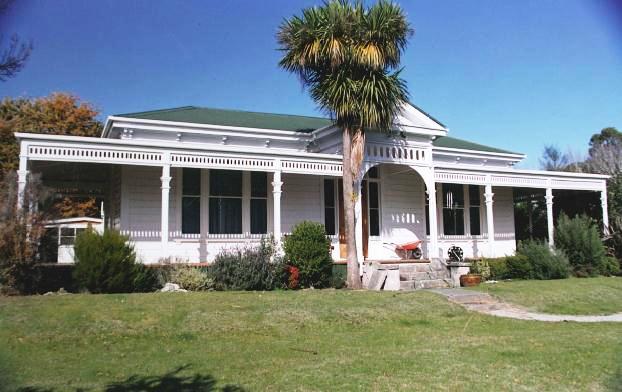
Constructed as the centrepiece of a country holding or estate on the outskirts of Gisborne, Heatherlea is a visually striking kauri residence erected in the mid-1890s. It was built for a socially prominent couple, Herewaka Poata and Colonel Thomas Porter, whose partnership reflects the long history of interracial marriage in colonial New Zealand, and particularly the perceived advantageousness of alliances between well-connected Pākehā settlers and high-ranking Māori women. The large, single-storey home is associated with complex intersections between Māori and colonial Pākehā histories, as well as gendered and class narratives; and especially reflects strategies by members of both Māori and Pākehā communities to adapt to rapidly changing circumstances within the colonial economy, and especially in relation to land ownership. The current property demonstrates the absorption of large landed holdings on the outskirts of provincial towns to increasingly intensive suburban expansion.
The fertile lands around Tūranganui-a-kiwa, now known as Gisborne, have enduring associations with several iwi connected to the waka Te Ikaroa-a-Rauru, Horouta and Tākitimu. The Kaiti Block, bounded by the Waimata River to the north and west, remained in undivided Māori ownership until 1888 when it was partitioned to individual Māori owners. In 1889, Kaiti 261 was transferred to Herewaka Poata (1845-1904), a woman of high standing or ‘ariki tapairu’ whose father – Ngāti Porou rangatira Tama-i-whakanehua-i-te-rangi – had signed Te Tiriti o Waitangi / The Treaty of Waitangi at Tokomaru Bay. Judith Binney notes that ‘[i]t is known […] that among Ngāti Porou of the East Coast rank could outweigh gender. Female chiefly leaders were accepted by them, and are recalled as the eponymous founders of certain hapū’. Poata’s husband was Thomas Porter (1843-1920), a military officer who through his marriage connections and other means acquired nearly a million acres of Poverty Bay land for the Crown as a land purchase officer, and also became personally wealthy through other business and farming interests. Porter was mayor of Gisborne in the 1870s and 1880s. Poata was also active, becoming involved with the Women’s Christian Temperance Union and being one of a small number of Māori women to sign the 1892 suffrage petition – a major landmark in winning democratic rights for women.
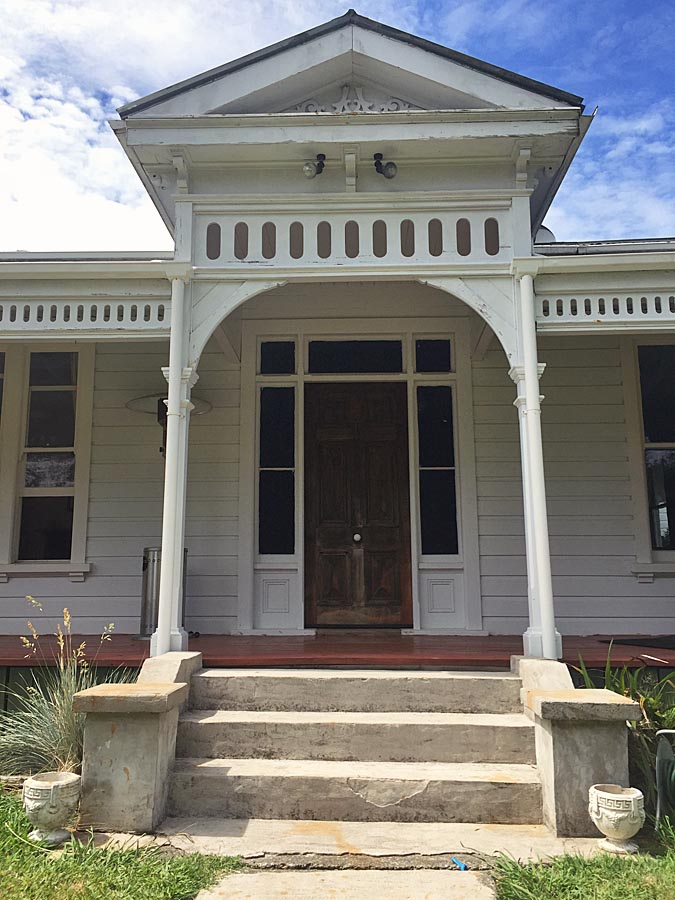
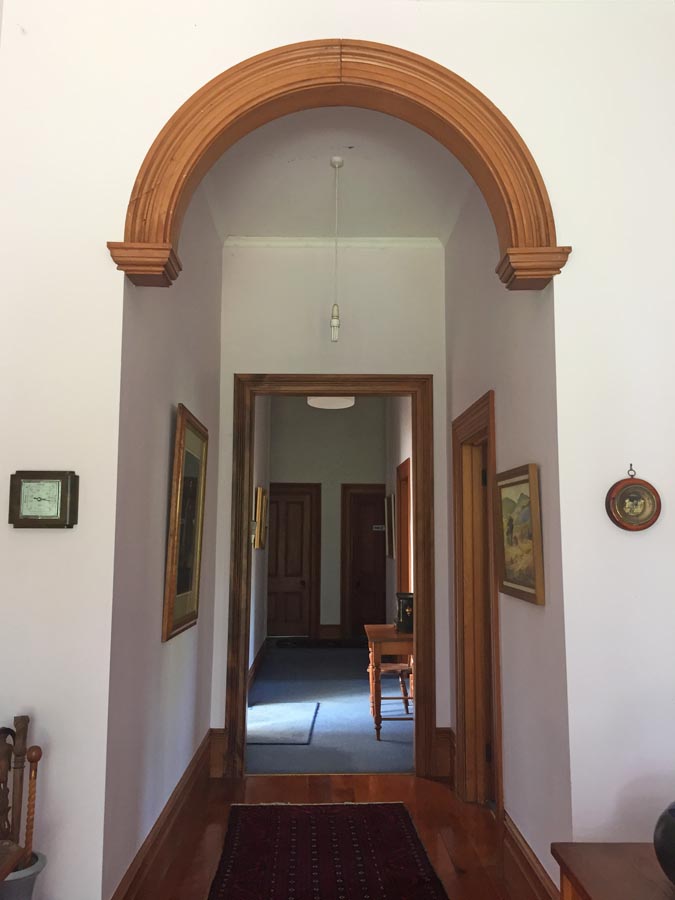
Reflecting their wealth and status, Poata and Porter built a grand, nine-room timber residence on the 27-acre estate in circa 1894 after their house in the centre of Gisborne burnt down. Highly visible within its rural setting to the east of the town, the structure directly overlooked the Waimata River and was associated with planted gardens, a fountain, and a gazebo. Externally, the single-storey residence was of Georgian-influenced villa design, with a symmetrical hipped roof, ornate wraparound verandah and projecting portico. Likewise broadly symmetrical, the well-appointed interior incorporated main rooms either side of a central passage. Servants were quartered in a separate building. After construction, functions at the house included family gatherings involving the couple’s adult children, encompassing the notable tā moko expert Tāme Poata, and renowned singer and composer Fanny Rose Howie (also known as Te Rangi Pai) – who often toured overseas. Although formally resident at the house, in 1901-2 Thomas Porter led New Zealand contingents in the South African War and at King Edward VII’s coronation, subsequently being honoured as a Companion of the Order of Bath (CB).
Shortly before Herewaka Poata’s death in 1904, the property was transferred to an agent who subdivided the block. Porter nevertheless continued to reside at Heatherlea until 1914, after which the house and an associated ten-acre holding was sold. In 1977, further subdivision reduced the property to its current suburban footprint as part of Gisborne’s expansion. Changes to the residence have included a small rear addition by the 1940s; and attached garage by 1986; and an outdoor swimming pool in 2000. The place remains (2021) in use as a private residence.
The fertile lands around Tūranganui-a-kiwa, now known as Gisborne, have enduring associations with several iwi connected to the waka Te Ikaroa-a-Rauru, Horouta and Tākitimu. The Kaiti Block, bounded by the Waimata River to the north and west, remained in undivided Māori ownership until 1888 when it was partitioned to individual Māori owners. In 1889, Kaiti 261 was transferred to Herewaka Poata (1845-1904), a woman of high standing or ‘ariki tapairu’ whose father – Ngāti Porou rangatira Tama-i-whakanehua-i-te-rangi – had signed Te Tiriti o Waitangi / The Treaty of Waitangi at Tokomaru Bay. Judith Binney notes that ‘[i]t is known […] that among Ngāti Porou of the East Coast rank could outweigh gender. Female chiefly leaders were accepted by them, and are recalled as the eponymous founders of certain hapū’. Poata’s husband was Thomas Porter (1843-1920), a military officer who through his marriage connections and other means acquired nearly a million acres of Poverty Bay land for the Crown as a land purchase officer, and also became personally wealthy through other business and farming interests. Porter was mayor of Gisborne in the 1870s and 1880s. Poata was also active, becoming involved with the Women’s Christian Temperance Union and being one of a small number of Māori women to sign the 1892 suffrage petition – a major landmark in winning democratic rights for women.
Reflecting their wealth and status, Poata and Porter built a grand, nine-room timber residence on the 27-acre estate in circa 1894 after their house in the centre of Gisborne burnt down. Highly visible within its rural setting to the east of the town, the structure directly overlooked the Waimata River and was associated with planted gardens, a fountain, and a gazebo. Externally, the single-storey residence was of Georgian-influenced villa design, with a symmetrical hipped roof, ornate wraparound verandah and projecting portico. Likewise broadly symmetrical, the well-appointed interior incorporated main rooms either side of a central passage. Servants were quartered in a separate building. After construction, functions at the house included family gatherings involving the couple’s adult children, encompassing the notable tā moko expert Tāme Poata, and renowned singer and composer Fanny Rose Howie (also known as Te Rangi Pai) – who often toured overseas. Although formally resident at the house, in 1901-2 Thomas Porter led New Zealand contingents in the South African War and at King Edward VII’s coronation, subsequently being honoured as a Companion of the Order of Bath (CB).
Shortly before Herewaka Poata’s death in 1904, the property was transferred to an agent who subdivided the block. Porter nevertheless continued to reside at Heatherlea until 1914, after which the house and an associated ten-acre holding was sold. In 1977, further subdivision reduced the property to its current suburban footprint as part of Gisborne’s expansion. Changes to the residence have included a small rear addition by the 1940s; and attached garage by 1986; and an outdoor swimming pool in 2000. The place remains (2021) in use as a private residence.