

The Anglican orphanage was formed in 1860. It was incorporated under the Religious Charitable and Education Trusts Boards' Incorporation Act and was registered under the name Orphans' Home Trust Board. In 1905 a fire destroyed a central part of the orphanage premises which were located on a site not owned by the Anglican Trust. They therefore decided to build on an independent site and settled on an 86 acre property belonging to a Mr Wyllie in Papatoetoe.
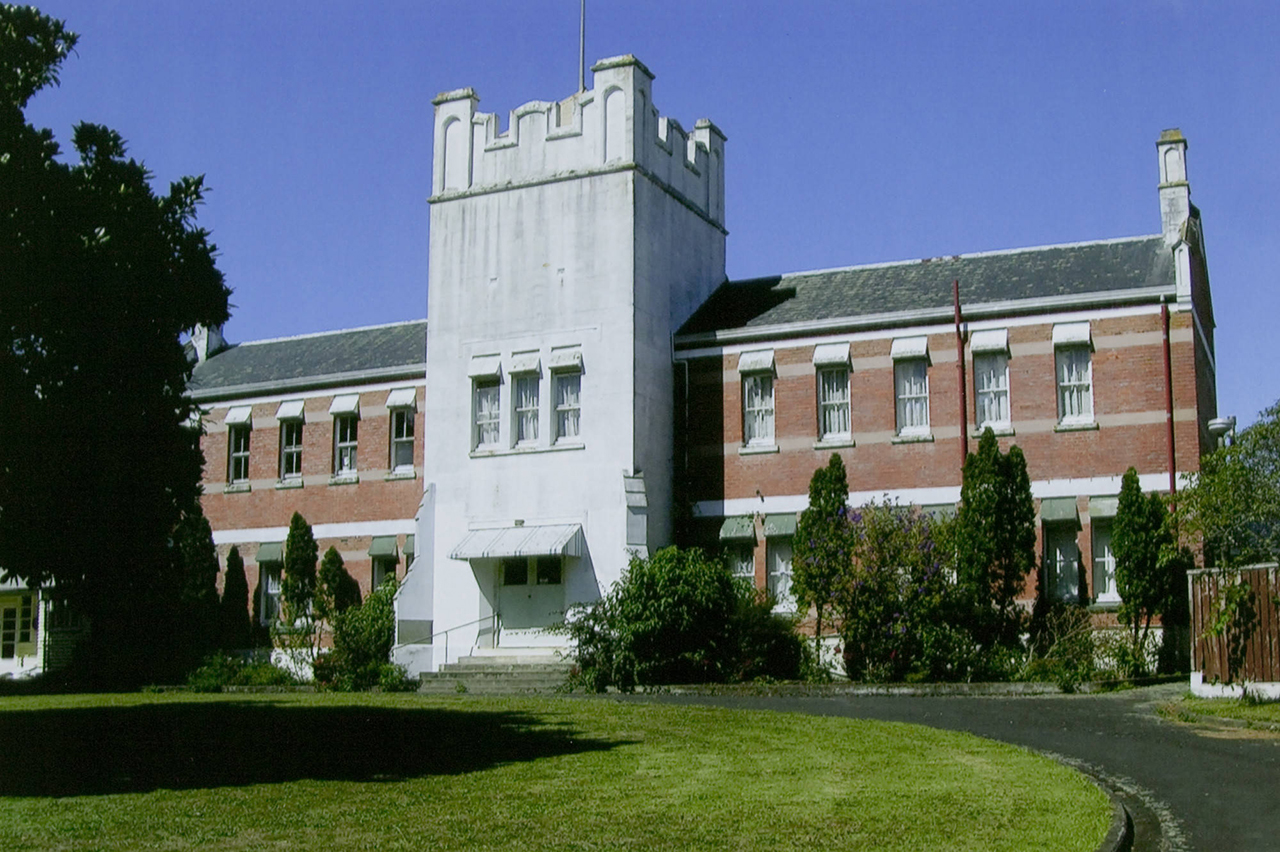
George Goldsbro' was accepted as architect for the orphanage after offering his services without charge. This was in memory of his father who had been an honorary medical officer at the institution. A sketch plan following pavilion planning was approved and the orphanage was built in 1907-9. St Saviour's Chapel was added in 1918-19 and the Administration Block in 1922-23.
In 1918 the Church Gazette reported that a chapel had been "in mind for some time" and that a further 472 pounds had been secured. It transpired that the chapel was built from funds subscribed by the children. The laying of the foundation stone took place on 14 September 1918. The war and an influenza epidemic both resulted in delays but the building was nevertheless opened on 1 March the following year.
The chapel contains several historical remnants. The foundation stone was obtained by Bishop Neligan from the Bell Harry Tower of England's Canterbury Cathedral. This Caen limestone came from Normandy and was used in the structural upgrading of the tower in the fourteenth century. The foundation stone sits on two basalt rocks, one from St John's College and the other from the ruins of Old St Thomas' Church, Tamaki. The basalt foundations are also from the ruins of Old St Thomas'.
Parliament passed a private act in December 1962 which changed the Orphans' Home Trust Board to the Church of England Children's Trust. Policy too had changed; foster and family homes were being used and there was a fall in the number of orphans owing to general prosperity, family benefit and demand for adoption. In 1963 the ten remaining children were moved to a family home and the property was sold to Mangere Hospital. The chapel continued to be used as a place for prayer and worship and the complex was sold to the present owner on 22 September 1993.
List Entry Information
Status
Listed
List Entry Status
Historic Place Category 1
Access
Private/No Public Access
List Number
7169
Date Entered
21st April 1994
Date of Effect
21st April 1994
City/District Council
Auckland Council
Region
Auckland Council
Extent of List Entry
Extent includes part of the land described as Lot 1 DP 149864 (RT NA89B/91), North Auckland Land District, and the building known as St Saviour’s Chapel thereon. Refer to the extent map tabled at the Heritage New Zealand Board meeting on 25 June 2015.
Legal description
Lot 1 DP 149864 (RT NA89B/91), North Auckland Land District.
Status
Listed
List Entry Status
Historic Place Category 1
Access
Private/No Public Access
List Number
7169
Date Entered
21st April 1994
Date of Effect
21st April 1994
City/District Council
Auckland Council
Region
Auckland Council
Extent of List Entry
Extent includes part of the land described as Lot 1 DP 149864 (RT NA89B/91), North Auckland Land District, and the building known as St Saviour’s Chapel thereon. Refer to the extent map tabled at the Heritage New Zealand Board meeting on 25 June 2015.
Legal description
Lot 1 DP 149864 (RT NA89B/91), North Auckland Land District.
Why is this place significant?
Historic Significance
Historical Significance or Value St Saviour's Chapel is of some historical significance, and has a certain rarity, in that it is an ecclesiastical building purpose built for an orphanage. The historical significance of St Saviour's Chapel cannot be isolated from that of the former St John's Orphanage. Located just to the north of the orphanage, the chapel was given prominence and centrality on the site, and was designed by the same architect (GS Goldsbro') and built of the same materials.
Physical Significance
ARCHITECTURAL QUALITY: St Saviour's is an excellent example of a small scale ecclesiastical building designed in an Arts and Crafts style. It is an early adaptation of Arts and Crafts philosophy to an ecclesiastical building, apparent in its honesty and simplicity of design and construction, good craftsmanship and attention to detail. The Arts and Crafts style sometimes incorporated elements of the English Domestic Revival or the Gothic Revival and St Saviour's alludes to the Gothic Revival without adhering to this historicist style. The chapel incorporates the re-use of building materials including a foundation stone from the Bell Harry Tower of England's Canterbury Cathedral and foundation walls built from the ruins of Old Thomas' Church, Tamaki. This re-use can be seen as physical evidence of the connection between the Church of England and its development in New Zealand and is in keeping with Arts and Crafts philosophy. Finally, St Saviour's Chapel is an important example of the work of GS Goldsbro'. It is an innovative design, revealing stylistic development by this Auckland architect and demonstrating a move away from historicist styles. TOWNSCAPE/LANDMARK VALUE: St Saviour's Chapel has centrality and prominence on the site of the former St John's Orphanage. It is situated beside a grove of mature trees. The location of the chapel was subject to some discussion and clerics decided upon the present site in order that it would be an unavoidable focal point in the lives of the children. "Children in trouble should have the chapel in a readily accessible place to which they might retire (having no mother to comfort them) to say their prayers".
Why is this place significant?
Historic Significance
Historical Significance or Value St Saviour's Chapel is of some historical significance, and has a certain rarity, in that it is an ecclesiastical building purpose built for an orphanage. The historical significance of St Saviour's Chapel cannot be isolated from that of the former St John's Orphanage. Located just to the north of the orphanage, the chapel was given prominence and centrality on the site, and was designed by the same architect (GS Goldsbro') and built of the same materials.
Physical Significance
ARCHITECTURAL QUALITY: St Saviour's is an excellent example of a small scale ecclesiastical building designed in an Arts and Crafts style. It is an early adaptation of Arts and Crafts philosophy to an ecclesiastical building, apparent in its honesty and simplicity of design and construction, good craftsmanship and attention to detail. The Arts and Crafts style sometimes incorporated elements of the English Domestic Revival or the Gothic Revival and St Saviour's alludes to the Gothic Revival without adhering to this historicist style. The chapel incorporates the re-use of building materials including a foundation stone from the Bell Harry Tower of England's Canterbury Cathedral and foundation walls built from the ruins of Old Thomas' Church, Tamaki. This re-use can be seen as physical evidence of the connection between the Church of England and its development in New Zealand and is in keeping with Arts and Crafts philosophy. Finally, St Saviour's Chapel is an important example of the work of GS Goldsbro'. It is an innovative design, revealing stylistic development by this Auckland architect and demonstrating a move away from historicist styles. TOWNSCAPE/LANDMARK VALUE: St Saviour's Chapel has centrality and prominence on the site of the former St John's Orphanage. It is situated beside a grove of mature trees. The location of the chapel was subject to some discussion and clerics decided upon the present site in order that it would be an unavoidable focal point in the lives of the children. "Children in trouble should have the chapel in a readily accessible place to which they might retire (having no mother to comfort them) to say their prayers".
Construction Professional
Name
Goldsbro, George Selwyn
Type
Architect
Biography
Goldsbro' was born in Auckland. He studied architecture there under R Mackay Fripp during 1884-88 before travelling to Australia. He worked in Melbourne until 1891 and then in Sydney under Messrs Sulman and Power, Mr Howard Joseland and Mr Theo Kemmis. On his return to Auckland in 1886 he joined Mackay Fripp in partnership. The partnership was dissolved in 1898 but during these two years Goldsbro' had been awarded second prize in the competition for the Auckland Stock Exchange and first prize in the competition for the Taranaki Club, New Plymouth. Several years later he established a partnership with Henry Wade and this firm was responsible for a wide variety of domestic and commercial buildings including the Terminus Hotel, Helensville (1906), Bishopscourt, Parnell (1906), Patterson Memorial Wing, St John's College (1909), Dalgety's Building, Customs Street (1912) and the Papatoetoe Orphanage (1922). He was awarded second prize in the competition for the Auckland Stock Exchange and first prize in the competition for the Taranaki Club, New Plymouth. Goldsbro' was an inaugural member of the New Zealand Institute of Architects formed in 1905. During the last two years of his life he was a partner in the firm Goldsbro' and Carter.
Construction Details
Start Year
1918
Finish Year
1919
Type
Original Construction
Description
September 1918 - March 1919
Construction Materials
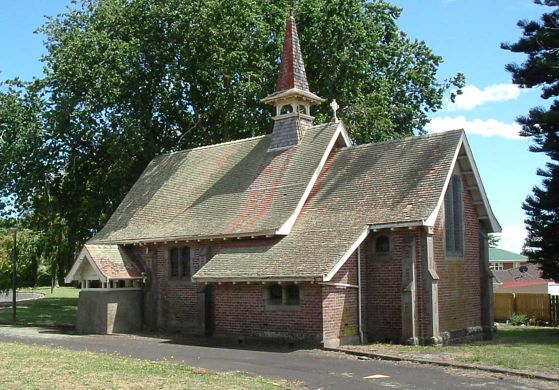
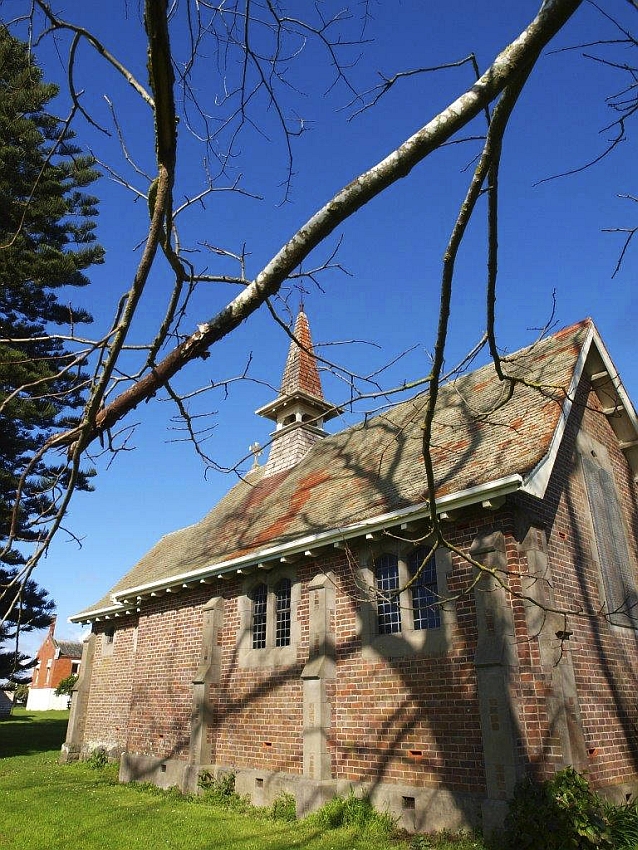
The chapel is built on foundations of brick, concrete and basalt, the latter coming from the ruins of Old St Thomas' Church, Tamaki. St Saviour's has cavity brick walls with brick and plaster buttresses. Timber roof trusses are exposed and the roof is clad with clay tiles. The steeple has timber shingles.
Notable Features
Carefully detailed porch and steeple Low eaves of the vestry
Construction Professional
Name
Goldsbro, George Selwyn
Type
Architect
Biography
Goldsbro' was born in Auckland. He studied architecture there under R Mackay Fripp during 1884-88 before travelling to Australia. He worked in Melbourne until 1891 and then in Sydney under Messrs Sulman and Power, Mr Howard Joseland and Mr Theo Kemmis. On his return to Auckland in 1886 he joined Mackay Fripp in partnership. The partnership was dissolved in 1898 but during these two years Goldsbro' had been awarded second prize in the competition for the Auckland Stock Exchange and first prize in the competition for the Taranaki Club, New Plymouth. Several years later he established a partnership with Henry Wade and this firm was responsible for a wide variety of domestic and commercial buildings including the Terminus Hotel, Helensville (1906), Bishopscourt, Parnell (1906), Patterson Memorial Wing, St John's College (1909), Dalgety's Building, Customs Street (1912) and the Papatoetoe Orphanage (1922). He was awarded second prize in the competition for the Auckland Stock Exchange and first prize in the competition for the Taranaki Club, New Plymouth. Goldsbro' was an inaugural member of the New Zealand Institute of Architects formed in 1905. During the last two years of his life he was a partner in the firm Goldsbro' and Carter.
Construction Details
Start Year
1918
Finish Year
1919
Type
Original Construction
Description
September 1918 - March 1919
Construction Materials
The chapel is built on foundations of brick, concrete and basalt, the latter coming from the ruins of Old St Thomas' Church, Tamaki. St Saviour's has cavity brick walls with brick and plaster buttresses. Timber roof trusses are exposed and the roof is clad with clay tiles. The steeple has timber shingles.
Notable Features
Carefully detailed porch and steeple Low eaves of the vestry
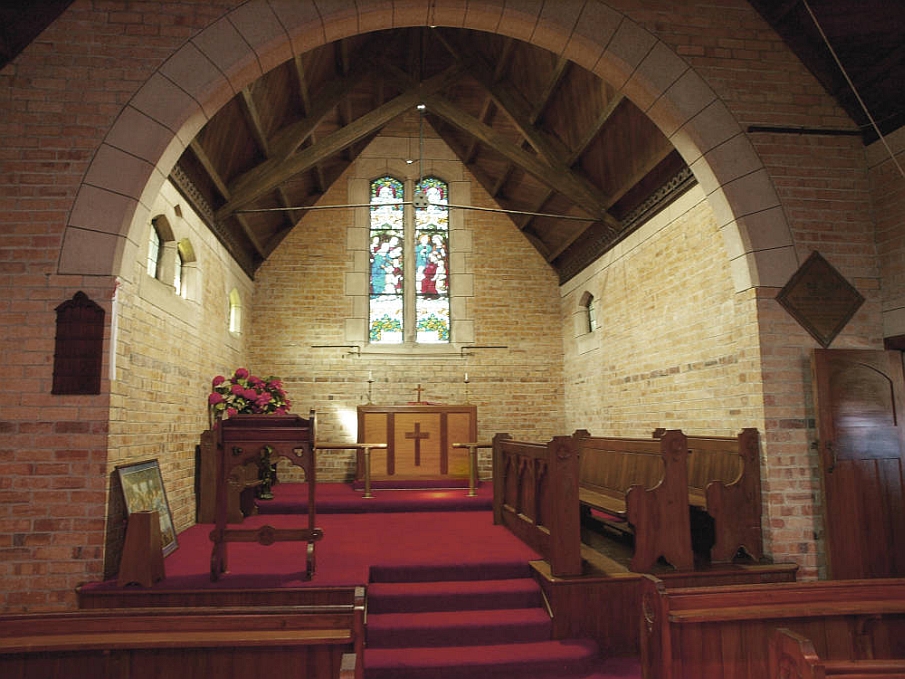
Builder: Mr Sexton ARCHITECTURAL DESCRIPTION: St Saviour's Chapel is a small scale example of the Arts and Crafts style adapted for ecclesiastical purposes. It is simple in plan with a nave in the west, chancel in the east, and porch and vestry to the south of the nave and chancel respectively. St Saviour's is well crafted and particular attention has been paid to the entry porch and the steeple. The roof of the nave is a steep belled gable. From the south, this roof appears to overlap that of the chancel and vestry. The low roof of the vestry is barely six feet above ground at the eaves. Toward the east end of the nave roof is a centrally placed steeple. The steeple has a timber bellcote and a four sided spire surmounted by a cross. The entry porch has its own gabled roof and is characterised by overhanging eaves, projecting rafters and a shingled gable end. The gable is supported on open framing and a rough cast sloping wall of solid brick. Allusion to the Gothic Revival is apparent in the use of buttresses and pointed windows. The latter are somewhat flattened in comparison to the traditional lancet arch, and other than in the east and west ends are of squat proportion. The interior is of a lighter coloured brick than the exterior. A round arch defines the crossing from the nave to the chancel. The plastering of the arch simulates voussoirs. Similarly, the plastering around the leaded windows simulates the use of quoins. A pair of stained glass windows graces the east end of the chancel. Along the top of the side walls is a single plastered course with a carved timber diaper strip above. The latter features a series of quatrefoils. The exposed roof structure comprises a scissor beam truss system held by steel ties and the ceiling is diagonally match-lined. Arts and Crafts details include the timber doors and their wrought iron latches which indicate crafting by hand. MODIFICATIONS: July 1925: Pierce memorial windows added to the east end
Builder: Mr Sexton ARCHITECTURAL DESCRIPTION: St Saviour's Chapel is a small scale example of the Arts and Crafts style adapted for ecclesiastical purposes. It is simple in plan with a nave in the west, chancel in the east, and porch and vestry to the south of the nave and chancel respectively. St Saviour's is well crafted and particular attention has been paid to the entry porch and the steeple. The roof of the nave is a steep belled gable. From the south, this roof appears to overlap that of the chancel and vestry. The low roof of the vestry is barely six feet above ground at the eaves. Toward the east end of the nave roof is a centrally placed steeple. The steeple has a timber bellcote and a four sided spire surmounted by a cross. The entry porch has its own gabled roof and is characterised by overhanging eaves, projecting rafters and a shingled gable end. The gable is supported on open framing and a rough cast sloping wall of solid brick. Allusion to the Gothic Revival is apparent in the use of buttresses and pointed windows. The latter are somewhat flattened in comparison to the traditional lancet arch, and other than in the east and west ends are of squat proportion. The interior is of a lighter coloured brick than the exterior. A round arch defines the crossing from the nave to the chancel. The plastering of the arch simulates voussoirs. Similarly, the plastering around the leaded windows simulates the use of quoins. A pair of stained glass windows graces the east end of the chancel. Along the top of the side walls is a single plastered course with a carved timber diaper strip above. The latter features a series of quatrefoils. The exposed roof structure comprises a scissor beam truss system held by steel ties and the ceiling is diagonally match-lined. Arts and Crafts details include the timber doors and their wrought iron latches which indicate crafting by hand. MODIFICATIONS: July 1925: Pierce memorial windows added to the east end
Historical and Associated Iwi / Hapū / Whānau
Completion Date
17th December 1993
Report Written By
NZHPT
Information Sources
Auckland Weekly News
Auckland Weekly News
Church Gazette
Church Gazette
Cyclopedia of New Zealand, 1902
Cyclopedia Company, Industrial, descriptive, historical, biographical facts, figures, illustrations, Wellington, N.Z, 1897-1908, Vol.2, Christchurch, 1902
Wises Post Office Directories
Wises Post Office Directories
New Zealand Herald
New Zealand Herald, 12 July 1932, p. 6; 28 September 1933, p. 6.
Smytheman, 1962
Ivy F. Smytheman and Albert E. Tonson, Our First Hundred Years, A Historical Record of Papatoetoe, Papatoetoe, 1962.
Other Information
A copy of the original report is available from the NZHPT Northern region office. Please note that entry on the New Zealand Heritage List/Rarangi Korero identifies only the heritage values of the property concerned, and should not be construed as advice on the state of the property, or as a comment of its soundness or safety, including in regard to earthquake risk, safety in the event of fire, or insanitary conditions.
Historical and Associated Iwi / Hapū / Whānau
Completion Date
17th December 1993
Report Written By
NZHPT
Information Sources
Auckland Weekly News
Auckland Weekly News
Church Gazette
Church Gazette
Cyclopedia of New Zealand, 1902
Cyclopedia Company, Industrial, descriptive, historical, biographical facts, figures, illustrations, Wellington, N.Z, 1897-1908, Vol.2, Christchurch, 1902
Wises Post Office Directories
Wises Post Office Directories
New Zealand Herald
New Zealand Herald, 12 July 1932, p. 6; 28 September 1933, p. 6.
Smytheman, 1962
Ivy F. Smytheman and Albert E. Tonson, Our First Hundred Years, A Historical Record of Papatoetoe, Papatoetoe, 1962.
Other Information
A copy of the original report is available from the NZHPT Northern region office. Please note that entry on the New Zealand Heritage List/Rarangi Korero identifies only the heritage values of the property concerned, and should not be construed as advice on the state of the property, or as a comment of its soundness or safety, including in regard to earthquake risk, safety in the event of fire, or insanitary conditions.
Former Usages
General Usage: Religion
Specific Usage: Chapel
Former Usages
General Usage: Religion
Specific Usage: Chapel
Location
Sign up to hear more
Get the latest heritage news, features and events delivered
straight to your inbox.
