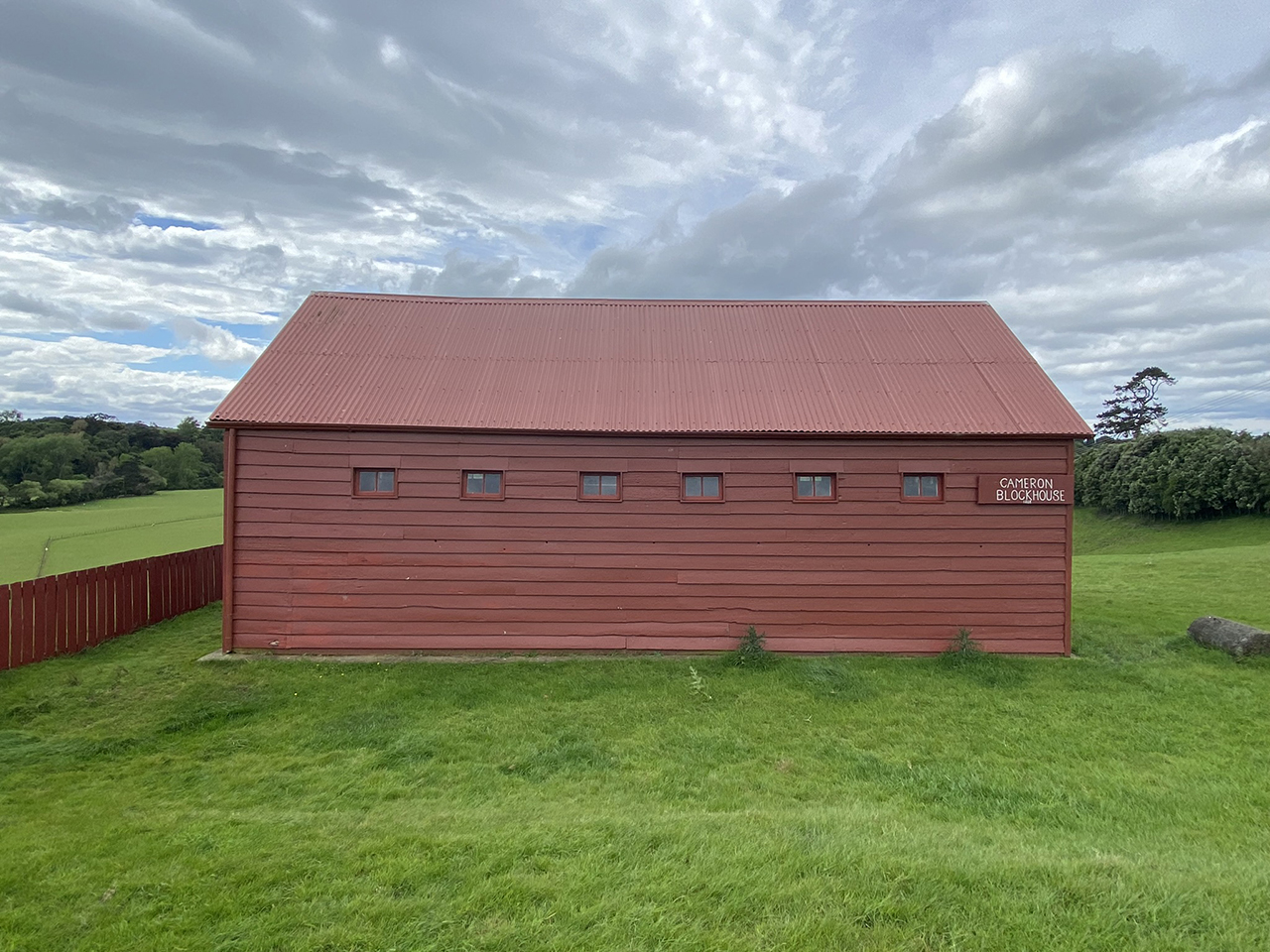
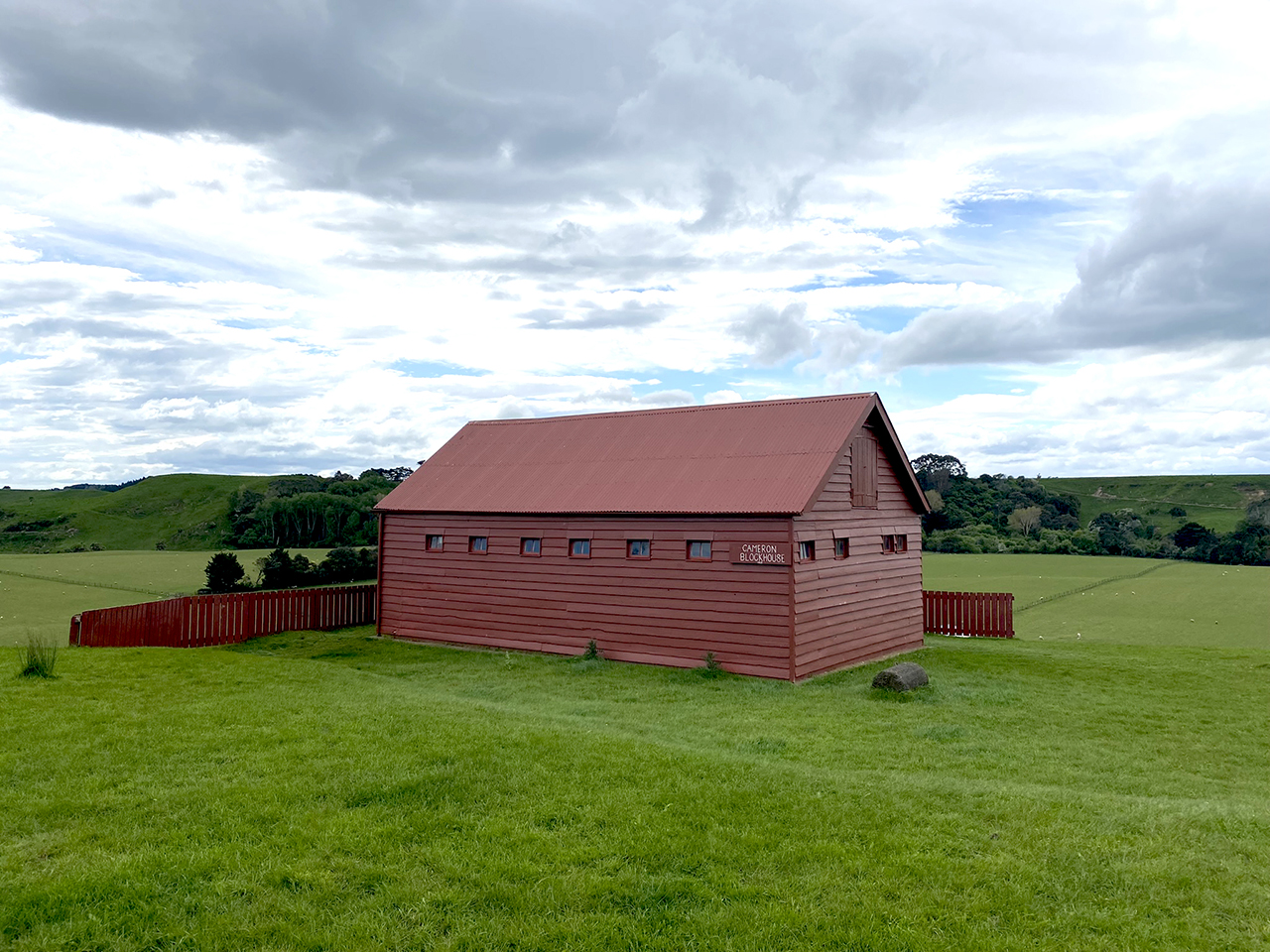
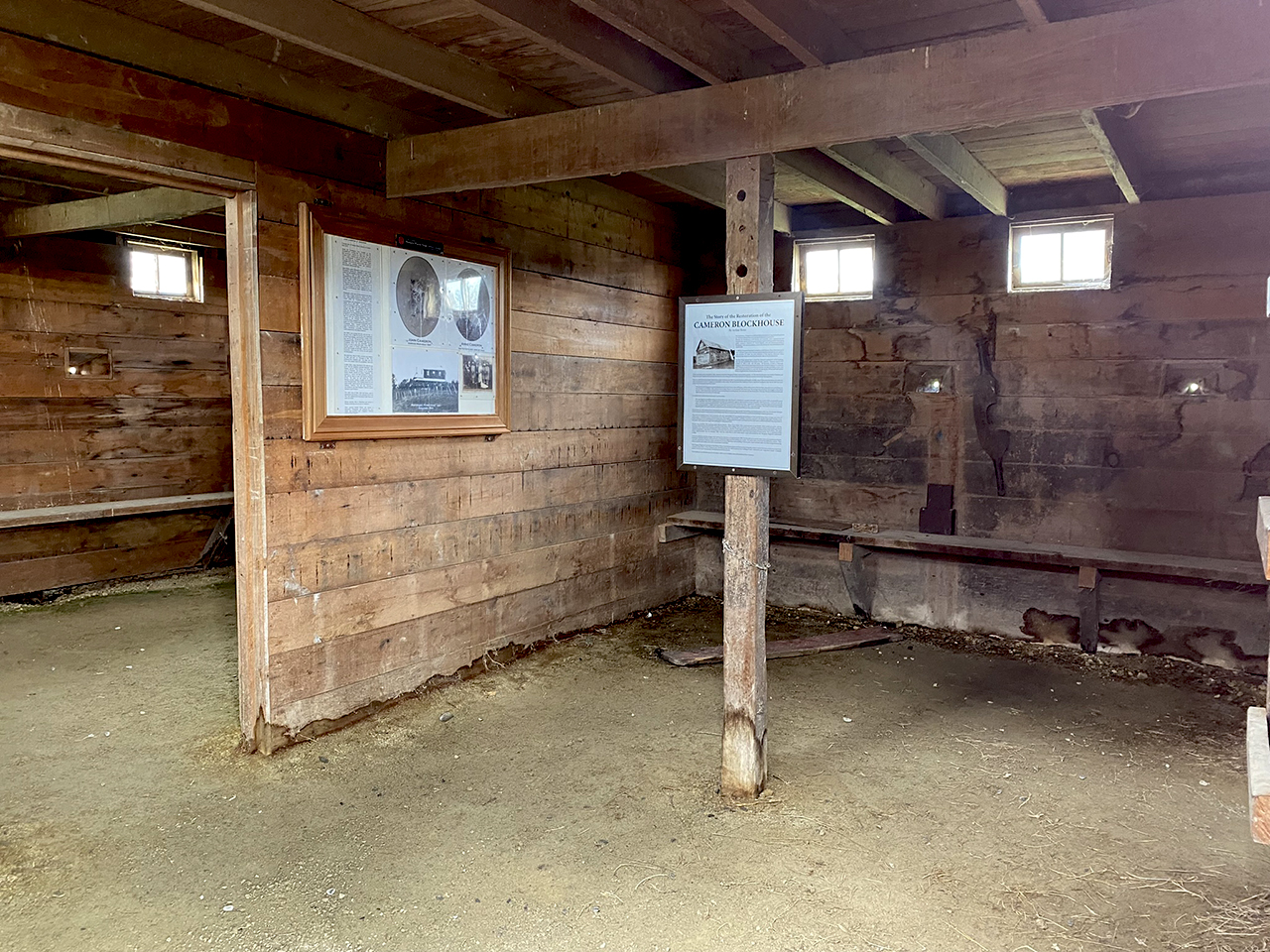
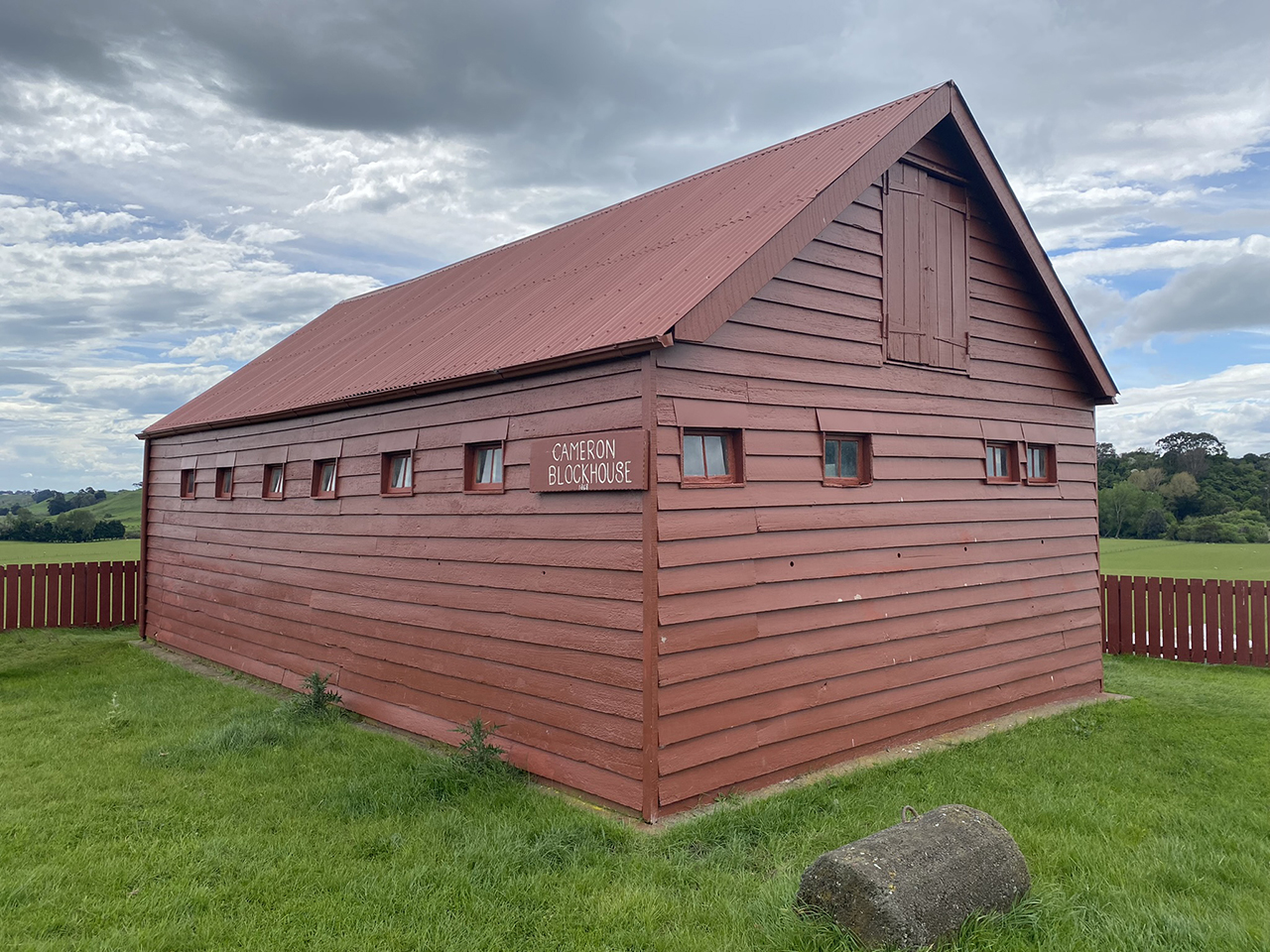
The Cameron Blockhouse was one of a number of redoubts built on high ground in the district. As an innovative method of protecting against bullets and fire the walls were packed with clay. The blockhouse was positioned in such a way that the people inside could signal to two other blockhouses belonging to the Campbell and Morgan families, who could in turn relay messages to the York Stockade in Wanganui. The Cameron Blockhouse never actually came under attack. Over the years the blockhouse was modified use as a farm building, including the removal of the east wall. This was later reinstated in the 1970s. Between 1988 and 1990 the Wanganui branch committee of the New Zealand Historic Places Trust and other volunteers undertook to restore the blockhouse.
The building has great historical significance as a privately constructed, purpose-built blockhouse. It represents a social and cultural attitude toward racial conflict and war. It is located in a dramatic setting and has considerable landscape significance. The building has technological interest for the use of readily available materials to create a protective layer in the building's defence. The blockhouse was built in 1868 and thus has significance as an archaeological site. In February 1996 a Heritage Covenant was placed on the property. The blockhouse is open to the public.


List Entry Information
Status
Listed
List Entry Status
Historic Place Category 1
Access
Able to Visit
List Number
7179
Date Entered
27th October 1994
Date of Effect
27th October 1994
City/District Council
Whanganui District
Region
Horizons (Manawatū-Whanganui) Region
Legal description
Pt Lot 1 DP 307308 (RT WN 309868), Wellington Land District
Location Description
Approximately 6km south of Wanganui.
Status
Listed
List Entry Status
Historic Place Category 1
Access
Able to Visit
List Number
7179
Date Entered
27th October 1994
Date of Effect
27th October 1994
City/District Council
Whanganui District
Region
Horizons (Manawatū-Whanganui) Region
Legal description
Pt Lot 1 DP 307308 (RT WN 309868), Wellington Land District
Location Description
Approximately 6km south of Wanganui.
Why is this place significant?
Cultural Significance
The following text was prepared as part of an upgrade project and was completed [02 Oct 2001] It indicates the relations between local Maori and the European settlers in the region at this time.
Historic Significance
Historical Significance or Value The following text was prepared as part of an upgrade project and was completed [02 Oct 2001]: The blockhouse is a rare surviving example of a privately built blockhouse, and has significance as it represents a contemporary Victorian attitude towards race relations and war. This historic place was registered under the Historic Places Act 1993. The Description below includes the text from the original Proposal for Classification report considered by the NZHPT Board at the time of registration. The Cameron Blockhouse is a rare surviving example of a privately built blockhouse and has historical significance as it personifies the level to which race relations had fallen in Victorian New Zealand. It is a realisation of the extent to which early settlers went to protect themselves and their families when threatened by the possibility of a Maori uprising.
Physical Significance
The following text was prepared as part of an upgrade project and was completed [02 Oct 2001] Architectural Quality: The blockhouse is a purpose built military defence building. Its construction style and material are an innovative solution to a perceived threat. The clay infill walls are an innovative solution to the problem of strengthening a building designed and constructed to withstand attack. The Cameron Blockhouse is rare example of a timber blockhouse dating to the New Zealand Wars. The building is situated on a hilltop overlooking a valley. Its location was chosen to place the blockhouse in line of sight of two other blockhouses. It is a dramatic setting and has great landscape significance. The blockhouse was built in 1868 and thus has significance as an archaeological site.
Why is this place Category 1 / Category 2?
Detail Of Assessed Criteria
The following text was prepared as part of an upgrade project and was completed [02 Oct 2001] a - Reflects aspects NZ history b - Association with events/persons/ideas NZ history f - Potential public education g - Technical/value/design
Why is this place significant?
Cultural Significance
The following text was prepared as part of an upgrade project and was completed [02 Oct 2001] It indicates the relations between local Maori and the European settlers in the region at this time.
Historic Significance
Historical Significance or Value The following text was prepared as part of an upgrade project and was completed [02 Oct 2001]: The blockhouse is a rare surviving example of a privately built blockhouse, and has significance as it represents a contemporary Victorian attitude towards race relations and war. This historic place was registered under the Historic Places Act 1993. The Description below includes the text from the original Proposal for Classification report considered by the NZHPT Board at the time of registration. The Cameron Blockhouse is a rare surviving example of a privately built blockhouse and has historical significance as it personifies the level to which race relations had fallen in Victorian New Zealand. It is a realisation of the extent to which early settlers went to protect themselves and their families when threatened by the possibility of a Maori uprising.
Physical Significance
The following text was prepared as part of an upgrade project and was completed [02 Oct 2001] Architectural Quality: The blockhouse is a purpose built military defence building. Its construction style and material are an innovative solution to a perceived threat. The clay infill walls are an innovative solution to the problem of strengthening a building designed and constructed to withstand attack. The Cameron Blockhouse is rare example of a timber blockhouse dating to the New Zealand Wars. The building is situated on a hilltop overlooking a valley. Its location was chosen to place the blockhouse in line of sight of two other blockhouses. It is a dramatic setting and has great landscape significance. The blockhouse was built in 1868 and thus has significance as an archaeological site.
Why is this place Category 1 / Category 2?
Detail Of Assessed Criteria
The following text was prepared as part of an upgrade project and was completed [02 Oct 2001] a - Reflects aspects NZ history b - Association with events/persons/ideas NZ history f - Potential public education g - Technical/value/design
Construction Professional
Name
Cameron, John
Type
Builder
Biography
By local tradition and presumption, the Cameron Blockhouse, Wanganui, is thought to have been designed by its owner/builder, John Cameron. Cameron was born in 1817 on the isle of North Uist in the Hebrides and immigrated to New Zealand in 1840. He had purchased a parcel of land in the Wanganui district through the New Zealand Company. He originally farmed this area in partnership with his neighbour, Captain Moses Campbell. This partnership was dissolved in 1858 and Cameron purchased several nearby blocks of land on which he bred sheep and cattle. Horse breeding was also an important business and hobby.
Construction Details
Start Year
1868
Type
Original Construction
Type
Modification
Description
Removal of a portion of the east gable wall
Start Year
1979
startYearCirca
Type
Reconstruction
Description
Partial restoration including the reinstatement of the east gable wall Partial restoration including the reinstatement of the east wall
Start Year
1988
Finish Year
1990
finishYearCirca
Type
Reconstruction
Description
Complete restoration including a concrete perimeter foundation, replacement of weatherboards and some windows, realignment of spouting, painting of exterior walls & roof
Construction Materials
Floor of compacted earth; double totara walls packed with clay; roof sheathed with corrugated iron. Nails were hand forged, some up to 7cm long.
Notable Features
Clay infill and loopholes in walls
Construction Professional
Name
Cameron, John
Type
Builder
Biography
By local tradition and presumption, the Cameron Blockhouse, Wanganui, is thought to have been designed by its owner/builder, John Cameron. Cameron was born in 1817 on the isle of North Uist in the Hebrides and immigrated to New Zealand in 1840. He had purchased a parcel of land in the Wanganui district through the New Zealand Company. He originally farmed this area in partnership with his neighbour, Captain Moses Campbell. This partnership was dissolved in 1858 and Cameron purchased several nearby blocks of land on which he bred sheep and cattle. Horse breeding was also an important business and hobby.
Construction Details
Start Year
1868
Type
Original Construction
Type
Modification
Description
Removal of a portion of the east gable wall
Start Year
1979
startYearCirca
Type
Reconstruction
Description
Partial restoration including the reinstatement of the east gable wall Partial restoration including the reinstatement of the east wall
Start Year
1988
Finish Year
1990
finishYearCirca
Type
Reconstruction
Description
Complete restoration including a concrete perimeter foundation, replacement of weatherboards and some windows, realignment of spouting, painting of exterior walls & roof
Construction Materials
Floor of compacted earth; double totara walls packed with clay; roof sheathed with corrugated iron. Nails were hand forged, some up to 7cm long.
Notable Features
Clay infill and loopholes in walls
This historic place was registered under the Historic Places Act 1993. The Description below includes the text from the original Proposal for Classification report considered by the NZHPT Board at the time of registration. DESCRIPTION: The Cameron Blockhouse was built as a place of refuge for the family of John Cameron. John Cameron took up the land on which the blockhouse stands in 1840. With Maori unrest on the west coast of the North Island in 1862-63, Cameron raised a troop of volunteer cavalry. At this time there was little danger of attack on Marangai. Following the Hauhau uprising on the west coast of the North Island in 1868, however, the problems had escalated to such a degree that it was deemed necessary to provide some form of protection for local settlers and their families. Invasion by Titokawaru was a possibility and the Cameron Blockhouse was one of a number of redoubts built on high ground in the district. The Cameron Blockhouse was designed to withstand about 24 hours of siege and was situated so that signals could be communicated to two other blockhouses belonging to the Campbell and Morgan families, who could in turn relay messages to the York Stockade in Wanganui. The Cameron Blockhouse never actually came under attack. The blockhouse has been used for farm purposes including stabling and storage. The present owner, Neil Corballis, is the great-grandson of John Cameron. The land on which the blockhouse stands was gazetted as an historic reserve in 1978. From 1988-90 complete restoration was undertaken by volunteers with the supervision of Norm Hubbard. An archaeological search was also carried out at this time. The only item of interest found was a coin dated 1868 and believed to be of Norwegian origin. Cameron Blockhouse was officially opened on 24 November 1990.
ARCHITECT/ENGINEER/DESIGNER: Probably designed by John CAMERON The following text was prepared as part of an upgrade project and was completed [02 Oct 2001] ARCHITECTURAL DESCRIPTION: The building is rectangular in plan with a pitched roof of corrugated iron. The double totara [kauri?] walls are packed with 15cm of clay to make them bullet- proof and fire proof. The exterior walls have a series of loopholes at standing height for muskets. The floor consists of packed earth. Two internal walls divide the internal space into three rooms and there is a loft/attic above. The latter was accessed by a rope ladder that could be pulled up in times of attack. The nails used in the construction of the blockhouse were hand-forged, and some are up to 7cm long.
Historical and Associated Iwi / Hapū / Whānau
Completion Date
2nd October 2001
Report Written By
Helen McCracken
Information Sources
Bates, 1973
AP Bates and M.J.G. Smart, The Wanganui Story, Wanganui, 1973
Leslie, 1990
Mary Leslie, The Lakes District Wanganui, Wanganui, 1990
Wanganui Chronicle
Wanganui Chronicle
Other Information
Please note that entry on the New Zealand Heritage List/Rarangi Korero identifies only the heritage values of the property concerned, and should not be construed as advice on the state of the property, or as a comment of its soundness or safety, including in regard to earthquake risk, safety in the event of fire, or insanitary conditions.
Historical and Associated Iwi / Hapū / Whānau
Completion Date
2nd October 2001
Report Written By
Helen McCracken
Information Sources
Bates, 1973
AP Bates and M.J.G. Smart, The Wanganui Story, Wanganui, 1973
Leslie, 1990
Mary Leslie, The Lakes District Wanganui, Wanganui, 1990
Wanganui Chronicle
Wanganui Chronicle
Other Information
Please note that entry on the New Zealand Heritage List/Rarangi Korero identifies only the heritage values of the property concerned, and should not be construed as advice on the state of the property, or as a comment of its soundness or safety, including in regard to earthquake risk, safety in the event of fire, or insanitary conditions.
Current Usages
Uses: Civic Facilities
Specific Usage: Historic Property
Former Usages
General Usage: Agriculture
Specific Usage: Barn
General Usage: Agriculture
Specific Usage: Shed
General Usage: Agriculture
Specific Usage: Stables
Current Usages
Uses: Civic Facilities
Specific Usage: Historic Property
Former Usages
General Usage: Agriculture
Specific Usage: Barn
General Usage: Agriculture
Specific Usage: Shed
General Usage: Agriculture
Specific Usage: Stables
Location
Stay up to date with Heritage this month