List Entry Information
Status
Listed
List Entry Status
Historic Place Category 2
Access
Able to Visit
List Number
7238
Date Entered
14th July 1995
Date of Effect
14th July 1995
City/District Council
New Plymouth District
Region
Taranaki Region
Extent of List Entry
Extent includes part of the land described as Secs 1237-1238 Town of New Plymouth (RT 606481; NZ Gazette 2013 p.47), Taranaki Land District, and the structure known as The Poet’s Bridge thereon, including its abutments. Refer to the extent map tabled at the Rārangi Kōrero meeting on 8 June 2017.
Legal description
Secs 1237-1238 Town of New Plymouth (RT 606481; NZ Gazette 2013 p.47), Taranaki Land District
Status
Listed
List Entry Status
Historic Place Category 2
Access
Able to Visit
List Number
7238
Date Entered
14th July 1995
Date of Effect
14th July 1995
City/District Council
New Plymouth District
Region
Taranaki Region
Extent of List Entry
Extent includes part of the land described as Secs 1237-1238 Town of New Plymouth (RT 606481; NZ Gazette 2013 p.47), Taranaki Land District, and the structure known as The Poet’s Bridge thereon, including its abutments. Refer to the extent map tabled at the Rārangi Kōrero meeting on 8 June 2017.
Legal description
Secs 1237-1238 Town of New Plymouth (RT 606481; NZ Gazette 2013 p.47), Taranaki Land District
Why is this place significant?
Cultural Significance
This historic place was registered under the Historic Places Act 1993. The following text is from the original Recommendation for Classification report considered by the NZHPT Board at the time of registration. Cultural/Social: As part of Pukekura Park for over one hundred years the bridge has played a significant part in the recreational life of New Plymouth.
Historic Significance
Historical Significance or Value This historic place was registered under the Historic Places Act 1993. The following text is from the original Recommendation for Classification report considered by the NZHPT Board at the time of registration. Historical: The Poet's Bridge, a gift of public benefaction, has been part of New Plymouth's recreational life since 1883. The replica constructed in 1937 continues this tradition but also has new and valid historical associations of its own.
Physical Significance
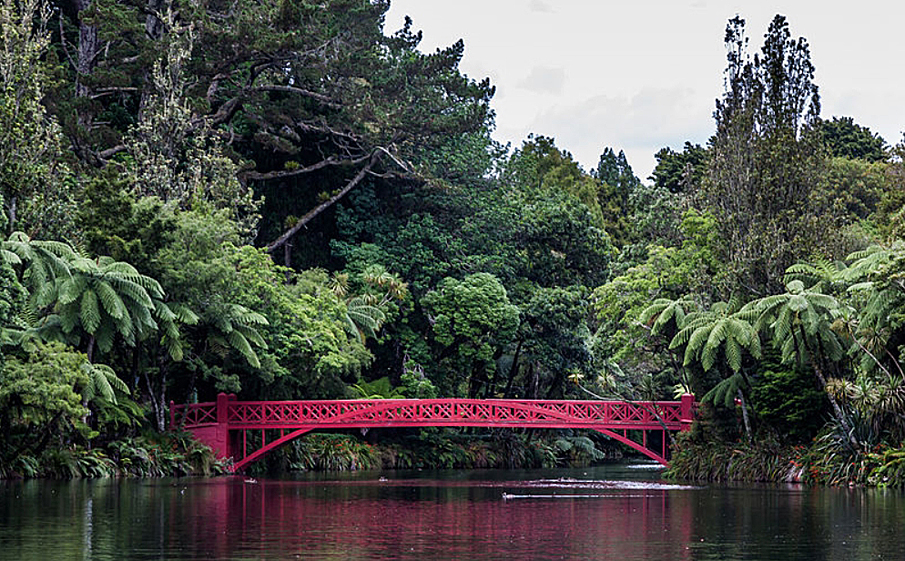
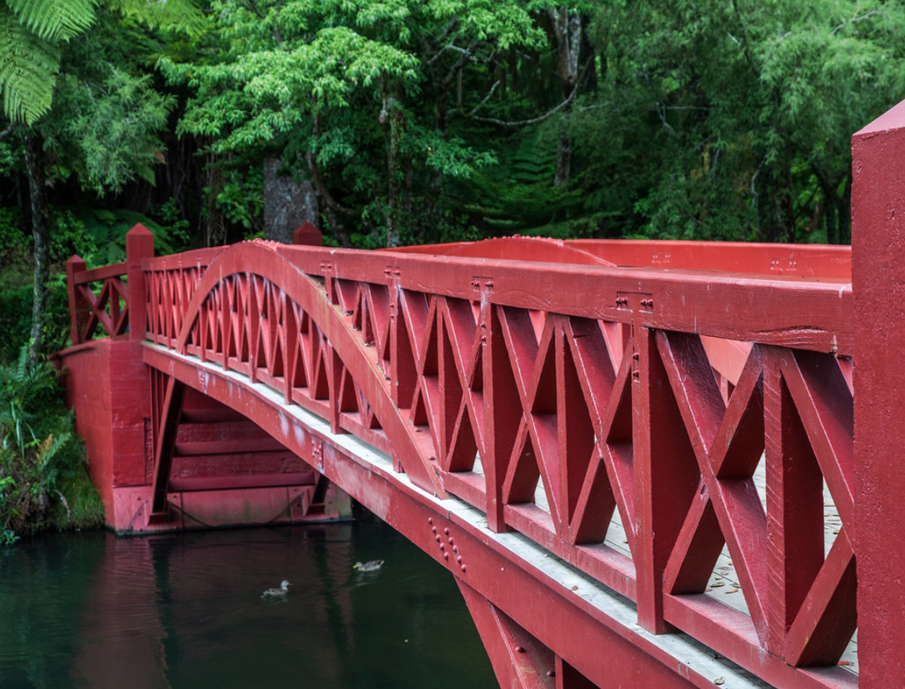
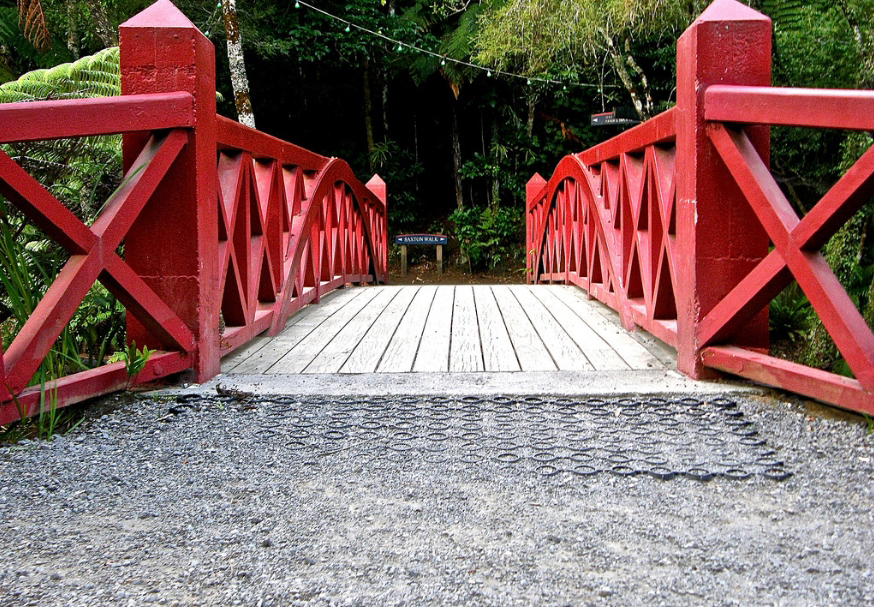
This historic place was registered under the Historic Places Act 1993. The following text is from the original Recommendation for Classification report considered by the NZHPT Board at the time of registration. Aesthetic: The Poet's Bridge is situated across the boating lake at Pukekura Park. It can be viewed from a distance or appreciated at close range and is still in use as a pedestrian bridge. It has native bush surrounds and stands out as a result of its bright red colour which is said to have been inspired by the red lacquer bridge at NIkko, Japan (K Prichard). Architectural: The Poet's Bridge was designed by H YD. Barclay, an engineer, and opened on 11 March 1884. By 1937 the bridge had deteriorated to such an extent that rebuilding was necessary. The replica displays an ethical integrity because it can be distinguished as a new piece of work. It does not pretend to be the original bridge. It is unclear how much of the original fabric still remains. Technological: The bridge appears well-designed, well-constructed and has survived nearly 60 years of use.
Why is this place Category 1 / Category 2?
Detail Of Assessed Criteria
This historic place was registered under the Historic Places Act 1993. The following text is from the original Recommendation for Classification report considered by the NZHPT Board at the time of registration. a) the extent to which the place reflects important or representative aspects of New Zealand history: b) the association of the place with events, persons, or ideas of importance in New Zealand history: c) the potential of the place to provide knowledge of New Zealand history: The Poet's Bridge was first built in 1883 and was financed by a donation made by Mr J T Davis from winnings of £150 from a horse race. The winning horse was named 'The Poet'. The bridge reflects representative aspects of New Zealand history, including transport, public benefaction and public parks. It has the potential to provide knowledge of aspects of New Zealand history, in that the 1937 bridge may contain material recycled from the original. From this maybe gained information on construction techniques and contemporary material. The most important aspect of the bridge is its role as an icon; the bridge has achieved a level of local significance in the popular mind. e) the community association with, or public esteem for, the place: The Poet's Bridge has achieved a level of local significance in the popular mind by virtue of its prominent position in a place of public recreation. On the bridge is a plaque commemorating a gift of public benefaction. g) the technical accomplishment or value, or design of the place: The bridge appears well-designed, well-constructed and has survived nearly 60 years of use. The current replica bridge is thought to follow the construction of the original 1884 bridge. The two arched members have a U-shaped cross-section, built up from two angle irons; girders and bracing are of iron and steel; the decking and balustrades are of timber. Conclusion: The Poet's Bridge, New Plymouth, is recommended for registration as a Category II as a place of historical and cultural heritage significance and value. A gift of public benefaction, the bridge across the boating lake at Pukekura Park has had a prominent position in this public recreational space since 1883. The community's association with this structure, even though replicated in 1937, is still strong. It also has aesthetic appeal.
Why is this place significant?
Cultural Significance
This historic place was registered under the Historic Places Act 1993. The following text is from the original Recommendation for Classification report considered by the NZHPT Board at the time of registration. Cultural/Social: As part of Pukekura Park for over one hundred years the bridge has played a significant part in the recreational life of New Plymouth.
Historic Significance
Historical Significance or Value This historic place was registered under the Historic Places Act 1993. The following text is from the original Recommendation for Classification report considered by the NZHPT Board at the time of registration. Historical: The Poet's Bridge, a gift of public benefaction, has been part of New Plymouth's recreational life since 1883. The replica constructed in 1937 continues this tradition but also has new and valid historical associations of its own.
Physical Significance
This historic place was registered under the Historic Places Act 1993. The following text is from the original Recommendation for Classification report considered by the NZHPT Board at the time of registration. Aesthetic: The Poet's Bridge is situated across the boating lake at Pukekura Park. It can be viewed from a distance or appreciated at close range and is still in use as a pedestrian bridge. It has native bush surrounds and stands out as a result of its bright red colour which is said to have been inspired by the red lacquer bridge at NIkko, Japan (K Prichard). Architectural: The Poet's Bridge was designed by H YD. Barclay, an engineer, and opened on 11 March 1884. By 1937 the bridge had deteriorated to such an extent that rebuilding was necessary. The replica displays an ethical integrity because it can be distinguished as a new piece of work. It does not pretend to be the original bridge. It is unclear how much of the original fabric still remains. Technological: The bridge appears well-designed, well-constructed and has survived nearly 60 years of use.
Why is this place Category 1 / Category 2?
Detail Of Assessed Criteria
This historic place was registered under the Historic Places Act 1993. The following text is from the original Recommendation for Classification report considered by the NZHPT Board at the time of registration. a) the extent to which the place reflects important or representative aspects of New Zealand history: b) the association of the place with events, persons, or ideas of importance in New Zealand history: c) the potential of the place to provide knowledge of New Zealand history: The Poet's Bridge was first built in 1883 and was financed by a donation made by Mr J T Davis from winnings of £150 from a horse race. The winning horse was named 'The Poet'. The bridge reflects representative aspects of New Zealand history, including transport, public benefaction and public parks. It has the potential to provide knowledge of aspects of New Zealand history, in that the 1937 bridge may contain material recycled from the original. From this maybe gained information on construction techniques and contemporary material. The most important aspect of the bridge is its role as an icon; the bridge has achieved a level of local significance in the popular mind. e) the community association with, or public esteem for, the place: The Poet's Bridge has achieved a level of local significance in the popular mind by virtue of its prominent position in a place of public recreation. On the bridge is a plaque commemorating a gift of public benefaction. g) the technical accomplishment or value, or design of the place: The bridge appears well-designed, well-constructed and has survived nearly 60 years of use. The current replica bridge is thought to follow the construction of the original 1884 bridge. The two arched members have a U-shaped cross-section, built up from two angle irons; girders and bracing are of iron and steel; the decking and balustrades are of timber. Conclusion: The Poet's Bridge, New Plymouth, is recommended for registration as a Category II as a place of historical and cultural heritage significance and value. A gift of public benefaction, the bridge across the boating lake at Pukekura Park has had a prominent position in this public recreational space since 1883. The community's association with this structure, even though replicated in 1937, is still strong. It also has aesthetic appeal.
Construction Details
Start Year
1937
Type
Modification
Description
Due to deteriorated state of the bridge it was rebuilt replicating the original
Start Year
1884
Type
Original Construction
Description
Opened 11 March 1884
Construction Details
Start Year
1937
Type
Modification
Description
Due to deteriorated state of the bridge it was rebuilt replicating the original
Start Year
1884
Type
Original Construction
Description
Opened 11 March 1884
Design Engineer: H V D Barclay
Design Engineer: H V D Barclay
Historical and Associated Iwi / Hapū / Whānau
Information Sources
New Zealand Historic Places Trust (NZHPT)
New Zealand Historic Places Trust
Scanlan, 1978
A B Scanlon, Pukekura - A Centennial History of Pukekura Park and Brooklands, New Plymouth (1978)
Other Information
A copy of the original report is available from the NZHPT Central Region office Please note that entry on the New Zealand Heritage List/Rarangi Korero identifies only the heritage values of the property concerned, and should not be construed as advice on the state of the property, or as a comment of its soundness or safety, including in regard to earthquake risk, safety in the event of fire, or insanitary conditions.
Historical and Associated Iwi / Hapū / Whānau
Information Sources
New Zealand Historic Places Trust (NZHPT)
New Zealand Historic Places Trust
Scanlan, 1978
A B Scanlon, Pukekura - A Centennial History of Pukekura Park and Brooklands, New Plymouth (1978)
Other Information
A copy of the original report is available from the NZHPT Central Region office Please note that entry on the New Zealand Heritage List/Rarangi Korero identifies only the heritage values of the property concerned, and should not be construed as advice on the state of the property, or as a comment of its soundness or safety, including in regard to earthquake risk, safety in the event of fire, or insanitary conditions.
Former Usages
General Usage: Transport
Specific Usage: Bridge/ Viaduct
Former Usages
General Usage: Transport
Specific Usage: Bridge/ Viaduct