The Commercial Hotel commenced by Thomas Henderson in 1841 and operating on the site by June 1843, traded under that name until 1959. The current boutique Hotel DeBrett occupies part of two 1842 Crown Grants in former Shortland Crescent. The earliest hotel was destroyed with adjoining timber buildings in 1858, and rebuilt as a three-storey brick structure. Notwithstanding a fire in 1875, the building retained its mid-nineteenth century appearance until 1925 when widening of High Street required the building to be cut back by 3.8 metres.
Re-building of the block described as a series of buildings originally erected for different owners, the floor levels varying, began in May 1925. The new design raised the hotel to three storeys along both frontages, with portions of the old walls carrying the additional weight. Underpinning provided a uniform floor level and new cellar at the building’s southern end. The alterations by W.J. Grevatt and Son were followed in February 1926 by additions including shops. The project was completed by August 1926.
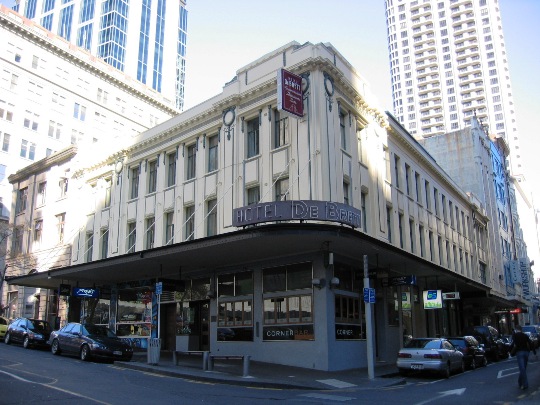
The corner landmark of a Stripped Classical style was designed by noted Auckland architects Wade and Bartley. Access to the public and private bars was from High Street. The upper two floors contained 35 bedrooms, sitting room and bathrooms; and a rear, two-storey section fronting O’Connell Street provided staff accommodation.
Dominion Breweries bought the property in 1953 undertaking modernisations in 1957-9. Sit-down drinking was introduced to Auckland with a trial garden bar, a departure from men standing to drink as they had done since 1917 following the introduction of six o’clock closing in New Zealand hotels. The Commercial also became the first Auckland hotel to have a private bathroom in every bedroom. Above the Garden Bar were the new lounge, dining room and kitchen. An additional floor over the O’Connell Street portion provided staff accommodation. The main entrance was transferred to High Street, where a lift was installed. The guest accommodation re-opened in 1959, catering for 48 in the renamed Hotel De Brett with 24-hour room service. In 1964, the dining room was extended. Women’s toilets were added on the ground floor in 1968 following the end of the six o’clock swill, which allowed more civilised drinking and women to socialise in bars other than the House Bar. In new ownership, the hotel closed for refurbishment in 1983. Re-opened in May 1984, the refurbished hotel had five bars, 25 guest rooms and ground-floor shops. In new ownership again in 2007 the building, a backpackers since 1999, became a boutique hotel and won the heritage category of the Auckland architecture awards in 2009.

List Entry Information
Status
Listed
List Entry Status
Historic Place Category 2
Access
Private/No Public Access
List Number
7264
Date Entered
25th August 1995
Date of Effect
25th August 1995
City/District Council
Auckland Council
Region
Auckland Council
Extent of List Entry
Extent includes the land described as Lot 1 DP 19999 (RT NA78D/164), North Auckland Land District, and the building known as Hotel DeBrett thereon
Legal description
Lot 1 DP 19999 (RT NA78D/164), North Auckland Land District.
Status
Listed
List Entry Status
Historic Place Category 2
Access
Private/No Public Access
List Number
7264
Date Entered
25th August 1995
Date of Effect
25th August 1995
City/District Council
Auckland Council
Region
Auckland Council
Extent of List Entry
Extent includes the land described as Lot 1 DP 19999 (RT NA78D/164), North Auckland Land District, and the building known as Hotel DeBrett thereon
Legal description
Lot 1 DP 19999 (RT NA78D/164), North Auckland Land District.
Why is this place significant?
Cultural Significance
This historic place was registered under the Historic Places Act 1993. The following text is from the original Recommendation for Registration considered by the NZHPT Board at the time of registration. Social/Cultural: Since 1841 the site of the Commercial Hotel and De Bretts has served as a meeting place for the people of Auckland. The continued existence of hotels, such as this one, demonstrates the role that the traditional hotel still plays in New Zealand culture and how as drinking habits and social customs have changed, the hotel has adapted.
Historic Significance
Historical Significance or Value This historic place was registered under the Historic Places Act 1993. The following text is from the original Recommendation for Registration considered by the NZHPT Board at the time of registration. De Bretts Hotel has local historical significance as a central city hotel with a history of 140 years trading on the present site.
Physical Significance
This historic place was registered under the Historic Places Act 1993. The following text is from the original Recommendation for Registration considered by the NZHPT Board at the time of registration. Aesthetic: Much of De Bretts' aesthetic value lies in the way in which the building relates to the adjacent structures which are of a similar age and architectural style. This corner building, with two fine frontages, forms a significant part of the High St/Shortland St streetscape. Architectural: De Bretts, formerly the Commercial Hotel, is a good example of late 1920s hotel architecture in the Stripped Classicism style on the exterior facades. The interior elements are exemplary of both 1920s Art Deco and 1950s-60s Modernism.
Why is this place Category 1 / Category 2?
Detail Of Assessed Criteria
This historic place was registered under the Historic Places Act 1993. The following text is from the original Recommendation for Registration considered by the NZHPT Board at the time of registration. The following comments are made in relation to the criteria identified under S.23(2) of the Historic Places Act 1993. b) The association of the place with events, persons, or ideas of importance in New Zealand history: The first building on the site, the Commercial Hotel, was constructed in 1841. This was destroyed in a fire in 1858 and replaced with a brick structure. Around the end of the late 1920s the brick structure was destroyed by fire and replaced by the present reinforced concrete building. Thomas Henderson, who built the first hotel on site in 1841, was an important businessman in colonial Auckland. His company, Henderson & Macfarlane , dominated the milling and shipping scene in early Auckland. He was a founder of the BNZ and was the first port agent for the Union Steam Ship Co. (his son, Thomas, becoming its first branch manager in 1879). Hotels played a major role in the life of the colony and the developing city. They provided alcohol, beds, entertainment and a place for public meetings. c) The potential of the place to provide knowledge of New Zealand history: De Bretts demonstrates styles and trends in twentieth century hotel architecture. A hotel has occupied the site since the early days of Auckland's European settlement. g) The technical accomplishment or value, or design of the place: The exterior of the De Bretts building is an interesting example of the phase of transition from the highly decorative Classicism to stripped Modernism. In this building, the symbolism of classic structural elements (such as the column, capital and pediment) is present, but in a very stripped back form. The building's two main facades give emphasis to the corner which is set off by the lofty curving steel verandah, with its smooth soffit, which links the two frontages and serves as a contrast to the sharp edge. Commercial Hotel, as it was originally known, is significant in that it was one of the earliest reinforced concrete hotels in Auckland. At a time when the city had a large number of corner pubs, most of which were masonry construction built before the turn of the century, this one was quite unique. The Commercial Hotel closed in 1957 and reopened as Hotel De Brett in 1959. During the two year period that the hotel was closed. extensive interior modifications were made. These modifications were of a high quality and are a significant feature of the hotel's heritage value. Inside the hotel, various original pieces of detail still exist throughout. The inlaid veneer panelling work and Art Deco influenced 'House Bar' date from the 1920s-30s and the entrance-foyer area still retains the atmosphere of a 1950s premiere boutique hotel. A feature of the 1959 foyer is the way in which it relates to the earlier 1926 detailing. The combination of the periods results in a sympathetic clash between the styles, for example, where mosaic meets floorboards and where marble meets veneer panelling. k) The extent to which the place forms part of a wider historical and cultural complex or historical and cultural landscape: The De Bretts Hotel building is an integral element in the grouping of 1920s-30s buildings clustered around the Shortland St/High St/O'Connell St corners. It serves an important function as part of the group, creating the unique urban character of the area. Conclusion: De Bretts Hotel, High St, Auckland, is recommended for registration as a Category II as a place of historical and cultural heritage significance and value. The hotel has formed a focal point for Auckland's social life since 1844 and is an important part of the city's social and cultural fabric. The 1920s style hotel, with 1959 interior features, is set within a group of inter-war buildings that form the aesthetically pleasing High St area.
Why is this place significant?
Cultural Significance
This historic place was registered under the Historic Places Act 1993. The following text is from the original Recommendation for Registration considered by the NZHPT Board at the time of registration. Social/Cultural: Since 1841 the site of the Commercial Hotel and De Bretts has served as a meeting place for the people of Auckland. The continued existence of hotels, such as this one, demonstrates the role that the traditional hotel still plays in New Zealand culture and how as drinking habits and social customs have changed, the hotel has adapted.
Historic Significance
Historical Significance or Value This historic place was registered under the Historic Places Act 1993. The following text is from the original Recommendation for Registration considered by the NZHPT Board at the time of registration. De Bretts Hotel has local historical significance as a central city hotel with a history of 140 years trading on the present site.
Physical Significance
This historic place was registered under the Historic Places Act 1993. The following text is from the original Recommendation for Registration considered by the NZHPT Board at the time of registration. Aesthetic: Much of De Bretts' aesthetic value lies in the way in which the building relates to the adjacent structures which are of a similar age and architectural style. This corner building, with two fine frontages, forms a significant part of the High St/Shortland St streetscape. Architectural: De Bretts, formerly the Commercial Hotel, is a good example of late 1920s hotel architecture in the Stripped Classicism style on the exterior facades. The interior elements are exemplary of both 1920s Art Deco and 1950s-60s Modernism.
Why is this place Category 1 / Category 2?
Detail Of Assessed Criteria
This historic place was registered under the Historic Places Act 1993. The following text is from the original Recommendation for Registration considered by the NZHPT Board at the time of registration. The following comments are made in relation to the criteria identified under S.23(2) of the Historic Places Act 1993. b) The association of the place with events, persons, or ideas of importance in New Zealand history: The first building on the site, the Commercial Hotel, was constructed in 1841. This was destroyed in a fire in 1858 and replaced with a brick structure. Around the end of the late 1920s the brick structure was destroyed by fire and replaced by the present reinforced concrete building. Thomas Henderson, who built the first hotel on site in 1841, was an important businessman in colonial Auckland. His company, Henderson & Macfarlane , dominated the milling and shipping scene in early Auckland. He was a founder of the BNZ and was the first port agent for the Union Steam Ship Co. (his son, Thomas, becoming its first branch manager in 1879). Hotels played a major role in the life of the colony and the developing city. They provided alcohol, beds, entertainment and a place for public meetings. c) The potential of the place to provide knowledge of New Zealand history: De Bretts demonstrates styles and trends in twentieth century hotel architecture. A hotel has occupied the site since the early days of Auckland's European settlement. g) The technical accomplishment or value, or design of the place: The exterior of the De Bretts building is an interesting example of the phase of transition from the highly decorative Classicism to stripped Modernism. In this building, the symbolism of classic structural elements (such as the column, capital and pediment) is present, but in a very stripped back form. The building's two main facades give emphasis to the corner which is set off by the lofty curving steel verandah, with its smooth soffit, which links the two frontages and serves as a contrast to the sharp edge. Commercial Hotel, as it was originally known, is significant in that it was one of the earliest reinforced concrete hotels in Auckland. At a time when the city had a large number of corner pubs, most of which were masonry construction built before the turn of the century, this one was quite unique. The Commercial Hotel closed in 1957 and reopened as Hotel De Brett in 1959. During the two year period that the hotel was closed. extensive interior modifications were made. These modifications were of a high quality and are a significant feature of the hotel's heritage value. Inside the hotel, various original pieces of detail still exist throughout. The inlaid veneer panelling work and Art Deco influenced 'House Bar' date from the 1920s-30s and the entrance-foyer area still retains the atmosphere of a 1950s premiere boutique hotel. A feature of the 1959 foyer is the way in which it relates to the earlier 1926 detailing. The combination of the periods results in a sympathetic clash between the styles, for example, where mosaic meets floorboards and where marble meets veneer panelling. k) The extent to which the place forms part of a wider historical and cultural complex or historical and cultural landscape: The De Bretts Hotel building is an integral element in the grouping of 1920s-30s buildings clustered around the Shortland St/High St/O'Connell St corners. It serves an important function as part of the group, creating the unique urban character of the area. Conclusion: De Bretts Hotel, High St, Auckland, is recommended for registration as a Category II as a place of historical and cultural heritage significance and value. The hotel has formed a focal point for Auckland's social life since 1844 and is an important part of the city's social and cultural fabric. The 1920s style hotel, with 1959 interior features, is set within a group of inter-war buildings that form the aesthetically pleasing High St area.
Construction Professional
Name
Bartley & Wade
Type
Architectural Partnership
Biography
Alva Bartley was the son of Edward Bartley, a prominent Auckland architect. He trained in his father's office until he enlisted for military service. After the war he remained in London to study at the Architectural Association. He also became an Associate of the Royal Institute of British Architects. Wade and Bartley established a partnership about 1920 and it lasted until the late 1930s. Their major works include the Public Library and Borough Council offices, Dargaville (1922), the Commercial Hotel (now De Bretts, 1927), A and G Price Ltd, Quay Street (1927), Pascoes Jewellers, Karangahape Road, the former Auckland Electric Power Board building (1930) and the 1YA Studio building (now Television New Zealand, 1934), all in Auckland.
Name
W.J. Grevatt and Son
Type
Builder
Biography
No biography is currently available for this construction professional
Name
Noel Cole
Type
Builder
Biography
No biography is currently available for this construction professional
Name
Mitchinson, Simiona and Gasgoigne Associates
Type
Architectural Partnership
Biography
No biography is currently available for this construction professional
Construction Details
Start Year
1926
Type
Original Construction
Type
Original Construction
Description
Hotel, two-storey timber building on this site
Period
c.1841-3
Start Year
1858
Type
Demolished - Fire
Start Year
1860
startYearCirca
Type
Original Construction
Description
Hotel, three-storey brick
Start Year
1875
Type
Modification
Description
Possible fire damage
Start Year
1925
Type
Modification
Description
Building cut back 3.8m along High Street, extensive alterations incorporating adjoining building(s).
Start Year
1926
Type
Addition
Description
at Shortland, High, O’Connell Streets
Type
Modification
Description
Interior, and strengthening to take additions.
Period
1957-9
Start Year
1964
Type
Modification
Description
Dining room extended (first floor).
Start Year
1968
Type
Modification
Description
Female toilets provided (ground floor).
Start Year
1983
Type
Refurbishment/renovation
Start Year
2007
Type
Refurbishment/renovation
Description
Refurbishment; ground floor retail; service court converted to roofed atrium.
Construction Professional
Name
Bartley & Wade
Type
Architectural Partnership
Biography
Alva Bartley was the son of Edward Bartley, a prominent Auckland architect. He trained in his father's office until he enlisted for military service. After the war he remained in London to study at the Architectural Association. He also became an Associate of the Royal Institute of British Architects. Wade and Bartley established a partnership about 1920 and it lasted until the late 1930s. Their major works include the Public Library and Borough Council offices, Dargaville (1922), the Commercial Hotel (now De Bretts, 1927), A and G Price Ltd, Quay Street (1927), Pascoes Jewellers, Karangahape Road, the former Auckland Electric Power Board building (1930) and the 1YA Studio building (now Television New Zealand, 1934), all in Auckland.
Name
W.J. Grevatt and Son
Type
Builder
Biography
No biography is currently available for this construction professional
Name
Noel Cole
Type
Builder
Biography
No biography is currently available for this construction professional
Name
Mitchinson, Simiona and Gasgoigne Associates
Type
Architectural Partnership
Biography
No biography is currently available for this construction professional
Construction Details
Start Year
1926
Type
Original Construction
Type
Original Construction
Description
Hotel, two-storey timber building on this site
Period
c.1841-3
Start Year
1858
Type
Demolished - Fire
Start Year
1860
startYearCirca
Type
Original Construction
Description
Hotel, three-storey brick
Start Year
1875
Type
Modification
Description
Possible fire damage
Start Year
1925
Type
Modification
Description
Building cut back 3.8m along High Street, extensive alterations incorporating adjoining building(s).
Start Year
1926
Type
Addition
Description
at Shortland, High, O’Connell Streets
Type
Modification
Description
Interior, and strengthening to take additions.
Period
1957-9
Start Year
1964
Type
Modification
Description
Dining room extended (first floor).
Start Year
1968
Type
Modification
Description
Female toilets provided (ground floor).
Start Year
1983
Type
Refurbishment/renovation
Start Year
2007
Type
Refurbishment/renovation
Description
Refurbishment; ground floor retail; service court converted to roofed atrium.
Historical and Associated Iwi / Hapū / Whānau
Completion Date
30th June 2015
Report Written By
Joan McKenzie
Information Sources
New Zealand Historic Places Trust (NZHPT)
New Zealand Historic Places Trust
New Zealand Herald
11 Nov 1903, p.6.
Other Information
A copy of the original report is available from the NZHPT Northern region office Please note that entry on the New Zealand Heritage List/Rarangi Korero identifies only the heritage values of the property concerned, and should not be construed as advice on the state of the property, or as a comment of its soundness or safety, including in regard to earthquake risk, safety in the event of fire, or insanitary conditions. A fully referenced upgrade report is available on request from the Northern Region Office of Heritage New Zealand
Historical and Associated Iwi / Hapū / Whānau
Completion Date
30th June 2015
Report Written By
Joan McKenzie
Information Sources
New Zealand Historic Places Trust (NZHPT)
New Zealand Historic Places Trust
New Zealand Herald
11 Nov 1903, p.6.
Other Information
A copy of the original report is available from the NZHPT Northern region office Please note that entry on the New Zealand Heritage List/Rarangi Korero identifies only the heritage values of the property concerned, and should not be construed as advice on the state of the property, or as a comment of its soundness or safety, including in regard to earthquake risk, safety in the event of fire, or insanitary conditions. A fully referenced upgrade report is available on request from the Northern Region Office of Heritage New Zealand
Current Usages
Uses: Trade
Specific Usage: Pub/bar/tavern/public hotel
Uses: Trade
Specific Usage: Shop
Former Usages
General Usage: Accommodation
Specific Usage: Backpackers/ Youth Hostel
General Usage: Accommodation
Specific Usage: Boarding/ Guest House
Current Usages
Uses: Trade
Specific Usage: Pub/bar/tavern/public hotel
Uses: Trade
Specific Usage: Shop
Former Usages
General Usage: Accommodation
Specific Usage: Backpackers/ Youth Hostel
General Usage: Accommodation
Specific Usage: Boarding/ Guest House
Location
Sign up to hear more
Get the latest heritage news, features and events delivered
straight to your inbox.

