

List Entry Information
Status
Listed
List Entry Status
Historic Place Category 2
Access
Private/No Public Access
List Number
7279
Date Entered
14th December 1995
Date of Effect
14th December 1995
City/District Council
Hurunui District
Region
Canterbury Region
Extent of List Entry
Extent includes the land described as Lot 3 DP 76896 (RT CB44A/1123, NZ Gazette 2007 p.1642), Canterbury Land District and the building known as Ashley County Council Offices (Former) thereon.
Legal description
Lot 3 DP 76896 (RT CB44A/1123, NZ Gazette 2007 p.1642), Canterbury Land District
Status
Listed
List Entry Status
Historic Place Category 2
Access
Private/No Public Access
List Number
7279
Date Entered
14th December 1995
Date of Effect
14th December 1995
City/District Council
Hurunui District
Region
Canterbury Region
Extent of List Entry
Extent includes the land described as Lot 3 DP 76896 (RT CB44A/1123, NZ Gazette 2007 p.1642), Canterbury Land District and the building known as Ashley County Council Offices (Former) thereon.
Legal description
Lot 3 DP 76896 (RT CB44A/1123, NZ Gazette 2007 p.1642), Canterbury Land District
Why is this place significant?
Cultural Significance
This historic place was registered under the Historic Places Act 1993. The following text is from the original Recommendation for Registration considered by the NZHPT Board at the time of registration. Social/Cultural: Despite the buildings change of use in recent years, it still has a prominent role in the life of this small rural community. It is particularly significant as the community's war memorial.
Historic Significance
Historical Significance or Value This historic place was registered under the Historic Places Act 1993. The following text is from the original Recommendation for Registration considered by the NZHPT Board at the time of registration. The former offices of the Ashley County Council have historical significance because of their importance to the history of the local government of the area and for their role as a civic memorial to local servicemen during the First World War.
Physical Significance
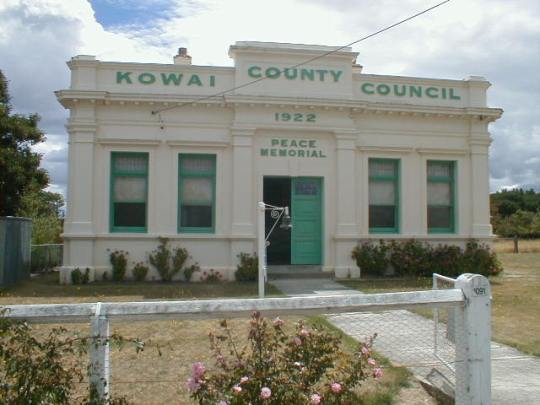
This historic place was registered under the Historic Places Act 1993. The following text is from the original Recommendation for Registration considered by the NZHPT Board at the time of registration. Aesthetic: This building with its Stripped Classical facade and rural setting has aesthetic appeal. Architectural: The former Ashley County Council building, erected in 1922, is an example of inter-war Stripped Classical architecture on its main facade, and early functional modernism in terms of the plain brick and plaster construction of the building (rear and side elevations). The interior design of the place represents a limited application of an Arts & Crafts aesthetic to a public building in the form of timber dados, window frames and fireplace surrounds.
Why is this place Category 1 / Category 2?
Detail Of Assessed Criteria
This historic place was registered under the Historic Places Act 1993. The following text is from the original Recommendation for Registration considered by the NZHPT Board at the time of registration. The following comments are made in relation to the criteria identified under S.23(2) of the Historic Places Act 1993. a) The extent to which the place reflects important or representative aspects of New Zealand history: The building has always played a prominent role in the public life of the Ashley area, first as a seat of local government and more recently, first for storage and now as a repository for local archives and other historical records. c) The potential of the place to provide knowledge of New Zealand history: The former County Council Offices building serves as a memorial to both the servicemen and women of the two world wars and the changing nature of local government representation in the area. The fact that the new District Council allowed the local historical society to use the building for the storage of local archives, means that this historic place will play an important role in the provision of knowledge of local history. e) The community association with, or public esteem for, the place: The local community has always been closely associated with this building, firstly, as the local body facility and in its present form as archival storage space for the local historical society. f) The potential of the place for public education: This building is representative of the former County Council system and the previous territorial authority boundaries. g) The technical accomplishment or value, or design of the place: The former Ashley County Council Office building is an example of inter-war Stripped Classical architecture. Classical features on the exterior facade of this building tend to override functional expression. The main facade is a classical false front whereas the real structure of the building is of plain cavity brick, concrete plastered walls on the side and at the rear. Interior features of the building follow the same inter-war style with classical details evident in the patterned ceilings with plaster mouldings, and in the marble memorials to both World Wars. Timber window architraves and wall dados reflect an Arts & Crafts influence. The building was designed by prominent Christchurch architects, the England Brothers. Conclusion: The former Ashley County Council Offices, is recommended for registration as a Category II as a place of historical and cultural heritage significance and value. The former Ashley County Council Offices is a typical example of a public building of its period. Designed by prominent Christchurch architects, the England Brothers, the building is aesthetically pleasing and is historically significant as county council offices and serves as an important local war memorial
Why is this place significant?
Cultural Significance
This historic place was registered under the Historic Places Act 1993. The following text is from the original Recommendation for Registration considered by the NZHPT Board at the time of registration. Social/Cultural: Despite the buildings change of use in recent years, it still has a prominent role in the life of this small rural community. It is particularly significant as the community's war memorial.
Historic Significance
Historical Significance or Value This historic place was registered under the Historic Places Act 1993. The following text is from the original Recommendation for Registration considered by the NZHPT Board at the time of registration. The former offices of the Ashley County Council have historical significance because of their importance to the history of the local government of the area and for their role as a civic memorial to local servicemen during the First World War.
Physical Significance
This historic place was registered under the Historic Places Act 1993. The following text is from the original Recommendation for Registration considered by the NZHPT Board at the time of registration. Aesthetic: This building with its Stripped Classical facade and rural setting has aesthetic appeal. Architectural: The former Ashley County Council building, erected in 1922, is an example of inter-war Stripped Classical architecture on its main facade, and early functional modernism in terms of the plain brick and plaster construction of the building (rear and side elevations). The interior design of the place represents a limited application of an Arts & Crafts aesthetic to a public building in the form of timber dados, window frames and fireplace surrounds.
Why is this place Category 1 / Category 2?
Detail Of Assessed Criteria
This historic place was registered under the Historic Places Act 1993. The following text is from the original Recommendation for Registration considered by the NZHPT Board at the time of registration. The following comments are made in relation to the criteria identified under S.23(2) of the Historic Places Act 1993. a) The extent to which the place reflects important or representative aspects of New Zealand history: The building has always played a prominent role in the public life of the Ashley area, first as a seat of local government and more recently, first for storage and now as a repository for local archives and other historical records. c) The potential of the place to provide knowledge of New Zealand history: The former County Council Offices building serves as a memorial to both the servicemen and women of the two world wars and the changing nature of local government representation in the area. The fact that the new District Council allowed the local historical society to use the building for the storage of local archives, means that this historic place will play an important role in the provision of knowledge of local history. e) The community association with, or public esteem for, the place: The local community has always been closely associated with this building, firstly, as the local body facility and in its present form as archival storage space for the local historical society. f) The potential of the place for public education: This building is representative of the former County Council system and the previous territorial authority boundaries. g) The technical accomplishment or value, or design of the place: The former Ashley County Council Office building is an example of inter-war Stripped Classical architecture. Classical features on the exterior facade of this building tend to override functional expression. The main facade is a classical false front whereas the real structure of the building is of plain cavity brick, concrete plastered walls on the side and at the rear. Interior features of the building follow the same inter-war style with classical details evident in the patterned ceilings with plaster mouldings, and in the marble memorials to both World Wars. Timber window architraves and wall dados reflect an Arts & Crafts influence. The building was designed by prominent Christchurch architects, the England Brothers. Conclusion: The former Ashley County Council Offices, is recommended for registration as a Category II as a place of historical and cultural heritage significance and value. The former Ashley County Council Offices is a typical example of a public building of its period. Designed by prominent Christchurch architects, the England Brothers, the building is aesthetically pleasing and is historically significant as county council offices and serves as an important local war memorial
Construction Details
Start Year
1922
Type
Original Construction
Construction Details
Start Year
1922
Type
Original Construction
Historical and Associated Iwi / Hapū / Whānau
Information Sources
New Zealand Historic Places Trust (NZHPT)
New Zealand Historic Places Trust
Other Information
A copy of the original report is available from the NZHPT Southern region office Please note that entry on the New Zealand Heritage List/Rarangi Korero identifies only the heritage values of the property concerned, and should not be construed as advice on the state of the property, or as a comment of its soundness or safety, including in regard to earthquake risk, safety in the event of fire, or insanitary conditions.
Historical and Associated Iwi / Hapū / Whānau
Information Sources
New Zealand Historic Places Trust (NZHPT)
New Zealand Historic Places Trust
Other Information
A copy of the original report is available from the NZHPT Southern region office Please note that entry on the New Zealand Heritage List/Rarangi Korero identifies only the heritage values of the property concerned, and should not be construed as advice on the state of the property, or as a comment of its soundness or safety, including in regard to earthquake risk, safety in the event of fire, or insanitary conditions.
Former Usages
General Usage: Government
Specific Usage: Council/local government building
Former Usages
General Usage: Government
Specific Usage: Council/local government building
Location
Stay up to date with Heritage this month
