Quick links


Quick links
Quick links
Quick links
Quick links
Quick links
2 Worcester Street, 25 Hereford Street, 39 Hereford Street, 30 Worcester Street, 40 Worcester Street, CHRISTCHURCH
Public
Historic Place Category 1
List No. 7301
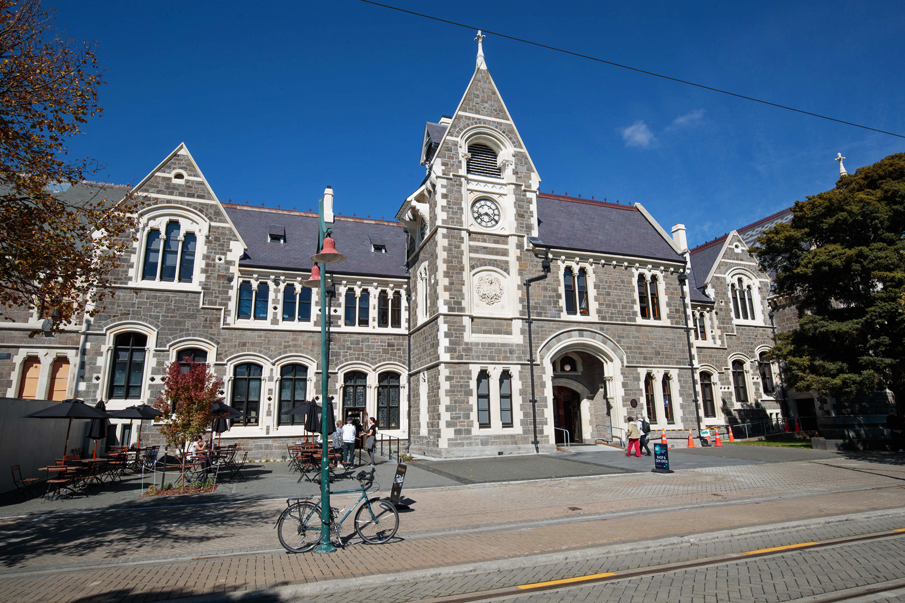
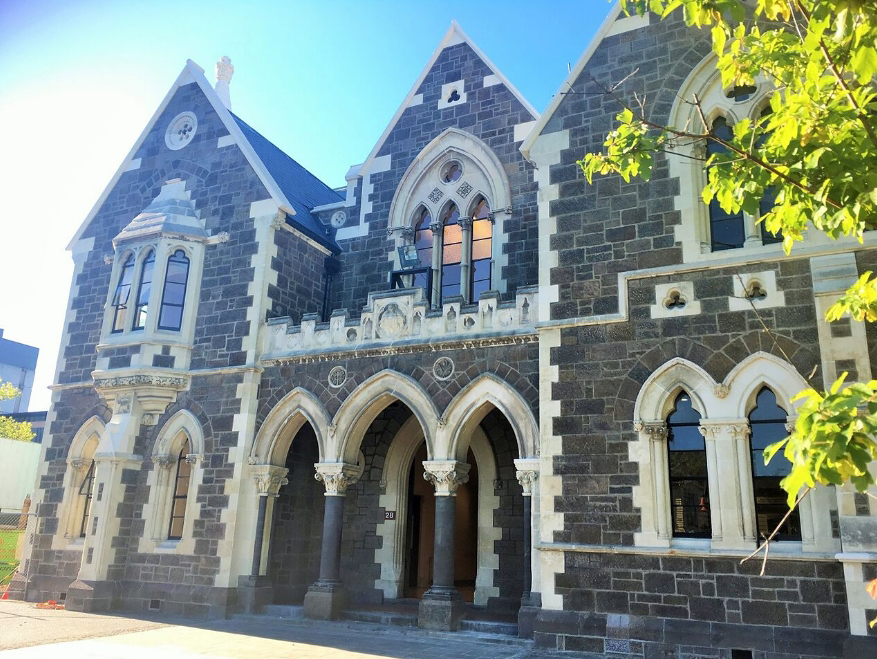
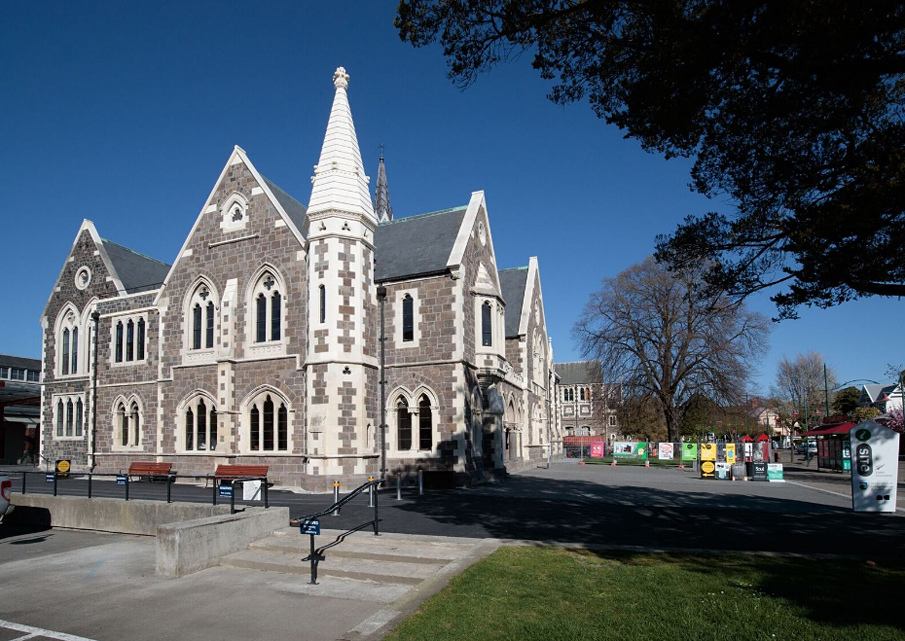
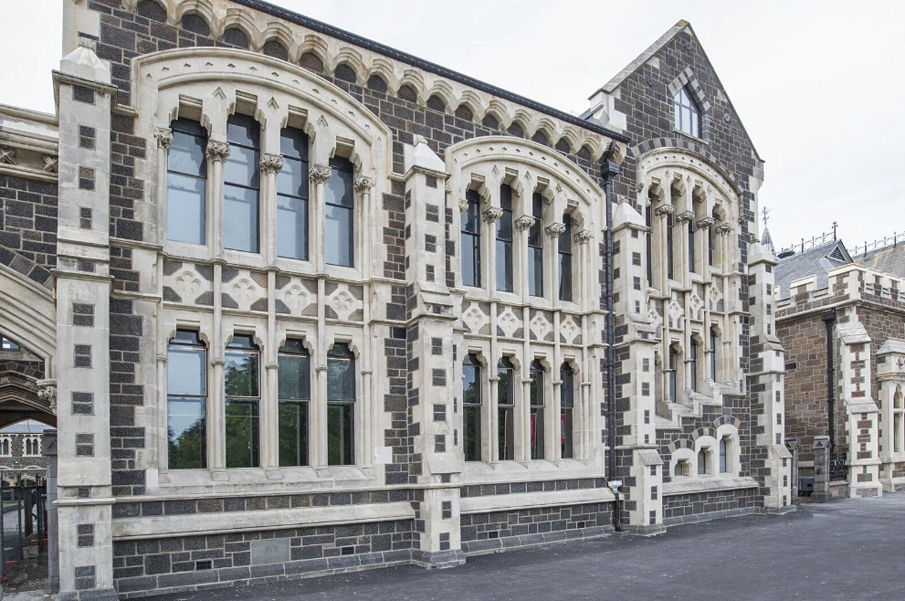
List Entry Information
Status
Listed
List Entry Status
Historic Place Category 1
Access
Able to Visit
List Number
7301
Date Entered
15th February 1990
Date of Effect
7th September 2025
City/District Council
Christchurch City
Region
Canterbury Region
Extent of List Entry
Extent includes the land described as Lots 1, 3, 4, 6 DP 435041 and Lots 1-2 DP 470290 (RTs 531681, 531683, 531684, 531686, 635090, 635091), Canterbury Land District and the building complex known as Te Matatiki Toi Ora The Arts Centre thereon, and the following chattel: Lectern. The modern Workshop and Registry Addition buildings are excluded from the Extent.
Legal description
Lots 1, 3, 4, 6 DP 435041 and Lots 1-2 DP 470290 (RTs 531681, 531683, 531684, 531686, 635090, 635091), Canterbury Land District
Location Description
The site is the block bounded by Worcester Street, Rolleston Avenue, Hereford Street and Montreal Street, Christchurch
Status
Listed
List Entry Status
Historic Place Category 1
Access
Able to Visit
List Number
7301
Date Entered
15th February 1990
Date of Effect
7th September 2025
City/District Council
Christchurch City
Region
Canterbury Region
Extent of List Entry
Extent includes the land described as Lots 1, 3, 4, 6 DP 435041 and Lots 1-2 DP 470290 (RTs 531681, 531683, 531684, 531686, 635090, 635091), Canterbury Land District and the building complex known as Te Matatiki Toi Ora The Arts Centre thereon, and the following chattel: Lectern. The modern Workshop and Registry Addition buildings are excluded from the Extent.
Legal description
Lots 1, 3, 4, 6 DP 435041 and Lots 1-2 DP 470290 (RTs 531681, 531683, 531684, 531686, 635090, 635091), Canterbury Land District
Location Description
The site is the block bounded by Worcester Street, Rolleston Avenue, Hereford Street and Montreal Street, Christchurch
Why is this place significant?
Cultural Significance
Cultural Significance or Value Te Matatiki Toi Ora The Arts Centre has especially high cultural significance. It has been identified as world-class, one of 15 global sites featured in the 2021 publication, ‘World Culture Districts: Spaces of the 21st century’. The name Te Matatiki Toi Ora – meaning ‘the spring of living art’ – was gifted to The Arts Centre by mana whenua, Te Rūnanga o Ngāi Tūāhuriri, during the post-quakes restoration of the site, in recognition of pre-colonial matatiki (springs) in the vicinity and acknowledging that matatiki are bearers of knowledge and wellbeing. Te Rūnanga o Ngāi Tūāhūriri hold value in the site in its potential to bring their wider stories back to the surface in a colonial setting. A Māori Advisory Committee at Te Matatiki Toi Ora The Arts Centre also recognises the site’s potential to tell the stories of Matariki and Puaka, and bicultural layers of history, technology, science, arts and creative industry. The site has enduring cultural significance as a place of higher learning, one which when first established in the nineteenth century reflected the British beliefs, values and vision of the province’s colonial settlers, the Canterbury Association, and which matured over time as the country developed. Historical educational achievements attained at the site continue to be recognised and celebrated long after the university formally vacated the site in the 1970s. Academic cultural connections that can be experienced include Rutherford’s Den permanent interactive exhibition space and at the Observatory, as well as through the 2017 return of the University of Canterbury teaching and recital spaces for Music and Classics students, as well as the Teece Museum of Classical Antiquities, in the former Chemistry Building. Graduation processions still begin here before the ceremonial march to the Christchurch Town Hall. Since being gifted to the people of Christchurch in the 1970s, The Arts Centre has inspired generations of creatives and visitors. The Arts Centre of Christchurch Trust Act 2015 recognises its national role, mandating the site be held as a unique and outstanding cultural centre. The Act outlines two core responsibilities: to protect the heritage buildings and to foster and encourage arts, culture, heritage, education and creativity. Nowhere else in the country is an entire city block of heritage buildings held in trust for public benefit in this way. Artists and performers across Aotearoa have long described The Arts Centre as a formative to their creative journeys. Creatives who have held residencies or studio space there frequently speak of the site’s community-driven atmosphere. It has fostered connection and experimentation across literature, visual arts, theatre and performance. From the studios of sculptors like Neil Dawson, Bing Dawe and Graham Bennett, to printmakers like Barry Cleavin and Jule Einhorn, to Māori carving and tā moko practitioners, Riki and Tony Manuel, The Arts Centre has nurtured a community of visual and multi-disciplinary artists who acknowledge the site’s inspirational environment and opportunities for public engagement. Much-loved institutions such as The Court Theatre, Academy Cinema, Southern Ballet, Free Theatre, the Christchurch School of Music and the Dux de Lux – all early and long-standing anchor tenants at The Arts Centre, until the Canterbury Earthquakes of 2010-2011 – provided launchpads for the careers of many well-known New Zealand performers. Dux de Lux was especially steeped in Kiwi musical lore as a much-loved venue for numerous notable and new bands including Anika Moa, Pop Mechanix, The Bats, Fat Freddy’s Drop, Shapeshifter, Dance Exponents, Graham Brazier and Laurence Arabia. For many years the Dux was also home to Pacific Underground, the groundbreaking performing arts collective that nurtured talents such as Oscar Kightley, David Fane, and Shimpal Lelisi - key figures in Naked Samoans and creators of Bro'Town, alongside musicians like Ladi6, Dallas Tamaira (Fat Freddy’s Drop), and Scribe. The Great Hall has welcomed acclaimed artists ranging from pianist Maurice Till and violinist Fiona Pears, and singer Ali Harper through the popular Lunchtime Concerts series, and a packed audience for Maisey Rika in Matariki 2023. The Arts Centre continues to evolve. With over 70 organisations as tenants, the site is alive with dance, music, Māori art, galleries, art-house cinema, tattoo, theatre, writing, retail and hospitality and more. Major festivals held at the site include annual Sculpture Festival, Matariki celebrations, and the International Buskers Festival. Regular school holiday programmes, workshops and a weekend market near the former Registry Building keep the place vibrant and connected to the community. Social Significance or Value As a place that brings people together and is important to existing communities, Te Matatiki Toi Ora The Arts Centre has exceptionally high social significance. Gifted to the people of Christchurch, and now with an intergenerational sense of shared ownership, it is the special nature of the place, with diverse uses, spaces and interactions, that provide countless opportunities for people to form bonds with each other. The tradition of accessibility, including weekend and pop-up markets, has meant a strong relationship has formed over a long time between The Arts Centre and the Christchurch community and its visitors. In all aspects and at all phases of The Arts Centre’s development - including its very many challenges – the collaboration of people is at its core. The history, beauty and social connection of the former educational site was the reason arts and heritage communities agitated for its protection and adaptive reuse as a centralised creative hub. The feasibility plan for an arts centre, developed in 1974 by a driven group of Christchurch talents, brought about a huge groundswell of public feeling in support. Under the charismatic directorship of Christopher Doig, from the mid-1980s, an even broader community became involved with The Arts Centre. Continuing evidence of the exceptional social value of the place was seen in 2024 when some 4,100 submissions were received on the Christchurch City Council’s long term plan urging funding allocation for such a vital community asset. An accoladed New Zealand tourist attraction, some one million locals and visitors enter the complex every year to attend a diverse range of events from kapa haka to opera, from Sculpture and Matariki Festivals to children’s theatre and circus arts. It's a place for regular informal meetups with friends, a place to dine, browse or relax. The site has an established history of creative residencies and its also a popular location for school education programmes. Now, with the inclusion of a boutique hotel with the post-quake rebuild of the Observatory building, more and more visitors are experiencing short-term stays at the complex.
Historic Significance
Historical Significance or Value Te Matatiki Toi Ora The Arts Centre has especially high historical significance for the role it has played in the educational history of New Zealand and its subsequent history as this country’s flagship arts centre. Canterbury College was one of the earliest tertiary education providers in New Zealand and its establishment in 1873 was pivotal in academic development. It had the country’s first permanent building designed specifically for university purposes (the Clock Tower Building, 1877) as well as the city’s first public high schools (Christchurch Girls’ High School, 1878 and Christchurch Boys’ High School, 1879-1881), all governed by the Canterbury College Board. The Registry Building of 1916 was the first purpose-built registry in New Zealand, serving as the university’s administrative centre for sixty years. The university, now known as Te Whare Wānanga o Waitaha/University of Canterbury, has gone on to become one of New Zealand’s premier higher education institutions. It is directly associated with historically significant alumni and faculty, including Ernest Rutherford, Sir Āpirana Ngata, and lecturer Karl Popper. Numerous major developments in the arts and sciences have taken place within the buildings. The Canterbury College School of Art, established in the former Christchurch Girls’ High Building from 1882, was the place of study for many important New Zealand artists. The inclusion of an engineering school at the university site came about through advocacy by local businesses for technical training and a more general desire to have specialist and practical education at the university. Community engagement was a key part of the College's identity. One notable symbol of this connection was the Observatory which was made available as a public scientific resource. Canterbury College also embraced public education through initiatives like Professor Bickerton’s popular science lectures and support for the Workers’ Educational Association (W.E.A.), founded in Christchurch in 1915. James Shelley, a passionate advocate for public culture and the arts, led both the College's extension work and the W.E.A. Following the departure of the university to its new site in Ilam in the mid-1970s, and the site’s reinvention as an arts centre, the tenancies in the buildings have been evolving. At the outset, it hosted practical health, wellbeing and environmental related organisations. Primarily, however, it has been host to creative tenants with strong historical connection to Christchurch. Until the disruption of the Canterbury Earthquakes of 2010-2011, many of these tenants had become long-standing institutions synonymous with the place - The Court Theatre, Southern Ballet, Academy Cinema, Christchurch School of Music, and Riki Manuel’s Māori arts workshop gallery and tā moko studio.
Physical Significance
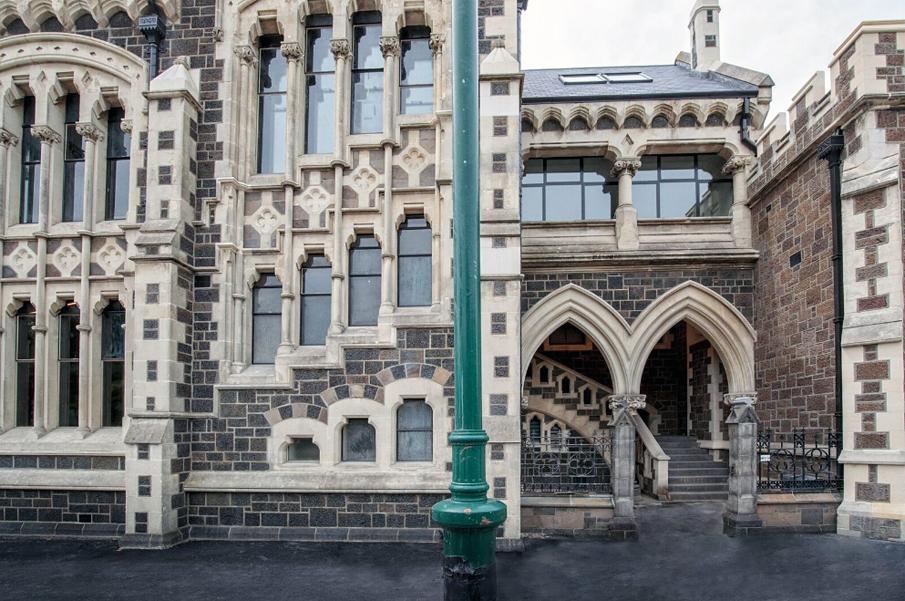
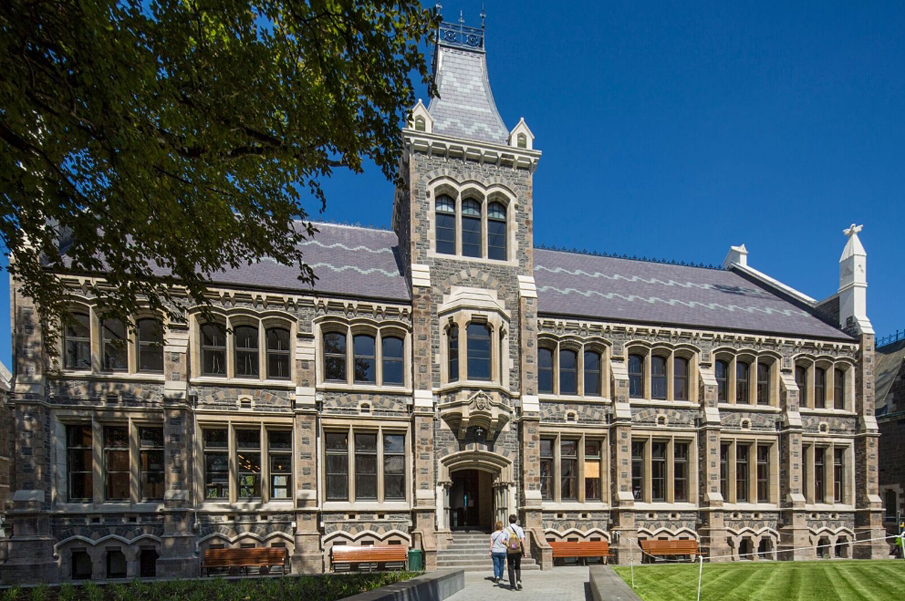
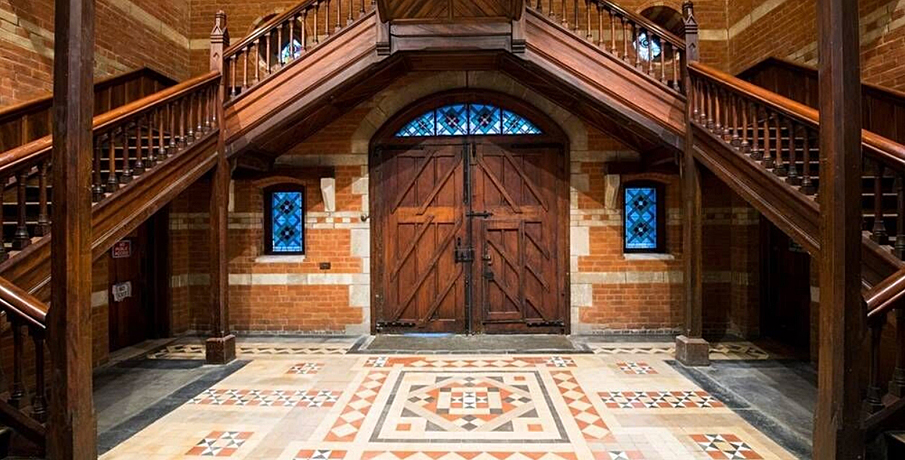
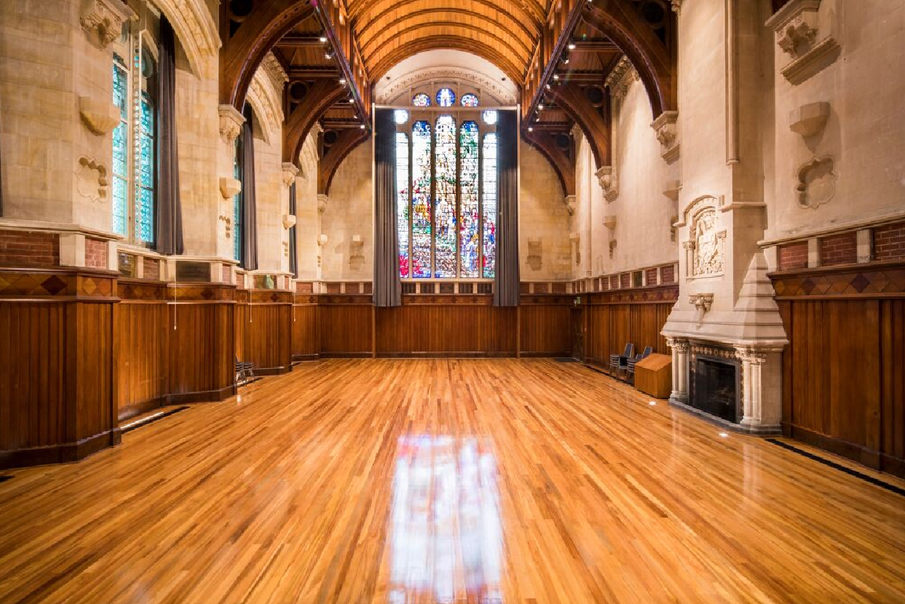
Aesthetic Significance or Value Te Matatiki Toi Ora The Arts Centre has especially strong aesthetic qualities that appeal to the senses and evoke emotional responses. The buildings’ materials and display of superb craftsmanship has high visual and tactile appeal, the very choice of style harking back to medieval architecture of faraway Europe. Small differences in detail in each building phase provide interest, yet the entire complex provides a visually pleasing overall sense of cohesiveness. With its layout and quadrangles, the place is evocative of the cloistered colleges of Oxford and Cambridge, a deliberate link to religious and education ideals of the English colleges of the founders of the Canterbury Association. These elements evoke a range of emotional responses, for many an appreciation of colonial architectural endeavours and educational efforts, but for some also a feeling of how elitist that had been, since not everyone was included in this privileged world. There is recognition, too, that feelings are not either one or another. As Juanita Hepi points out, while the architecture is Pākehā, her Māori ancestors would have had an admiration for the craftsmanship of the buildings. The design and architecture of the place elicits a feeling that the place is special and therefore people react differently when they enter the site. While various parts of the complex evoke all manner of emotions for their original educational and subsequent functions, the College Hall (Great Hall) can be singled out for having a special set of aesthetic qualities. With its scale and stunning architectural interior, including a remarkable ridge-and- furrow hammerbeam ceiling and memorial stained-glass window, the space holds memories for people as a special place of gathering – whether it be for school and university examinations, conferral of degrees, weddings, shows, presentations, recitals, or public meetings. The buildings themselves are the subject of art, film sets and photography. At times, the buildings are integral to performance, as was experienced in Free Theatre’s production of Orwell’s 1984, where interrogated audiences were made to climb up an exterior staircase on Rolleston Avenue and into the performance space. As a centre for creativity, performance, visitation and hospitality, the place provides sights, sounds, smells, feel and taste that create a sense of place. These qualities are demonstrably valued by both existing communities directly associated with the place and a broad public, to the extent that they would be expected to experience a profound sense of loss if these aesthetic values were no longer there. Archaeological Significance or Value Te Matatiki Toi Ora The Arts Centre has archaeological value, since it provides, or is demonstrably likely to provide, physical evidence of human activity that could be investigated through archaeological methods. As this city block is understood to have fallen within part of the much larger Pā known as Pūāri, which was still in occasional use in the 1860s, there is potential for the place to provide further evidence about this Ngāi Tūāhuriri Pā. The subsequent nineteenth century colonial development of Canterbury College, including Christchurch’s first two public high schools and other residences on the city block site, means there is archaeological potential for both the land and standing buildings to provide insight into those involved in its construction or who occupied and adapted the place over time. Occasional archaeological monitoring and investigations carried out over many decades, before, during and following the Canterbury Earthquakes of 2010-2011, have provided archaeological insight. Most of the earthworks monitored have been minor – such as digging new footings for repairing building foundations or trenching for installing new services. As well as revealing foundations and nineteenth century artefact scatter, some items of interest have been uncovered, such as well-preserved paper artefacts and cigarette boxes in the dry cavities between walls and floors of buildings. Archaeological work carried out, in public view, in the North Quad in 2015-2016 found likely foundation remains of the ‘Tin Shed’ – the first science building constructed in Christchurch, built as a ‘temporary’ building for the chemistry department in 1876/1877 and demolished in 1916 – and a rubbish pit filled with scientific glassware. There remains potential for further discovery of physical remains relating to human activity within the entire block that could provide new or additional information about the place that is not otherwise well documented or understood. Architectural Significance or Value Te Matatiki Toi Ora The Arts Centre has especially high architectural significance. As a unified collection of Gothic Revival buildings designed by significant architects - B. W. Mountfort, C. J. Mountfort, T. W. Cane, W. B. Armson, S. H. Seager, and the practice of Collins and Harman - The Arts Centre is an exceptional complex of New Zealand architecture. A close reading of the buildings highlights differences in their design yet together these buildings, with their consistent use of materials and shared design language, create a cohesive architectural ensemble across the central city site. With their characteristic steeply pitched roofs and irregular facades, almost all buildings at the site are broadly considered as excellent examples of the Gothic Revival style. An exception, yet in keeping with the site’s nineteenth century English influences, is the former Students’ Union Building’s Domestic Revival Style, which reflects Collins and Harman’s deliberate intent to follow on a style of that building’s residential origins designed by architect F.W. Petre. The distinct architectural identity lets people know they are somewhere special, and it is this that wraps around all the activities at The Arts Centre, providing a real sense of place. The building scale and layout are key dimensions of its architecture. The complex can be described as monumental, but at a human scale since it was constructed primarily through human labour rather than mechanical labour. Cloistered quadrangles contribute to the special traditional collegiate character. Architectural detail, cleverly used for decorative effect and to create a generally consistent style across the site, adds to the significance. The interiors – both grand and intimate spaces – tell the story of the development of the complex. While modified over time, the complex maintains a high level of architectural integrity and authenticity, and it remains recognisable as the architecture of Anglican colonial Christchurch and its first university site. Technological Significance or Value Te Matatiki Toi Ora The Arts Centre has high technological significance. Its various phases of construction demonstrate accomplished craftsmanship. This is especially the case with respect to stonemasonry, both in initial building and through the early and exemplary approach to renewal, strengthening and repair following the Canterbury Earthquakes of 2010 and 2011. The technological excellence has been recognised internationally. While the meticulous restoration of the Great Hall has received particular acclaim, technologically important stories can be seen through the various seismic solutions used in different buildings in the whole complex. The complex is one of the most substantial collections of stone-faced masonry buildings in New Zealand and it continues to contribute continuity of the stonemason’s craft in the region and beyond. Skilful workmanship of interiors, such as polychromatic brickwork and tiling in the Clock Tower Block entrance and the ‘symphony of native timbers’ and stained-glass window in the Great Hall, adds to the site’s technological significance.
Why is this place Category 1 / Category 2?
Detail Of Assessed Criteria
Te Matatiki Toi Ora The Arts Centre holds outstanding heritage significance for its exceptional aesthetic, architectural, cultural, historical, social and technological qualities as a largely Gothic Revival styled building complex, containing more than 20 (mostly connected) buildings, that was formerly the home of Canterbury College (University of Canterbury) and since the 1970s has developed into a much-loved and vibrant hub for creative communities and visitors. The significance of the site is layered and includes the part it can play in telling wider Ngāi Tūāhuriri histories, the influential development of the site by Canterbury College and its related important academic history, the eventual change of use to become New Zealand’s flagship arts centre since the mid-1970s, and its accoladed repair, restoration and revitalisation following the Canterbury Earthquakes of 2010-2011 - the biggest heritage restoration project of its kind that the country has ever seen. Significant for being held in trust as an arts centre for Ōtautahi Christchurch residents and visitors, Te Matatiki Toi Ora The Arts Centre is an exemplar of sustained adaptive reuse across an entire block of heritage buildings. The relationship between the buildings, the arts, and the communities associated with the site is deeply interconnected: the heritage architecture offers both space and inspiration; the arts animate and showcase the setting; and the people bring vitality, meaning, and ongoing relevance to this dynamic creative precinct. This place was assessed against the criteria set out in section 66(3) of the Heritage New Zealand Pouhere Taonga Act 2014 and found to qualify as a Category 1 historic place under the following criteria: a, b, d, e, f, g, h, j and k. (a) The extent to which the place reflects important or representative aspects of New Zealand history. Te Matatiki Toi Ora The Arts Centre reflects the evolution and value placed on education, innovation, arts and heritage conservation in New Zealand. It illustrates many key aspects of New Zealand’s educational and cultural history, especially since for a century the site served as the home of Canterbury College, New Zealand’s second university after Otago. From its earliest years, the institution reflected academic culture rooted in both tradition and progressive ideals. In contrast to its Oxbridge model, women were admitted from the outset. The establishment of the School of Engineering in the 1890s reflects the government’s moves to link university growth to vocational training, and in particular the recognition of the value of scientific and technical skills to the developing colony. The Arts Centre also has an important place in reflecting the evolution of the country’s artistic traditions. It was the birthplace of the influential ‘Canterbury School’ of visual artists, nurtured by the School of Art, and fostered a thriving theatre culture through the Canterbury College Drama Society. The site’s adaptative reuse since the mid-1970s demonstrates aspects of developments in our history of heritage conservation. Following the classification of the main buildings as a single Category A (now Category 1) heritage site by the New Zealand Historic Places Trust (now Heritage New Zealand Pouhere Taonga), architects Rod Cook and Chris Cochran prepared what was then the most comprehensive conservation plan undertaken in the country. This pioneering document set a new standard for heritage practice in New Zealand and helped establish conservation planning as a common approach in the protection of historic places. The extensive restoration work following the Canterbury Earthquakes of 2010 and 2011—a significant seismic event in New Zealand’s recent history—further demonstrates The Arts Centre’s importance in national heritage and disaster recovery. The large-scale programme of strengthening and rebuilding, involving skilled conservation specialists and traditional trades such as stonemasonry, has become a symbol of resilience. It stands as the largest heritage restoration project ever undertaken in New Zealand, embodying both the trauma of the earthquakes and the country’s evolving capacity for heritage preservation and renewal. (b) The association of the place with events, persons, or ideas of importance in New Zealand history. Te Matatiki Toi Ora The Arts Centre is deeply connected to many influential figures in New Zealand’s history, particularly through its association with Canterbury College. Architect Benjamin Woolfield Mountfort left a lasting legacy with his Gothic Revival buildings, while John Macmillan Brown championed higher education for women. Julius von Haast made significant contributions to geology and museum development, and Alexander Bickerton, a brilliant chemistry professor, is memorialised in the Great Hall. Ada Wells and Helen Connon were trailblazers in women's rights and education, with Connon being the first woman in the British Empire to earn an Honours degree. The Arts Centre also celebrates the achievements of Ernest Rutherford, whose groundbreaking work in physics is honoured through ‘Rutherford’s Den’. Āpirana Ngata, the first Māori university graduate, became a prominent political and cultural leader. Samuel Hurst Seager contributed to both architecture and education, while Alice Candy and Ngaio Marsh advanced women's academic and theatrical roles. Clarence Beeby shaped modern education, and James Shelley influenced both adult education and broadcasting. Artists like Olivia Spencer Bower, Rita Angus, and William Sutton helped define New Zealand’s visual arts landscape. Further notable figures include philosopher Karl Popper, whose work in science philosophy remains influential, and Marion Steven and James Logie, who established a significant classical antiquities collection. Ian Axford made major contributions to astrophysics, while Margaret Mahy enriched children’s literature and often returned to The Arts Centre for events. Beatrice Tinsley, a pioneering astrophysicist, is remembered for her profound impact on modern astronomy. After the university completed its shift off-site to Ilam in the 1970s, as an arts centre the place developed intimate new associations with numerous well-known creatives - too many to name. Christopher Doig, former Canterbury University student and renowned opera singer, stands out as The Arts Centre’s dynamic Director between 1984 and 1988. He introduced open air commercial ideas to the site and actively encouraging Māori carving and tā moko practioners, Riki and Tony Manuel, who are recognised as helping to ease Ōtautahi/Christchurch to accept biculturalism at their innovative gallery. Artist (former student and later lecturer) Tom Taylor was deeply involved in the development of The Arts Centre and designed its first logo. The Court Theatre and Free Theatre helped launch careers of numerous actors and playwrights. Pacific Underground, a groundbreaking collective of Pacific Island creatives, including Oscar Kightley and David Fane, also formed and operated out of The Arts Centre. Well known visual artists associated with place include Neil Dawson, Bing Dawe, Llew Summers, Graham Bennett, Barry Cleavin and Jule Einhorn (Gingko Print/Salamander Gallery). (d) The importance of the place to tangata whenua A small part of a much broader cultural space in Ōtautahi/Christchurch for Ngāi Tūāhuriri, the historic landscape with a mosaic of wetlands and small waterways upon which the city sits, had mahinga kai, trails and rest stops between temporary and permanent settlements. Once colonial settlers arrived, Christchurch became firstly a place of economic activity for Māori but subsequently a generational grievance about broken promises, land rights, loss and submersion. Slowly re-emerging as an authentic and integral part of the community since the late 1970s, Te Matatiki Toi Ora The Arts Centre now serves as a focus, a talking point for mana whenua histories of the area. Puamiria Parata-Goodall’s A Cultural Narrative prepared for The Arts Centre of Christchurch (2019, p.15) notes that Te Matatiki Toi Ora The Arts Centre sits amidst notable springs: Te Puna o Waiwhetū (the Christchurch Arts Gallery named for the puna/spring it rests on), Waipapa (Little Hagley’s Māori name) and a puna at Canterbury Museum which has lost its name over time. Historically, over 400 waterways meandered through the landscape providing not only transport routes, mahinga kai, mahinga toi and places of cleansing and ritual for Māori; the water itself is an essential fundament to all life. Te Matatiki Toi Ora, a name gifted by Ngāi Tūāhuriri in 2015, meaning ‘the Spring of Living Art’, not only acknowledges water providing the wellspring of life but it is a signal honour of recognition by mana whenua to the creative wellspring of The Arts Centre. In recent times, the renaming and encouragement of new Māori creative spaces such as Te Whare Tapere, reflects a broader national movement toward elevating Māori voices in cultural institutions. Since June 2024, a permanent exhibition - Te Waiatatanga Mai o te Atua The Song of the Gods – opened at The Arts Centre, telling a version of the Ngāi Tahu creation story as written by Matiaha Tiramōrehu in 1849. Set in the Observatory Building, six Ngāi Tahu artists have reinterpreted this story through an immersive, sensory experience with monumental artworks. Design considerations are now being woven into The Arts Centre reinvigorating the presence of tangata whenua in Christchurch. As expressed in the specially commissioned Cultural Narrative, ‘...the spatial layout of the Arts Centre lends itself to thinking about the multiple layers of story that can be told throughout site. There are opportunities for the subtle integration of elements which hint at aspects of stories, leading visitors through the site on a journey’ (Puamiria Parata-Goodall, A Cultural Narrative prepared for The Arts Centre of Christchurch, 2019). In this specially prepared Cultural Narrative, the importance of the site to tangata whenua is expressed by themselves: ‘Recognition of the history of the land and the traditions and knowledge of its indigenous people helps to create a stronger foundation for the Arts Centre. Being able to retell the stories of Pūari Pā, Ōtautahi, Ōtākaro, Waipapa and Waiwhetū would locate the Arts Centre within a truly bicultural landscape. Being able to bring to light the scientific knowledge and mātauranga Māori of local tohunga would also bring real credibility and authenticity. The Arts Centre has the opportunity to do this in a very creative way. This is the perfect opportunity for the Arts Centre to take the lead to tell our bicultural story and educate the future generations about some of the many bicultural layers of history, technology, science, arts and creative industry’. (e) The community association with, or public esteem for the place Te Matatiki Toi Ora The Arts Centre holds a particularly strong place in the hearts of the community, with a wide range of groups – ranging from artists, musicians, educators, students, heritage supporters through to workers in tourism, hospitality and retail - maintaining special connections to the whole site. This includes the former Students’ Union Building, where there are long-lasting fond memories about the days of it operating as Dux de Lux, a hugely popular restaurant, beer garden and music venue. The site’s preservation and continued vibrancy stand as a testament to collective community effort, reflecting decades of sustained interest, advocacy, and support. It is not only a landmark of architectural and historical significance but also a living symbol of shared pride and commitment to the arts and cultural heritage. (f) The potential of the place for public education Te Matatiki Toi Ora The Arts Centre, prominently located in central Christchurch and open to the public, holds significant potential for public education. Its striking Gothic Revival and English Domestic Revival architecture is both distinctive and accessible, drawing a steady stream of first-time and returning visitors. Experiencing the site firsthand offers an opportunity to engage with both its origins as an educational institution and its later transformation into a cultural hub. The Arts Centre supports a range of experiential learning activities, including creative residencies, performances, workshops, and exhibitions. Interpretive displays and installations throughout the complex share the stories of its historic uses and the people associated with them. Notable educational features include ‘Rutherford’s Den’ in the Clock Tower Block, which combines a preserved lecture theatre with an interactive exhibition in atomic theory and the history of scientific discovery, and the restored astronomical Observatory, both of which provide tangible links to The Art Centre’s scientific and academic past. (g) The technical accomplishment, value, or design of the place Te Matatiki Toi Ora The Arts Centre demonstrates creative excellence and technical accomplishment in its design and construction, presenting as a remarkably homogenous Gothic Revival complex, despite being designed and built over many decades. Different approaches to seismic strengthening in different parts of the complex demonstrate creative solutions following the Canterbury Earthquakes of 2010-2011. The restoration and strengthening of the Great Hall, in particular, received national and international recognition, highlighting the technical skill and heritage sensitivity involved in The Art Centre’s recovery and ongoing preservation. (h) The symbolic or commemorative value of the place Te Matatiki Toi Ora The Arts Centre contains significant commemorative elements that honour individuals and events of historical importance. The Great Hall (formerly College Hall) serves as a central site of remembrance, featuring plaques and busts that celebrate notable figures from the university’s past. Most prominently, a large stained glass window on the north wall commemorates the staff and students of Canterbury College who served in the First World War. More than 200 members of the college community participated in the war effort, with 98 losing their lives and over twenty percent sustaining injuries. (j) The importance of identifying rare types of historic places Te Matatiki Toi Ora The Arts Centre has rarity value as the largest and most cohesive collection of Gothic Revival architecture in New Zealand, occupying an entire inner-city block. Held in trust for the people of Christchurch and governed independently, it is a rare and adventurous example of large-scale heritage conservation supporting contemporary cultural use. Nowhere else in the country is an entire city block of heritage buildings held in trust for residents and visitors in this way. Its post-earthquake restoration, following the Canterbury Earthquakes of 2010–2011, was the largest heritage project of its kind in New Zealand, recognised both nationally and internationally for its technical and creative accomplishments. (k) The extent to which the place forms part of a wider historical and cultural area Te Matatiki Toi Ora The Arts Centre sits within a historically and culturally layered landscape that was once part of Pūāri, a significant pā and mahinga kai site for Ngāi Tūāhuriri of Kaiapoi Pā. This area served as an important seasonal settlement and food-gathering site until the 1860s, when it was gradually transformed by the development of colonial Christchurch. While the original Māori presence has been obscured by urbanisation, the area still retains numerous heritage buildings that reflect its layered past. These include a cluster of late nineteenth-century residences on Worcester Street, and the Christchurch Botanic Gardens, which has its main entrance opposite the Great Hall façade on Rolleston Avenue. A sort of Gothic Revival precinct runs from Christ’s College and Canterbury Museum on Rolleston Avenue, down Worcester Street (including Te Matatiki Toi Ora The Arts Centre) to the Cathedral Church of Christ in Cathedral Square and across nearby to the Canterbury Provincial Council Buildings on Durham Street. The Canterbury Earthquakes of 2010-2011 did cause damage to these buildings and, as at 2025, the Cathedral and Provincial Council Buildings are stabilised but work has paused, while for the most part the buildings at Te Matatiki Toi Ora The Arts Centre have been strengthened, restored and in full use.
Why is this place significant?
Cultural Significance
Cultural Significance or Value Te Matatiki Toi Ora The Arts Centre has especially high cultural significance. It has been identified as world-class, one of 15 global sites featured in the 2021 publication, ‘World Culture Districts: Spaces of the 21st century’. The name Te Matatiki Toi Ora – meaning ‘the spring of living art’ – was gifted to The Arts Centre by mana whenua, Te Rūnanga o Ngāi Tūāhuriri, during the post-quakes restoration of the site, in recognition of pre-colonial matatiki (springs) in the vicinity and acknowledging that matatiki are bearers of knowledge and wellbeing. Te Rūnanga o Ngāi Tūāhūriri hold value in the site in its potential to bring their wider stories back to the surface in a colonial setting. A Māori Advisory Committee at Te Matatiki Toi Ora The Arts Centre also recognises the site’s potential to tell the stories of Matariki and Puaka, and bicultural layers of history, technology, science, arts and creative industry. The site has enduring cultural significance as a place of higher learning, one which when first established in the nineteenth century reflected the British beliefs, values and vision of the province’s colonial settlers, the Canterbury Association, and which matured over time as the country developed. Historical educational achievements attained at the site continue to be recognised and celebrated long after the university formally vacated the site in the 1970s. Academic cultural connections that can be experienced include Rutherford’s Den permanent interactive exhibition space and at the Observatory, as well as through the 2017 return of the University of Canterbury teaching and recital spaces for Music and Classics students, as well as the Teece Museum of Classical Antiquities, in the former Chemistry Building. Graduation processions still begin here before the ceremonial march to the Christchurch Town Hall. Since being gifted to the people of Christchurch in the 1970s, The Arts Centre has inspired generations of creatives and visitors. The Arts Centre of Christchurch Trust Act 2015 recognises its national role, mandating the site be held as a unique and outstanding cultural centre. The Act outlines two core responsibilities: to protect the heritage buildings and to foster and encourage arts, culture, heritage, education and creativity. Nowhere else in the country is an entire city block of heritage buildings held in trust for public benefit in this way. Artists and performers across Aotearoa have long described The Arts Centre as a formative to their creative journeys. Creatives who have held residencies or studio space there frequently speak of the site’s community-driven atmosphere. It has fostered connection and experimentation across literature, visual arts, theatre and performance. From the studios of sculptors like Neil Dawson, Bing Dawe and Graham Bennett, to printmakers like Barry Cleavin and Jule Einhorn, to Māori carving and tā moko practitioners, Riki and Tony Manuel, The Arts Centre has nurtured a community of visual and multi-disciplinary artists who acknowledge the site’s inspirational environment and opportunities for public engagement. Much-loved institutions such as The Court Theatre, Academy Cinema, Southern Ballet, Free Theatre, the Christchurch School of Music and the Dux de Lux – all early and long-standing anchor tenants at The Arts Centre, until the Canterbury Earthquakes of 2010-2011 – provided launchpads for the careers of many well-known New Zealand performers. Dux de Lux was especially steeped in Kiwi musical lore as a much-loved venue for numerous notable and new bands including Anika Moa, Pop Mechanix, The Bats, Fat Freddy’s Drop, Shapeshifter, Dance Exponents, Graham Brazier and Laurence Arabia. For many years the Dux was also home to Pacific Underground, the groundbreaking performing arts collective that nurtured talents such as Oscar Kightley, David Fane, and Shimpal Lelisi - key figures in Naked Samoans and creators of Bro'Town, alongside musicians like Ladi6, Dallas Tamaira (Fat Freddy’s Drop), and Scribe. The Great Hall has welcomed acclaimed artists ranging from pianist Maurice Till and violinist Fiona Pears, and singer Ali Harper through the popular Lunchtime Concerts series, and a packed audience for Maisey Rika in Matariki 2023. The Arts Centre continues to evolve. With over 70 organisations as tenants, the site is alive with dance, music, Māori art, galleries, art-house cinema, tattoo, theatre, writing, retail and hospitality and more. Major festivals held at the site include annual Sculpture Festival, Matariki celebrations, and the International Buskers Festival. Regular school holiday programmes, workshops and a weekend market near the former Registry Building keep the place vibrant and connected to the community. Social Significance or Value As a place that brings people together and is important to existing communities, Te Matatiki Toi Ora The Arts Centre has exceptionally high social significance. Gifted to the people of Christchurch, and now with an intergenerational sense of shared ownership, it is the special nature of the place, with diverse uses, spaces and interactions, that provide countless opportunities for people to form bonds with each other. The tradition of accessibility, including weekend and pop-up markets, has meant a strong relationship has formed over a long time between The Arts Centre and the Christchurch community and its visitors. In all aspects and at all phases of The Arts Centre’s development - including its very many challenges – the collaboration of people is at its core. The history, beauty and social connection of the former educational site was the reason arts and heritage communities agitated for its protection and adaptive reuse as a centralised creative hub. The feasibility plan for an arts centre, developed in 1974 by a driven group of Christchurch talents, brought about a huge groundswell of public feeling in support. Under the charismatic directorship of Christopher Doig, from the mid-1980s, an even broader community became involved with The Arts Centre. Continuing evidence of the exceptional social value of the place was seen in 2024 when some 4,100 submissions were received on the Christchurch City Council’s long term plan urging funding allocation for such a vital community asset. An accoladed New Zealand tourist attraction, some one million locals and visitors enter the complex every year to attend a diverse range of events from kapa haka to opera, from Sculpture and Matariki Festivals to children’s theatre and circus arts. It's a place for regular informal meetups with friends, a place to dine, browse or relax. The site has an established history of creative residencies and its also a popular location for school education programmes. Now, with the inclusion of a boutique hotel with the post-quake rebuild of the Observatory building, more and more visitors are experiencing short-term stays at the complex.
Historic Significance
Historical Significance or Value Te Matatiki Toi Ora The Arts Centre has especially high historical significance for the role it has played in the educational history of New Zealand and its subsequent history as this country’s flagship arts centre. Canterbury College was one of the earliest tertiary education providers in New Zealand and its establishment in 1873 was pivotal in academic development. It had the country’s first permanent building designed specifically for university purposes (the Clock Tower Building, 1877) as well as the city’s first public high schools (Christchurch Girls’ High School, 1878 and Christchurch Boys’ High School, 1879-1881), all governed by the Canterbury College Board. The Registry Building of 1916 was the first purpose-built registry in New Zealand, serving as the university’s administrative centre for sixty years. The university, now known as Te Whare Wānanga o Waitaha/University of Canterbury, has gone on to become one of New Zealand’s premier higher education institutions. It is directly associated with historically significant alumni and faculty, including Ernest Rutherford, Sir Āpirana Ngata, and lecturer Karl Popper. Numerous major developments in the arts and sciences have taken place within the buildings. The Canterbury College School of Art, established in the former Christchurch Girls’ High Building from 1882, was the place of study for many important New Zealand artists. The inclusion of an engineering school at the university site came about through advocacy by local businesses for technical training and a more general desire to have specialist and practical education at the university. Community engagement was a key part of the College's identity. One notable symbol of this connection was the Observatory which was made available as a public scientific resource. Canterbury College also embraced public education through initiatives like Professor Bickerton’s popular science lectures and support for the Workers’ Educational Association (W.E.A.), founded in Christchurch in 1915. James Shelley, a passionate advocate for public culture and the arts, led both the College's extension work and the W.E.A. Following the departure of the university to its new site in Ilam in the mid-1970s, and the site’s reinvention as an arts centre, the tenancies in the buildings have been evolving. At the outset, it hosted practical health, wellbeing and environmental related organisations. Primarily, however, it has been host to creative tenants with strong historical connection to Christchurch. Until the disruption of the Canterbury Earthquakes of 2010-2011, many of these tenants had become long-standing institutions synonymous with the place - The Court Theatre, Southern Ballet, Academy Cinema, Christchurch School of Music, and Riki Manuel’s Māori arts workshop gallery and tā moko studio.
Physical Significance
Aesthetic Significance or Value Te Matatiki Toi Ora The Arts Centre has especially strong aesthetic qualities that appeal to the senses and evoke emotional responses. The buildings’ materials and display of superb craftsmanship has high visual and tactile appeal, the very choice of style harking back to medieval architecture of faraway Europe. Small differences in detail in each building phase provide interest, yet the entire complex provides a visually pleasing overall sense of cohesiveness. With its layout and quadrangles, the place is evocative of the cloistered colleges of Oxford and Cambridge, a deliberate link to religious and education ideals of the English colleges of the founders of the Canterbury Association. These elements evoke a range of emotional responses, for many an appreciation of colonial architectural endeavours and educational efforts, but for some also a feeling of how elitist that had been, since not everyone was included in this privileged world. There is recognition, too, that feelings are not either one or another. As Juanita Hepi points out, while the architecture is Pākehā, her Māori ancestors would have had an admiration for the craftsmanship of the buildings. The design and architecture of the place elicits a feeling that the place is special and therefore people react differently when they enter the site. While various parts of the complex evoke all manner of emotions for their original educational and subsequent functions, the College Hall (Great Hall) can be singled out for having a special set of aesthetic qualities. With its scale and stunning architectural interior, including a remarkable ridge-and- furrow hammerbeam ceiling and memorial stained-glass window, the space holds memories for people as a special place of gathering – whether it be for school and university examinations, conferral of degrees, weddings, shows, presentations, recitals, or public meetings. The buildings themselves are the subject of art, film sets and photography. At times, the buildings are integral to performance, as was experienced in Free Theatre’s production of Orwell’s 1984, where interrogated audiences were made to climb up an exterior staircase on Rolleston Avenue and into the performance space. As a centre for creativity, performance, visitation and hospitality, the place provides sights, sounds, smells, feel and taste that create a sense of place. These qualities are demonstrably valued by both existing communities directly associated with the place and a broad public, to the extent that they would be expected to experience a profound sense of loss if these aesthetic values were no longer there. Archaeological Significance or Value Te Matatiki Toi Ora The Arts Centre has archaeological value, since it provides, or is demonstrably likely to provide, physical evidence of human activity that could be investigated through archaeological methods. As this city block is understood to have fallen within part of the much larger Pā known as Pūāri, which was still in occasional use in the 1860s, there is potential for the place to provide further evidence about this Ngāi Tūāhuriri Pā. The subsequent nineteenth century colonial development of Canterbury College, including Christchurch’s first two public high schools and other residences on the city block site, means there is archaeological potential for both the land and standing buildings to provide insight into those involved in its construction or who occupied and adapted the place over time. Occasional archaeological monitoring and investigations carried out over many decades, before, during and following the Canterbury Earthquakes of 2010-2011, have provided archaeological insight. Most of the earthworks monitored have been minor – such as digging new footings for repairing building foundations or trenching for installing new services. As well as revealing foundations and nineteenth century artefact scatter, some items of interest have been uncovered, such as well-preserved paper artefacts and cigarette boxes in the dry cavities between walls and floors of buildings. Archaeological work carried out, in public view, in the North Quad in 2015-2016 found likely foundation remains of the ‘Tin Shed’ – the first science building constructed in Christchurch, built as a ‘temporary’ building for the chemistry department in 1876/1877 and demolished in 1916 – and a rubbish pit filled with scientific glassware. There remains potential for further discovery of physical remains relating to human activity within the entire block that could provide new or additional information about the place that is not otherwise well documented or understood. Architectural Significance or Value Te Matatiki Toi Ora The Arts Centre has especially high architectural significance. As a unified collection of Gothic Revival buildings designed by significant architects - B. W. Mountfort, C. J. Mountfort, T. W. Cane, W. B. Armson, S. H. Seager, and the practice of Collins and Harman - The Arts Centre is an exceptional complex of New Zealand architecture. A close reading of the buildings highlights differences in their design yet together these buildings, with their consistent use of materials and shared design language, create a cohesive architectural ensemble across the central city site. With their characteristic steeply pitched roofs and irregular facades, almost all buildings at the site are broadly considered as excellent examples of the Gothic Revival style. An exception, yet in keeping with the site’s nineteenth century English influences, is the former Students’ Union Building’s Domestic Revival Style, which reflects Collins and Harman’s deliberate intent to follow on a style of that building’s residential origins designed by architect F.W. Petre. The distinct architectural identity lets people know they are somewhere special, and it is this that wraps around all the activities at The Arts Centre, providing a real sense of place. The building scale and layout are key dimensions of its architecture. The complex can be described as monumental, but at a human scale since it was constructed primarily through human labour rather than mechanical labour. Cloistered quadrangles contribute to the special traditional collegiate character. Architectural detail, cleverly used for decorative effect and to create a generally consistent style across the site, adds to the significance. The interiors – both grand and intimate spaces – tell the story of the development of the complex. While modified over time, the complex maintains a high level of architectural integrity and authenticity, and it remains recognisable as the architecture of Anglican colonial Christchurch and its first university site. Technological Significance or Value Te Matatiki Toi Ora The Arts Centre has high technological significance. Its various phases of construction demonstrate accomplished craftsmanship. This is especially the case with respect to stonemasonry, both in initial building and through the early and exemplary approach to renewal, strengthening and repair following the Canterbury Earthquakes of 2010 and 2011. The technological excellence has been recognised internationally. While the meticulous restoration of the Great Hall has received particular acclaim, technologically important stories can be seen through the various seismic solutions used in different buildings in the whole complex. The complex is one of the most substantial collections of stone-faced masonry buildings in New Zealand and it continues to contribute continuity of the stonemason’s craft in the region and beyond. Skilful workmanship of interiors, such as polychromatic brickwork and tiling in the Clock Tower Block entrance and the ‘symphony of native timbers’ and stained-glass window in the Great Hall, adds to the site’s technological significance.
Why is this place Category 1 / Category 2?
Detail Of Assessed Criteria
Te Matatiki Toi Ora The Arts Centre holds outstanding heritage significance for its exceptional aesthetic, architectural, cultural, historical, social and technological qualities as a largely Gothic Revival styled building complex, containing more than 20 (mostly connected) buildings, that was formerly the home of Canterbury College (University of Canterbury) and since the 1970s has developed into a much-loved and vibrant hub for creative communities and visitors. The significance of the site is layered and includes the part it can play in telling wider Ngāi Tūāhuriri histories, the influential development of the site by Canterbury College and its related important academic history, the eventual change of use to become New Zealand’s flagship arts centre since the mid-1970s, and its accoladed repair, restoration and revitalisation following the Canterbury Earthquakes of 2010-2011 - the biggest heritage restoration project of its kind that the country has ever seen. Significant for being held in trust as an arts centre for Ōtautahi Christchurch residents and visitors, Te Matatiki Toi Ora The Arts Centre is an exemplar of sustained adaptive reuse across an entire block of heritage buildings. The relationship between the buildings, the arts, and the communities associated with the site is deeply interconnected: the heritage architecture offers both space and inspiration; the arts animate and showcase the setting; and the people bring vitality, meaning, and ongoing relevance to this dynamic creative precinct. This place was assessed against the criteria set out in section 66(3) of the Heritage New Zealand Pouhere Taonga Act 2014 and found to qualify as a Category 1 historic place under the following criteria: a, b, d, e, f, g, h, j and k. (a) The extent to which the place reflects important or representative aspects of New Zealand history. Te Matatiki Toi Ora The Arts Centre reflects the evolution and value placed on education, innovation, arts and heritage conservation in New Zealand. It illustrates many key aspects of New Zealand’s educational and cultural history, especially since for a century the site served as the home of Canterbury College, New Zealand’s second university after Otago. From its earliest years, the institution reflected academic culture rooted in both tradition and progressive ideals. In contrast to its Oxbridge model, women were admitted from the outset. The establishment of the School of Engineering in the 1890s reflects the government’s moves to link university growth to vocational training, and in particular the recognition of the value of scientific and technical skills to the developing colony. The Arts Centre also has an important place in reflecting the evolution of the country’s artistic traditions. It was the birthplace of the influential ‘Canterbury School’ of visual artists, nurtured by the School of Art, and fostered a thriving theatre culture through the Canterbury College Drama Society. The site’s adaptative reuse since the mid-1970s demonstrates aspects of developments in our history of heritage conservation. Following the classification of the main buildings as a single Category A (now Category 1) heritage site by the New Zealand Historic Places Trust (now Heritage New Zealand Pouhere Taonga), architects Rod Cook and Chris Cochran prepared what was then the most comprehensive conservation plan undertaken in the country. This pioneering document set a new standard for heritage practice in New Zealand and helped establish conservation planning as a common approach in the protection of historic places. The extensive restoration work following the Canterbury Earthquakes of 2010 and 2011—a significant seismic event in New Zealand’s recent history—further demonstrates The Arts Centre’s importance in national heritage and disaster recovery. The large-scale programme of strengthening and rebuilding, involving skilled conservation specialists and traditional trades such as stonemasonry, has become a symbol of resilience. It stands as the largest heritage restoration project ever undertaken in New Zealand, embodying both the trauma of the earthquakes and the country’s evolving capacity for heritage preservation and renewal. (b) The association of the place with events, persons, or ideas of importance in New Zealand history. Te Matatiki Toi Ora The Arts Centre is deeply connected to many influential figures in New Zealand’s history, particularly through its association with Canterbury College. Architect Benjamin Woolfield Mountfort left a lasting legacy with his Gothic Revival buildings, while John Macmillan Brown championed higher education for women. Julius von Haast made significant contributions to geology and museum development, and Alexander Bickerton, a brilliant chemistry professor, is memorialised in the Great Hall. Ada Wells and Helen Connon were trailblazers in women's rights and education, with Connon being the first woman in the British Empire to earn an Honours degree. The Arts Centre also celebrates the achievements of Ernest Rutherford, whose groundbreaking work in physics is honoured through ‘Rutherford’s Den’. Āpirana Ngata, the first Māori university graduate, became a prominent political and cultural leader. Samuel Hurst Seager contributed to both architecture and education, while Alice Candy and Ngaio Marsh advanced women's academic and theatrical roles. Clarence Beeby shaped modern education, and James Shelley influenced both adult education and broadcasting. Artists like Olivia Spencer Bower, Rita Angus, and William Sutton helped define New Zealand’s visual arts landscape. Further notable figures include philosopher Karl Popper, whose work in science philosophy remains influential, and Marion Steven and James Logie, who established a significant classical antiquities collection. Ian Axford made major contributions to astrophysics, while Margaret Mahy enriched children’s literature and often returned to The Arts Centre for events. Beatrice Tinsley, a pioneering astrophysicist, is remembered for her profound impact on modern astronomy. After the university completed its shift off-site to Ilam in the 1970s, as an arts centre the place developed intimate new associations with numerous well-known creatives - too many to name. Christopher Doig, former Canterbury University student and renowned opera singer, stands out as The Arts Centre’s dynamic Director between 1984 and 1988. He introduced open air commercial ideas to the site and actively encouraging Māori carving and tā moko practioners, Riki and Tony Manuel, who are recognised as helping to ease Ōtautahi/Christchurch to accept biculturalism at their innovative gallery. Artist (former student and later lecturer) Tom Taylor was deeply involved in the development of The Arts Centre and designed its first logo. The Court Theatre and Free Theatre helped launch careers of numerous actors and playwrights. Pacific Underground, a groundbreaking collective of Pacific Island creatives, including Oscar Kightley and David Fane, also formed and operated out of The Arts Centre. Well known visual artists associated with place include Neil Dawson, Bing Dawe, Llew Summers, Graham Bennett, Barry Cleavin and Jule Einhorn (Gingko Print/Salamander Gallery). (d) The importance of the place to tangata whenua A small part of a much broader cultural space in Ōtautahi/Christchurch for Ngāi Tūāhuriri, the historic landscape with a mosaic of wetlands and small waterways upon which the city sits, had mahinga kai, trails and rest stops between temporary and permanent settlements. Once colonial settlers arrived, Christchurch became firstly a place of economic activity for Māori but subsequently a generational grievance about broken promises, land rights, loss and submersion. Slowly re-emerging as an authentic and integral part of the community since the late 1970s, Te Matatiki Toi Ora The Arts Centre now serves as a focus, a talking point for mana whenua histories of the area. Puamiria Parata-Goodall’s A Cultural Narrative prepared for The Arts Centre of Christchurch (2019, p.15) notes that Te Matatiki Toi Ora The Arts Centre sits amidst notable springs: Te Puna o Waiwhetū (the Christchurch Arts Gallery named for the puna/spring it rests on), Waipapa (Little Hagley’s Māori name) and a puna at Canterbury Museum which has lost its name over time. Historically, over 400 waterways meandered through the landscape providing not only transport routes, mahinga kai, mahinga toi and places of cleansing and ritual for Māori; the water itself is an essential fundament to all life. Te Matatiki Toi Ora, a name gifted by Ngāi Tūāhuriri in 2015, meaning ‘the Spring of Living Art’, not only acknowledges water providing the wellspring of life but it is a signal honour of recognition by mana whenua to the creative wellspring of The Arts Centre. In recent times, the renaming and encouragement of new Māori creative spaces such as Te Whare Tapere, reflects a broader national movement toward elevating Māori voices in cultural institutions. Since June 2024, a permanent exhibition - Te Waiatatanga Mai o te Atua The Song of the Gods – opened at The Arts Centre, telling a version of the Ngāi Tahu creation story as written by Matiaha Tiramōrehu in 1849. Set in the Observatory Building, six Ngāi Tahu artists have reinterpreted this story through an immersive, sensory experience with monumental artworks. Design considerations are now being woven into The Arts Centre reinvigorating the presence of tangata whenua in Christchurch. As expressed in the specially commissioned Cultural Narrative, ‘...the spatial layout of the Arts Centre lends itself to thinking about the multiple layers of story that can be told throughout site. There are opportunities for the subtle integration of elements which hint at aspects of stories, leading visitors through the site on a journey’ (Puamiria Parata-Goodall, A Cultural Narrative prepared for The Arts Centre of Christchurch, 2019). In this specially prepared Cultural Narrative, the importance of the site to tangata whenua is expressed by themselves: ‘Recognition of the history of the land and the traditions and knowledge of its indigenous people helps to create a stronger foundation for the Arts Centre. Being able to retell the stories of Pūari Pā, Ōtautahi, Ōtākaro, Waipapa and Waiwhetū would locate the Arts Centre within a truly bicultural landscape. Being able to bring to light the scientific knowledge and mātauranga Māori of local tohunga would also bring real credibility and authenticity. The Arts Centre has the opportunity to do this in a very creative way. This is the perfect opportunity for the Arts Centre to take the lead to tell our bicultural story and educate the future generations about some of the many bicultural layers of history, technology, science, arts and creative industry’. (e) The community association with, or public esteem for the place Te Matatiki Toi Ora The Arts Centre holds a particularly strong place in the hearts of the community, with a wide range of groups – ranging from artists, musicians, educators, students, heritage supporters through to workers in tourism, hospitality and retail - maintaining special connections to the whole site. This includes the former Students’ Union Building, where there are long-lasting fond memories about the days of it operating as Dux de Lux, a hugely popular restaurant, beer garden and music venue. The site’s preservation and continued vibrancy stand as a testament to collective community effort, reflecting decades of sustained interest, advocacy, and support. It is not only a landmark of architectural and historical significance but also a living symbol of shared pride and commitment to the arts and cultural heritage. (f) The potential of the place for public education Te Matatiki Toi Ora The Arts Centre, prominently located in central Christchurch and open to the public, holds significant potential for public education. Its striking Gothic Revival and English Domestic Revival architecture is both distinctive and accessible, drawing a steady stream of first-time and returning visitors. Experiencing the site firsthand offers an opportunity to engage with both its origins as an educational institution and its later transformation into a cultural hub. The Arts Centre supports a range of experiential learning activities, including creative residencies, performances, workshops, and exhibitions. Interpretive displays and installations throughout the complex share the stories of its historic uses and the people associated with them. Notable educational features include ‘Rutherford’s Den’ in the Clock Tower Block, which combines a preserved lecture theatre with an interactive exhibition in atomic theory and the history of scientific discovery, and the restored astronomical Observatory, both of which provide tangible links to The Art Centre’s scientific and academic past. (g) The technical accomplishment, value, or design of the place Te Matatiki Toi Ora The Arts Centre demonstrates creative excellence and technical accomplishment in its design and construction, presenting as a remarkably homogenous Gothic Revival complex, despite being designed and built over many decades. Different approaches to seismic strengthening in different parts of the complex demonstrate creative solutions following the Canterbury Earthquakes of 2010-2011. The restoration and strengthening of the Great Hall, in particular, received national and international recognition, highlighting the technical skill and heritage sensitivity involved in The Art Centre’s recovery and ongoing preservation. (h) The symbolic or commemorative value of the place Te Matatiki Toi Ora The Arts Centre contains significant commemorative elements that honour individuals and events of historical importance. The Great Hall (formerly College Hall) serves as a central site of remembrance, featuring plaques and busts that celebrate notable figures from the university’s past. Most prominently, a large stained glass window on the north wall commemorates the staff and students of Canterbury College who served in the First World War. More than 200 members of the college community participated in the war effort, with 98 losing their lives and over twenty percent sustaining injuries. (j) The importance of identifying rare types of historic places Te Matatiki Toi Ora The Arts Centre has rarity value as the largest and most cohesive collection of Gothic Revival architecture in New Zealand, occupying an entire inner-city block. Held in trust for the people of Christchurch and governed independently, it is a rare and adventurous example of large-scale heritage conservation supporting contemporary cultural use. Nowhere else in the country is an entire city block of heritage buildings held in trust for residents and visitors in this way. Its post-earthquake restoration, following the Canterbury Earthquakes of 2010–2011, was the largest heritage project of its kind in New Zealand, recognised both nationally and internationally for its technical and creative accomplishments. (k) The extent to which the place forms part of a wider historical and cultural area Te Matatiki Toi Ora The Arts Centre sits within a historically and culturally layered landscape that was once part of Pūāri, a significant pā and mahinga kai site for Ngāi Tūāhuriri of Kaiapoi Pā. This area served as an important seasonal settlement and food-gathering site until the 1860s, when it was gradually transformed by the development of colonial Christchurch. While the original Māori presence has been obscured by urbanisation, the area still retains numerous heritage buildings that reflect its layered past. These include a cluster of late nineteenth-century residences on Worcester Street, and the Christchurch Botanic Gardens, which has its main entrance opposite the Great Hall façade on Rolleston Avenue. A sort of Gothic Revival precinct runs from Christ’s College and Canterbury Museum on Rolleston Avenue, down Worcester Street (including Te Matatiki Toi Ora The Arts Centre) to the Cathedral Church of Christ in Cathedral Square and across nearby to the Canterbury Provincial Council Buildings on Durham Street. The Canterbury Earthquakes of 2010-2011 did cause damage to these buildings and, as at 2025, the Cathedral and Provincial Council Buildings are stabilised but work has paused, while for the most part the buildings at Te Matatiki Toi Ora The Arts Centre have been strengthened, restored and in full use.
Construction Professional
Name
Collins & Harman
Type
Architectural Partnership
Biography
One of the two oldest architectural firms in New Zealand, Armson, Collins and Harman was established by William Barnett Armson in 1870. After serving his articles with Armson, John James Collins (1855-1933) bought the practice after the former's death in 1883 and subsequently took Richard Dacre Harman (1859-1927) into partnership four years later. Collins' son, John Goddard Collins (1886-1973), joined the firm in 1903. Armson, Collins and Harman was one of Christchurch's leading architectural practices in the early years of this century. Notable examples of the firm's work include the Christchurch Press Building (1909), Nazareth House (1909), the former Canterbury College Students Union (1927), the Nurses Memorial Chapel at Christchurch Public Hospital (1927) and the Sign of the Takahe (1936). Their domestic work includes Blue Cliffs Station Homestead (1889) and Meadowbank Homestead, Irwell. In 1928 the firm's name was simplified to Collins and Harman and the firm continues today as Collins Architects Ltd. With a versatility and competence that betrayed the practice's debt to Armson's skill and professionalism, Collins and Harman designed a wide variety of building types in a range of styles.
Name
Seager, Samuel Hurst
Type
Architect
Biography
Seager (1855-1933) studied at Canterbury College between 1880-82. He trained in Christchurch in the offices of Benjamin Woolfield Mountfort (1825-1898) and Alfred William Simpson before completing his qualifications in London in 1884. In 1885, shortly after his return to Christchurch, he won a competition for the design of the new Municipal Chambers, and this launched his career. Seager achieved renown for his domestic architecture. He was one of the earliest New Zealand architects to move away from historical styles and seek design with a New Zealand character. The Sign of the Kiwi, Christchurch (1917) illustrates this aspect of his work. He is also known for his larger Arts and Crafts style houses such as Daresbury, Christchurch (1899). Between 1893 and 1903 Seager taught architecture and design at the Canterbury University College School of Art. He was a pioneer in town planning, having a particular interest in the "garden city" concept. Some of these ideas were expressed in a group of houses designed as a unified and landscaped precinct on Sumner Spur (1902-14). He became an authority on the lighting of art galleries. After World War I he was appointed by the Imperial War Graves Commission to design war memorials in Gallipoli, Belgium and France. In New Zealand he designed the Massey Memorial, Point Halswell, Wellington (1925).
Name
Mountfort, Cyril Julian
Type
Architect
Biography
C J Mountfort (1852-1920) was the second son of Benjamin Woolfield Mountfort (1825-1898), the notable nineteenth century Gothic Revival architect in New Zealand. He assisted in his father's practice in the 1880s and 1890s before taking over the practice after 1898. C J Mountfort's architecture tended to resemble that of his father, although it was usually less successful. Two of his important ecclesiastical designs were those for the Church of St Luke The Evangelist, Christchurch (1908-9) and St John's Anglican Church, Hororata (1910).
Name
Cane, Thomas Walter
Type
Architect
Biography
Thomas Cane (1830-1905) was born in Brighton, Sussex. For many years he worked for Sir Gilbert Scott, the celebrated architect of London. Cane came to Lyttelton in 1874 and succeeded Benjamin Woolfield Mountfort (1825-1898) as Provincial Architect for Canterbury. He held this position until the abolition of the provinces in 1876, making his name as a Christchurch architect. Cane was responsible for Corfe House at Christ's College and for Christchurch Girls' High School which became the School of Art, and later an extension of the University of Canterbury Library. Cane also achieved recognition as a landscape artist.
Name
Mountfort, Benjamin Woolfield
Type
Architect
Biography
Benjamin Woolfield Mountfort (1825-98) trained as an architect in England, in the office of Richard Cromwell Carpenter, a member of the Cambridge Camden Society (later the Ecclesiological Society). He arrived in Canterbury in 1850. Mountfort was New Zealand's pre-eminent Gothic Revival architect and, according to architectural historian Ian Lochhead, 'did most to shape the architectural character of nineteenth-century Christchurch.' The buildings he designed were almost exclusively in the Gothic Revival style. During his career he designed many churches and additions to churches; those still standing include the Trinity Congregational Church in Christchurch (1874), St Mary's Church in Parnell, Auckland and the Church of the Good Shepherd in Phillipstown, Christchurch (1884). In 1857 he became the first architect to the province of Canterbury. He designed the Canterbury Provincial Council Buildings in three stages from 1858 to 1865. The stone chamber of this building can be considered the greatest accomplishment of his career. He was involved in many important commissions from the 1870s, including the Canterbury Museum (1869-82) and the Clock-tower Block on the Canterbury College campus (1876-77). He was also involved in the construction of Christchurch's Cathedral and made several major modifications to the original design. Mountfort introduced a number of High Victorian elements to New Zealand architecture, such as the use of constructional polychromy, probably first used in New Zealand in the stone tower of the Canterbury Provincial Government Buildings (1859). Overall, his oeuvre reveals a consistent and virtually unerring application of Puginian principles including a commitment to the Gothic style, honest use of materials and picturesque utility. The result was the construction of inventive and impressive buildings of outstanding quality. He died in Christchurch in 1898. A belfry at the Church of the Good Shepherd in Phillipstown, the church he attended for the last ten years of his life, was erected in his honour.
Name
Petre, Francis William
Type
Architect
Biography
Petre (1847-1918) was born in Lower Hutt. He was the son of the Hon. Henry William Petre and grandson of the eleventh Baron Petre, Chairman of the second New Zealand Company. Petre trained in London as a naval architect, engineer, and architect, returning to New Zealand in 1872. During the next three years he was employed by Brogden and Sons, English railway contractors, superintending the construction of the Dunedin-Clutha and the Blenheim-Picton railways. He set up office in Dunedin in 1875 as an architect and civil engineer. He designed a house for Judge Chapman (1875), followed by 'Cargill's Castle' (1876) for E B Cargill and then St Dominic's Priory (1877), all in mass concrete. It is for his church designs and for his pioneering use of concrete that Petre is most recognised. His church buildings include St Joseph's Cathedral, Dunedin (1878-86), Sacred Heart Basilica (now Cathedral of the Sacred Heart), Wellington (1901), St Patrick's Basilica, Oamaru, (1894 and 1903) and the Cathedral of the Blessed Sacrament, Christchurch, (1904-05), which is the outstanding achievement of his career. Petre's commercial buildings include the Guardian Royal Exchange Assurance Building (1881-82) and Pheonix House (now Airport House, c.1885), both in Dunedin.
Name
Armson, William Barnett
Type
Architect
Biography
Armson (1832/3?-83) was born in England and emigrated to New Zealand with his family in around 1852. They shifted to Australia two years later and settled in Melbourne. Here Armson was articled to the architectural and civil engineering firm of Purchas and Swyer for a period of six years. He was trained in architecture, engineering and surveying. Armson returned to New Zealand in 1862 during the Otago gold rushes. He was appointed architectural draughtsman in the Provincial Engineer's Department and was soon promoted to Assistant Architect. Made redundant in 1864, Armson practised in Dunedin before superiving construction of St Luke's Church at Oamaru in 1865. Armson moved to Hokitika in 1866 and practised on his own account, designing a wide variety of buildings. These include bank branch offices in towns around the West Coast, and the Hokitika Town Hall (1869). He moved to Christchurch in 1870 and it was here that he prospered as an architect. His buildings include the former Public Library (1875), the Bank of New Zealand, Lyttelton (1878), the Bank of New Zealand, Princes Street, Dunedin (1879), Christchurch Girls' High School (1880), St Mary's Church, Timaru (1880) as well as many shops and offices. From 1870 until his death, Armson was unrivalled as a commercial architect in Christchurch. He was also known for his professionalism and in 1872 was one of the founding members of the Canterbury Association of Architects. The practice founded by Armson in 1870 continued as Collins Architects Limited.
Construction Details
Start Year
1879
Finish Year
1913
Type
Additional building added to site
Description
Christchurch Boys’ High School (and west wing addition) [1879-1881,1891, 1896 & 1913]
Start Year
1882
Type
Additional building added to site
Description
College Hall (the Great Hall)
Start Year
1888
Type
Additional building added to site
Description
Classics Building
Start Year
1891
Type
Additional building added to site
Description
Mechanical Engineering Building
Start Year
1896
Finish Year
1918
Type
Additional building added to site
Description
Biology-Observatory Block [1896 & 1918]
Start Year
1901
Finish Year
1902
Type
Additional building added to site
Description
Electrical Engineering Building
Start Year
1906
Finish Year
1915
Type
Additional building added to site
Description
Hydraulic Engineering Laboratory [1906 & 1913-1914]
Start Year
1910
Type
Additional building added to site
Description
Chemistry Building
Start Year
1916
Type
Additional building added to site
Description
Common Room, Library
Start Year
1916
Finish Year
1926
Type
Additional building added to site
Description
Registry [1916 & 1926]
Start Year
1916
Finish Year
1917
Type
Additional building added to site
Description
Arcades, North and South Quadrangles
Start Year
1917
Type
Additional building added to site
Description
West Lecture Theatre Building, Physics Building
Start Year
1918
Type
Additional building added to site
Description
Biology
Start Year
1923
Type
Additional building added to site
Description
Engineering Extension
Start Year
1883
Finish Year
1956
Type
Additional building added to site
Description
Students’ Union Building utilising existing 1883 residence [1883, 1929, 1951 & 1956]
Start Year
1957
Finish Year
1966
Type
Additional building added to site
Description
Registry Addition (Not part of the Listing Extent) [1957 & 1966]
Start Year
2014
startYearCirca
Type
Additional building added to site
Description
Workshop
Start Year
2022
Type
Reconstruction
Description
Biology-Observatory Block, now boutique hotel and observatory
Start Year
1877
Finish Year
1879
Type
Original Construction
Description
Clock Tower Block
Start Year
1878
Finish Year
1902
Type
Additional building added to site
Description
Christchurch Girls’ High School (later School of Art) [1878, 1893 & 1902]
Construction Materials
Basalt, limestone, brick, slate, timber, glass, metal, concrete
Notable Features
Clock Tower Block (CA-CB) | Architect: B.W. Mountfort | Dates: 1877 and 1879 Fronting Worcester Street (Boulevard), the Clock Tower Block, contains the main entrance and tower rising above the roofline of the surrounding buildings. Setting the tone for subsequent buildings, the outer walls are constructed of Port Hills basalt, cut to irregular sizes, with facings of limestone. The building exhibits Mountfort’s broadly Gothic style, with idiosyncratic motifs such as segment-headed rather than pointed windows and chevron shaped corbels. On the interior, walls of most rooms are patterned in red brick and contrasting white stone. The grand entrance hall contains polychromatic tiling and a timber staircase rising in separate flights from either side of the entrance hall, joining mid-way to form a single central flight to the first-floor rooms. Great Hall (CC) | Architect: B.W. Mountfort | Dates: 1882 (restoration 2012-2016) Situated at the north-western corner of the site is the Great Hall (College Hall). Distinctive elements of this basalt and limestone building include patterned slate roofing, buttresses, segmental-arched windows, ridge and furrow barrel-vaulted ceiling and coffered soffits, use of native timbers, and baronial carved stone fireplace. A conical-roofed turret, more than 23 metres in height, sits at the south-west end of the exterior. The north elevation is dominated by a large window made up of five ornamented headed lights, with five circular lights above, the whole encompassed by a lozenge-decorated segmental arch. Within is a large stained glass window made up from some 4,000 individual pieces of glass depicting figures, legendary and real, in honour of those from this site associated with the First World War. The walls are lined with timber dado and recesses to accommodate commemorate plaques and memorials. As part of an extensive programme of repair, strengthening and restoration on the building between 2012-2016, the Great Hall incorporates a hidden concrete and steel strengthening system. Former Girls’ High School/School of Art (DA) | Architect: T.W. Cane | Dates: 1878 (1893 addition by Cane; 1902 addition by S. H. Seager) At the south-western corner of the site, on Worcester and Hereford Streets, this Gothic Revival style basalt and limestone building has notable features including crested steeply pitched gable roofing surmounted by timber flèche, varied windows including some pointed arched windows and others with heavy window canopy, buttresses and crenellated parapet. Former Boys’ High School (AA) | Architect: W. Armson | Dates: 1881 (additions of 1891, 1896 and 1913 by Collins and Harman) Built of basalt with limestone facings and porphyry entrance columns, the building is a solid multi-gabled structure, with key features including a crenellated triple arch entrance at the centre of the north elevation, a slender polygonal tower on the east elevation and roof flèche. Classics Block (CD) | Architect: B.W. Mountfort | Dates: 1888 (alterations of 1917 by Collins and Harman) Adjoining the Great Hall, this narrow two-storeyed basalt and limestone building is part of the highly visible and continuous Gothic Revival elevation facing the Botanic Gardens. Additions on the north elevation include a porch supported on a short arcade. Notable interior features include walls with alternating bands of red brick and white stone, and engravings with classical mottos. The building was strengthened and repaired following the Canterbury Earthquakes of 2010-2011. Upgrades on the ground floor include toilet and kitchenette facilities. Mechanical Engineering (BD)| Architect: B.W. Mountfort | Dates: 1891 Notable features of this gabled basalt and limestone faced building include, on the ground floor of the north elevation, elongated rectangular window openings, stop chamfered with a string course forming pointed hood moulds above. While the North-quad facing south façade of the building has had rudimentary temporary repairs, as of 2025, the northern façade of the Mechanical Engineering Building is propped with significant external and internal bracing, awaiting future repair and restoration. Electrical Engineering (BB) | Architect: C.J. Mountfort | Dates: 1901-1902 (west elevation alterations in 1916 by Collins and Harman) This two-storeyed gabled red brick building was clad in stone on its west elevation in 1916 and arcades added. Its brick elevations have plain white stone dressings. A modern sky bridge connecting the building to the neighbouring Electrical Engineering Extension building at first floor level (designed by Warren and Mahoney) was completed as part of the post-earthquake repair programme in 2023. Observatory and Biology/Botany (FA and FB) | Architect: B. W Mountfort | Dates: 1896 (additions of 1918 by Collins and Harman, and repair and reconstruction 2022) Key features of this basalt- and limestone-faced buildings are its large circular tower on its north elevation, which has rectangular window openings with Gothic pointed facings and string courses stepping their way around the tower up to ornamental machicolations. At the top of the tower are external railings and a revolving dome roof. Following partial collapse in the Canterbury Earthquakes of 2010-2011, the Biology Block has been rebuilt in concrete, reclad with the original basalt stone, and adapted to accommodate a boutique hotel. The Observatory houses the Townsend Teece Telescope (on loan from the University of Canterbury), a 6-inch refractor telescope made in 1864 by Cooke and Sons of York and London. It has been restored following damage from the 2010-2011 Canterbury Earthquakes. Hydraulics Laboratory (BC) | Architect: Collins and Harman | Dates: 1906 (and additions 1913-1914) This gabled three-storeyed basalt- and limestone-faced building was badly damaged in the Canterbury Earthquakes and, as of 2025, its east and north façades are propped with significant external and internal bracing, awaiting future restoration. Gymnasium (AB) | Architect: Collins and Harman | Dates: 1908 Distinctive features of the brick and stone Gymnasium building are its ogee-arched windows and long lantern atop the roof. The original crest over the main entrance door has been re-carved. A modern canopy in steel and glass, designed by Warren and Mahoney Architects, has been constructed on the north side of the building, over the site of what was originally the Boys’ High School swimming pool. Some markings and structure of the pool remain visible Chemistry Building (EA) | Architect: Collins and Harman | Dates: 1910 This substantial basalt- and limestone-faced building stands on the south, Hereford Street, side of the block, and has its main entrance at the base of a pavilion-roofed tower above the roof line, fronting the South Quad. The building has a sub-basement, two full floors and an attic level. Elements such as the oriel window and the segmental-arched doorway directly reference other buildings on the site, and the regular form and larger areas of glazing in the building reflect a stylistic transition to a later more Collegiate Gothic. External stainless steel seismic strengthening is visible. Common Room (GA) | Architect: Collins and Harman | Dates: 1916 The Men’s Common Room was designed by Collins and Harman - despite its comparatively small size, it continues the Gothic Revival style. Boxed in by other larger and more decorative buildings, it contributes to the whole rather than makes a statement by itself. Arcades link it to both the nearby former Library and the former Engineering Block Registry (HA-HB) | Architect: Collins and Harman | Dates: 1916 (basalt-faced addition to west elevation by Collins and Harman 1926) The two-storeyed basalt- and limestone-faced Registry Building, located at the north-east corner of the block on the Worcester-Montreal Streets corner, sits separately from the main cluster buildings on the site. Its Tudor Gothic Revival style and building materials connect visually with the main complex Notable features include large-mullioned windows and tall chimneys (reconstructed following the Canterbury Earthquakes of 2010-2011). Not included in the extent of the List entry, but adjacent to the Registry Building, is a modernist Registry Additions building constructed of Summerhill stone on the ground floor (1957) and steel framed glazing on its first floor (1965-1966). Library (GC) | Architect: Collins and Harman | Dates: 1916 Set centrally between the North and South quadrangles, this single storey with basement basalt- and limestone-faced building is of the Tudor Gothic Revival style. With its arcades linking east and west to neighbouring buildings, the Library effectively creates the two separate quadrangles, an important spatial concept that harks back to the Oxbridge atmosphere. Both principal elevations contain large Tudor-arched windows – the main north elevation also has two large bay windows. The roof is crested, and the gables are surmounted with large foliar finials. Cloisters [Arcades] (GB) and Quadrangles | Architect: Collins and Harman | Dates: 1916-1917 The North and South Quadrangles and the Arcades that surround them are key elements of Samuel Hurst Seager’s campus rejuvenation plan. The two quadrangles differ in size - the smaller arcaded northern quadrangle, measuring some 36 by 32 metres, and the larger southern quadrangle, spanning round 90 by 28 metres. Both contain paths as well as raised and kerbed grassed areas. The South Quadrangle contains a large copper beech tree. The arcades, constructed in the cloister style of collegiate and ecclesiastical architecture, serve an aesthetic and functional purpose by connecting the buildings and defining the quadrangles. The North Quadrangle, with the main entrance, is the showpiece quad. Partial arcading runs along the frontages of buildings on its east, south and west sides (Electrical Engineering, Classics and part of the Library buildings). The arcades have wide pointed arches supported on heavy basalt columns with sculpted capitals. The South Quadrangle only has the Library arcades on its northern side. As part of the post-quakes’ rejuvenation, Ngā Whāriki Manaaki, an area of paved tiling to appear as a woven mat, sits in the forecourt area in front of the Observatory Tower. West Lecture (Hight) Block (CE) | Architect: Collins and Harman | Dates: 1917 This basalt- and limestone-faced building has a particularly busy exterior. On its west elevation, separated by buttresses, are three bays with lower and upper floor windows expressed as single units and with a dividing band decorated by quatrefoils. Extended slender colonettes form the mullions. These windows step up in the southern-most bay to reflect what were originally the tiers of the lecture theatres inside. Another prominent feature is the external stair that curves up from Rolleston Avenue under a twin-arched porch with (now glazed in) balcony above. Major changes to the interior have taken place in the 1970s, and again post-Canterbury Earthquakes as part of a major repair and strengthening programme. Physics Building (FC) | Architect: Collins and Harman | Dates: 1917 This three-storeyed basalt- and limestone-clad Gothic Revival building adjoins the Biology/Observatory Building and forms the eastern frame of the south quadrangle. The building has segmentally arched windows on the lower level, ornamented ones on the upper, chevron moulded cornice and pitched slate roof, pierced by dormers. At ground level are plain stop chamfered window openings lighting the basement level. On the west elevation, the main entrance, incorporates an ornamented head motif and carved Canterbury College shield above. Post-quakes repair of this building was completed in 2022, and it forms part of the new boutique hotel across the Physics, Biology and Observatory buildings. Engineering Extension (BA) | Architect: Collins, Harman and Munnings |Dates: 1923 Set back from the Worcester Street footpath, this two-storeyed basalt- and limestone-faced building was the last significant Gothic Revival building to be constructed on the site. The flattened arches and greater glazing are typical of Tudor Gothic, the later form of Gothic then in vogue (and seen on the Library and Registry buildings). Notable features include carved shields between buttresses, a crenellated false tower and copper-clad fleche, ventilator dormers on the slate roof. Repair and strengthening following the Canterbury Earthquakes of 2010-2011 includes visible steel columns and beams on the interior. Students’ Union Building (IA-IE) | Architect: F.W. Petre (1883) with major extension by Collins and Harman (1929) | Dates: 1883, 1929 (and later additions in 1951 and 1956) Located at the south-east corner of The Arts Centre Block, on the corner of Montreal and Hereford Streets, the Students’ Union Building (Former) is a two-storeyed English Domestic Revival/Tudor Revival style, with red brick on the ground floor and half-timbering on the upper storey. This building started life in the early 1880s as a private residence, designed by Francis Petre and which, when extended to become the Students’ Union Building by Collins and Harman in the late 1920s, it continued in the English Domestic Revival style, distinct from the surrounding Gothic Revival stone buildings elsewhere in The Arts Centre complex. Nevertheless, it retains compatibility through scale and massing. As of 2025 this building awaits repair following damage occurred in the Canterbury Earthquakes of 2010-2011.
Construction Professional
Name
Collins & Harman
Type
Architectural Partnership
Biography
One of the two oldest architectural firms in New Zealand, Armson, Collins and Harman was established by William Barnett Armson in 1870. After serving his articles with Armson, John James Collins (1855-1933) bought the practice after the former's death in 1883 and subsequently took Richard Dacre Harman (1859-1927) into partnership four years later. Collins' son, John Goddard Collins (1886-1973), joined the firm in 1903. Armson, Collins and Harman was one of Christchurch's leading architectural practices in the early years of this century. Notable examples of the firm's work include the Christchurch Press Building (1909), Nazareth House (1909), the former Canterbury College Students Union (1927), the Nurses Memorial Chapel at Christchurch Public Hospital (1927) and the Sign of the Takahe (1936). Their domestic work includes Blue Cliffs Station Homestead (1889) and Meadowbank Homestead, Irwell. In 1928 the firm's name was simplified to Collins and Harman and the firm continues today as Collins Architects Ltd. With a versatility and competence that betrayed the practice's debt to Armson's skill and professionalism, Collins and Harman designed a wide variety of building types in a range of styles.
Name
Seager, Samuel Hurst
Type
Architect
Biography
Seager (1855-1933) studied at Canterbury College between 1880-82. He trained in Christchurch in the offices of Benjamin Woolfield Mountfort (1825-1898) and Alfred William Simpson before completing his qualifications in London in 1884. In 1885, shortly after his return to Christchurch, he won a competition for the design of the new Municipal Chambers, and this launched his career. Seager achieved renown for his domestic architecture. He was one of the earliest New Zealand architects to move away from historical styles and seek design with a New Zealand character. The Sign of the Kiwi, Christchurch (1917) illustrates this aspect of his work. He is also known for his larger Arts and Crafts style houses such as Daresbury, Christchurch (1899). Between 1893 and 1903 Seager taught architecture and design at the Canterbury University College School of Art. He was a pioneer in town planning, having a particular interest in the "garden city" concept. Some of these ideas were expressed in a group of houses designed as a unified and landscaped precinct on Sumner Spur (1902-14). He became an authority on the lighting of art galleries. After World War I he was appointed by the Imperial War Graves Commission to design war memorials in Gallipoli, Belgium and France. In New Zealand he designed the Massey Memorial, Point Halswell, Wellington (1925).
Name
Mountfort, Cyril Julian
Type
Architect
Biography
C J Mountfort (1852-1920) was the second son of Benjamin Woolfield Mountfort (1825-1898), the notable nineteenth century Gothic Revival architect in New Zealand. He assisted in his father's practice in the 1880s and 1890s before taking over the practice after 1898. C J Mountfort's architecture tended to resemble that of his father, although it was usually less successful. Two of his important ecclesiastical designs were those for the Church of St Luke The Evangelist, Christchurch (1908-9) and St John's Anglican Church, Hororata (1910).
Name
Cane, Thomas Walter
Type
Architect
Biography
Thomas Cane (1830-1905) was born in Brighton, Sussex. For many years he worked for Sir Gilbert Scott, the celebrated architect of London. Cane came to Lyttelton in 1874 and succeeded Benjamin Woolfield Mountfort (1825-1898) as Provincial Architect for Canterbury. He held this position until the abolition of the provinces in 1876, making his name as a Christchurch architect. Cane was responsible for Corfe House at Christ's College and for Christchurch Girls' High School which became the School of Art, and later an extension of the University of Canterbury Library. Cane also achieved recognition as a landscape artist.
Name
Mountfort, Benjamin Woolfield
Type
Architect
Biography
Benjamin Woolfield Mountfort (1825-98) trained as an architect in England, in the office of Richard Cromwell Carpenter, a member of the Cambridge Camden Society (later the Ecclesiological Society). He arrived in Canterbury in 1850. Mountfort was New Zealand's pre-eminent Gothic Revival architect and, according to architectural historian Ian Lochhead, 'did most to shape the architectural character of nineteenth-century Christchurch.' The buildings he designed were almost exclusively in the Gothic Revival style. During his career he designed many churches and additions to churches; those still standing include the Trinity Congregational Church in Christchurch (1874), St Mary's Church in Parnell, Auckland and the Church of the Good Shepherd in Phillipstown, Christchurch (1884). In 1857 he became the first architect to the province of Canterbury. He designed the Canterbury Provincial Council Buildings in three stages from 1858 to 1865. The stone chamber of this building can be considered the greatest accomplishment of his career. He was involved in many important commissions from the 1870s, including the Canterbury Museum (1869-82) and the Clock-tower Block on the Canterbury College campus (1876-77). He was also involved in the construction of Christchurch's Cathedral and made several major modifications to the original design. Mountfort introduced a number of High Victorian elements to New Zealand architecture, such as the use of constructional polychromy, probably first used in New Zealand in the stone tower of the Canterbury Provincial Government Buildings (1859). Overall, his oeuvre reveals a consistent and virtually unerring application of Puginian principles including a commitment to the Gothic style, honest use of materials and picturesque utility. The result was the construction of inventive and impressive buildings of outstanding quality. He died in Christchurch in 1898. A belfry at the Church of the Good Shepherd in Phillipstown, the church he attended for the last ten years of his life, was erected in his honour.
Name
Petre, Francis William
Type
Architect
Biography
Petre (1847-1918) was born in Lower Hutt. He was the son of the Hon. Henry William Petre and grandson of the eleventh Baron Petre, Chairman of the second New Zealand Company. Petre trained in London as a naval architect, engineer, and architect, returning to New Zealand in 1872. During the next three years he was employed by Brogden and Sons, English railway contractors, superintending the construction of the Dunedin-Clutha and the Blenheim-Picton railways. He set up office in Dunedin in 1875 as an architect and civil engineer. He designed a house for Judge Chapman (1875), followed by 'Cargill's Castle' (1876) for E B Cargill and then St Dominic's Priory (1877), all in mass concrete. It is for his church designs and for his pioneering use of concrete that Petre is most recognised. His church buildings include St Joseph's Cathedral, Dunedin (1878-86), Sacred Heart Basilica (now Cathedral of the Sacred Heart), Wellington (1901), St Patrick's Basilica, Oamaru, (1894 and 1903) and the Cathedral of the Blessed Sacrament, Christchurch, (1904-05), which is the outstanding achievement of his career. Petre's commercial buildings include the Guardian Royal Exchange Assurance Building (1881-82) and Pheonix House (now Airport House, c.1885), both in Dunedin.
Name
Armson, William Barnett
Type
Architect
Biography
Armson (1832/3?-83) was born in England and emigrated to New Zealand with his family in around 1852. They shifted to Australia two years later and settled in Melbourne. Here Armson was articled to the architectural and civil engineering firm of Purchas and Swyer for a period of six years. He was trained in architecture, engineering and surveying. Armson returned to New Zealand in 1862 during the Otago gold rushes. He was appointed architectural draughtsman in the Provincial Engineer's Department and was soon promoted to Assistant Architect. Made redundant in 1864, Armson practised in Dunedin before superiving construction of St Luke's Church at Oamaru in 1865. Armson moved to Hokitika in 1866 and practised on his own account, designing a wide variety of buildings. These include bank branch offices in towns around the West Coast, and the Hokitika Town Hall (1869). He moved to Christchurch in 1870 and it was here that he prospered as an architect. His buildings include the former Public Library (1875), the Bank of New Zealand, Lyttelton (1878), the Bank of New Zealand, Princes Street, Dunedin (1879), Christchurch Girls' High School (1880), St Mary's Church, Timaru (1880) as well as many shops and offices. From 1870 until his death, Armson was unrivalled as a commercial architect in Christchurch. He was also known for his professionalism and in 1872 was one of the founding members of the Canterbury Association of Architects. The practice founded by Armson in 1870 continued as Collins Architects Limited.
Construction Details
Start Year
1879
Finish Year
1913
Type
Additional building added to site
Description
Christchurch Boys’ High School (and west wing addition) [1879-1881,1891, 1896 & 1913]
Start Year
1882
Type
Additional building added to site
Description
College Hall (the Great Hall)
Start Year
1888
Type
Additional building added to site
Description
Classics Building
Start Year
1891
Type
Additional building added to site
Description
Mechanical Engineering Building
Start Year
1896
Finish Year
1918
Type
Additional building added to site
Description
Biology-Observatory Block [1896 & 1918]
Start Year
1901
Finish Year
1902
Type
Additional building added to site
Description
Electrical Engineering Building
Start Year
1906
Finish Year
1915
Type
Additional building added to site
Description
Hydraulic Engineering Laboratory [1906 & 1913-1914]
Start Year
1910
Type
Additional building added to site
Description
Chemistry Building
Start Year
1916
Type
Additional building added to site
Description
Common Room, Library
Start Year
1916
Finish Year
1926
Type
Additional building added to site
Description
Registry [1916 & 1926]
Start Year
1916
Finish Year
1917
Type
Additional building added to site
Description
Arcades, North and South Quadrangles
Start Year
1917
Type
Additional building added to site
Description
West Lecture Theatre Building, Physics Building
Start Year
1918
Type
Additional building added to site
Description
Biology
Start Year
1923
Type
Additional building added to site
Description
Engineering Extension
Start Year
1883
Finish Year
1956
Type
Additional building added to site
Description
Students’ Union Building utilising existing 1883 residence [1883, 1929, 1951 & 1956]
Start Year
1957
Finish Year
1966
Type
Additional building added to site
Description
Registry Addition (Not part of the Listing Extent) [1957 & 1966]
Start Year
2014
startYearCirca
Type
Additional building added to site
Description
Workshop
Start Year
2022
Type
Reconstruction
Description
Biology-Observatory Block, now boutique hotel and observatory
Start Year
1877
Finish Year
1879
Type
Original Construction
Description
Clock Tower Block
Start Year
1878
Finish Year
1902
Type
Additional building added to site
Description
Christchurch Girls’ High School (later School of Art) [1878, 1893 & 1902]
Construction Materials
Basalt, limestone, brick, slate, timber, glass, metal, concrete
Notable Features
Clock Tower Block (CA-CB) | Architect: B.W. Mountfort | Dates: 1877 and 1879 Fronting Worcester Street (Boulevard), the Clock Tower Block, contains the main entrance and tower rising above the roofline of the surrounding buildings. Setting the tone for subsequent buildings, the outer walls are constructed of Port Hills basalt, cut to irregular sizes, with facings of limestone. The building exhibits Mountfort’s broadly Gothic style, with idiosyncratic motifs such as segment-headed rather than pointed windows and chevron shaped corbels. On the interior, walls of most rooms are patterned in red brick and contrasting white stone. The grand entrance hall contains polychromatic tiling and a timber staircase rising in separate flights from either side of the entrance hall, joining mid-way to form a single central flight to the first-floor rooms. Great Hall (CC) | Architect: B.W. Mountfort | Dates: 1882 (restoration 2012-2016) Situated at the north-western corner of the site is the Great Hall (College Hall). Distinctive elements of this basalt and limestone building include patterned slate roofing, buttresses, segmental-arched windows, ridge and furrow barrel-vaulted ceiling and coffered soffits, use of native timbers, and baronial carved stone fireplace. A conical-roofed turret, more than 23 metres in height, sits at the south-west end of the exterior. The north elevation is dominated by a large window made up of five ornamented headed lights, with five circular lights above, the whole encompassed by a lozenge-decorated segmental arch. Within is a large stained glass window made up from some 4,000 individual pieces of glass depicting figures, legendary and real, in honour of those from this site associated with the First World War. The walls are lined with timber dado and recesses to accommodate commemorate plaques and memorials. As part of an extensive programme of repair, strengthening and restoration on the building between 2012-2016, the Great Hall incorporates a hidden concrete and steel strengthening system. Former Girls’ High School/School of Art (DA) | Architect: T.W. Cane | Dates: 1878 (1893 addition by Cane; 1902 addition by S. H. Seager) At the south-western corner of the site, on Worcester and Hereford Streets, this Gothic Revival style basalt and limestone building has notable features including crested steeply pitched gable roofing surmounted by timber flèche, varied windows including some pointed arched windows and others with heavy window canopy, buttresses and crenellated parapet. Former Boys’ High School (AA) | Architect: W. Armson | Dates: 1881 (additions of 1891, 1896 and 1913 by Collins and Harman) Built of basalt with limestone facings and porphyry entrance columns, the building is a solid multi-gabled structure, with key features including a crenellated triple arch entrance at the centre of the north elevation, a slender polygonal tower on the east elevation and roof flèche. Classics Block (CD) | Architect: B.W. Mountfort | Dates: 1888 (alterations of 1917 by Collins and Harman) Adjoining the Great Hall, this narrow two-storeyed basalt and limestone building is part of the highly visible and continuous Gothic Revival elevation facing the Botanic Gardens. Additions on the north elevation include a porch supported on a short arcade. Notable interior features include walls with alternating bands of red brick and white stone, and engravings with classical mottos. The building was strengthened and repaired following the Canterbury Earthquakes of 2010-2011. Upgrades on the ground floor include toilet and kitchenette facilities. Mechanical Engineering (BD)| Architect: B.W. Mountfort | Dates: 1891 Notable features of this gabled basalt and limestone faced building include, on the ground floor of the north elevation, elongated rectangular window openings, stop chamfered with a string course forming pointed hood moulds above. While the North-quad facing south façade of the building has had rudimentary temporary repairs, as of 2025, the northern façade of the Mechanical Engineering Building is propped with significant external and internal bracing, awaiting future repair and restoration. Electrical Engineering (BB) | Architect: C.J. Mountfort | Dates: 1901-1902 (west elevation alterations in 1916 by Collins and Harman) This two-storeyed gabled red brick building was clad in stone on its west elevation in 1916 and arcades added. Its brick elevations have plain white stone dressings. A modern sky bridge connecting the building to the neighbouring Electrical Engineering Extension building at first floor level (designed by Warren and Mahoney) was completed as part of the post-earthquake repair programme in 2023. Observatory and Biology/Botany (FA and FB) | Architect: B. W Mountfort | Dates: 1896 (additions of 1918 by Collins and Harman, and repair and reconstruction 2022) Key features of this basalt- and limestone-faced buildings are its large circular tower on its north elevation, which has rectangular window openings with Gothic pointed facings and string courses stepping their way around the tower up to ornamental machicolations. At the top of the tower are external railings and a revolving dome roof. Following partial collapse in the Canterbury Earthquakes of 2010-2011, the Biology Block has been rebuilt in concrete, reclad with the original basalt stone, and adapted to accommodate a boutique hotel. The Observatory houses the Townsend Teece Telescope (on loan from the University of Canterbury), a 6-inch refractor telescope made in 1864 by Cooke and Sons of York and London. It has been restored following damage from the 2010-2011 Canterbury Earthquakes. Hydraulics Laboratory (BC) | Architect: Collins and Harman | Dates: 1906 (and additions 1913-1914) This gabled three-storeyed basalt- and limestone-faced building was badly damaged in the Canterbury Earthquakes and, as of 2025, its east and north façades are propped with significant external and internal bracing, awaiting future restoration. Gymnasium (AB) | Architect: Collins and Harman | Dates: 1908 Distinctive features of the brick and stone Gymnasium building are its ogee-arched windows and long lantern atop the roof. The original crest over the main entrance door has been re-carved. A modern canopy in steel and glass, designed by Warren and Mahoney Architects, has been constructed on the north side of the building, over the site of what was originally the Boys’ High School swimming pool. Some markings and structure of the pool remain visible Chemistry Building (EA) | Architect: Collins and Harman | Dates: 1910 This substantial basalt- and limestone-faced building stands on the south, Hereford Street, side of the block, and has its main entrance at the base of a pavilion-roofed tower above the roof line, fronting the South Quad. The building has a sub-basement, two full floors and an attic level. Elements such as the oriel window and the segmental-arched doorway directly reference other buildings on the site, and the regular form and larger areas of glazing in the building reflect a stylistic transition to a later more Collegiate Gothic. External stainless steel seismic strengthening is visible. Common Room (GA) | Architect: Collins and Harman | Dates: 1916 The Men’s Common Room was designed by Collins and Harman - despite its comparatively small size, it continues the Gothic Revival style. Boxed in by other larger and more decorative buildings, it contributes to the whole rather than makes a statement by itself. Arcades link it to both the nearby former Library and the former Engineering Block Registry (HA-HB) | Architect: Collins and Harman | Dates: 1916 (basalt-faced addition to west elevation by Collins and Harman 1926) The two-storeyed basalt- and limestone-faced Registry Building, located at the north-east corner of the block on the Worcester-Montreal Streets corner, sits separately from the main cluster buildings on the site. Its Tudor Gothic Revival style and building materials connect visually with the main complex Notable features include large-mullioned windows and tall chimneys (reconstructed following the Canterbury Earthquakes of 2010-2011). Not included in the extent of the List entry, but adjacent to the Registry Building, is a modernist Registry Additions building constructed of Summerhill stone on the ground floor (1957) and steel framed glazing on its first floor (1965-1966). Library (GC) | Architect: Collins and Harman | Dates: 1916 Set centrally between the North and South quadrangles, this single storey with basement basalt- and limestone-faced building is of the Tudor Gothic Revival style. With its arcades linking east and west to neighbouring buildings, the Library effectively creates the two separate quadrangles, an important spatial concept that harks back to the Oxbridge atmosphere. Both principal elevations contain large Tudor-arched windows – the main north elevation also has two large bay windows. The roof is crested, and the gables are surmounted with large foliar finials. Cloisters [Arcades] (GB) and Quadrangles | Architect: Collins and Harman | Dates: 1916-1917 The North and South Quadrangles and the Arcades that surround them are key elements of Samuel Hurst Seager’s campus rejuvenation plan. The two quadrangles differ in size - the smaller arcaded northern quadrangle, measuring some 36 by 32 metres, and the larger southern quadrangle, spanning round 90 by 28 metres. Both contain paths as well as raised and kerbed grassed areas. The South Quadrangle contains a large copper beech tree. The arcades, constructed in the cloister style of collegiate and ecclesiastical architecture, serve an aesthetic and functional purpose by connecting the buildings and defining the quadrangles. The North Quadrangle, with the main entrance, is the showpiece quad. Partial arcading runs along the frontages of buildings on its east, south and west sides (Electrical Engineering, Classics and part of the Library buildings). The arcades have wide pointed arches supported on heavy basalt columns with sculpted capitals. The South Quadrangle only has the Library arcades on its northern side. As part of the post-quakes’ rejuvenation, Ngā Whāriki Manaaki, an area of paved tiling to appear as a woven mat, sits in the forecourt area in front of the Observatory Tower. West Lecture (Hight) Block (CE) | Architect: Collins and Harman | Dates: 1917 This basalt- and limestone-faced building has a particularly busy exterior. On its west elevation, separated by buttresses, are three bays with lower and upper floor windows expressed as single units and with a dividing band decorated by quatrefoils. Extended slender colonettes form the mullions. These windows step up in the southern-most bay to reflect what were originally the tiers of the lecture theatres inside. Another prominent feature is the external stair that curves up from Rolleston Avenue under a twin-arched porch with (now glazed in) balcony above. Major changes to the interior have taken place in the 1970s, and again post-Canterbury Earthquakes as part of a major repair and strengthening programme. Physics Building (FC) | Architect: Collins and Harman | Dates: 1917 This three-storeyed basalt- and limestone-clad Gothic Revival building adjoins the Biology/Observatory Building and forms the eastern frame of the south quadrangle. The building has segmentally arched windows on the lower level, ornamented ones on the upper, chevron moulded cornice and pitched slate roof, pierced by dormers. At ground level are plain stop chamfered window openings lighting the basement level. On the west elevation, the main entrance, incorporates an ornamented head motif and carved Canterbury College shield above. Post-quakes repair of this building was completed in 2022, and it forms part of the new boutique hotel across the Physics, Biology and Observatory buildings. Engineering Extension (BA) | Architect: Collins, Harman and Munnings |Dates: 1923 Set back from the Worcester Street footpath, this two-storeyed basalt- and limestone-faced building was the last significant Gothic Revival building to be constructed on the site. The flattened arches and greater glazing are typical of Tudor Gothic, the later form of Gothic then in vogue (and seen on the Library and Registry buildings). Notable features include carved shields between buttresses, a crenellated false tower and copper-clad fleche, ventilator dormers on the slate roof. Repair and strengthening following the Canterbury Earthquakes of 2010-2011 includes visible steel columns and beams on the interior. Students’ Union Building (IA-IE) | Architect: F.W. Petre (1883) with major extension by Collins and Harman (1929) | Dates: 1883, 1929 (and later additions in 1951 and 1956) Located at the south-east corner of The Arts Centre Block, on the corner of Montreal and Hereford Streets, the Students’ Union Building (Former) is a two-storeyed English Domestic Revival/Tudor Revival style, with red brick on the ground floor and half-timbering on the upper storey. This building started life in the early 1880s as a private residence, designed by Francis Petre and which, when extended to become the Students’ Union Building by Collins and Harman in the late 1920s, it continued in the English Domestic Revival style, distinct from the surrounding Gothic Revival stone buildings elsewhere in The Arts Centre complex. Nevertheless, it retains compatibility through scale and massing. As of 2025 this building awaits repair following damage occurred in the Canterbury Earthquakes of 2010-2011.
Kā Pakihi Whakatekateka o Waitaha, Mātauranga and New Knowledge Systems The vast network of wetlands and plains of Kā Pakihi Whakatekateka o Waitaha/Canterbury Plains is inherently important to the history of its early occupation. Permanent pā sites and temporary kainga were located within and around the Plains as Waitaha, Ngāti Māmoe and subsequently Ngāi Tahu settled into their occupation that would continue for hundreds of years until new settlers came in the mid-nineteenth century. The plentiful terrestrial, marine and freshwater resources were husbanded, harvested, stored and traded through multiple generations. The area was criss-crossed with trails connecting to kainga and pā. The significant pā of Kaiapoi had several satellite kainga, one of which was Pūari, an extremely old pā first established by Waitaha. Pūari became well known as a mahinga kai trading pā with their Ngāi Tahu whanaunga at Taumutu and Rapaki and the other Horomaka Pā and others as they travelled through the landscape. Over those many generations of occupation, Pūari, like others, saw the development and establishment of remarkable new knowledge around mahinga kai including the extraction of deadly toxins from karaka and tutu berries to render them safe for consumption and the preparation of kāuru, a sweet food made from baked tī kōuka (cabbage trees). This sophisticated indigenous treatment of natural resources is acknowledged today: ‘The level of exploration, testing and empirical observation in finding these things out is an extraordinary story of adaptation and achievement, particularly because we know it occurred very quickly’. Mātauranga (indigenous knowledge) gained over centuries of observation also evolved into a higher teaching system, the Whare Wānanga, where skills were honed and tribal mātauranga was passed down and thoroughly interrogated by those select participants. One of Ngai Tahu’s leading tohunga (expert) born in 1840, the same year the Treaty of Waitangi was signed, was Tame Kirini otherwise known as Thomas Green. Tame Kirini was trained by the tohunga Natanahira Waruwarutu who had been previously trained by the Ngāi Tūāhuriri tohunga, Taiarorua. As soon as Māori engaged with the foreigners that appeared on their doorstep, they had quickly investigated new knowledge and new knowledge systems merging relevant or interesting information into their own understanding/mentis/worldview/kete. The intelligence that was fostered and forged in the Whare Wānanga was highly capable of absorbing and engaging in not only their world but also others, such as new discoveries by western astronomers and scientists. Canterbury Association Settlement From the late 1840s, a programme of systematic colonial settlement was established by the Canterbury Association, led by John Robert Godley and Edward Gibbon Wakefield, and founded on the principles of the Church of England. From 1849-1850 the Canterbury Association surveyed what was to be its chief city, Christchurch, planning for an Anglican Cathedral to be built in a square at the physical heart, from which a central street would lead to a college, museum and public gardens. From the 1850s, Ōtautahi was transformed into a colonial settlement with roads, commercial buildings, houses, churches, schools and hotels. Ngāi Tūāhuriri from Kaiapoi traded with the new settlers at the Market Square (Victoria Square) and in the early days of the colonial settlement, continued use of their two outpost pā in the city – Ōtākaro near Bealey Avenue and Pūari near Hagley Park. It was within this landscape once dominated by Pūari Pā in Ōtautahi/Christchurch, and intercepted by meandering springs feeding in to the Ōtakaro awa, that the colonial settlers determined they would build one of the earliest of New Zealand’s university colleges. Canterbury College The Canterbury Association founders’ vision for education was for a university campus to be established as a colonial equivalent of their own former colleges in England - Oxford and Cambridge. Canterbury College was established in 1873 as part of the University of New Zealand, an association of tertiary institutions. Lectures were first held in Christchurch Public Library. In September 1873, the Board of Governors of Canterbury College issued a formal call for architectural designs for the College’s first buildings, to be built of stone and include a large hall seating around 500 with a gallery, two classrooms for 60 students each with adjoining rooms, a boardroom, and accommodation for a housekeeper. Christchurch architects, Benjamin Mountfort, Samuel Farr, and Frederick Strouts submitted proposals. The College Board selected Mountfort to be the College Architect based on his expansive Gothic Revival vision. This period was a time of a strong resurgence of Gothic Revival architecture, particularly in England, where it was promoted as the morally appropriate architectural style. The Gothic Revival was influenced by English figures such as A. W. N. Pugin, whose 1841 work The True Principles of Pointed or Christian Architecture championed Gothic design. In selecting Gothic as the architectural style for Canterbury College, and Benjamin Mountfort as the college architect, the ideals of the Canterbury Association Colonists were being maintained. Its models, Oxford and Cambridge, had played an important part in the Gothic Revival movement from the second quarter of the nineteenth century. Gothic was seen as reflecting historical, national (English), Christian, and social beliefs. Mountfort was especially committed to Gothic Revival, having already designed several prominent Canterbury churches and public buildings in the style. Debate over where Canterbury College should be sited delayed the initial building plans and financial constraints meant Mountfort was required to pare back his original proposal. Eventually a site on the corner of Worcester Street and Antigua Street (now Rolleston Avenue), near the new museum, was chosen. The Board asked Mountfort to design a temporary building for use as a Chemical Laboratory and this - a corrugated iron and timber structure – was completed in 1877, just prior to the completion of the stone Clock Tower Block. The Laboratory held the largest lecture room in Christchurch at that time, and it was used both for teaching and for public demonstrations and lectures. Despite its make-shift intention, the ‘Tin Shed’, as it became known, remained in use on site for three decades before it was removed. The first permanent building constructed to Mountfort’s design was the Clock Tower Block, built between 1876 and 1877. It included the porters’ and registrars’ offices, professors’ studies, a lecture room and board room. An East Wing extension, part of Mountfort’s plan, was completed in 1879, providing five more rooms, including classrooms for modern languages, biology and geology. The College Hall was also intended to be part of Mountfort’s initial development but wasn’t built until 1881-1882. When it opened in August 1882, the College Hall was the most prestigious of all the college buildings and the largest public space in Christchurch. Providing a grand place of assembly - used for important occasions such as graduation ceremonies, special lectures and examinations – it eventually became known as the Great Hall. In 1938, a stained-glass memorial was installed in the north wall window in 1938. Designed in 1918 by English artist, Martin Travers, the memorial window commemorates staff and students from Canterbury College who fought in the First World War. Canterbury College’s first professors—William Alexander Bickerton (Chemistry and Physics), John Macmillan Brown (Classics, English, Political Economy), and Charles Henry Herbert Cook (Mathematics, Natural Philosophy, and Engineering)—brought diverse backgrounds and visions that shaped the institution’s early identity. Bickerton’s appointment reflected a desire to establish a practical and technological focus within the curriculum, diverging from the traditional Oxbridge model favoured by the colony’s early settlers. Known for his unconventional appearance and appeal to working-class audiences, Bickerton symbolised intellectual freedom and accessibility. Macmillan Brown, a scholarship recipient from a modest Scottish background, had excelled at both Glasgow and Oxford. He was deeply committed to broadening access to education, particularly for women—a cause in which Canterbury would take national leadership. Cook, who studied at Melbourne and Cambridge, brought a valuable Australasian academic perspective to the College. The professors began teaching in 1875, joined by lecturers in modern languages, law, biology, geology, and the classics. Among these was Julius von Haast, later succeeded by Frederick Hutton, a passionate advocate for Darwinian theory. Early students to have passed through the Clock Tower Block’s tiled foyer included academically successful women, Helen Connon and Kate Edger, along with Ernest Rutherford, who commenced his scientific career as one of Bickerton’s students, carrying out research in the basement (‘Rutherford’s Den’) and Āpirana Ngata, who completed his Bachelor of Arts in political science at Canterbury College. While teaching was the primary focus during Canterbury College’s early decades, research gained prominence by the early twentieth century. Pioneering figures like Rutherford, John Erskine, and Henry Denham laid the groundwork for a research culture. Canterbury College Board The governance of Canterbury College was initially dominated by members from the pastoral elite, or runholders, with later boards reflecting broader representation from industry, commerce, and law. A significant source of Canterbury College’s early strength came from land endowments granted by the Canterbury Provincial Government, which gave it a financial advantage over other institutions through into the early twentieth century. The Board of Governors was not only responsible for the university but, at various times, also for a number of cultural and educational institutions, including the Canterbury Museum, Public Library, Girls’ and Boys’ High Schools, the School of Art, and the School of Agriculture. Christchurch Girls’ High School While many early male students came from Christ’s College, there was no equivalent institution preparing girls for university. Recognising this gap, in 1876 Canterbury College took responsibility for establishing a girls’ high school. A site at the corner of Rolleston Avenue and Hereford Street was purchased and architect Thomas Cane was engaged to design a building that would harmonise in style, material and general elevation with Mountfort’s university buildings that were about to be built on Worcester Street. The school opened in temporary facilities in 1877 before moving to its own new building in 1878. The first headmistress, Georgina Ingle, was succeeded by Helen Connon, who’d been the first female student enrolled at Canterbury College in 1875. Connon’s own educational journey, marked by perseverance and excellence, reflected the school’s mission: to prepare young women for university entrance and academic achievement. Instruction at Christchurch Girls’ High School included English, Latin, French, mathematics, and natural history, alongside optional subjects such as music and drawing. The curriculum was rigorous, designed to meet matriculation standards and enable young women to pursue higher education—an ambitious aim for the time. The school’s facilities soon proved inadequate. Concerns over its proximity to Christchurch Boys’ High School and increasing student numbers led to a move in 1881 to larger premises at nearby Cranmer Square. The original building was repurposed as Canterbury College’s School of Art, continuing its role in advancing education. School of Art The Canterbury College School of Art opened in March 1882 after the Girls’ High School vacated its original buildings. Following the model of the famed South Kensington Art School in London, the School of Art (an autonomous division of Canterbury College) provided training in both fine and applied arts. The school initially focused on craft and industry-related education and the different stages of instruction had students learning drawing, painting, modelling, design, machine construction, building construction, wood engraving and lithography. In the first term of 1882, 28 students attended morning classes – many being ‘ladies’, including Kate Sheppard and her sister-in-law, Marie Beath, Rosa Budden, and Margaret Stoddart and Frances Stoddart. Another 63 attended evening classes – these were mostly male artisans, coming from mechanical occupations, building trades and lithography. Edith Munnings, one of the few women in that evening class, later became the School of Art’s first female lecturer. Samuel Hurst Seager, another early student, began his long association with the School of Art as lecturer in Architecture and Decorative Design in 1893. Many successful students went through the School, some of whom include Sydney Lough Tompson, Leonard Booth, Raymond McIntyre, Charles Bickerton, Grace Butler (née Cumming), Heathcote Helmore, Ngaio Marsh, Colin Lovell-Smith, Olivia Spencer Bower, Rita Angus, Toss Wollaston, Leo Bensemann, Austen Deans – and some went on to join the teaching staff, such as Samuel Hurst Seager, Cecil F. Kelly, Evelyn Page (Polson) and Rata Lovell-Smith. After Kate Beath completed her studies at the School of Art in 1904, she began training as an architect in Seager’s practice - it appears she was New Zealand’s first female architect. Additional arts and crafts courses were introduced, including repoussé work, house painting, sign writing, gilding, embossing, graining and marbelling, cabinetmaking, needlework and canework. London- and Edinburgh-trained Frederick Gurnsey joined the staff in 1907, teaching carving, modelling, casting, enamelling and metalwork. The years between 1900 and 1949, largely dominated by two generations of Canterbury artists, set the scene for a new order in the visual arts in New Zealand. Students from the period 1950-1960 included artists Jacqueline Fahey, Gil Hanly, Pat Hanly, Hamish Keith, John Coley, Quentin Macfarlane, Bill Culbert and Ted Bracey. Exhibitions were held within the School of Art complex. From around 1930 there began a move away from practical or industrial arts towards a narrower definition of fine arts. This period, circa 1930-1950, had Canterbury College's School of Art at the forefront of the movement to create a New Zealand art, and it contributed to the development of the regional Canterbury style, dominated by the landscape. The School of Art became increasingly integrated into the College under the leadership of Archibald Nicoll and Richard Wallwork. In 1929, the university approved a Diploma of Fine Arts, and in the 1950s, the school gained full university status. It was through the fine arts, and particularly painting and drawing, that the Canterbury College School of Art became the most well-regarded art faculty in New Zealand through the middle decades of the twentieth century. Christchurch Boys’ High School The creation of Christchurch Boys’ High School in the late 1870s was driven by both necessity and rivalry. Canterbury College faculty had expressed concern over the poor academic preparation of incoming male students, especially in the sciences, and tension with Christ’s College’s Upper Department added pressure. A one-acre site on Worcester Street, near the Clock Tower Block, was secured and construction of its first school building took place between 1879 and 1880, though occupation was delayed until May 1881 due to concerns about dampness. The architect was William Armson. Thomas Miller, a Cambridge-educated scholar, was appointed as the first headmaster. The curriculum was broad, offering both classical and practical subjects to boys aged 9–15. Additional facilities, such as a gymnasium and swimming pool, reflected the school's progressive approach to education. The first day pupil, William H. Montgomery, later became a Member of Parliament and community advocate. Christchurch Boys’ High School was very popular – by 1897 it could claim to be New Zealand’s largest secondary school for boys – and additions made in 1891, 1896 and 1913 added more teaching rooms, storerooms, and laboratories. However, its burgeoning role in the early twentieth century necessitated the school moving to a new site in Riccarton in 1926. Its buildings and grounds were eagerly taken over by the university – the Departments of Economics, Biology, Geology and Forestry, and parts of the Department of Education and School of Engineering were immediate new occupants. The Department of Psychology moved in later, and in 1926 the former Boys’ High ‘Big Room’ was taken over by the Canterbury College Drama Society to become The Little Theatre, one of New Zealand’s seminal contemporary performance spaces and where James Shelley and later Ngaio Marsh undertook their pioneering productions. For the 26 years that it operated as The Little Theatre, the place fostered theatre culture in Christchurch and provided a training ground for a generation of New Zealand actors. The School of Engineering The School of Engineering, founded in 1887, was a landmark in Canterbury College’s development and a reflection of its founding vision to provide training in civil and natural engineering. Edward Dobson, a veteran engineer, provided the initial vision, while Robert Julian Scott, a younger and dynamic railway engineer, expanded the programme with a mechanical focus. Though initially resisted due to cost, by the 1890s the government began linking university growth to vocational training. Funds were secured and a Mechanical Engineering Laboratory was constructed, to B.W. Mountfort‘s designs, between 1890 and 1891. Fronting onto Worcester Street, the building adjoined the already completed East Wing extension to the Clock Tower Block. With government support secured by Premier Richard Seddon, the Electrical Engineering Laboratory (a red brick building, designed by B.W. Mountfort’s son, C. J. Mountfort) opened in 1902—the first Canterbury College building funded by the state. By 1904, engineering degrees were formally recognised, and in 1905 the school gained international accreditation. Scott's leadership also successfully prevented Auckland from developing a rival school, ensuring Canterbury’s dominance in engineering education. It was later clad in stone to make it more in keeping with the surrounding buildings. A notable event in the Electrical Engineering Building took place in 1952, when, as part of student training, New Zealand’s first on-air television transmissions took place in a laboratory on its ground floor. This was a decade before the New Zealand Broadcasting Corporation began telecasts. Another major addition to the School of Engineering was the Hydraulic Laboratory, designed by the architectural partnership of Collins and Harman, and built and equipped in stages between 1905 and 1914. The first stage added the ground floor of the laboratory, with a large roof-top water tank used for creating flows of varying depths and intensity for experiments. Another storey was added by 1914 and included a lecture room, departmental library, workshop, applied mechanics room, preparation room, and lecturers’ study. Biology and Observatory By the 1890s, growth of the Biology Department created a pressing need for dedicated laboratory space. However, limited funding due to a national economic depression required a strategic approach. Canterbury College Board decided to combine resources by constructing a new biological laboratory that would also house a refractor telescope, donated by James Townsend in 1891. Since its installation in the Observatory Tower in 1896, the telescope has been maintained and operated for public viewing by the University of Canterbury as part of its commitment to science outreach in the community. It has been restored following damage from the 2010-2011 Canterbury Earthquakes. Completed in 1896, the Biological Laboratory and Observatory became B.W. Mountfort’s final major commission for Canterbury College. The building featured a large lecture room, storeroom, and professor’s study on the upper floor, while the ground floor included a preparation area, a senior laboratory, and a main laboratory with bench seating for 21 students. Notable biology professors have included Arthur Dendy (who’d successful campaigned for the new building), Charles Chilton (one of the first Canterbury students to be appointed professor at the university and renowned marine biologist), and Edward Percival (internationally renowned expert on fisheries). When the Observatory opened in 1896, the Townsend Telescope was made accessible to the public under supervision. In 1918, an extension designed by Collins and Harman was constructed to link the Biology and Botany buildings with the new Physics Building, also helping to enclose the southern quadrangle. Chemistry Building For 35 years, Canterbury College’s science departments made do with the ‘temporary’ corrugated iron and timber Chemistry Laboratory (the ‘Old Tin Shed’). Its replacement finally came after Head of Chemistry Dr W.P. Evans—an alumnus—successfully campaigned for a new facility in the early 1900s. Built between 1909 and 1910, the substantial Chemistry Laboratory Building was designed by Collins and Harman. The basement housed the chemical store, dangerous goods store, gas analysis room, research room, strong room, combustion room, workshop, and a technical laboratory with a model gas producer. Student laboratories were on the ground floor. On the first floor were a large lecture room, preparation room, physical chemistry laboratory, professor’s office, reading room, and balance room. The College Library Canterbury College had no formal library until 1916. From 1873, book collections were scattered across the campus, including in the College Hall and various departments. A joint effort by staff and students to raise awareness and funds led to the construction of a new library beginning in early 1914. Led by Professor Arnold Wall and supported by public contributions and government funds, a dedicated College Library building opened in 1916, significantly enhancing academic resources for students and staff. As plans for the new Library developed, lecturer and architect Samuel Hurst Seager played a key role by consulting staff and proposing a vision for improving the College site. He strongly believed the library should be at the heart of college life and therefore should occupy a prominent central position. Built to designs by Collins and Harman, the Library was placed between the quadrangles, and the old Chemical Laboratory was removed, as Seager had proposed. Seager’s 'Grand Design' Architect Samuel Hurst Seager, a former student, later lecturer and a member of the Board of Governors, made a significant contribution through his 1913 unifying master plan for the campus. Drawing inspiration from the quadrangle designs of Oxford and Cambridge, Seager proposed a coherent architectural vision that honoured B.W. Mountfort’s original Gothic Revival design vision. His plan aimed to organise future development around two harmonious quadrangles, face some brick exteriors in stone and remove some older timber buildings and corrugated iron shed. Although Seager claimed only a consultative role, his ideas were central to shaping the cohesiveness of the site. In making the ‘finest educational block in [the] Dominion’, the Canterbury College Board’s big building programme provided significant employment for building trades. The firm Collins and Harman was tasked with implementing Seager’s scheme. The Grand Design included a western lecture block, built between 1915 and 1917 and originally containing two lecture theatres and the History Department. Arcades and Common Room Seager proposed arranging the buildings around quadrangles, connected by arcades in the cloistered style, to give the site a traditional collegiate character. Arcading was planned around the new Library and in the north quadrangle. As the Library’s construction required the demolition of the men’s common room, a new one was built in the south quadrangle between the Physics and Electrical Engineering buildings. Designed by Collins and Harman, the modest two-storey structure was completed in 1916. It served as a common room until 1929, when students moved into a dedicated Student Union building. In the 1930s, it housed Canta, the student magazine – prominent poet Denis Glover was editor through much of that time - and by the 1960s it had become the librarian’s office. Physics Building Designed by Collins and Harman and completed in 1917, the new Physics Building helped define the south quadrangle envisioned by Seager. The ground floor featured a 50-seat lecture theatre and a general laboratory. The first floor contained eight small laboratories and studies, with storage in the attic and a workshop in the basement. The second floor provided access to a specially constructed roof chamber for a transit instrument used to determine true noon—the only one of its kind in Christchurch at the time. A trap-door system extending from the roof to the ground floor allowed for transporting items and, potentially, suspending a long pendulum to demonstrate Earth's rotation. In 1918, an extension was completed to connect the Biology and Botany departments to the Physics Building, further contributing to the enclosure of the southern quadrangle. The building has particular associations with first Professor of Physics, Dr Clinton Coleridge Farr. Under Farr’s successor, Frederick White, the Physics Department commenced research on the ionosphere and its equipment and expertise was used for radio communications during World War Two. Between 1937 and 1952, the Physics basement housed the national radio-physical laboratory, monitoring the use of radioactive material. Registry By 1913, Canterbury College’s enrolment had grown to 354 students, increasing pressure on both teaching and administrative space. Administration had expanded in scope as well, covering not only the university but also the Public Library, the Girls' and Boys' High Schools, the School of Art, and the Museum. To meet these growing demands, and at the insistence of College Registrar, George Mason, a separate Registry building was built in 1916, to the designs of Collins and Harman. It was New Zealand’s first purpose-designed Registry building. Its location, on the corner of Worcester and Montreal Streets meant that the free-standing building was set apart from the main university complex. A large addition in the same Gothic Revival style was made to the western elevation a decade later. A burgeoning student population by the late 1950s resulted a Registry Addition, built in two distinct phases – and in a style that was in stark contrast to the existing buildings on the site - in 1957 and 1966. Students’ Union Many of Canterbury College’s early students were already involved in the teaching profession, some as trainees. They worked all day and attended lectures in early morning or the evening and sometimes Saturdays, leaving little time for social activities. This changed over time, however, as student numbers increased. The Canterbury College Student Union, founded in 1894, played a key role in organising student social and sporting activities. For decades, it operated without a dedicated space, but in 1923 the Union proposed establishing a purpose-built facility. The College Review of June 1926 emphasised the importance of such a building in fostering social and intellectual fellowship as part of university life. Although the Union hoped for a new facility, the Board of Governors had recently acquired Llanmaes House, a brick and half-timbered house, located at the corner of Montreal and Hereford Streets. Built in 1883 by architect F. W. Petre for John Lewis, a Christchurch merchant, Llanmaes House served as a private residence for several decades, including as student lodgings, and was later occupied by Dr Charles Chilton, a prominent biologist and university figure who became the first rector appointed in Australasia. In 1928-1929 the house was remodelled and extended by Collins and Harman in a matching mock Tudor style to become the Students’ Union Building. It officially opened in 1929, featuring men’s and women’s common rooms and a staff common room. It quickly became the social and cultural hub of university life, housing common rooms, club facilities, and the student newspaper Canta. Social and political upheavals of the 1930s reignited student activism. The opening of the Students’ Union, and a new literary and cultural energy—exemplified by poet Denis Glover—signalled a more engaged, socially conscious student body. The buildings of Seager’s scheme, erected during the period of World War One, remedied the College accommodation crisis. After World War Two, however, the College – from 1933 officially ‘Canterbury University College’ - again desperately needed more accommodation. ‘Temporary’ buildings, this time in the form of pre-fabs/army huts, again crowded the site. By 1949, after considerable debate, a decision was made that the College move to more spacious grounds and erect new buildings at Ilam. The School of Fine Arts was the first to move in 1957, with Engineering following from 1959. The university was renamed the University of Canterbury, officially becoming independent in 1961 following the abolition of the University of New Zealand. By 1975 the city site was vacated completely by the university. The Arts Centre – Establishment and Early Vision As early as 1972, discussions began around transforming the former university site in central Christchurch into an arts centre. This laid the groundwork for Prime Minister, Norman Kirk, to announce at the time of the university’s centennial in 1973 that once the university had vacated the site it would be gifted to the people of Christchurch for use as a cultural and educational centre. ‘It was a great gift to the city, the province, and the nation,’ Kirk said, hoping ‘that the bodies that use the buildings will draw from the threads of all the cultures in New Zealand, and attempt to produce something uniquely New Zealand in character’. An early proposal to sell off the eastern half of the site was strongly opposed by the public, reinforcing the importance of preserving the site as a unified entity under single ownership. A 1974 feasibility study, led by prominent Christchurch figures, outlined a bold vision for an internationally significant Arts Centre. It proposed the establishment of a trust, professional management, and income-generating initiatives like carparking. It attracted overwhelming public support. Though there were a few precedents overseas – the Institute of Contemporary Art in London’s Nash House, and in Sydney there were moves afoot to reinvigorate The Rocks as a cultural precinct – there was nothing like this in New Zealand. After the university completed its shift to Ilam in the mid-1970s, the Technical Institute (Polytechnic) leased several buildings as a temporary solution to accommodation issues, providing crucial breathing space for The Arts Centre to secure long-term tenants. Initially there were no funds for a caretaker so, from around 1973-1974 until 1978, polytechnic graphic design teacher and sculptor, Neil Dawson, lived in a flat within the former Student’s Union Building and set up a studio in the former School of Art building in exchange for opening and closing the buildings and checking on them from midnight each night. Temporary structures that had cluttered the site since the 1940s began to be removed. In April 1977 a unique Christchurch City Council zoning went into effect over The Arts Centre site, permitting the following activities: 1. Residential accommodation; 2. Educational and cultural activities; 3. Places of assembly, Child Care Centres, Clubrooms, indoor recreational activities; 4. Theatres and Cinemas; 5. Cafes, coffee bars, restaurants and licensed premises for club members and the general public; 6. Sale of good accessory to the activities on the site; 7. Special professional services where tenants can show close association with other activities on the site; 8. Medical and legal services where no single establishment occupies more than 100 square metres. Numerous groups expressed interest in occupying the space. The Court Theatre became a major tenant, occupying 9,000 square feet (836 square metres). By 1978, other significant tenants included the Academy Cinema, Southern Ballet, and the Christchurch School of Music. Around 50 organisations were based at The Arts Centre, along with 50 individuals using studios and workshops in former classrooms. At the end of 1978, The Arts Centre of Christchurch Trust formally became the owner and landlord of the centre. At an official handing over ceremony in October 1979, University of Canterbury’s Vice Chancellor, Professor Brownlie, declared The Arts Centre ‘surely the most adventurous cultural project in the country’. Broadening Access and Expanding Activities From the late 1970s onward, there was a clear focus on ensuring The Arts Centre served a diverse public rather than a perceived elite few. A balance between cultural and commercial activity was encouraged, bringing in retailers, restaurateurs, and events that broadened its appeal. A support group – later ‘Friends of The Arts Centre’ - played an active role in fundraising and community engagement. By the early 1980s, flats were built in the Hight Block, a jazz cellar was developed in the former library basement and the Christchurch Arts Festival, the QEII Arts Council regional office were based at The Arts Centre. Another early and long-standing tenant was the Dux de Lux vegetarian restaurant and bar, operating in the former Students’ Union Building. Introducing new culinary experiences and gigs, ‘The Dux’, became a truly special and very popular social venue in the city and the launchpad for many musicians. Anika Moa had her first gig there, aged 16, with Tiki Taane mixing. Pop Mechanix, The Bats, Fat Freddy’s Drop, Shapeshifter, Dance Exponents, Graham Brazier, Laurence Arabia and numerous others performed there to the delight of different demographics jostling ‘shoulder to shoulder’. Pacific Underground, a groundbreaking collective of Pacific Island artists, also formed and operated out of the Dux. From 1997 their office was upstairs above restaurant – this also served as a hub for arts programmes that supported emerging writers, actors, musicians, turntablists and graffiti artists. In 1999 Pacific Underground moved into a small ground floor office at the Dux and started planning to host a Pacific Arts Festival, which became an annual fixture at The Arts Centre between 2001 and 2010. From the outset, tenancies at The Arts Centre included practical health, wellbeing and advocacy related organisations. In 1978, for example, the complex provided space for such organisations as the International Meditation Society, The Yoga Studio, Alcoholics Anonymous, Civic Child Care Centre, Diabetes Centre, Environmental Vanguard Organisation, feminist Resource Centre, College of General Practitioners, Family Life Council, Family Planning Association and the Nurses Association. In July 1980 the newly formed Gay Information Centre also operated from the site. The Environment and Peace Information Centre (Epicentre) were in the former Chemistry Building in the 1980s and 1990s, the Canterbury office of the Royal Forest and Bird Society also occupied space there and held meetings in various buildings in The Arts Centre. The site expanded its operations to weekends, introducing a specialist arts and crafts market that sometimes led to permanent tenancy. From 1984, under the directorship of former student and internationally renowned opera singer, Chris Doig, a coffee shop was established in the Clock Tower Block, and outdoor events such as a trial Indian dance concert paved the way for regular activities like the Sunday ‘Out to Lunch’ concerts and fringe festivals. While some early groups only met weekly and later moved to other centres, new craft workshops and retail studios were introduced. Artists were encouraged to blend studio work with retail offerings to attract more visitors. Outdoor café tables added a relaxed, European-style ambiance to the site, further drawing in locals and visitors. Numerous visual artists and arts and crafts practitioners found a natural home at The Arts Centre, including sculptors, painters, ceramists, textile crafters and weavers. Rather than working behind closed doors, often the artists’ presence was public, and visitors could interact with the creative process. Beyond its role as a working space, The Arts Centre became a marketplace for artisan goods and local craftsmanship. Weekend markets, pop-up stalls, and galleries gave local artists and craftspeople direct access to the public. Doig actively encouraged Riki Manuel and his wife Vivienne to bring their Māori carving business into The Arts Centre. Riki, who traces his whakapapa to Ngāti Porou but was raised in Te Waipounamu with strong ties to Ngāi Tahu, has a deep and longstanding connection to the Arts Centre and to Ōtautahi Christchurch. From 1985 until the closure of The Arts Centre following the Canterbury Earthquakes in 2011, Riki operated his well-known workshop gallery and tā moko studio from within the former Boiler Room of the site. Over those 26 years, the business thrived to the point where he employed three carvers, reflecting both the popularity and importance of his work. Riki takes pride in helping shape Christchurch into a more bicultural city—when he first arrived, it felt very English, with barely noticeable Māori presence. Through his work he helped change that whether providing a warm space for other Māori creatives to gather, to be the visible Māori presence in amongst a very conservative Christchurch community or the gifts of his mahi to international leaders and royalty, or symbolic gifts to other nations, showcasing the beauty (and value) of Māori toi (art). Today, his art can be seen across the city, including installations at Tūranga, Christchurch’s central library, in Victoria Square and in The Arts Centre itself. His contribution to both The Arts Centre and the cultural fabric of Christchurch has been significant and enduring. The Arts Centre has been a cradle for experimental and professional theatre and music. The Court Theatre, housed in The Arts Centre for 35 years from 1976, helped launch the careers of many New Zealand actors and playwrights. Free Theatre Christchurch (opened at The Arts Centre in 1982, returned 2014–2018) has become the country’s longest-running experimental theatre company, renowned for their innovative productions and use of non-traditional performance spaces, including heritage buildings in The Arts Centre. Pacific Underground provided a platform for Pasifika voices in theatre and music at a time when such perspectives were still marginalised in mainstream Aotearoa New Zealand. Well-known performers like Oscar Kightley, Scribe, Ladi6, David Fane had early affiliations with Pacific Underground and its performances in The Arts Centre venues. Founding Pacific Underground members, Tanya Muagututi’a and Posenai Mavaega recalled in 2019 how special the place was to them - ‘We pretty much became part of the furniture at the Dux...’ In 1988, the Centre Gallery, which had been operating out of the former Library since 1978, was converted into the McDougall Art Annex for showing contemporary art. Effectively a box gallery within a gallery, the opening of the annex was hailed as ‘an historic moment in the development of the arts in Christchurch, being the first extension of public display space for art since the opening of the McDougall Gallery in 1932’. Indoor venues like the Great Hall received upgrades, enhancing year-round entertainment offerings. However, the need for ongoing maintenance and conservation remained a challenge, pushing The Arts Centre to adopt a more entrepreneurial approach, with initiatives such as the Print Shop. Art and Industry, founded in 1999 to provide a meeting ground for industry, public funders and contemporary visual arts in Christchurch, were tenants in the former Chemistry Building. The Physics Room, a contemporary art gallery, was a long-term tenant of the Physics Building. The World Buskers Festival, a hugely popular annual international festival of street performers, was established at The Arts Centre in 1993 and its director, Jodi Wright, had her office there for nearly 20 years from 1992. For more than three decades, The Arts Centre complex has formed a welcoming space and backdrop for acclaimed street theatre busking acts ranging from juggling, acrobatics, clowning, magic and stand-up comedy. Numerous other events such as the SCAPE Public Art exhibitions, Matariki and KidsFest have activated the site for a wide audience and brought further vibrancy. Canterbury Earthquakes 2010-2011 - Resilience, Renewal, and Ongoing Challenges The Arts Centre has always been a site of change and experimentation, continually evolving to meet the complex demands of maintaining a large heritage precinct. Balancing operational and economic needs—such as building maintenance, tenant relationships, and public expectations—has required adaptability and innovation. Attempts to add a new building in the late-2000s, a Conservatorium of Music, were rejected by Christchurch City Council following intense public opposition. The major Canterbury Earthquakes of 2010 and 2011 caused significant structural damage and forced the closure of the complex for repair, strengthening, and restoration. The devastation to The Arts Centre from the earthquakes was immense – almost all its heritage buildings were damaged, and the cost of restoration was estimated at over NZD$290 million. Supported by insurance settlements, philanthropic contributions, and local and national government funding, the site became the largest heritage restoration project in the country’s history. The work was carried out by a dedicated team of engineers, stonemasons, and craftspeople who worked tirelessly to restore the buildings while upgrading them to meet modern seismic standards. Slowly, The Arts Centre began to reemerge. In 2015, a new name, Te Matatiki Toi Ora – meaning ‘the wellspring of creativity’ or ‘spring of wellbeing or living art’ – was gifted by Ngāi Tūāhuriri, acknowledging the mana whenua and marking a significant moment in The Arts Centre’s commitment to biculturalism. The Great Hall reopened in 2016, ‘Rutherford’s Den’ returned soon after, and galleries, shops, and eateries gradually reoccupied their spaces. By the early 2020s, all but three of the heritage buildings were restored – these are the Hydraulics and Mechanical Engineering Buildings and the Former Students’ Union Building. While many long-standing tenants, including previously key anchor institutions, departed due to the quakes, as The Arts Centre was gradually restored and the central city reopened to the public, a mix of returning and new tenants helped reinvigorate the space. Despite the university formally relocating decades earlier, the University of Canterbury never entirely vacated the city site. The University Theatre and the Canterbury Branch of the New Zealand Federation of University Women maintained a presence for many years. More recently, following the restoration of the Chemistry Building, the university re-established a formal presence in The Arts Centre. Since 2017 it has operated the Teece Museum of Classical Antiquities along with the School of Classics and Music from that location, once again linking the site with its academic heritage. More recently, Māori and Pacific creatives have praised The Art Centre’s shift towards bicultural partnership and inclusion. Performer and kapa haka leader Corban Te Aika noted in 2023 that ‘Te Matatiki Toi Ora is becoming a place that reflects all of us—it’s a centre not just for the arts, but for identity’. In 2023, Te Whare Tapere, a dedicated Māori arts and storytelling/performance space, opened in the former Common Room building. Led by Māori artists and creators, the space provides room for wānanga, performance, and exhibitions grounded in kaupapa Māori. Creatives involved in the development of Te Whare Tapere have acknowledged the importance of having a dedicated venue for indigenous expression in a historically colonial institution. Juanita Hepi speaks powerfully about the significance of The Arts Centre in her personal and professional journey—it is where her career began, and today it remains central to her work as the home of Te Whare Tapere. Her story resonates strongly with youth culture, highlighting themes of identity, creativity, and connection to whakapapa. Juanita’s lineage is deeply rooted in Aotearoa, with ties to Kāi Tahu, Waitaha, Kāti Māmoe, Ngāti Mutunga, Moriori, Ngāti Kahungunu, Ngāti Wai, and Ngāpuhi, reflecting a rich and broad heritage. Her work, grounded in both ancestral knowledge and contemporary expression, has earned her recognition not only nationally but also on the international stage. This continuity of Māori contribution to The Arts Centre—and the cultural landscape of Christchurch—is profoundly meaningful to the continued evolution of The Art Centre. The community continues to have a strong association with the place. In 2024, when the Christchurch City Council’s draft Long Term Plan omitted its usual funding allocation for The Arts Centre, a surge of some 4,100 public submissions called for the reinstatement of funding and reaffirmed the site’s importance to the cultural life of the city. As of 2025, The Arts Centre continues to serve as a dynamic hub for the arts, education, and tourism. It hosts a diverse array of tenants and activities, including the University of Canterbury School of Music, the Observatory Hotel with public stargazing, exhibition and creation space, three museums, and the Health Technology Centre. The site supports a broad mix of visual art, theatre, film, writing, music, and performance, alongside service industries and hospitality venues. It also stages major events such as the Matariki celebrations and Buskers Festival, as well as four annual children’s programmes and creative residencies. The annual Sculpture Festival, hosted in partnership with local and national artists, transforms the courtyards and walkways into an outdoor gallery of three-dimensional art. The inaugural Asian Arts Festival in 2023 brought together creatives from across the continent, embracing the city's growing multicultural identity. The former Students’ Union Building remains part of this evolving landscape, currently awaiting repair and re-tenanting.
Kā Pakihi Whakatekateka o Waitaha, Mātauranga and New Knowledge Systems The vast network of wetlands and plains of Kā Pakihi Whakatekateka o Waitaha/Canterbury Plains is inherently important to the history of its early occupation. Permanent pā sites and temporary kainga were located within and around the Plains as Waitaha, Ngāti Māmoe and subsequently Ngāi Tahu settled into their occupation that would continue for hundreds of years until new settlers came in the mid-nineteenth century. The plentiful terrestrial, marine and freshwater resources were husbanded, harvested, stored and traded through multiple generations. The area was criss-crossed with trails connecting to kainga and pā. The significant pā of Kaiapoi had several satellite kainga, one of which was Pūari, an extremely old pā first established by Waitaha. Pūari became well known as a mahinga kai trading pā with their Ngāi Tahu whanaunga at Taumutu and Rapaki and the other Horomaka Pā and others as they travelled through the landscape. Over those many generations of occupation, Pūari, like others, saw the development and establishment of remarkable new knowledge around mahinga kai including the extraction of deadly toxins from karaka and tutu berries to render them safe for consumption and the preparation of kāuru, a sweet food made from baked tī kōuka (cabbage trees). This sophisticated indigenous treatment of natural resources is acknowledged today: ‘The level of exploration, testing and empirical observation in finding these things out is an extraordinary story of adaptation and achievement, particularly because we know it occurred very quickly’. Mātauranga (indigenous knowledge) gained over centuries of observation also evolved into a higher teaching system, the Whare Wānanga, where skills were honed and tribal mātauranga was passed down and thoroughly interrogated by those select participants. One of Ngai Tahu’s leading tohunga (expert) born in 1840, the same year the Treaty of Waitangi was signed, was Tame Kirini otherwise known as Thomas Green. Tame Kirini was trained by the tohunga Natanahira Waruwarutu who had been previously trained by the Ngāi Tūāhuriri tohunga, Taiarorua. As soon as Māori engaged with the foreigners that appeared on their doorstep, they had quickly investigated new knowledge and new knowledge systems merging relevant or interesting information into their own understanding/mentis/worldview/kete. The intelligence that was fostered and forged in the Whare Wānanga was highly capable of absorbing and engaging in not only their world but also others, such as new discoveries by western astronomers and scientists. Canterbury Association Settlement From the late 1840s, a programme of systematic colonial settlement was established by the Canterbury Association, led by John Robert Godley and Edward Gibbon Wakefield, and founded on the principles of the Church of England. From 1849-1850 the Canterbury Association surveyed what was to be its chief city, Christchurch, planning for an Anglican Cathedral to be built in a square at the physical heart, from which a central street would lead to a college, museum and public gardens. From the 1850s, Ōtautahi was transformed into a colonial settlement with roads, commercial buildings, houses, churches, schools and hotels. Ngāi Tūāhuriri from Kaiapoi traded with the new settlers at the Market Square (Victoria Square) and in the early days of the colonial settlement, continued use of their two outpost pā in the city – Ōtākaro near Bealey Avenue and Pūari near Hagley Park. It was within this landscape once dominated by Pūari Pā in Ōtautahi/Christchurch, and intercepted by meandering springs feeding in to the Ōtakaro awa, that the colonial settlers determined they would build one of the earliest of New Zealand’s university colleges. Canterbury College The Canterbury Association founders’ vision for education was for a university campus to be established as a colonial equivalent of their own former colleges in England - Oxford and Cambridge. Canterbury College was established in 1873 as part of the University of New Zealand, an association of tertiary institutions. Lectures were first held in Christchurch Public Library. In September 1873, the Board of Governors of Canterbury College issued a formal call for architectural designs for the College’s first buildings, to be built of stone and include a large hall seating around 500 with a gallery, two classrooms for 60 students each with adjoining rooms, a boardroom, and accommodation for a housekeeper. Christchurch architects, Benjamin Mountfort, Samuel Farr, and Frederick Strouts submitted proposals. The College Board selected Mountfort to be the College Architect based on his expansive Gothic Revival vision. This period was a time of a strong resurgence of Gothic Revival architecture, particularly in England, where it was promoted as the morally appropriate architectural style. The Gothic Revival was influenced by English figures such as A. W. N. Pugin, whose 1841 work The True Principles of Pointed or Christian Architecture championed Gothic design. In selecting Gothic as the architectural style for Canterbury College, and Benjamin Mountfort as the college architect, the ideals of the Canterbury Association Colonists were being maintained. Its models, Oxford and Cambridge, had played an important part in the Gothic Revival movement from the second quarter of the nineteenth century. Gothic was seen as reflecting historical, national (English), Christian, and social beliefs. Mountfort was especially committed to Gothic Revival, having already designed several prominent Canterbury churches and public buildings in the style. Debate over where Canterbury College should be sited delayed the initial building plans and financial constraints meant Mountfort was required to pare back his original proposal. Eventually a site on the corner of Worcester Street and Antigua Street (now Rolleston Avenue), near the new museum, was chosen. The Board asked Mountfort to design a temporary building for use as a Chemical Laboratory and this - a corrugated iron and timber structure – was completed in 1877, just prior to the completion of the stone Clock Tower Block. The Laboratory held the largest lecture room in Christchurch at that time, and it was used both for teaching and for public demonstrations and lectures. Despite its make-shift intention, the ‘Tin Shed’, as it became known, remained in use on site for three decades before it was removed. The first permanent building constructed to Mountfort’s design was the Clock Tower Block, built between 1876 and 1877. It included the porters’ and registrars’ offices, professors’ studies, a lecture room and board room. An East Wing extension, part of Mountfort’s plan, was completed in 1879, providing five more rooms, including classrooms for modern languages, biology and geology. The College Hall was also intended to be part of Mountfort’s initial development but wasn’t built until 1881-1882. When it opened in August 1882, the College Hall was the most prestigious of all the college buildings and the largest public space in Christchurch. Providing a grand place of assembly - used for important occasions such as graduation ceremonies, special lectures and examinations – it eventually became known as the Great Hall. In 1938, a stained-glass memorial was installed in the north wall window in 1938. Designed in 1918 by English artist, Martin Travers, the memorial window commemorates staff and students from Canterbury College who fought in the First World War. Canterbury College’s first professors—William Alexander Bickerton (Chemistry and Physics), John Macmillan Brown (Classics, English, Political Economy), and Charles Henry Herbert Cook (Mathematics, Natural Philosophy, and Engineering)—brought diverse backgrounds and visions that shaped the institution’s early identity. Bickerton’s appointment reflected a desire to establish a practical and technological focus within the curriculum, diverging from the traditional Oxbridge model favoured by the colony’s early settlers. Known for his unconventional appearance and appeal to working-class audiences, Bickerton symbolised intellectual freedom and accessibility. Macmillan Brown, a scholarship recipient from a modest Scottish background, had excelled at both Glasgow and Oxford. He was deeply committed to broadening access to education, particularly for women—a cause in which Canterbury would take national leadership. Cook, who studied at Melbourne and Cambridge, brought a valuable Australasian academic perspective to the College. The professors began teaching in 1875, joined by lecturers in modern languages, law, biology, geology, and the classics. Among these was Julius von Haast, later succeeded by Frederick Hutton, a passionate advocate for Darwinian theory. Early students to have passed through the Clock Tower Block’s tiled foyer included academically successful women, Helen Connon and Kate Edger, along with Ernest Rutherford, who commenced his scientific career as one of Bickerton’s students, carrying out research in the basement (‘Rutherford’s Den’) and Āpirana Ngata, who completed his Bachelor of Arts in political science at Canterbury College. While teaching was the primary focus during Canterbury College’s early decades, research gained prominence by the early twentieth century. Pioneering figures like Rutherford, John Erskine, and Henry Denham laid the groundwork for a research culture. Canterbury College Board The governance of Canterbury College was initially dominated by members from the pastoral elite, or runholders, with later boards reflecting broader representation from industry, commerce, and law. A significant source of Canterbury College’s early strength came from land endowments granted by the Canterbury Provincial Government, which gave it a financial advantage over other institutions through into the early twentieth century. The Board of Governors was not only responsible for the university but, at various times, also for a number of cultural and educational institutions, including the Canterbury Museum, Public Library, Girls’ and Boys’ High Schools, the School of Art, and the School of Agriculture. Christchurch Girls’ High School While many early male students came from Christ’s College, there was no equivalent institution preparing girls for university. Recognising this gap, in 1876 Canterbury College took responsibility for establishing a girls’ high school. A site at the corner of Rolleston Avenue and Hereford Street was purchased and architect Thomas Cane was engaged to design a building that would harmonise in style, material and general elevation with Mountfort’s university buildings that were about to be built on Worcester Street. The school opened in temporary facilities in 1877 before moving to its own new building in 1878. The first headmistress, Georgina Ingle, was succeeded by Helen Connon, who’d been the first female student enrolled at Canterbury College in 1875. Connon’s own educational journey, marked by perseverance and excellence, reflected the school’s mission: to prepare young women for university entrance and academic achievement. Instruction at Christchurch Girls’ High School included English, Latin, French, mathematics, and natural history, alongside optional subjects such as music and drawing. The curriculum was rigorous, designed to meet matriculation standards and enable young women to pursue higher education—an ambitious aim for the time. The school’s facilities soon proved inadequate. Concerns over its proximity to Christchurch Boys’ High School and increasing student numbers led to a move in 1881 to larger premises at nearby Cranmer Square. The original building was repurposed as Canterbury College’s School of Art, continuing its role in advancing education. School of Art The Canterbury College School of Art opened in March 1882 after the Girls’ High School vacated its original buildings. Following the model of the famed South Kensington Art School in London, the School of Art (an autonomous division of Canterbury College) provided training in both fine and applied arts. The school initially focused on craft and industry-related education and the different stages of instruction had students learning drawing, painting, modelling, design, machine construction, building construction, wood engraving and lithography. In the first term of 1882, 28 students attended morning classes – many being ‘ladies’, including Kate Sheppard and her sister-in-law, Marie Beath, Rosa Budden, and Margaret Stoddart and Frances Stoddart. Another 63 attended evening classes – these were mostly male artisans, coming from mechanical occupations, building trades and lithography. Edith Munnings, one of the few women in that evening class, later became the School of Art’s first female lecturer. Samuel Hurst Seager, another early student, began his long association with the School of Art as lecturer in Architecture and Decorative Design in 1893. Many successful students went through the School, some of whom include Sydney Lough Tompson, Leonard Booth, Raymond McIntyre, Charles Bickerton, Grace Butler (née Cumming), Heathcote Helmore, Ngaio Marsh, Colin Lovell-Smith, Olivia Spencer Bower, Rita Angus, Toss Wollaston, Leo Bensemann, Austen Deans – and some went on to join the teaching staff, such as Samuel Hurst Seager, Cecil F. Kelly, Evelyn Page (Polson) and Rata Lovell-Smith. After Kate Beath completed her studies at the School of Art in 1904, she began training as an architect in Seager’s practice - it appears she was New Zealand’s first female architect. Additional arts and crafts courses were introduced, including repoussé work, house painting, sign writing, gilding, embossing, graining and marbelling, cabinetmaking, needlework and canework. London- and Edinburgh-trained Frederick Gurnsey joined the staff in 1907, teaching carving, modelling, casting, enamelling and metalwork. The years between 1900 and 1949, largely dominated by two generations of Canterbury artists, set the scene for a new order in the visual arts in New Zealand. Students from the period 1950-1960 included artists Jacqueline Fahey, Gil Hanly, Pat Hanly, Hamish Keith, John Coley, Quentin Macfarlane, Bill Culbert and Ted Bracey. Exhibitions were held within the School of Art complex. From around 1930 there began a move away from practical or industrial arts towards a narrower definition of fine arts. This period, circa 1930-1950, had Canterbury College's School of Art at the forefront of the movement to create a New Zealand art, and it contributed to the development of the regional Canterbury style, dominated by the landscape. The School of Art became increasingly integrated into the College under the leadership of Archibald Nicoll and Richard Wallwork. In 1929, the university approved a Diploma of Fine Arts, and in the 1950s, the school gained full university status. It was through the fine arts, and particularly painting and drawing, that the Canterbury College School of Art became the most well-regarded art faculty in New Zealand through the middle decades of the twentieth century. Christchurch Boys’ High School The creation of Christchurch Boys’ High School in the late 1870s was driven by both necessity and rivalry. Canterbury College faculty had expressed concern over the poor academic preparation of incoming male students, especially in the sciences, and tension with Christ’s College’s Upper Department added pressure. A one-acre site on Worcester Street, near the Clock Tower Block, was secured and construction of its first school building took place between 1879 and 1880, though occupation was delayed until May 1881 due to concerns about dampness. The architect was William Armson. Thomas Miller, a Cambridge-educated scholar, was appointed as the first headmaster. The curriculum was broad, offering both classical and practical subjects to boys aged 9–15. Additional facilities, such as a gymnasium and swimming pool, reflected the school's progressive approach to education. The first day pupil, William H. Montgomery, later became a Member of Parliament and community advocate. Christchurch Boys’ High School was very popular – by 1897 it could claim to be New Zealand’s largest secondary school for boys – and additions made in 1891, 1896 and 1913 added more teaching rooms, storerooms, and laboratories. However, its burgeoning role in the early twentieth century necessitated the school moving to a new site in Riccarton in 1926. Its buildings and grounds were eagerly taken over by the university – the Departments of Economics, Biology, Geology and Forestry, and parts of the Department of Education and School of Engineering were immediate new occupants. The Department of Psychology moved in later, and in 1926 the former Boys’ High ‘Big Room’ was taken over by the Canterbury College Drama Society to become The Little Theatre, one of New Zealand’s seminal contemporary performance spaces and where James Shelley and later Ngaio Marsh undertook their pioneering productions. For the 26 years that it operated as The Little Theatre, the place fostered theatre culture in Christchurch and provided a training ground for a generation of New Zealand actors. The School of Engineering The School of Engineering, founded in 1887, was a landmark in Canterbury College’s development and a reflection of its founding vision to provide training in civil and natural engineering. Edward Dobson, a veteran engineer, provided the initial vision, while Robert Julian Scott, a younger and dynamic railway engineer, expanded the programme with a mechanical focus. Though initially resisted due to cost, by the 1890s the government began linking university growth to vocational training. Funds were secured and a Mechanical Engineering Laboratory was constructed, to B.W. Mountfort‘s designs, between 1890 and 1891. Fronting onto Worcester Street, the building adjoined the already completed East Wing extension to the Clock Tower Block. With government support secured by Premier Richard Seddon, the Electrical Engineering Laboratory (a red brick building, designed by B.W. Mountfort’s son, C. J. Mountfort) opened in 1902—the first Canterbury College building funded by the state. By 1904, engineering degrees were formally recognised, and in 1905 the school gained international accreditation. Scott's leadership also successfully prevented Auckland from developing a rival school, ensuring Canterbury’s dominance in engineering education. It was later clad in stone to make it more in keeping with the surrounding buildings. A notable event in the Electrical Engineering Building took place in 1952, when, as part of student training, New Zealand’s first on-air television transmissions took place in a laboratory on its ground floor. This was a decade before the New Zealand Broadcasting Corporation began telecasts. Another major addition to the School of Engineering was the Hydraulic Laboratory, designed by the architectural partnership of Collins and Harman, and built and equipped in stages between 1905 and 1914. The first stage added the ground floor of the laboratory, with a large roof-top water tank used for creating flows of varying depths and intensity for experiments. Another storey was added by 1914 and included a lecture room, departmental library, workshop, applied mechanics room, preparation room, and lecturers’ study. Biology and Observatory By the 1890s, growth of the Biology Department created a pressing need for dedicated laboratory space. However, limited funding due to a national economic depression required a strategic approach. Canterbury College Board decided to combine resources by constructing a new biological laboratory that would also house a refractor telescope, donated by James Townsend in 1891. Since its installation in the Observatory Tower in 1896, the telescope has been maintained and operated for public viewing by the University of Canterbury as part of its commitment to science outreach in the community. It has been restored following damage from the 2010-2011 Canterbury Earthquakes. Completed in 1896, the Biological Laboratory and Observatory became B.W. Mountfort’s final major commission for Canterbury College. The building featured a large lecture room, storeroom, and professor’s study on the upper floor, while the ground floor included a preparation area, a senior laboratory, and a main laboratory with bench seating for 21 students. Notable biology professors have included Arthur Dendy (who’d successful campaigned for the new building), Charles Chilton (one of the first Canterbury students to be appointed professor at the university and renowned marine biologist), and Edward Percival (internationally renowned expert on fisheries). When the Observatory opened in 1896, the Townsend Telescope was made accessible to the public under supervision. In 1918, an extension designed by Collins and Harman was constructed to link the Biology and Botany buildings with the new Physics Building, also helping to enclose the southern quadrangle. Chemistry Building For 35 years, Canterbury College’s science departments made do with the ‘temporary’ corrugated iron and timber Chemistry Laboratory (the ‘Old Tin Shed’). Its replacement finally came after Head of Chemistry Dr W.P. Evans—an alumnus—successfully campaigned for a new facility in the early 1900s. Built between 1909 and 1910, the substantial Chemistry Laboratory Building was designed by Collins and Harman. The basement housed the chemical store, dangerous goods store, gas analysis room, research room, strong room, combustion room, workshop, and a technical laboratory with a model gas producer. Student laboratories were on the ground floor. On the first floor were a large lecture room, preparation room, physical chemistry laboratory, professor’s office, reading room, and balance room. The College Library Canterbury College had no formal library until 1916. From 1873, book collections were scattered across the campus, including in the College Hall and various departments. A joint effort by staff and students to raise awareness and funds led to the construction of a new library beginning in early 1914. Led by Professor Arnold Wall and supported by public contributions and government funds, a dedicated College Library building opened in 1916, significantly enhancing academic resources for students and staff. As plans for the new Library developed, lecturer and architect Samuel Hurst Seager played a key role by consulting staff and proposing a vision for improving the College site. He strongly believed the library should be at the heart of college life and therefore should occupy a prominent central position. Built to designs by Collins and Harman, the Library was placed between the quadrangles, and the old Chemical Laboratory was removed, as Seager had proposed. Seager’s 'Grand Design' Architect Samuel Hurst Seager, a former student, later lecturer and a member of the Board of Governors, made a significant contribution through his 1913 unifying master plan for the campus. Drawing inspiration from the quadrangle designs of Oxford and Cambridge, Seager proposed a coherent architectural vision that honoured B.W. Mountfort’s original Gothic Revival design vision. His plan aimed to organise future development around two harmonious quadrangles, face some brick exteriors in stone and remove some older timber buildings and corrugated iron shed. Although Seager claimed only a consultative role, his ideas were central to shaping the cohesiveness of the site. In making the ‘finest educational block in [the] Dominion’, the Canterbury College Board’s big building programme provided significant employment for building trades. The firm Collins and Harman was tasked with implementing Seager’s scheme. The Grand Design included a western lecture block, built between 1915 and 1917 and originally containing two lecture theatres and the History Department. Arcades and Common Room Seager proposed arranging the buildings around quadrangles, connected by arcades in the cloistered style, to give the site a traditional collegiate character. Arcading was planned around the new Library and in the north quadrangle. As the Library’s construction required the demolition of the men’s common room, a new one was built in the south quadrangle between the Physics and Electrical Engineering buildings. Designed by Collins and Harman, the modest two-storey structure was completed in 1916. It served as a common room until 1929, when students moved into a dedicated Student Union building. In the 1930s, it housed Canta, the student magazine – prominent poet Denis Glover was editor through much of that time - and by the 1960s it had become the librarian’s office. Physics Building Designed by Collins and Harman and completed in 1917, the new Physics Building helped define the south quadrangle envisioned by Seager. The ground floor featured a 50-seat lecture theatre and a general laboratory. The first floor contained eight small laboratories and studies, with storage in the attic and a workshop in the basement. The second floor provided access to a specially constructed roof chamber for a transit instrument used to determine true noon—the only one of its kind in Christchurch at the time. A trap-door system extending from the roof to the ground floor allowed for transporting items and, potentially, suspending a long pendulum to demonstrate Earth's rotation. In 1918, an extension was completed to connect the Biology and Botany departments to the Physics Building, further contributing to the enclosure of the southern quadrangle. The building has particular associations with first Professor of Physics, Dr Clinton Coleridge Farr. Under Farr’s successor, Frederick White, the Physics Department commenced research on the ionosphere and its equipment and expertise was used for radio communications during World War Two. Between 1937 and 1952, the Physics basement housed the national radio-physical laboratory, monitoring the use of radioactive material. Registry By 1913, Canterbury College’s enrolment had grown to 354 students, increasing pressure on both teaching and administrative space. Administration had expanded in scope as well, covering not only the university but also the Public Library, the Girls' and Boys' High Schools, the School of Art, and the Museum. To meet these growing demands, and at the insistence of College Registrar, George Mason, a separate Registry building was built in 1916, to the designs of Collins and Harman. It was New Zealand’s first purpose-designed Registry building. Its location, on the corner of Worcester and Montreal Streets meant that the free-standing building was set apart from the main university complex. A large addition in the same Gothic Revival style was made to the western elevation a decade later. A burgeoning student population by the late 1950s resulted a Registry Addition, built in two distinct phases – and in a style that was in stark contrast to the existing buildings on the site - in 1957 and 1966. Students’ Union Many of Canterbury College’s early students were already involved in the teaching profession, some as trainees. They worked all day and attended lectures in early morning or the evening and sometimes Saturdays, leaving little time for social activities. This changed over time, however, as student numbers increased. The Canterbury College Student Union, founded in 1894, played a key role in organising student social and sporting activities. For decades, it operated without a dedicated space, but in 1923 the Union proposed establishing a purpose-built facility. The College Review of June 1926 emphasised the importance of such a building in fostering social and intellectual fellowship as part of university life. Although the Union hoped for a new facility, the Board of Governors had recently acquired Llanmaes House, a brick and half-timbered house, located at the corner of Montreal and Hereford Streets. Built in 1883 by architect F. W. Petre for John Lewis, a Christchurch merchant, Llanmaes House served as a private residence for several decades, including as student lodgings, and was later occupied by Dr Charles Chilton, a prominent biologist and university figure who became the first rector appointed in Australasia. In 1928-1929 the house was remodelled and extended by Collins and Harman in a matching mock Tudor style to become the Students’ Union Building. It officially opened in 1929, featuring men’s and women’s common rooms and a staff common room. It quickly became the social and cultural hub of university life, housing common rooms, club facilities, and the student newspaper Canta. Social and political upheavals of the 1930s reignited student activism. The opening of the Students’ Union, and a new literary and cultural energy—exemplified by poet Denis Glover—signalled a more engaged, socially conscious student body. The buildings of Seager’s scheme, erected during the period of World War One, remedied the College accommodation crisis. After World War Two, however, the College – from 1933 officially ‘Canterbury University College’ - again desperately needed more accommodation. ‘Temporary’ buildings, this time in the form of pre-fabs/army huts, again crowded the site. By 1949, after considerable debate, a decision was made that the College move to more spacious grounds and erect new buildings at Ilam. The School of Fine Arts was the first to move in 1957, with Engineering following from 1959. The university was renamed the University of Canterbury, officially becoming independent in 1961 following the abolition of the University of New Zealand. By 1975 the city site was vacated completely by the university. The Arts Centre – Establishment and Early Vision As early as 1972, discussions began around transforming the former university site in central Christchurch into an arts centre. This laid the groundwork for Prime Minister, Norman Kirk, to announce at the time of the university’s centennial in 1973 that once the university had vacated the site it would be gifted to the people of Christchurch for use as a cultural and educational centre. ‘It was a great gift to the city, the province, and the nation,’ Kirk said, hoping ‘that the bodies that use the buildings will draw from the threads of all the cultures in New Zealand, and attempt to produce something uniquely New Zealand in character’. An early proposal to sell off the eastern half of the site was strongly opposed by the public, reinforcing the importance of preserving the site as a unified entity under single ownership. A 1974 feasibility study, led by prominent Christchurch figures, outlined a bold vision for an internationally significant Arts Centre. It proposed the establishment of a trust, professional management, and income-generating initiatives like carparking. It attracted overwhelming public support. Though there were a few precedents overseas – the Institute of Contemporary Art in London’s Nash House, and in Sydney there were moves afoot to reinvigorate The Rocks as a cultural precinct – there was nothing like this in New Zealand. After the university completed its shift to Ilam in the mid-1970s, the Technical Institute (Polytechnic) leased several buildings as a temporary solution to accommodation issues, providing crucial breathing space for The Arts Centre to secure long-term tenants. Initially there were no funds for a caretaker so, from around 1973-1974 until 1978, polytechnic graphic design teacher and sculptor, Neil Dawson, lived in a flat within the former Student’s Union Building and set up a studio in the former School of Art building in exchange for opening and closing the buildings and checking on them from midnight each night. Temporary structures that had cluttered the site since the 1940s began to be removed. In April 1977 a unique Christchurch City Council zoning went into effect over The Arts Centre site, permitting the following activities: 1. Residential accommodation; 2. Educational and cultural activities; 3. Places of assembly, Child Care Centres, Clubrooms, indoor recreational activities; 4. Theatres and Cinemas; 5. Cafes, coffee bars, restaurants and licensed premises for club members and the general public; 6. Sale of good accessory to the activities on the site; 7. Special professional services where tenants can show close association with other activities on the site; 8. Medical and legal services where no single establishment occupies more than 100 square metres. Numerous groups expressed interest in occupying the space. The Court Theatre became a major tenant, occupying 9,000 square feet (836 square metres). By 1978, other significant tenants included the Academy Cinema, Southern Ballet, and the Christchurch School of Music. Around 50 organisations were based at The Arts Centre, along with 50 individuals using studios and workshops in former classrooms. At the end of 1978, The Arts Centre of Christchurch Trust formally became the owner and landlord of the centre. At an official handing over ceremony in October 1979, University of Canterbury’s Vice Chancellor, Professor Brownlie, declared The Arts Centre ‘surely the most adventurous cultural project in the country’. Broadening Access and Expanding Activities From the late 1970s onward, there was a clear focus on ensuring The Arts Centre served a diverse public rather than a perceived elite few. A balance between cultural and commercial activity was encouraged, bringing in retailers, restaurateurs, and events that broadened its appeal. A support group – later ‘Friends of The Arts Centre’ - played an active role in fundraising and community engagement. By the early 1980s, flats were built in the Hight Block, a jazz cellar was developed in the former library basement and the Christchurch Arts Festival, the QEII Arts Council regional office were based at The Arts Centre. Another early and long-standing tenant was the Dux de Lux vegetarian restaurant and bar, operating in the former Students’ Union Building. Introducing new culinary experiences and gigs, ‘The Dux’, became a truly special and very popular social venue in the city and the launchpad for many musicians. Anika Moa had her first gig there, aged 16, with Tiki Taane mixing. Pop Mechanix, The Bats, Fat Freddy’s Drop, Shapeshifter, Dance Exponents, Graham Brazier, Laurence Arabia and numerous others performed there to the delight of different demographics jostling ‘shoulder to shoulder’. Pacific Underground, a groundbreaking collective of Pacific Island artists, also formed and operated out of the Dux. From 1997 their office was upstairs above restaurant – this also served as a hub for arts programmes that supported emerging writers, actors, musicians, turntablists and graffiti artists. In 1999 Pacific Underground moved into a small ground floor office at the Dux and started planning to host a Pacific Arts Festival, which became an annual fixture at The Arts Centre between 2001 and 2010. From the outset, tenancies at The Arts Centre included practical health, wellbeing and advocacy related organisations. In 1978, for example, the complex provided space for such organisations as the International Meditation Society, The Yoga Studio, Alcoholics Anonymous, Civic Child Care Centre, Diabetes Centre, Environmental Vanguard Organisation, feminist Resource Centre, College of General Practitioners, Family Life Council, Family Planning Association and the Nurses Association. In July 1980 the newly formed Gay Information Centre also operated from the site. The Environment and Peace Information Centre (Epicentre) were in the former Chemistry Building in the 1980s and 1990s, the Canterbury office of the Royal Forest and Bird Society also occupied space there and held meetings in various buildings in The Arts Centre. The site expanded its operations to weekends, introducing a specialist arts and crafts market that sometimes led to permanent tenancy. From 1984, under the directorship of former student and internationally renowned opera singer, Chris Doig, a coffee shop was established in the Clock Tower Block, and outdoor events such as a trial Indian dance concert paved the way for regular activities like the Sunday ‘Out to Lunch’ concerts and fringe festivals. While some early groups only met weekly and later moved to other centres, new craft workshops and retail studios were introduced. Artists were encouraged to blend studio work with retail offerings to attract more visitors. Outdoor café tables added a relaxed, European-style ambiance to the site, further drawing in locals and visitors. Numerous visual artists and arts and crafts practitioners found a natural home at The Arts Centre, including sculptors, painters, ceramists, textile crafters and weavers. Rather than working behind closed doors, often the artists’ presence was public, and visitors could interact with the creative process. Beyond its role as a working space, The Arts Centre became a marketplace for artisan goods and local craftsmanship. Weekend markets, pop-up stalls, and galleries gave local artists and craftspeople direct access to the public. Doig actively encouraged Riki Manuel and his wife Vivienne to bring their Māori carving business into The Arts Centre. Riki, who traces his whakapapa to Ngāti Porou but was raised in Te Waipounamu with strong ties to Ngāi Tahu, has a deep and longstanding connection to the Arts Centre and to Ōtautahi Christchurch. From 1985 until the closure of The Arts Centre following the Canterbury Earthquakes in 2011, Riki operated his well-known workshop gallery and tā moko studio from within the former Boiler Room of the site. Over those 26 years, the business thrived to the point where he employed three carvers, reflecting both the popularity and importance of his work. Riki takes pride in helping shape Christchurch into a more bicultural city—when he first arrived, it felt very English, with barely noticeable Māori presence. Through his work he helped change that whether providing a warm space for other Māori creatives to gather, to be the visible Māori presence in amongst a very conservative Christchurch community or the gifts of his mahi to international leaders and royalty, or symbolic gifts to other nations, showcasing the beauty (and value) of Māori toi (art). Today, his art can be seen across the city, including installations at Tūranga, Christchurch’s central library, in Victoria Square and in The Arts Centre itself. His contribution to both The Arts Centre and the cultural fabric of Christchurch has been significant and enduring. The Arts Centre has been a cradle for experimental and professional theatre and music. The Court Theatre, housed in The Arts Centre for 35 years from 1976, helped launch the careers of many New Zealand actors and playwrights. Free Theatre Christchurch (opened at The Arts Centre in 1982, returned 2014–2018) has become the country’s longest-running experimental theatre company, renowned for their innovative productions and use of non-traditional performance spaces, including heritage buildings in The Arts Centre. Pacific Underground provided a platform for Pasifika voices in theatre and music at a time when such perspectives were still marginalised in mainstream Aotearoa New Zealand. Well-known performers like Oscar Kightley, Scribe, Ladi6, David Fane had early affiliations with Pacific Underground and its performances in The Arts Centre venues. Founding Pacific Underground members, Tanya Muagututi’a and Posenai Mavaega recalled in 2019 how special the place was to them - ‘We pretty much became part of the furniture at the Dux...’ In 1988, the Centre Gallery, which had been operating out of the former Library since 1978, was converted into the McDougall Art Annex for showing contemporary art. Effectively a box gallery within a gallery, the opening of the annex was hailed as ‘an historic moment in the development of the arts in Christchurch, being the first extension of public display space for art since the opening of the McDougall Gallery in 1932’. Indoor venues like the Great Hall received upgrades, enhancing year-round entertainment offerings. However, the need for ongoing maintenance and conservation remained a challenge, pushing The Arts Centre to adopt a more entrepreneurial approach, with initiatives such as the Print Shop. Art and Industry, founded in 1999 to provide a meeting ground for industry, public funders and contemporary visual arts in Christchurch, were tenants in the former Chemistry Building. The Physics Room, a contemporary art gallery, was a long-term tenant of the Physics Building. The World Buskers Festival, a hugely popular annual international festival of street performers, was established at The Arts Centre in 1993 and its director, Jodi Wright, had her office there for nearly 20 years from 1992. For more than three decades, The Arts Centre complex has formed a welcoming space and backdrop for acclaimed street theatre busking acts ranging from juggling, acrobatics, clowning, magic and stand-up comedy. Numerous other events such as the SCAPE Public Art exhibitions, Matariki and KidsFest have activated the site for a wide audience and brought further vibrancy. Canterbury Earthquakes 2010-2011 - Resilience, Renewal, and Ongoing Challenges The Arts Centre has always been a site of change and experimentation, continually evolving to meet the complex demands of maintaining a large heritage precinct. Balancing operational and economic needs—such as building maintenance, tenant relationships, and public expectations—has required adaptability and innovation. Attempts to add a new building in the late-2000s, a Conservatorium of Music, were rejected by Christchurch City Council following intense public opposition. The major Canterbury Earthquakes of 2010 and 2011 caused significant structural damage and forced the closure of the complex for repair, strengthening, and restoration. The devastation to The Arts Centre from the earthquakes was immense – almost all its heritage buildings were damaged, and the cost of restoration was estimated at over NZD$290 million. Supported by insurance settlements, philanthropic contributions, and local and national government funding, the site became the largest heritage restoration project in the country’s history. The work was carried out by a dedicated team of engineers, stonemasons, and craftspeople who worked tirelessly to restore the buildings while upgrading them to meet modern seismic standards. Slowly, The Arts Centre began to reemerge. In 2015, a new name, Te Matatiki Toi Ora – meaning ‘the wellspring of creativity’ or ‘spring of wellbeing or living art’ – was gifted by Ngāi Tūāhuriri, acknowledging the mana whenua and marking a significant moment in The Arts Centre’s commitment to biculturalism. The Great Hall reopened in 2016, ‘Rutherford’s Den’ returned soon after, and galleries, shops, and eateries gradually reoccupied their spaces. By the early 2020s, all but three of the heritage buildings were restored – these are the Hydraulics and Mechanical Engineering Buildings and the Former Students’ Union Building. While many long-standing tenants, including previously key anchor institutions, departed due to the quakes, as The Arts Centre was gradually restored and the central city reopened to the public, a mix of returning and new tenants helped reinvigorate the space. Despite the university formally relocating decades earlier, the University of Canterbury never entirely vacated the city site. The University Theatre and the Canterbury Branch of the New Zealand Federation of University Women maintained a presence for many years. More recently, following the restoration of the Chemistry Building, the university re-established a formal presence in The Arts Centre. Since 2017 it has operated the Teece Museum of Classical Antiquities along with the School of Classics and Music from that location, once again linking the site with its academic heritage. More recently, Māori and Pacific creatives have praised The Art Centre’s shift towards bicultural partnership and inclusion. Performer and kapa haka leader Corban Te Aika noted in 2023 that ‘Te Matatiki Toi Ora is becoming a place that reflects all of us—it’s a centre not just for the arts, but for identity’. In 2023, Te Whare Tapere, a dedicated Māori arts and storytelling/performance space, opened in the former Common Room building. Led by Māori artists and creators, the space provides room for wānanga, performance, and exhibitions grounded in kaupapa Māori. Creatives involved in the development of Te Whare Tapere have acknowledged the importance of having a dedicated venue for indigenous expression in a historically colonial institution. Juanita Hepi speaks powerfully about the significance of The Arts Centre in her personal and professional journey—it is where her career began, and today it remains central to her work as the home of Te Whare Tapere. Her story resonates strongly with youth culture, highlighting themes of identity, creativity, and connection to whakapapa. Juanita’s lineage is deeply rooted in Aotearoa, with ties to Kāi Tahu, Waitaha, Kāti Māmoe, Ngāti Mutunga, Moriori, Ngāti Kahungunu, Ngāti Wai, and Ngāpuhi, reflecting a rich and broad heritage. Her work, grounded in both ancestral knowledge and contemporary expression, has earned her recognition not only nationally but also on the international stage. This continuity of Māori contribution to The Arts Centre—and the cultural landscape of Christchurch—is profoundly meaningful to the continued evolution of The Art Centre. The community continues to have a strong association with the place. In 2024, when the Christchurch City Council’s draft Long Term Plan omitted its usual funding allocation for The Arts Centre, a surge of some 4,100 public submissions called for the reinstatement of funding and reaffirmed the site’s importance to the cultural life of the city. As of 2025, The Arts Centre continues to serve as a dynamic hub for the arts, education, and tourism. It hosts a diverse array of tenants and activities, including the University of Canterbury School of Music, the Observatory Hotel with public stargazing, exhibition and creation space, three museums, and the Health Technology Centre. The site supports a broad mix of visual art, theatre, film, writing, music, and performance, alongside service industries and hospitality venues. It also stages major events such as the Matariki celebrations and Buskers Festival, as well as four annual children’s programmes and creative residencies. The annual Sculpture Festival, hosted in partnership with local and national artists, transforms the courtyards and walkways into an outdoor gallery of three-dimensional art. The inaugural Asian Arts Festival in 2023 brought together creatives from across the continent, embracing the city's growing multicultural identity. The former Students’ Union Building remains part of this evolving landscape, currently awaiting repair and re-tenanting.
Situated near the Christchurch Botanic Gardens and covering an entire block bounded by Worcester Street, Rolleston Avenue, Hereford Street and Montreal Street in central Ōtautahi/Christchurch, The Arts Centre comprises an expansive ensemble of basalt and limestone-faced Gothic Revival style buildings and, at the south-east corner, a freestanding brick English Domestic Revival style building. Most of the more than 20 buildings on the site are physically connected in some way and concentrated in the western half of the city block, centred around two quadrangles, while the eastern part of the site has more open spaces culminating in freestanding buildings at its eastern extent. Forming a prominent feature in the streetscape, the buildings are distinguished by formal asymmetry, steeply pitched roofs and feature a wide range of Gothic motifs. Landscaping across the site reinforces the architectural focus and preserves sightlines between the buildings. The architectural legacy of Benjamin Mountfort, the pre-eminent Gothic Revival architect in colonial Canterbury, is especially prominent. As far as was possible within financial constraints, Mountfort’s Canterbury College buildings were designed in accordance with Ecclesiological principles, cleverly designed in a freeform Gothic style, with reinvented motifs and the utilisation of segmental arches in place of pointed ones. Examples of his inventive Gothic detailing such as early English-style mouldings with his characteristic chevron motifs can be observed in the upper windows of the Clock Tower Block, the cornices, and in the composition of the Great Hall windows. While Mountfort’s contributions laid the stylistic foundations for the site, subsequent buildings reflect a broader chronological development. The former Girls’ and Boys’ High School buildings, designed respectively by Thomas Cane and William Armson, feature pointed-arch windows and entranceways, crenellated parapets above their entrances, and slender fleches atop their roofs. Later buildings on the site exhibit a looser interpretation of Gothic forms. For example, architectural elements drawn from late Gothic and Tudor design—such as Tudor arches and foliated finials—are evident in the former Library building situated between the two quadrangles, the former Boys’ High School Gymnasium, and the Electrical Engineering Extension on Worcester Street. These variations, though stylistically diverse, remain visually harmonious with Mountfort’s original buildings due to their consistent scale, materials, and massing. The Gothic principle that the interior function of a building should be expressed on the exterior is demonstrated in various ways, including the stepping of some windows to follow the line of tiered benches of the lecture theatres inside. Quatrefoil ventilation panels, striped voussoirs over windows and doorways, projecting string courses, hood moulds, and steeply crested gables are used throughout the complex. Several buildings feature oriel windows and structural buttresses, and the interiors frequently feature constructional polychromatic red and white brickwork. Craftsmanship in carved stonework is evident throughout the complex, from capitals and finials through to ventilation openings. Prominent among the ornamental features found throughout the site are carved representations of the Canterbury College shield. This heraldic device incorporates the arms of the archiepiscopal see of Canterbury in its upper half, symbolising ecclesiastical heritage, and emblems of agriculture and pasture in the lower half, reflecting the economic foundations of the Canterbury Province. Although the interiors of many buildings have undergone significant alterations over the decades—particularly through adaptive reuse and the extensive repairs necessitated by the Canterbury Earthquakes of 2010–2011—the exterior appearance of the complex remains relatively consistent. Restoration work has largely respected the original material palette and detailing. While interior spaces have, in many cases, been modernised for contemporary use, a sense of spatial continuity is retained across the site. The Great Hall remains an outstanding exception; seismic strengthening measures have been discreetly integrated, allowing the historic interior to be preserved in its near-original condition. The Architects The buildings at The Arts Centre are important as the products of numerous significant architects and architectural practices. These (and its various iterations during the late nineteenth and early twentieth century) are B. W. Mountfort, C. J. Mountfort, T. W. Cane, W. B. Armson, S. H. Seager, and the practice of Collins and Harman. The original English Domestic Revival brick residence that forms the core of the Students’ Union Building was designed by well-known architect, F.W. Petre. Later architects involved as the site became an arts centre include Don Donnithorne, who designed the conversion of parts of the Hight Block into flats in circa 1977, and the partnership of Warren and Mahoney, who have overseen the repair and development programme following the Canterbury Earthquakes of 2010-2011, alongside engineers Holmes Consulting. Comparative Analysis Gothic Revival Architecture Gothic Revival, as a nineteenth century architectural movement, spanned the globe. This architectural style can be found throughout New Zealand, as seen for example with the carpenter Gothic of Highwic, Auckland, and the Parliamentary Library, Wellington. It is central Christchurch, however, that holds New Zealand’s most significant and critically acclaimed cohesive collection of Gothic Revival style buildings. A sort of Gothic Revival precinct runs from Christ’s College and Canterbury Museum on Rolleston Avenue, along The Arts Centre Block on Worcester Street (Boulevard), down to the Cathedral Church of Christ in Cathedral Square and across nearby to the Canterbury Provincial Council Buildings on Durham Street. The Canterbury Earthquakes of 2010-2011 did cause damage to these buildings and, as at 2025, the Cathedral and Provincial Council Buildings remain stabilised but work has paused, yet for the most part, the buildings at Te Matatiki Toi Ora The Arts Centre have been strengthened, restored and in full use. The main university comparison is the University of Otago in Dunedin. Its buildings also utilised the Gothic Revival style, starting with Maxwell Bury’s Clock Tower Building of 1878 and being incrementally added to with other buildings of a similar style and basalt and limestone materials. Although its first building was constructed a little after Mountfort’s Canterbury College Clock Tower Block, the University of Otago was established as New Zealand’s first university in 1869. Its sprawling university precinct remains proudly in use as a university and includes a number of Listed buildings that are Gothic Revival in style (University of Otago Clock Tower Building, List No. 62; University of Otago Allen Hall Theatre and Archway, List No. 2225); University of Otago Home Science Block (List No. 2226); University of Otago Marama Hall (List No. 2227); University of Otago Professorial Houses (List No. 4406); and University of Otago Geology Block (List No. 4765). The Arts Centre, therefore, is not the only example of Gothic Revival architecture, but as a complex it is remarkably intact and authentic to the vision of its founders and early architects. Both The Arts Centre, as the former site of Canterbury College, and Otago University hold high significance as collegiate buildings employing Gothic Revival architecture in basalt- and limestone-faced buildings. Arts and Cultural Centres Te Matatiki Toi Ora The Arts Centre can be compared to other arts and cultural centres in Aotearoa New Zealand. When the site was gifted to the citizens of Christchurch for use as an arts centre, it was a step without precedence. In 1978, it was described as the biggest single centre for the arts in New Zealand. It remains unique as an arts centre set in particularly significant heritage buildings. Other arts and cultural centres in New Zealand include Te Puia, the premier Māori cultural centre in Rotorua which celebrated 60 years in 2023 and the Museum of New Zealand Te Papa Tongarewa (‘Te Papa’), which opened in 1998 after the merging of the National Museum of New Zealand and the National Art Gallery, Te Pōneke Arts Centre in Wellington (established 2005) and Corban Estate Arts Centre in West Auckland (established as an arts centre since 2001). While Te Puia and Te Papa are both significant cultural centres, neither are housed in heritage buildings and their scope differs from that of The Arts Centre. Te Pōneke Arts Centre runs an amalgamation of performance, visual and community arts in two buildings at 61-69 Abel Smith Street, Wellington. One of those buildings is scheduled with the Wellington City Council – the former Wellington Education Board building, a stripped Classical building designed by architect B.F. Kelly in 1938 and opened in 1940. There are some similarities, therefore, between Te Pōneke Arts Centre and Te Matatiki Toi Ora The Arts Centre but the latter’s long history and intimate association with its heritage buildings and spaces, including its drawcard as a tourist attraction, differs from the Wellington organisation whose identity with the buildings in which it is housed is more tenuous. Corban’s Estate Arts Centre, established after the Waitākere Arts and Cultural Development Trust purchased the former winery estate in 2001, has become a thriving centre for practising artists and visitors. Although housed in the historic buildings of the former Corban’s Winery and Mt Lebanon Vineyards, the buildings and structures themselves are not comparable to the architectural vision, execution and aesthetics of The Arts Centre. The Corban’s Winery and Mt Lebanon Vineyards (Former) is a Category 1 historic place (List No. 9336) because of its cultural, historic, archaeological and technological significance associated with its winemaking history but not specifically for its architecture.
Situated near the Christchurch Botanic Gardens and covering an entire block bounded by Worcester Street, Rolleston Avenue, Hereford Street and Montreal Street in central Ōtautahi/Christchurch, The Arts Centre comprises an expansive ensemble of basalt and limestone-faced Gothic Revival style buildings and, at the south-east corner, a freestanding brick English Domestic Revival style building. Most of the more than 20 buildings on the site are physically connected in some way and concentrated in the western half of the city block, centred around two quadrangles, while the eastern part of the site has more open spaces culminating in freestanding buildings at its eastern extent. Forming a prominent feature in the streetscape, the buildings are distinguished by formal asymmetry, steeply pitched roofs and feature a wide range of Gothic motifs. Landscaping across the site reinforces the architectural focus and preserves sightlines between the buildings. The architectural legacy of Benjamin Mountfort, the pre-eminent Gothic Revival architect in colonial Canterbury, is especially prominent. As far as was possible within financial constraints, Mountfort’s Canterbury College buildings were designed in accordance with Ecclesiological principles, cleverly designed in a freeform Gothic style, with reinvented motifs and the utilisation of segmental arches in place of pointed ones. Examples of his inventive Gothic detailing such as early English-style mouldings with his characteristic chevron motifs can be observed in the upper windows of the Clock Tower Block, the cornices, and in the composition of the Great Hall windows. While Mountfort’s contributions laid the stylistic foundations for the site, subsequent buildings reflect a broader chronological development. The former Girls’ and Boys’ High School buildings, designed respectively by Thomas Cane and William Armson, feature pointed-arch windows and entranceways, crenellated parapets above their entrances, and slender fleches atop their roofs. Later buildings on the site exhibit a looser interpretation of Gothic forms. For example, architectural elements drawn from late Gothic and Tudor design—such as Tudor arches and foliated finials—are evident in the former Library building situated between the two quadrangles, the former Boys’ High School Gymnasium, and the Electrical Engineering Extension on Worcester Street. These variations, though stylistically diverse, remain visually harmonious with Mountfort’s original buildings due to their consistent scale, materials, and massing. The Gothic principle that the interior function of a building should be expressed on the exterior is demonstrated in various ways, including the stepping of some windows to follow the line of tiered benches of the lecture theatres inside. Quatrefoil ventilation panels, striped voussoirs over windows and doorways, projecting string courses, hood moulds, and steeply crested gables are used throughout the complex. Several buildings feature oriel windows and structural buttresses, and the interiors frequently feature constructional polychromatic red and white brickwork. Craftsmanship in carved stonework is evident throughout the complex, from capitals and finials through to ventilation openings. Prominent among the ornamental features found throughout the site are carved representations of the Canterbury College shield. This heraldic device incorporates the arms of the archiepiscopal see of Canterbury in its upper half, symbolising ecclesiastical heritage, and emblems of agriculture and pasture in the lower half, reflecting the economic foundations of the Canterbury Province. Although the interiors of many buildings have undergone significant alterations over the decades—particularly through adaptive reuse and the extensive repairs necessitated by the Canterbury Earthquakes of 2010–2011—the exterior appearance of the complex remains relatively consistent. Restoration work has largely respected the original material palette and detailing. While interior spaces have, in many cases, been modernised for contemporary use, a sense of spatial continuity is retained across the site. The Great Hall remains an outstanding exception; seismic strengthening measures have been discreetly integrated, allowing the historic interior to be preserved in its near-original condition. The Architects The buildings at The Arts Centre are important as the products of numerous significant architects and architectural practices. These (and its various iterations during the late nineteenth and early twentieth century) are B. W. Mountfort, C. J. Mountfort, T. W. Cane, W. B. Armson, S. H. Seager, and the practice of Collins and Harman. The original English Domestic Revival brick residence that forms the core of the Students’ Union Building was designed by well-known architect, F.W. Petre. Later architects involved as the site became an arts centre include Don Donnithorne, who designed the conversion of parts of the Hight Block into flats in circa 1977, and the partnership of Warren and Mahoney, who have overseen the repair and development programme following the Canterbury Earthquakes of 2010-2011, alongside engineers Holmes Consulting. Comparative Analysis Gothic Revival Architecture Gothic Revival, as a nineteenth century architectural movement, spanned the globe. This architectural style can be found throughout New Zealand, as seen for example with the carpenter Gothic of Highwic, Auckland, and the Parliamentary Library, Wellington. It is central Christchurch, however, that holds New Zealand’s most significant and critically acclaimed cohesive collection of Gothic Revival style buildings. A sort of Gothic Revival precinct runs from Christ’s College and Canterbury Museum on Rolleston Avenue, along The Arts Centre Block on Worcester Street (Boulevard), down to the Cathedral Church of Christ in Cathedral Square and across nearby to the Canterbury Provincial Council Buildings on Durham Street. The Canterbury Earthquakes of 2010-2011 did cause damage to these buildings and, as at 2025, the Cathedral and Provincial Council Buildings remain stabilised but work has paused, yet for the most part, the buildings at Te Matatiki Toi Ora The Arts Centre have been strengthened, restored and in full use. The main university comparison is the University of Otago in Dunedin. Its buildings also utilised the Gothic Revival style, starting with Maxwell Bury’s Clock Tower Building of 1878 and being incrementally added to with other buildings of a similar style and basalt and limestone materials. Although its first building was constructed a little after Mountfort’s Canterbury College Clock Tower Block, the University of Otago was established as New Zealand’s first university in 1869. Its sprawling university precinct remains proudly in use as a university and includes a number of Listed buildings that are Gothic Revival in style (University of Otago Clock Tower Building, List No. 62; University of Otago Allen Hall Theatre and Archway, List No. 2225); University of Otago Home Science Block (List No. 2226); University of Otago Marama Hall (List No. 2227); University of Otago Professorial Houses (List No. 4406); and University of Otago Geology Block (List No. 4765). The Arts Centre, therefore, is not the only example of Gothic Revival architecture, but as a complex it is remarkably intact and authentic to the vision of its founders and early architects. Both The Arts Centre, as the former site of Canterbury College, and Otago University hold high significance as collegiate buildings employing Gothic Revival architecture in basalt- and limestone-faced buildings. Arts and Cultural Centres Te Matatiki Toi Ora The Arts Centre can be compared to other arts and cultural centres in Aotearoa New Zealand. When the site was gifted to the citizens of Christchurch for use as an arts centre, it was a step without precedence. In 1978, it was described as the biggest single centre for the arts in New Zealand. It remains unique as an arts centre set in particularly significant heritage buildings. Other arts and cultural centres in New Zealand include Te Puia, the premier Māori cultural centre in Rotorua which celebrated 60 years in 2023 and the Museum of New Zealand Te Papa Tongarewa (‘Te Papa’), which opened in 1998 after the merging of the National Museum of New Zealand and the National Art Gallery, Te Pōneke Arts Centre in Wellington (established 2005) and Corban Estate Arts Centre in West Auckland (established as an arts centre since 2001). While Te Puia and Te Papa are both significant cultural centres, neither are housed in heritage buildings and their scope differs from that of The Arts Centre. Te Pōneke Arts Centre runs an amalgamation of performance, visual and community arts in two buildings at 61-69 Abel Smith Street, Wellington. One of those buildings is scheduled with the Wellington City Council – the former Wellington Education Board building, a stripped Classical building designed by architect B.F. Kelly in 1938 and opened in 1940. There are some similarities, therefore, between Te Pōneke Arts Centre and Te Matatiki Toi Ora The Arts Centre but the latter’s long history and intimate association with its heritage buildings and spaces, including its drawcard as a tourist attraction, differs from the Wellington organisation whose identity with the buildings in which it is housed is more tenuous. Corban’s Estate Arts Centre, established after the Waitākere Arts and Cultural Development Trust purchased the former winery estate in 2001, has become a thriving centre for practising artists and visitors. Although housed in the historic buildings of the former Corban’s Winery and Mt Lebanon Vineyards, the buildings and structures themselves are not comparable to the architectural vision, execution and aesthetics of The Arts Centre. The Corban’s Winery and Mt Lebanon Vineyards (Former) is a Category 1 historic place (List No. 9336) because of its cultural, historic, archaeological and technological significance associated with its winemaking history but not specifically for its architecture.
Historical and Associated Iwi / Hapū / Whānau
Iwi: Ngāi Tahu
Hapu: Te Ngāi o Tūāhuriri Rūnanga
Completion Date
3rd August 2025
Report Written By
Robyn Burgess and Huia Pacey
Information Sources
Lochhead, 1999
Ian Lochhead, A Dream of Spires: Benjamin Mountfort and the Gothic Revival, Christchurch, 1999
Strange, 1994
Glyn Strange, The Arts Centre of Christchurch, Then and Now, Christchurch, 1994
Heritage New Zealand Pouhere Taonga File
36007-802
Strasser, 2021
Strasser, Christian (Ed), World Culture Districts: Spaces of the 21st century, Vienna, 2021
Walsh, 2020
Walsh, John, Christchurch Architecture: A Walking Guide, Auckland, 2020
Wilson, 2023
Wilson, John, A New History: The University of Canterbury, 1873-2023, Christchurch, 2023
Other Information
A fully referenced copy of the Listing Report is available upon request from the Southern Regional Office of Heritage New Zealand Pouhere Taonga Disclaimer Please note that entry on the New Zealand Heritage List/Rārangi Kōrero identifies only the heritage values of the property concerned, and should not be construed as advice on the state of the property, or as a comment of its soundness or safety, including in regard to earthquake risk, safety in the event of fire, or insanitary conditions. Archaeological sites are protected by the Heritage New Zealand Pouhere Taonga Act 2014, regardless of whether they are entered on the New Zealand Heritage List/Rārangi Kōrero or not. Archaeological sites include ‘places associated with pre-1900 human activity, where there may be evidence relating to the history of New Zealand’. This List entry report should not be read as a statement on whether or not the archaeological provisions of the Act apply to the property (s) concerned. Please contact your local Heritage New Zealand office for archaeological advice
Historical and Associated Iwi / Hapū / Whānau
Iwi: Ngāi Tahu
Hapu: Te Ngāi o Tūāhuriri Rūnanga
Completion Date
3rd August 2025
Report Written By
Robyn Burgess and Huia Pacey
Information Sources
Lochhead, 1999
Ian Lochhead, A Dream of Spires: Benjamin Mountfort and the Gothic Revival, Christchurch, 1999
Strange, 1994
Glyn Strange, The Arts Centre of Christchurch, Then and Now, Christchurch, 1994
Heritage New Zealand Pouhere Taonga File
36007-802
Strasser, 2021
Strasser, Christian (Ed), World Culture Districts: Spaces of the 21st century, Vienna, 2021
Walsh, 2020
Walsh, John, Christchurch Architecture: A Walking Guide, Auckland, 2020
Wilson, 2023
Wilson, John, A New History: The University of Canterbury, 1873-2023, Christchurch, 2023
Other Information
A fully referenced copy of the Listing Report is available upon request from the Southern Regional Office of Heritage New Zealand Pouhere Taonga Disclaimer Please note that entry on the New Zealand Heritage List/Rārangi Kōrero identifies only the heritage values of the property concerned, and should not be construed as advice on the state of the property, or as a comment of its soundness or safety, including in regard to earthquake risk, safety in the event of fire, or insanitary conditions. Archaeological sites are protected by the Heritage New Zealand Pouhere Taonga Act 2014, regardless of whether they are entered on the New Zealand Heritage List/Rārangi Kōrero or not. Archaeological sites include ‘places associated with pre-1900 human activity, where there may be evidence relating to the history of New Zealand’. This List entry report should not be read as a statement on whether or not the archaeological provisions of the Act apply to the property (s) concerned. Please contact your local Heritage New Zealand office for archaeological advice
Current Usages
Uses: Accommodation
Specific Usage: Artist's Residence
Uses: Accommodation
Specific Usage: Hotel
Uses: Civic Facilities
Specific Usage: Art Centre
Uses: Civic Facilities
Specific Usage: Cinema/movie theatre
Uses: Civic Facilities
Specific Usage: Studio - art
Uses: Civic Facilities
Specific Usage: Studio - photography/film/television/music
Uses: Commemoration
Specific Usage: Memorial - World War One
Uses: Research
Specific Usage: Observatory
Uses: Trade
Specific Usage: Market
Uses: Trade
Specific Usage: Restaurant/cafe/tearoom
Uses: Trade
Specific Usage: Shopping/retail complex
Former Usages
General Usage: Accommodation
Specific Usage: Apartment
General Usage: Education
Specific Usage: Polytechnic
General Usage: Education
Specific Usage: School
General Usage: Education
Specific Usage: School of Arts
General Usage: Education
Specific Usage: University
General Usage: Health
Specific Usage: Health Services - other
General Usage: Research
Specific Usage: Scientific building/ laboratory
Web Links
description: Engineering NZ Heritage
description: Te Matatiki Toi Ora The Arts Centre
Current Usages
Uses: Accommodation
Specific Usage: Artist's Residence
Uses: Accommodation
Specific Usage: Hotel
Uses: Civic Facilities
Specific Usage: Art Centre
Uses: Civic Facilities
Specific Usage: Cinema/movie theatre
Uses: Civic Facilities
Specific Usage: Studio - art
Uses: Civic Facilities
Specific Usage: Studio - photography/film/television/music
Uses: Commemoration
Specific Usage: Memorial - World War One
Uses: Research
Specific Usage: Observatory
Uses: Trade
Specific Usage: Market
Uses: Trade
Specific Usage: Restaurant/cafe/tearoom
Uses: Trade
Specific Usage: Shopping/retail complex
Former Usages
General Usage: Accommodation
Specific Usage: Apartment
General Usage: Education
Specific Usage: Polytechnic
General Usage: Education
Specific Usage: School
General Usage: Education
Specific Usage: School of Arts
General Usage: Education
Specific Usage: University
General Usage: Health
Specific Usage: Health Services - other
General Usage: Research
Specific Usage: Scientific building/ laboratory
Web Links
description: Engineering NZ Heritage
description: Te Matatiki Toi Ora The Arts Centre
Location
Get the latest heritage news, features and events delivered
straight to your inbox.
