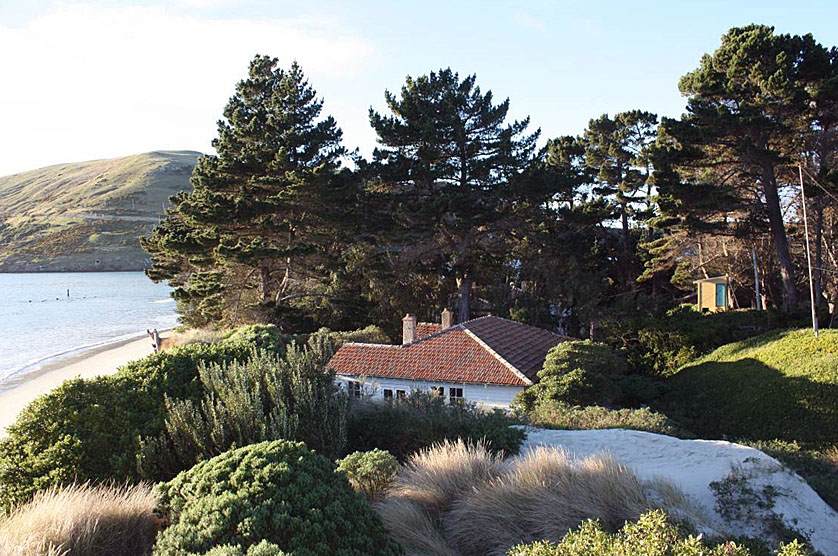
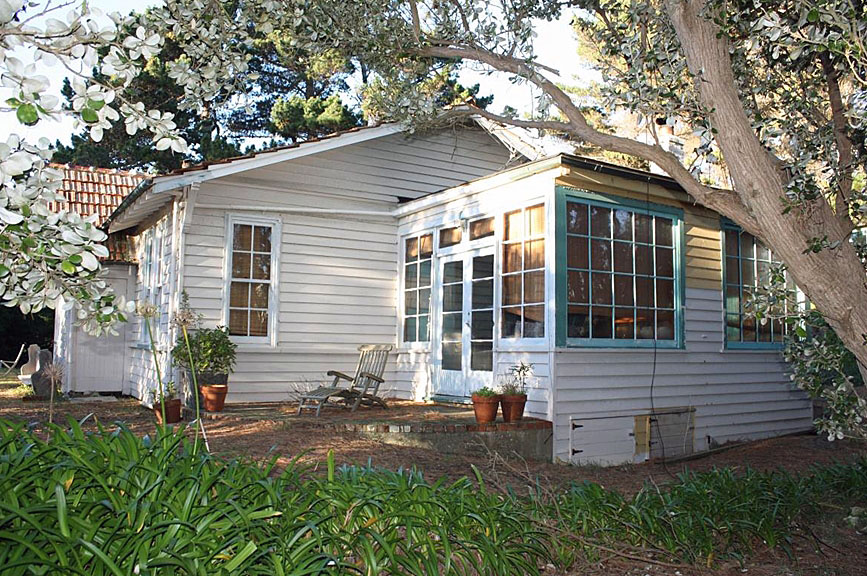
Hidden in low sand dunes of North Spit at the head of Otago Harbour and protected from the weather by looming trees is the Pilot Station Historic Area. The Pilot Station Historic Area consists of three cottages that from 1913 to 1923 provided accommodation for the Otago Harbour Board’s pilot and boatmen, responsible for piloting vessels in the harbour. These buildings recall the importance of the pilot service in the days before radio communication, and have architectural significance as examples of workers’ dwellings designed by prominent Dunedin architect Basil Hooper, known for his Arts and Crafts style residences.
Harbour pilotage is the ‘navigation of a vessel through restricted and shallow waters to an allocated berth and safely mooring her thereat, without incurring any damage to either the ship, or to harbour works and plant.’ Ships needed a guide to take them through the heads and onwards following the channel between the sandbars to the deep water harbour of Port Chalmers. A harbour pilot boarded the incoming or outgoing vessel. A long harbour with a narrow entrance between North Spit and Taiaroa Head, a narrow channel with sandbars nearby, and rocky islands to negotiate, Otago Harbour was a challenge to seafarers. These houses are located at the harbour entrance, with an anchorage for the pilot’s launch, and a jetty nearby. The proximity to the harbour entrance meant the pilots were on hand when a ship arrived.
In the 1860s, the first pilot station was at Taiaroa Head but in 1912, the Otago Harbour Board decided to relocate pilot service across the channel to North Spit, near the small settlement of Aramoana. The Otago Harbour Board commissioned Dunedin architect Basil Hooper to design a pilot’s house and two boatmen’s cottages. The houses are all weatherboard with Marseilles-tile roofs. The pilot’s house is the largest, as befitting his senior rank, while the two boatmen’s cottages, though different in exterior appearance, have the same floor plans. Hooper’s Arts and Crafts design is evident in the tiled ridge-line, the multi-paned windows, pitched gables and interior detailing. These working-class house designs are unusual for Hooper who was better known for his large residences for well-off clients. The boatmen’s houses have different external appearances, but have identical floor plans. Cottage No. 1 has a single, gabled roof, and a verandah with a steeply pitched roof. Cottage No. 2 has a hipped roof with two return gables, and a verandah with a flat roof. The floor plans show a kitchen, sitting room, and one or two bedrooms, a central main entrance hall and a cross passage, and a bathroom, scullery and one or two more bedrooms along the back of the house.
Work was underway by December 1912. The foundations for the pilot’s house were completed and the boatmen’s houses were ‘well forward’ by the 18 December. By November 1913, the Pilot Station was complete, and the cottages were occupied by ‘the harbourmaster’s staff.’
By the 1920s, improvements in communication technology, and access to a reliable motor launch led to the pilot service being relocated to Port Chalmers. The Otago Harbour Board put the houses up for tender and they were sold into private ownership.
In 2014, the three houses remain private residences, two available to rent as holiday cribs.
Harbour pilotage is the ‘navigation of a vessel through restricted and shallow waters to an allocated berth and safely mooring her thereat, without incurring any damage to either the ship, or to harbour works and plant.’ Ships needed a guide to take them through the heads and onwards following the channel between the sandbars to the deep water harbour of Port Chalmers. A harbour pilot boarded the incoming or outgoing vessel. A long harbour with a narrow entrance between North Spit and Taiaroa Head, a narrow channel with sandbars nearby, and rocky islands to negotiate, Otago Harbour was a challenge to seafarers. These houses are located at the harbour entrance, with an anchorage for the pilot’s launch, and a jetty nearby. The proximity to the harbour entrance meant the pilots were on hand when a ship arrived.
In the 1860s, the first pilot station was at Taiaroa Head but in 1912, the Otago Harbour Board decided to relocate pilot service across the channel to North Spit, near the small settlement of Aramoana. The Otago Harbour Board commissioned Dunedin architect Basil Hooper to design a pilot’s house and two boatmen’s cottages. The houses are all weatherboard with Marseilles-tile roofs. The pilot’s house is the largest, as befitting his senior rank, while the two boatmen’s cottages, though different in exterior appearance, have the same floor plans. Hooper’s Arts and Crafts design is evident in the tiled ridge-line, the multi-paned windows, pitched gables and interior detailing. These working-class house designs are unusual for Hooper who was better known for his large residences for well-off clients. The boatmen’s houses have different external appearances, but have identical floor plans. Cottage No. 1 has a single, gabled roof, and a verandah with a steeply pitched roof. Cottage No. 2 has a hipped roof with two return gables, and a verandah with a flat roof. The floor plans show a kitchen, sitting room, and one or two bedrooms, a central main entrance hall and a cross passage, and a bathroom, scullery and one or two more bedrooms along the back of the house.
Work was underway by December 1912. The foundations for the pilot’s house were completed and the boatmen’s houses were ‘well forward’ by the 18 December. By November 1913, the Pilot Station was complete, and the cottages were occupied by ‘the harbourmaster’s staff.’
By the 1920s, improvements in communication technology, and access to a reliable motor launch led to the pilot service being relocated to Port Chalmers. The Otago Harbour Board put the houses up for tender and they were sold into private ownership.
In 2014, the three houses remain private residences, two available to rent as holiday cribs.