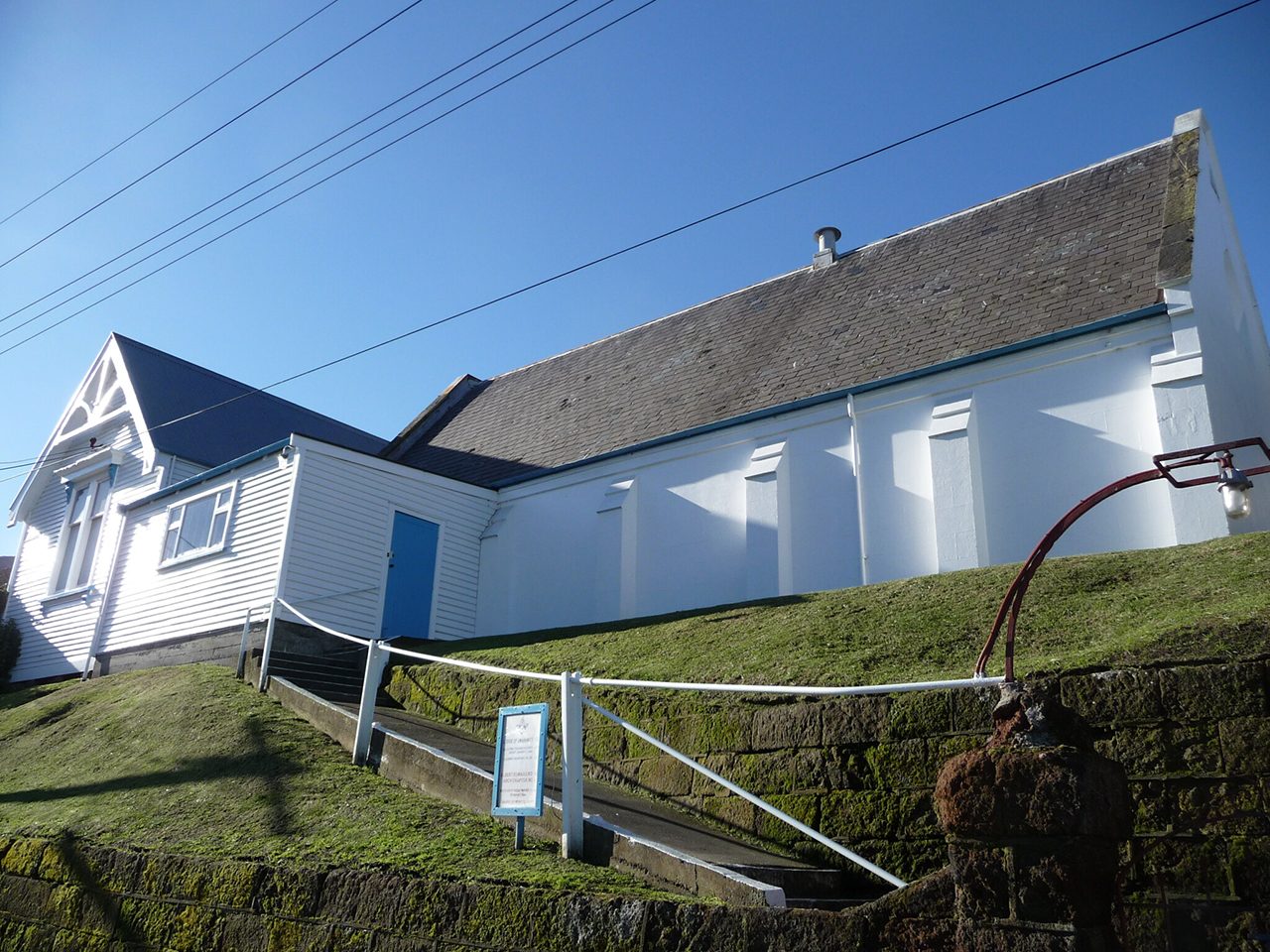
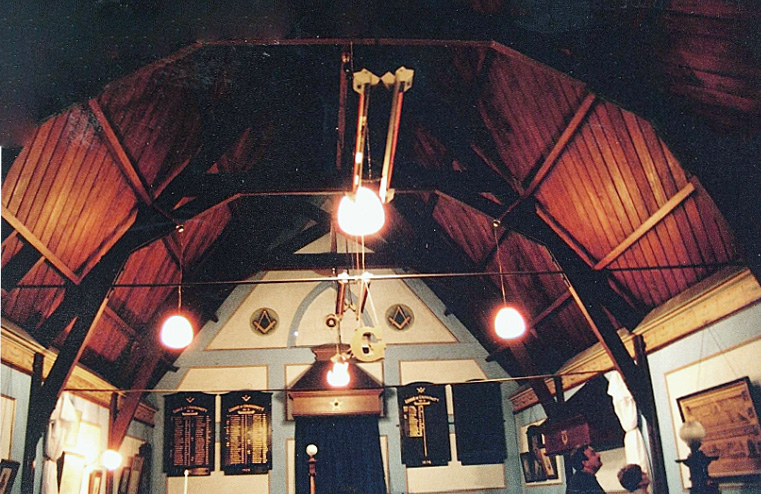
The design of the building is Victorian Free Gothic style, employing a simple interpretation of the Gothic Revival movement. The choice of such a style over the more common neo-classical design makes the building unusual for a lodge. The exterior has cemented walls and buttresses, parapeted gables and a steeply pitched slate roof. There is no fenestration in the original part of the building. In contrast to the relatively plain exterior, the interior is richly decorated and contains pointed arches in moulded relief wall design and an archived timber trussed ceiling. Masonic symbolism is found throughout the interior, including tessellated pavement (black and white squares) on the centre of the floor of the main hall, the square and compass, columns or pillars representing three ancient Greek orders of architecture, and tracing boards with symbols associated with Masonic principles of Truth, Love, Harmony, Peace and Charity.
In 1896-8 a timber refectory, also built in a restrained Gothic Revival style, was added to the original building to the designs of architect Cyril Mountfort, son of Benjamin W Mountfort. That addition has a large double window with timber architrave supported by decorative corbels. On the interior, the refectory walls having tongue and groove timber lining and the ceiling is of trussed timber of a simpler design than the original Lodge building ceiling.
Freemasonry has made an important contribution to the social, political and business life of New Zealand over the years. The Lodge of Unanimity has provided the setting for Freemasonry events since 1858, when the earlier building opened on the site. It helps inform about Lyttelton's history of having a relatively high number of Masonic lodges for the size of the town. Lodges provided a place where men could meet, exchange information and make social and business contacts. Lodge members have included a former mayor of Lyttelton (N C Schumacher), architect B W Mountfort and businessmen and local body members. Chattels of significance within the building include the Master's Chair made of English oak which was brought out to Lyttelton in the First Four Ships in 1850; Honours Boards of 1896 and 1976; the oak Altar, 1927; and Warden's columns which were presented by Fidelity No. 3 (English Constitution) in thanks for food parcels sent during World War Two and which are made from timber salvaged from the bombed out London Guild Hall.

List Entry Information
Status
Listed
List Entry Status
Historic Place Category 2
Access
Private/No Public Access
List Number
7382
Date Entered
24th April 1997
Date of Effect
24th April 1997
City/District Council
Christchurch City
Region
Canterbury Region
Extent of List Entry
Extent includes the land described as Lot 1 DP 63772 (RT CB37B/779), Canterbury Land District and the building known as Lodge of Unanimity No. 3 thereon, and its fittings and fixtures and the following notable features: Master's Chair, Honours Boards 1896 and 1976, Oak Altar 1927, Warden's columns). (Refer to map in Appendix 1 of the Information Upgrade Report for further information).
Legal description
Lot 1 DP 63772 (RT CB37B/779), Canterbury Land District
Location Description
The frontage of the Lodge of Unanimity No. 3 is at the junction of St Davids Street and Sumner Road, Lyttelton.
Status
Listed
List Entry Status
Historic Place Category 2
Access
Private/No Public Access
List Number
7382
Date Entered
24th April 1997
Date of Effect
24th April 1997
City/District Council
Christchurch City
Region
Canterbury Region
Extent of List Entry
Extent includes the land described as Lot 1 DP 63772 (RT CB37B/779), Canterbury Land District and the building known as Lodge of Unanimity No. 3 thereon, and its fittings and fixtures and the following notable features: Master's Chair, Honours Boards 1896 and 1976, Oak Altar 1927, Warden's columns). (Refer to map in Appendix 1 of the Information Upgrade Report for further information).
Legal description
Lot 1 DP 63772 (RT CB37B/779), Canterbury Land District
Location Description
The frontage of the Lodge of Unanimity No. 3 is at the junction of St Davids Street and Sumner Road, Lyttelton.
Construction Professional
Name
Mountfort, Benjamin Woolfield
Type
Architect
Biography
Benjamin Woolfield Mountfort (1825-98) trained as an architect in England, in the office of Richard Cromwell Carpenter, a member of the Cambridge Camden Society (later the Ecclesiological Society). He arrived in Canterbury in 1850. Mountfort was New Zealand's pre-eminent Gothic Revival architect and, according to architectural historian Ian Lochhead, 'did most to shape the architectural character of nineteenth-century Christchurch.' The buildings he designed were almost exclusively in the Gothic Revival style. During his career he designed many churches and additions to churches; those still standing include the Trinity Congregational Church in Christchurch (1874), St Mary's Church in Parnell, Auckland and the Church of the Good Shepherd in Phillipstown, Christchurch (1884). In 1857 he became the first architect to the province of Canterbury. He designed the Canterbury Provincial Council Buildings in three stages from 1858 to 1865. The stone chamber of this building can be considered the greatest accomplishment of his career. He was involved in many important commissions from the 1870s, including the Canterbury Museum (1869-82) and the Clock-tower Block on the Canterbury College campus (1876-77). He was also involved in the construction of Christchurch's Cathedral and made several major modifications to the original design. Mountfort introduced a number of High Victorian elements to New Zealand architecture, such as the use of constructional polychromy, probably first used in New Zealand in the stone tower of the Canterbury Provincial Government Buildings (1859). Overall, his oeuvre reveals a consistent and virtually unerring application of Puginian principles including a commitment to the Gothic style, honest use of materials and picturesque utility. The result was the construction of inventive and impressive buildings of outstanding quality. He died in Christchurch in 1898. A belfry at the Church of the Good Shepherd in Phillipstown, the church he attended for the last ten years of his life, was erected in his honour.
Construction Details
Start Year
1876
Finish Year
1878
Type
Original Construction
Description
Construction of Lodge of Unanimity building
Start Year
1896
Finish Year
1898
Type
Addition
Description
Refectory addition
Construction Professional
Name
Mountfort, Benjamin Woolfield
Type
Architect
Biography
Benjamin Woolfield Mountfort (1825-98) trained as an architect in England, in the office of Richard Cromwell Carpenter, a member of the Cambridge Camden Society (later the Ecclesiological Society). He arrived in Canterbury in 1850. Mountfort was New Zealand's pre-eminent Gothic Revival architect and, according to architectural historian Ian Lochhead, 'did most to shape the architectural character of nineteenth-century Christchurch.' The buildings he designed were almost exclusively in the Gothic Revival style. During his career he designed many churches and additions to churches; those still standing include the Trinity Congregational Church in Christchurch (1874), St Mary's Church in Parnell, Auckland and the Church of the Good Shepherd in Phillipstown, Christchurch (1884). In 1857 he became the first architect to the province of Canterbury. He designed the Canterbury Provincial Council Buildings in three stages from 1858 to 1865. The stone chamber of this building can be considered the greatest accomplishment of his career. He was involved in many important commissions from the 1870s, including the Canterbury Museum (1869-82) and the Clock-tower Block on the Canterbury College campus (1876-77). He was also involved in the construction of Christchurch's Cathedral and made several major modifications to the original design. Mountfort introduced a number of High Victorian elements to New Zealand architecture, such as the use of constructional polychromy, probably first used in New Zealand in the stone tower of the Canterbury Provincial Government Buildings (1859). Overall, his oeuvre reveals a consistent and virtually unerring application of Puginian principles including a commitment to the Gothic style, honest use of materials and picturesque utility. The result was the construction of inventive and impressive buildings of outstanding quality. He died in Christchurch in 1898. A belfry at the Church of the Good Shepherd in Phillipstown, the church he attended for the last ten years of his life, was erected in his honour.
Construction Details
Start Year
1876
Finish Year
1878
Type
Original Construction
Description
Construction of Lodge of Unanimity building
Start Year
1896
Finish Year
1898
Type
Addition
Description
Refectory addition
Historical and Associated Iwi / Hapū / Whānau
Completion Date
4th March 2009
Report Written By
Robyn Burgess
Information Sources
Cyclopedia of New Zealand, 1903
Cyclopedia Company, Industrial, descriptive, historical, biographical facts, figures, illustrations, Wellington, N.Z, 1897-1908, Vol. 3, Canterbury Provincial District, Christchurch, 1903
Lyttelton Times
Lyttelton Times
Press
Press, 17 May 1915, p.9.
Hewland, 1959
J L Hewland, English Freemasonry in Canterbury 1859-1959: a short history of the District Grand Lodge of Ancient Free and Accepted Masons of Canterbury, New Zealand, under the United Grand Lodge of England constituted 19th July, 1859, Christchurch, 1959.
Rice, 2004
Geoffrey W Rice, Lyttelton: Port and Town, an illustrated history, Canterbury University Press, Christchurch, 2004.
Wilson, 2007
John Wilson, City and Peninsula: the Historic Places of Christchurch and Banks Peninsula, Christchurch, 2007.
Other Information
This place was identified as significant under previous legislation with different information requirements. It remains significant under the current legislation. There is opportunity under our legislation and policies to add to this information. Further information about this place may be available from the Southern Regional Office of Heritage New Zealand Pouhere Taonga. A fully referenced Upgrade Report is available from the NZHPT Southern region office Please note that entry on the New Zealand Heritage List/Rarangi Korero identifies only the heritage values of the property concerned, and should not be construed as advice on the state of the property, or as a comment of its soundness or safety, including in regard to earthquake risk, safety in the event of fire, or insanitary conditions.
Historical and Associated Iwi / Hapū / Whānau
Completion Date
4th March 2009
Report Written By
Robyn Burgess
Information Sources
Cyclopedia of New Zealand, 1903
Cyclopedia Company, Industrial, descriptive, historical, biographical facts, figures, illustrations, Wellington, N.Z, 1897-1908, Vol. 3, Canterbury Provincial District, Christchurch, 1903
Lyttelton Times
Lyttelton Times
Press
Press, 17 May 1915, p.9.
Hewland, 1959
J L Hewland, English Freemasonry in Canterbury 1859-1959: a short history of the District Grand Lodge of Ancient Free and Accepted Masons of Canterbury, New Zealand, under the United Grand Lodge of England constituted 19th July, 1859, Christchurch, 1959.
Rice, 2004
Geoffrey W Rice, Lyttelton: Port and Town, an illustrated history, Canterbury University Press, Christchurch, 2004.
Wilson, 2007
John Wilson, City and Peninsula: the Historic Places of Christchurch and Banks Peninsula, Christchurch, 2007.
Other Information
This place was identified as significant under previous legislation with different information requirements. It remains significant under the current legislation. There is opportunity under our legislation and policies to add to this information. Further information about this place may be available from the Southern Regional Office of Heritage New Zealand Pouhere Taonga. A fully referenced Upgrade Report is available from the NZHPT Southern region office Please note that entry on the New Zealand Heritage List/Rarangi Korero identifies only the heritage values of the property concerned, and should not be construed as advice on the state of the property, or as a comment of its soundness or safety, including in regard to earthquake risk, safety in the event of fire, or insanitary conditions.
Current Usages
Uses: Civic Facilities
Specific Usage: Masonic Lodge
Former Usages
General Usage: Civic Facilities
Specific Usage: Masonic Lodge
Current Usages
Uses: Civic Facilities
Specific Usage: Masonic Lodge
Former Usages
General Usage: Civic Facilities
Specific Usage: Masonic Lodge
Location
Stay up to date with Heritage this month

